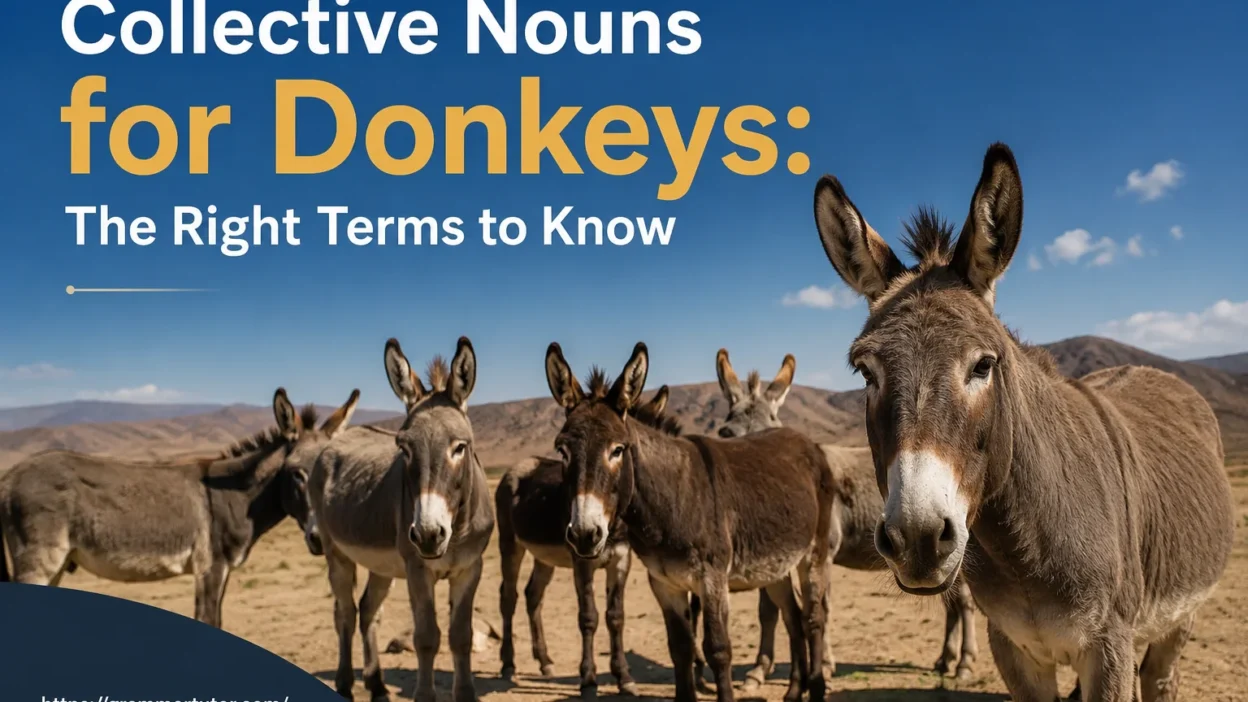
Collective Nouns for Donkeys make animal vocabulary more interesting and help you describe groups of animals in clear, natural English. The most common collective noun is drove, as in “a drove of donkeys.” You may also encounter a herd, which is a familiar general description for a group of donkeys. These expressions show how the English language provides different ways to describe animals living or traveling together.
A drove of donkeys is a useful expression when several donkeys are moving together or living together. Donkeys are social, intelligent, and hardworking animals that often live alongside other donkeys. They can develop strong social bonds, so understanding donkey behavior can make these group terms easier to remember. In everyday writing, choosing the right group names can also make a sentence sound more natural.
Learning these terms can also introduce you to donkey characteristics, physical characteristics, donkey diet, and other parts of their fascinating lives. Their behavior, diet, and relationships with other animals help explain their animal life and social nature. Building your vocabulary with terms such as drove and herd gives you practical ways to discuss animal groups, animal names, and groups of animals without relying on the same phrase every time.
Why Collective Nouns Are Used for Donkeys
Collective nouns help us describe several animals as one group without repeatedly using phrases such as a group of donkeys. They make sentences shorter and can create a more vivid picture of animals moving, resting, or feeding together.
Donkeys are naturally social animals. They may stay close to familiar companions, communicate through vocalizations and body language, and cooperate in their surroundings. Because they often travel or live together, expressions such as drove and herd can be useful when describing them.
The right collective noun can also depend on the situation. A drove of donkeys is a traditional expression, while a herd of donkeys is easy to understand and commonly used as a general description.
Collective Nouns for Donkeys
| Collective Noun | Used For | Simple Example |
| Drove | A group of donkeys moving or traveling together | A drove of donkeys crossed the road. |
| Herd | A group of donkeys living or moving together | A herd of donkeys grazed in the field. |
| Group | A general collection of donkeys | A group of donkeys stood near the barn. |
| Team | Donkeys working together | A team of donkeys carried the supplies. |
| Pack | Donkeys carrying loads together | A pack of donkeys traveled along the trail. |
Drove of Donkeys
A drove is a traditional collective noun that can be used for a group of donkeys. It describes several animals being driven, moved, or traveling together.
The word drove has historically been associated with groups of animals being driven from one place to another. For this reason, a drove of donkeys is especially suitable when the animals are traveling along a road, trail, or path.
Examples of “Drove of Donkeys”
- A drove of donkeys crossed the road.
- We saw a drove of donkeys on the hillside.
- The drove of donkeys moved toward the village.
- A drove of donkeys traveled along the narrow path.
- The farmer guided a drove of donkeys.
- A drove of donkeys walked across the valley.
- The drove of donkeys followed the trail.
- A drove of donkeys approached the farm.
- The villagers watched the drove of donkeys pass by.
- The drove of donkeys disappeared around the hill.
Herd of Donkeys
A herd is a general collective noun for a group of hoofed animals that live, graze, or move together. It can be used to describe donkeys as well.
A herd of donkeys is especially natural when the animals are grazing or living together rather than being driven from one location to another.
Examples of “Herd of Donkeys”
- A herd of donkeys grazed in the meadow.
- We saw a herd of donkeys near the river.
- The herd of donkeys rested under the trees.
- A large herd of donkeys gathered near the farm.
- The herd of donkeys moved toward the water.
- A herd of donkeys stood beside the fence.
- The farmer cared for a herd of donkeys.
- The herd of donkeys walked across the pasture.
- A herd of donkeys gathered at sunset.
- The herd of donkeys returned to the shelter.
Group of Donkeys
A group of donkeys is a simple and general expression. Unlike drove, it isn’t a specialized traditional collective noun, but it is completely clear and grammatically correct.
You can use a group whenever you don’t need to describe how the donkeys are behaving or why they’re together.
Examples of “Group of Donkeys”
- A group of donkeys stood near the barn.
- We saw a group of donkeys in the field.
- The group of donkeys moved toward the road.
- A group of donkeys gathered near the water.
- The farmer watched a group of donkeys.
- A group of donkeys rested beneath the trees.
- The group of donkeys followed the path.
- A group of donkeys walked across the pasture.
- The children observed a group of donkeys.
- A group of donkeys gathered near the fence.
Team of Donkeys
A team of donkeys can be used when several donkeys are working together. The word team focuses on cooperation rather than simply describing a social group.
Donkeys have historically been used for transportation and carrying loads, so the expression can be useful when describing animals working together.
Examples of “Team of Donkeys”
- A team of donkeys carried the supplies.
- The farmer used a team of donkeys.
- A team of donkeys pulled the cart.
- The team of donkeys worked throughout the morning.
- A team of donkeys carried heavy loads.
- The workers guided a team of donkeys.
- A team of donkeys traveled along the mountain path.
- The team of donkeys stopped near the village.
- A team of donkeys transported the equipment.
- The farmer prepared a team of donkeys for the journey.
Pack of Donkeys
A pack of donkeys can be used when donkeys are carrying loads or traveling together as working animals. The word pack highlights their role in carrying goods rather than simply describing their social group.
It is more context-specific than drove or herd, so the situation should make the meaning clear.
Examples of “Pack of Donkeys”
- A pack of donkeys carried supplies through the mountains.
- The pack of donkeys followed the narrow trail.
- A pack of donkeys transported food to the village.
- The workers guided a pack of donkeys.
- A pack of donkeys carried heavy bags.
- The pack of donkeys climbed the hillside.
- A pack of donkeys traveled across the rocky path.
- The guide watched the pack of donkeys carefully.
- A pack of donkeys stopped near the stream.
- The pack of donkeys continued toward the village.
Other Ways to Describe Donkeys
English doesn’t require you to use a specialized collective noun every time you mention several donkeys. Depending on your sentence, a group of donkeys, a herd of donkeys, or a drove of donkeys may all communicate the intended idea.
The best choice depends on the context. Use drove when you want a traditional expression for donkeys being driven or moving together. Use herds for a general social or grazing group. Use a team when the animals are working together, and pack when they are carrying loads.
Examples of Different Expressions
- A drove of donkeys traveled down the road.
- A herd of donkeys grazed peacefully.
- A group of donkeys gathered near the barn.
- A team of donkeys pulled the cart.
- A pack of donkeys carried supplies.
- The herd of donkeys rested in the shade.
- The drove of donkeys crossed the valley.
- The team of donkeys worked together.
- The group of donkeys moved toward the shelter.
- The pack of donkeys followed the mountain trail.
Interesting Facts About Donkeys
Donkeys are domesticated members of the horse family, or Equidae, and have been associated with humans for thousands of years. They are known for their endurance, sure-footedness, and ability to cope with challenging environments. Donkeys can live for many years when they receive proper nutrition, shelter, dental care, hoof care, and veterinary attention. Their lifespan varies depending on breed, genetics, workload, health, and living conditions.
One of the donkey’s most interesting physiological features is its adaptation to dry and rugged environments. Donkeys have strong legs and tough hooves that help them travel over rocky ground. Their large ears aren’t just distinctive in appearance; they also help with hearing and can assist with heat regulation. Donkeys also have excellent memories and can remember places, routes, and other animals for long periods.
Donkeys are herbivores and primarily eat grasses, hay, and other fibrous plant material. They are naturally adapted to consuming relatively coarse vegetation and can survive on forage that may be less nutritious than the lush grass preferred by many horses. However, domestic donkeys still need a properly managed diet because too much rich food can contribute to health problems.
Donkeys are also known for their distinctive bray. Their vocalizations can travel over considerable distances and help individuals communicate with one another. They use sounds along with body posture, ear position, facial expressions, and other behaviors to communicate.
Their social behavior is another reason collective nouns are useful. Donkeys can form strong bonds with companions and may become stressed when separated from familiar animals. They can live in social groups and often enjoy companionship, although individual personalities and relationships vary.
Examples of Donkey Facts
- Donkeys belong to the horse family.
- Donkeys are herbivores.
- Donkeys eat grass, hay, and other forage.
- Donkeys have strong and durable hooves.
- Their large ears are useful for hearing and heat regulation.
- Donkeys are known for their distinctive bray.
- Donkeys can form strong social bonds.
- Donkeys are known for their endurance.
- They can be well adapted to dry environments.
- Donkeys have been domesticated for thousands of years.
Conclusion
Understanding collective nouns for donkeys makes your English more precise and gives you a better way to describe groups of these social animals. Drove is the most commonly recognised collective noun, while herd can also be used as a general term. Knowing these expressions can improve your vocabulary and help you write about donkeys in a clear and natural way.
Read More: Collective Noun for Vipers: What Is a Group of Vipers Called?
FAQs
Q1. What is the collective noun for donkeys?
The most common collective noun for donkeys is drove. You can say “a drove of donkeys.”
Q2. Can you use “herd” for donkeys?
Yes. Herd can be used as a general collective term for a group of donkeys, especially when describing them living or moving together.
Q3. What does “a drove of donkeys” mean?
A drove of donkeys means a group of donkeys traveling, moving, or being kept together.
Q4. Is “drove” the only collective noun for donkeys?
No. Drove is the most notable term, but herd is also commonly understandable as a general description.
Q5. Should I say “a group of donkeys”?
Yes. A group of donkeys is completely correct and natural when you don’t need a specific collective noun.
Q6. Are donkeys social animals?
Yes. Donkeys are generally social animals and can form strong relationships with other donkeys.
Q7. What is the plural of donkey?
The plural of donkey is donkeys.
Q8. When should I use “drove”?
Use drove when you want a specific collective noun, particularly when describing several donkeys moving or travelling together.
Q9. Is “herd of donkeys” grammatically correct?
Yes. A herd of donkeys is grammatically correct and can be used as a general description of multiple donkeys together.
Q10. Why learn collective nouns for donkeys?
Learning these terms expands your animal vocabulary, helps you vary your writing, and makes it easier to describe groups of animals accurately.