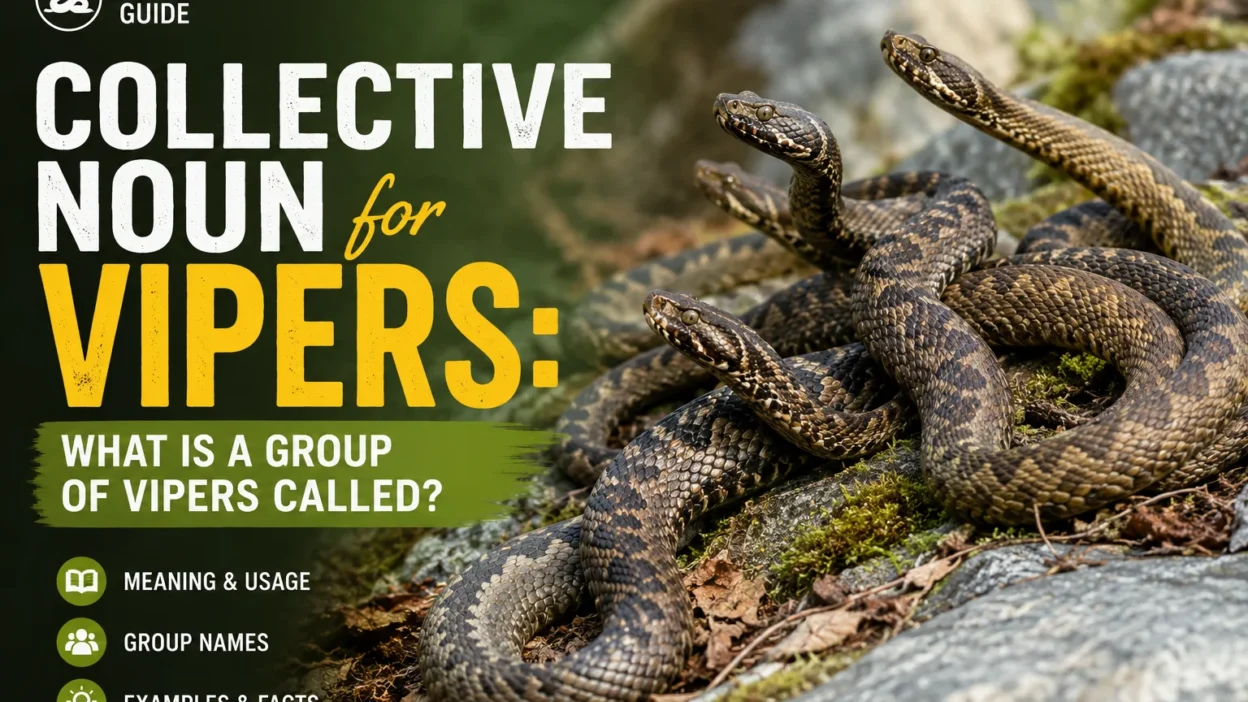
Learning the collective noun for vipers can make your writing more interesting while helping you describe these venomous snakes clearly and naturally. Instead of repeating “a group of vipers,” you can use suitable expressions that give readers a clearer picture of the snakes.
Vipers are a fascinating family of snakes known for their venom, specialized fangs, heat-sensing abilities, and distinctive heads. Although many are solitary, they can gather in particular places during certain seasons, making their group behavior worth describing.
Using the right collective noun can add variety and precision to your vocabulary. These unusual animal terminology choices are useful in wildlife writing because they help you describe vipers in a more engaging way without making the sentence difficult to understand.
Why Collective Nouns Are Used for Vipers
Collective nouns give a specific name to several animals considered together. With vipers, the choice of word can depend on how the snakes are behaving or where they are gathered.
Unlike highly social animals, many vipers generally spend much of their lives alone. However, groups may sometimes occur around hibernation sites, suitable shelters, food sources, or breeding areas. Writers may also use descriptive collective expressions creatively when several vipers appear together.
These terms make descriptions more vivid. A simple sentence about snakes can become much more interesting when the wording gives you a picture of their movement or arrangement.
Collective Nouns for Vipers
| Collective Noun | Used For | Simple Example |
| Nest | A group of vipers gathered together | A nest of vipers rested among the rocks. |
| Den | Vipers gathered in a sheltered place | A den of vipers sheltered underground. |
| Pit | A group of vipers gathered in one place | A pit of vipers lay beneath the stones. |
| Rhumba | A group of snakes moving together | A rhumba of vipers moved across the ground. |
| Bed | Vipers resting together | A bed of vipers rested in the grass. |
| Generation | A group of snakes of similar age or origin | A generation of vipers spread across the hillside. |
| Group | A general collection of vipers | A group of vipers gathered near the rocks. |
Nest of Vipers
A nest of vipers is a descriptive expression for several vipers gathered closely together. The word nest creates an image of snakes concentrated in one sheltered location.
It can be especially effective in descriptive or literary writing when several snakes are found together.
Examples of “Nest of Vipers”
- A nest of vipers rested beneath the rocks.
- We discovered a nest of vipers near the hillside.
- The nest of vipers remained hidden during the day.
- A nest of vipers emerged from the shelter.
- Rangers carefully avoided the nest of vipers.
- The nest of vipers disappeared into the grass.
- A nest of vipers gathered near the warm stones.
- The hikers spotted a nest of vipers from a distance.
- The nest of vipers stayed close to the rocky ground.
- A nest of vipers moved slowly through the vegetation.
Den of Vipers
A den of vipers describes vipers gathered in a sheltered place such as a rocky crevice, underground space, or protected hiding area. The word den emphasizes the shelter where the snakes are located.
This expression works particularly well when describing vipers that have gathered for protection or shelter.
Examples of “Den of Vipers”
- A den of vipers sheltered beneath the rocks.
- We found a den of vipers near the cave.
- The den of vipers remained undisturbed.
- A den of vipers occupied the rocky crevice.
- Rangers protected the area around the den of vipers.
- The hikers stayed away from the den of vipers.
- A den of vipers rested in the underground shelter.
- The den of vipers became active as temperatures rose.
- Scientists observed a den of vipers from a safe distance.
- The den of vipers provided shelter during cold weather.
Pit of Vipers
A pit of vipers is a vivid expression for a collection of vipers gathered closely in one location. The word pit creates a strong image of several snakes occupying a confined or recessed area.
This phrase is particularly common in dramatic, figurative, or literary descriptions.
Examples of “Pit of Vipers”
- A pit of vipers lay beneath the old stones.
- The explorers discovered a pit of vipers.
- A pit of vipers rested in the rocky hollow.
- The pit of vipers remained hidden from view.
- Rangers carefully approached the pit of vipers.
- A pit of vipers moved among the rocks.
- The travelers avoided the pit of vipers.
- A pit of vipers occupied the shallow depression.
- The pit of vipers disappeared into the darkness.
- We observed a pit of vipers from a safe distance.
Rhumba of Vipers
A rhumba of vipers is an unusual and colorful collective expression associated with a group of snakes. The word creates a playful image of snakes moving together.
This type of expression is more suitable for creative, humorous, or descriptive writing than for formal scientific descriptions. For ordinary wildlife writing, a simple phrase such as a group of vipers may be clearer.
Examples of “Rhumba of Vipers”
- A rhumba of vipers moved through the grass.
- We spotted a rhumba of vipers near the rocks.
- The rhumba of vipers slithered across the path.
- A rhumba of vipers disappeared into the bushes.
- The hikers watched the rhumba of vipers from afar.
- A rhumba of vipers moved between the stones.
- The rhumba of vipers slowly crossed the hillside.
- A rhumba of vipers gathered near the warm ground.
- The rhumba of vipers vanished into the vegetation.
- We observed the rhumba of vipers from a safe distance.
Bed of Vipers
A bed of vipers describes several vipers resting close together. The term bed emphasizes their resting position rather than simply their presence in a particular habitat.
It can be useful in descriptive writing when snakes are lying together in a sheltered or warm location.
Examples of “Bed of Vipers”
- A bed of vipers rested in the grass.
- We noticed a bed of vipers beneath the rocks.
- The bed of vipers remained still.
- A bed of vipers lay in the warm sunlight.
- The hikers avoided the bed of vipers.
- Rangers observed the bed of vipers carefully.
- A bed of vipers sheltered among the leaves.
- The bed of vipers remained hidden throughout the morning.
- A bed of vipers gathered near the warm stones.
- The snakes slowly moved away from the bed.
Generation of Vipers
A generation of vipers can be used as a descriptive expression for snakes belonging to the same period or age group. It focuses more on their relationship by age or reproduction than on the physical act of gathering.
This term is less useful when you simply want to say that several adult vipers are together. In that situation, a group of vipers is clearer.
Examples of “Generation of Vipers”
- A generation of vipers spread across the hillside.
- The researchers studied a generation of vipers.
- A new generation of vipers appeared in the region.
- The generation of vipers adapted to the environment.
- Scientists monitored the young generation of vipers.
- A generation of vipers developed in the protected habitat.
- The researchers compared two generations of vipers.
- A generation of vipers survived the changing conditions.
- The new generation of vipers remained near the shelter.
- Scientists recorded the generation of vipers carefully.
Group of Vipers
A group of vipers is the simplest general expression when you don’t need a specialized or literary collective noun. It can be used in everyday writing and conversation without suggesting a particular behavior.
Because many viper species are largely solitary, this neutral expression can sometimes be more appropriate than a specialized collective term.
Examples of “Group of Vipers”
- A group of vipers gathered near the rocks.
- We saw a group of vipers in the grass.
- The group of vipers moved toward the shelter.
- A group of vipers rested beneath the stones.
- Scientists observed a group of vipers.
- The group of vipers disappeared into the vegetation.
- Rangers monitored the group of vipers.
- A group of vipers remained hidden during the day.
- The hikers avoided the group of vipers.
- A group of vipers moved across the hillside.
Interesting Facts About Vipers
Vipers are a diverse group of venomous snakes found across many parts of the world. They belong to the family Viperidae, which includes vipers and pit vipers. Their lifespan varies among species and depends on factors such as habitat, food availability, predators, disease, and environmental conditions. Some viper species can live for many years in suitable conditions, particularly when protected from major threats.
One of the most remarkable physiological features of vipers is their specialized venom-delivery system. Many vipers have long, hinged fangs that can fold back against the roof of the mouth when not in use. When a viper strikes, these fangs rotate forward and help deliver venom into its prey. Their venom can contain a complex mixture of substances that affect different body systems.
Many pit vipers have another extraordinary adaptation: heat-sensing pits located between the eyes and nostrils. These organs allow them to detect infrared radiation from warm objects. This ability can help them locate prey, particularly in darkness. Not every viper has these facial pits, but they are a defining feature of the pit-viper group.
Vipers also have specialized body shapes and scales that help them survive in different habitats. Some species are adapted to forests, some to grasslands, some to rocky landscapes, and others to deserts. Their coloration can provide camouflage, allowing them to blend into leaves, soil, stones, or vegetation.
Their dietary habits are mainly carnivorous. Vipers typically eat animals such as rodents, birds, lizards, frogs, and other small prey, depending on the species. Many vipers use venom to immobilize prey before swallowing it. Some species use a sit-and-wait hunting strategy, remaining hidden until suitable prey comes within striking distance.
Despite their reputation, vipers don’t normally seek out humans as prey. Like other snakes, they generally prefer to avoid unnecessary confrontation. Their venom is primarily an adaptation for capturing prey and defending themselves, rather than an aggressive tool for attacking people.
Examples of Viper Facts
- Vipers are venomous snakes.
- Vipers belong to the family Viperidae.
- Many vipers have long, hinged fangs.
- Some vipers have heat-sensing facial pits.
- Vipers are mainly carnivorous.
- Their prey can include rodents, birds, lizards, and frogs.
- Many vipers rely on camouflage.
- Some vipers use ambush hunting.
- Viper species live in many different habitats.
- Vipers generally avoid unnecessary contact with humans.
Read More: Collective Noun for Spiders: Common Terms and Example Sentences
Conclusion
The collective noun for vipers makes descriptions of these venomous snakes more vivid and interesting. While vipers are often solitary, knowing the terms used for groups can improve your vocabulary and make wildlife writing more varied. Choosing a clear expression also helps readers understand how vipers may gather, move, or rest.
FAQs
Q1. What is the collective noun for vipers?
A commonly used collective noun for vipers is a nest of vipers. The exact term can vary depending on the source and context.
Q2. What do you call a group of vipers?
A group of vipers can be called a nest of vipers. You can also simply say “a group of vipers” when you want clear, everyday English.
Q3. Are vipers usually found in groups?
Many vipers are solitary animals. However, some may gather in suitable locations or during certain seasons.
Q4. Why are vipers called venomous snakes?
Vipers are called venomous snakes because they produce venom and use specialized fangs to inject it into prey.
Q5. Do all vipers have specialized fangs?
Yes. Vipers have long, hinged fangs that help them deliver venom effectively when they bite.
Q6. Can vipers sense heat?
Many vipers have heat-sensing abilities that help them detect warm-blooded prey, even when visibility is limited.
Q7. Where might vipers gather?
Vipers may gather in particular places that provide suitable shelter, warmth, food, or protection, depending on the species.
Q8. Is “group of vipers” grammatically correct?
Yes. Group of vipers is completely correct and is often the clearest choice in everyday writing.
Q9. Why learn collective nouns for animals?
Learning collective nouns can expand your vocabulary and make your writing more descriptive, varied, and engaging.
Q10. Is “nest of vipers” always the best term?
Not necessarily. “Nest of vipers is a traditional expression, but “a group of vipers” may be better when you want simple and precise modern English.