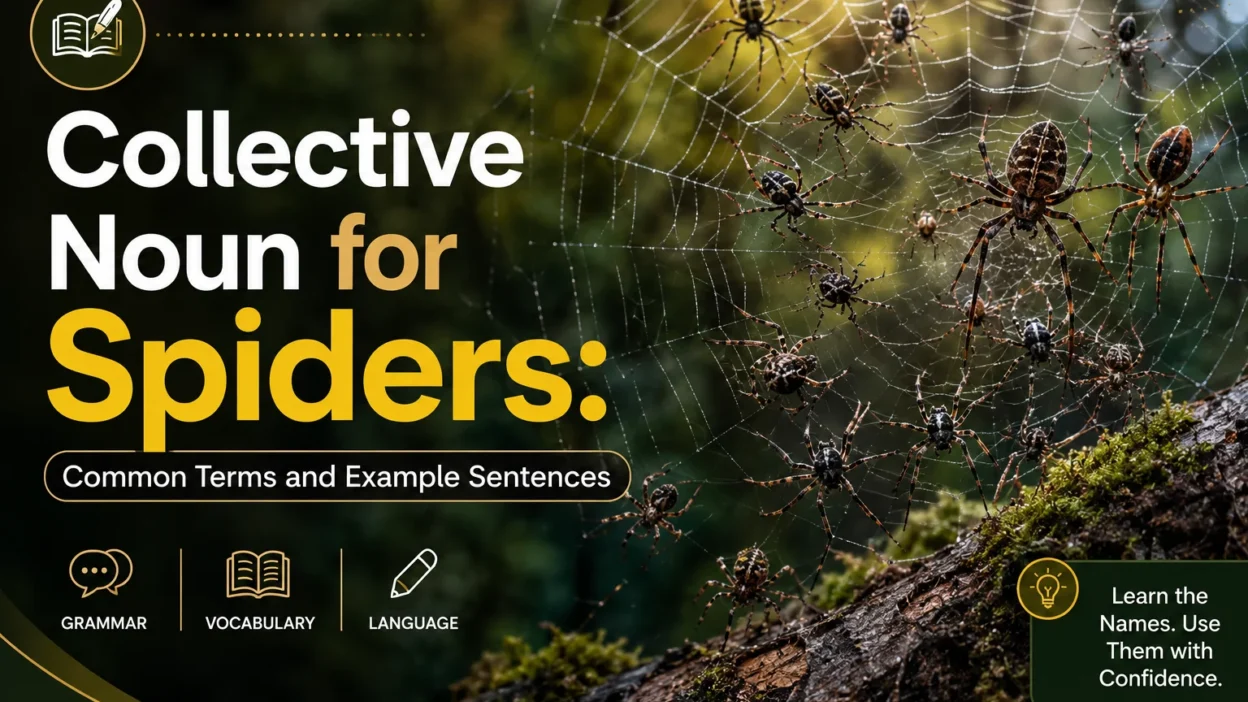
The collective noun or spiders topic introduces useful animal group names for describing these fascinating arachnids in everyday English. Instead of only saying a group of spiders, you can use different expressions based on the situation. A cluster of spiders is the commonly used expression, while clutter, colony, and nest may also appear when the context supports them.
These collective nouns make writing and conversation more descriptive and engaging. When spiders gather together, their numbers and surroundings can help you choose an appropriate term. For example, a cluster of spiders can describe spiders gathered in one place, while a colony may suggest spiders living close together in a shared area.
For people learning English, studying arachnids, or simply curious about unusual animal group names, these terms can enrich your vocabulary. They can also create vivid images of spiders gathering around webs or appearing in large numbers, making descriptions more specific while keeping the language clear and natural.
Why Collective Nouns Are Used for Spiders
Spiders are usually known as solitary animals, but some species can live close together or form groups. Spiders may gather around suitable habitats, food sources, or shared webs. Social spider species can even live in colonies containing many individuals.
Because spiders have different lifestyles, several expressions can be used to describe groups of them. Cluster is useful for spiders gathered closely together, while colony is more suitable when describing social spiders that live together.
These terms make descriptions more interesting and help readers imagine how spiders are positioned or behaving.
Collective Nouns for Spiders
| Collective Noun | Used For | Simple Example |
| Cluster | Spiders gathered closely together | A cluster of spiders rested under the leaves. |
| Clutter | A group of spiders, especially in a messy setting | A clutter of spiders covered the corner. |
| Colony | Social spiders living together | A colony of spiders lived in the web. |
| Nest | Spiders gathered around a shared nesting area | A nest of spiders was found under the bark. |
| Group | A general group of spiders | A group of spiders moved across the wall. |
Cluster of Spiders
A cluster of spiders describes spiders gathered closely together in one location. The word cluster focuses on their physical arrangement rather than a particular species or social structure.
You might use this expression when several spiders are found together under leaves, inside a sheltered space, or around a web.
Examples of “Cluster of Spiders”
- A cluster of spiders rested under the leaves.
- We found a cluster of spiders near the tree.
- The cluster of spiders remained still.
- A cluster of spiders gathered around the web.
- The children noticed a cluster of spiders in the corner.
- A cluster of spiders moved across the wall.
- The cluster of spiders disappeared beneath the bark.
- A large cluster of spiders covered the branch.
- We carefully observed the cluster of spiders.
- The cluster of spiders stayed together.
Clutter of Spiders
A clutter of spiders is a colorful and descriptive expression for a group of spiders. The word clutter creates an image of many spiders appearing together in a crowded or untidy-looking area.
This expression is more playful and literary than the straightforward group of spiders.
Examples of “Clutter of Spiders”
- A clutter of spiders covered the old wall.
- We discovered a clutter of spiders in the shed.
- The clutter of spiders gathered around the web.
- A clutter of spiders appeared beneath the roof.
- The clutter of spiders moved across the floor.
- A clutter of spiders occupied the dark corner.
- We carefully avoided the clutter of spiders.
- The clutter of spiders disappeared into the cracks.
- A clutter of spiders filled the sheltered space.
- The clutter of spiders remained near the web.
Colony of Spiders
A colony of spiders describes spiders that live together in a shared area, particularly social spider species. Most spider species are solitary, so colony is more appropriate when the spiders actually share a habitat or cooperate in some way.
Some social spiders build communal webs and live in large groups. In these situations, a colony provides a useful description of their social organization.
Examples of “Colony of Spiders”
- A colony of spiders lived inside the large web.
- Scientists studied a colony of spiders in the forest.
- The colony of spiders shared the same habitat.
- A large colony of spiders occupied the branches.
- The researchers observed the colony of spiders carefully.
- The colony of spiders built a communal web.
- A colony of spiders lived beneath the tree bark.
- The colony of spiders remained in the same area.
- Scientists examined the behavior of the colony.
- The colony of spiders contained many individuals.
Nest of Spiders
A nest of spiders can describe spiders associated with a shared nesting or sheltered area. However, it isn’t as general or standard as cluster or group. The exact meaning can depend on the species and context.
Spider egg sacs and sheltered areas may contain many young spiders, making the word nest useful in descriptive writing.
Examples of “Nest of Spiders”
- A nest of spiders was found beneath the bark.
- We discovered a nest of spiders in the corner.
- The nest of spiders remained hidden.
- A nest of spiders appeared inside the shed.
- The researcher examined the nest of spiders.
- The nest of spiders contained many young spiders.
- A nest of spiders was attached to the leaves.
- The nest of spiders remained undisturbed.
- We noticed a nest of spiders near the web.
- The nest of spiders provided shelter for the young.
Group of Spiders
A group of spiders is a simple general expression. It doesn’t describe a particular social behavior or physical arrangement, but it is easy to understand and can be used whenever several spiders are together.
Since many spider species are solitary, groups can be useful when you don’t know whether the spiders have a specific social relationship.
Examples of “Group of Spiders”
- A group of spiders moved across the wall.
- We saw a group of spiders near the tree.
- The group of spiders gathered around the web.
- A group of spiders appeared in the garden.
- The group of spiders remained beneath the leaves.
- A group of spiders lived near the old shed.
- We observed a group of spiders in the forest.
- The group of spiders moved into the shelter.
- A group of spiders gathered in the corner.
- The group of spiders disappeared under the bark.
Spider Behavior and Social Life
Spiders are arachnids, not insects, and most species live solitary lives. Many spiders spend much of their time hunting or waiting for prey on their own. However, not every spider follows this solitary lifestyle. Some species display varying degrees of social behavior and can live close together.
Social spiders can construct communal webs and may cooperate in capturing prey or caring for young. These species demonstrate that spider behavior can be much more complex than the solitary lifestyle commonly associated with spiders.
Spiders also use silk for many purposes. They may use it to build webs, create shelters, protect eggs, attach themselves to surfaces, or move through their environment. The web is therefore much more than a simple trap for prey.
Examples of Spider Behavior
- Most spiders are solitary.
- Some spider species live socially.
- Spiders produce silk.
- Many spiders use webs to capture prey.
- Some species build communal webs.
- Spiders can use silk to protect their eggs.
- Some spiders live in sheltered spaces.
- Spiders use specialized body parts to sense their surroundings.
- Many spiders are important predators of insects.
- Some social spiders cooperate with one another.
Interesting Facts About Spiders
Spiders are among the most diverse and successful groups of terrestrial arthropods. They have existed for hundreds of millions of years and occur in many habitats around the world. Their lifespan varies greatly by species. Some small spiders live for only months or around a year, while certain larger species, particularly some tarantulas, can live for many years. Female tarantulas generally live considerably longer than males.
Spiders have several unique physiological features. Their bodies have two main sections—the cephalothorax and abdomen—and they have eight legs, which distinguishes them from insects. They also have multiple eyes, although the number and arrangement vary between species. Many spiders use sensitive hairs and other sensory structures to detect vibrations, air movement, and contact with their surroundings.
One of the most remarkable features of spiders is their ability to produce silk. Silk is made from proteins and can have different properties depending on how a spider produces and uses it. Spiders use silk for webs, egg protection, shelters, safety lines, and movement. Not all spiders build traditional orb webs, and some species actively hunt their prey instead.
Spiders are primarily carnivorous predators. Their diet commonly includes insects and other small arthropods. Some larger species can capture prey such as small vertebrates. Spiders play an important ecological role because they help regulate populations of insects and other small animals.
Spiders also have specialized methods of feeding. Instead of chewing their prey like many animals, they typically use their mouthparts to immobilize prey and then release digestive enzymes that help break down tissues. They can then consume the resulting liquid food.
Examples of Spider Facts
- Spiders are arachnids, not insects.
- Most spiders have eight legs.
- Many spiders live solitary lives.
- Some spider species are social.
- Spiders produce silk.
- Silk can be used to build webs and shelters.
- Spiders are important predators.
- Many spiders eat insects and other arthropods.
- Some spiders can live for many years.
- Some social spiders live in communal webs.
Conclusion
Understanding the collective nouns for spiders makes English descriptions more interesting and precise. Terms such as cluster, clutter, colony, and nest can describe spiders in different situations. Knowing these expressions helps you write and speak about spiders more clearly while expanding your everyday vocabulary.
FAQs
Q1. What is the collective noun for spiders?
The most commonly used collective noun for spiders is cluster.
Q2. What do you call a group of spiders?
A group of spiders can be called a cluster of spiders. Other terms, such as clutter, colony, or nest, may also be used depending on context.
Q3. Is “cluster of spiders” correct?
Yes. Cluster of spiders is a natural expression for several spiders gathered together.
Q4. Can “colony” describe spiders?
Yes. Colony can describe spiders living together in the same area, particularly when they form a shared community.
Q5. Can “clutter” be used for spiders?
Yes, clutter is sometimes used as a collective term for spiders, especially when many spiders appear together in an untidy–looking area.
Q6. What is a nest of spiders?
A nest of spiders can refer to spiders gathered around or living in a sheltered place, although its use depends on context.
Q7. Why are collective nouns used for spiders?
Collective nouns provide a concise and descriptive way to talk about groups of spiders without repeatedly saying “a group of spiders.”
Q8. Are spiders insects?
No. Spiders are arachnids, not insects. They typically have eight legs and belong to a different biological group.
Q9. Which collective noun for spiders is best for everyday English?
Cluster of spiders is a clear and widely understandable choice for everyday descriptions.
Q10. Do collective nouns for spiders have to be used in formal English?
No. These expressions can be used in both everyday and descriptive writing, although the most suitable term depends on the context.