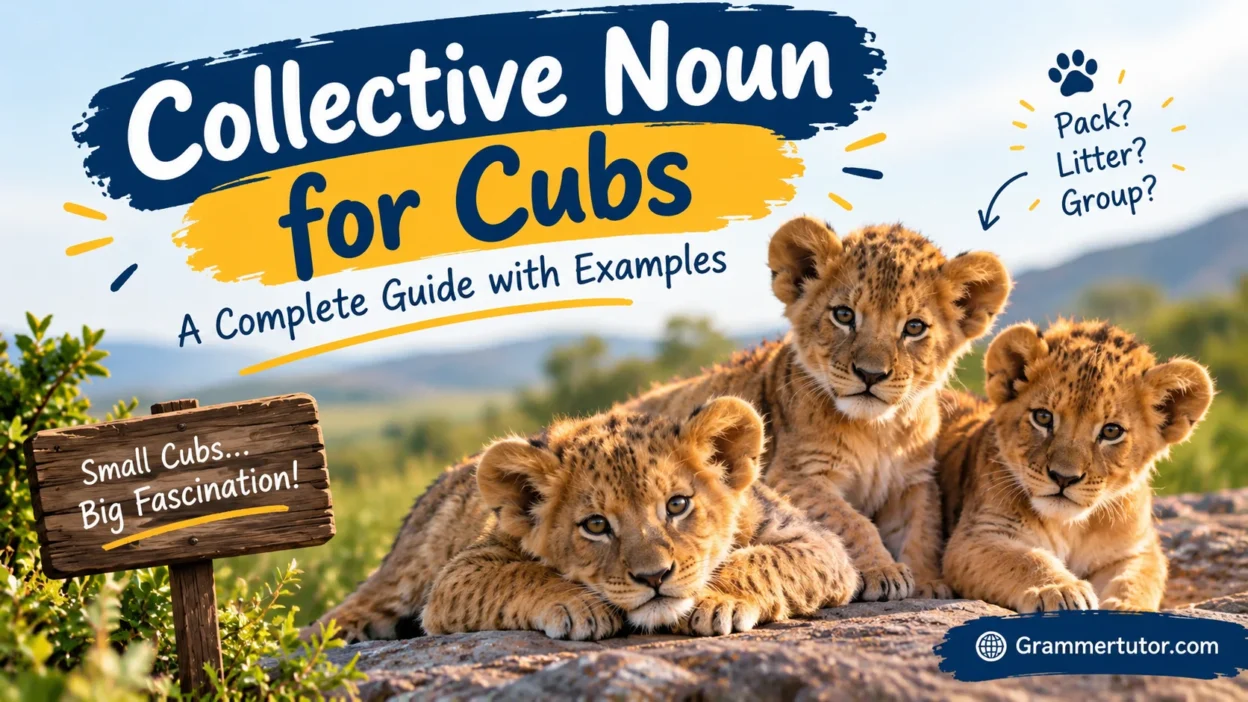
The collective noun for cubs helps describe young animals that stay together, especially lion cubs, tiger cubs, and other young mammals. A cub is usually small, playful, and curious, but it may remain dependent on its parents for food, protection, and learning.
When several cubs are together, English uses special collective nouns to make sentences shorter, clearer, and more interesting. Instead of always saying group of cubs, you can use expressions such as litter of cubs or den of cubs. These terms can make descriptions sound more natural in everyday English.
The best expression can depend on the animal, its age, the place where the cubs are gathered, and the situation being described. Understanding the common collective nouns, their meanings, and simple examples can help you use them naturally in creative writing and other forms of English.
Quick Answer: What Is the Collective Noun for Cubs?
The most common collective noun for cubs is a litter of cubs.
Other expressions may also describe cubs in particular situations:
- A litter of cubs – cubs born to the same mother.
- A den of cubs – cubs resting or living together in a den.
- A group of cubs – a general expression for several young animals.
- A pride of lion cubs – lion cubs living with pride.
- A family of cubs – cubs staying with their parents or relatives.
Among these terms, litter is usually the best choice when you mean several young animals born to one mother.
Why Are Collective Nouns Used for Cubs?
Collective nouns help us describe animals in a natural and expressive way. Cubs often spend their early lives close to one another. They sleep together, play together, follow their mother, and learn important survival skills as a group.
Using a collective noun gives the reader a clearer picture. For example, “a litter of cubs slept beside their mother” creates a more detailed image than “some cubs slept beside their mother.”
These terms are useful in many situations, including:
- Wildlife articles
- School assignments
- Animal stories
- Nature documentaries
- Children’s books
- Everyday conversations
- Creative writing
- English grammar lessons
The word litter focuses on the cubs’ shared birth. The word den highlights their home or resting place. Meanwhile, pride is connected mainly with lions and their social group.
Common Collective Nouns for Cubs
| Collective Noun | Used For | Simple Example |
| Litter of cubs | Cubs born to the same mother | A litter of cubs followed their mother. |
| Den of cubs | Cubs gathered inside a den | A den of cubs slept quietly. |
| Group of cubs | Several cubs in general | A group of cubs played near the trees. |
| Pride of lion cubs | Lion cubs living with a pride | A pride of lion cubs rested in the shade. |
| Family of cubs | Cubs staying with their family | A family of cubs moved through the forest. |
| Pack of wolf cubs | Wolf cubs associated with a wolf pack | A pack of wolf cubs waited for food. |
These expressions are not all interchangeable. Litter is the most widely useful term for cubs born together, while the other expressions depend on the animal or setting.
A Litter of Cubs
A litter of cubs refers to a group of young animals born to the same mother, commonly used for lions, bears, foxes, and other mammals.
Meaning of “A Litter of Cubs”
A litter of cubs refers to several young animals born to the same mother, usually during the same birth. The word litter is commonly used for young mammals such as lions, tigers, bears, foxes, dogs, cats, and wolves.
A litter may contain two, three, four, or more cubs. The number depends on the animal species and the mother’s health. Cubs in the same litter often grow up together and learn by copying one another.
This is the best collective noun when you want to focus on the cubs’ shared birth or their relationship with the same mother.
Examples of “A Litter of Cubs”
- A litter of cubs slept beside their mother.
- The ranger discovered a litter of cubs near the cave.
- A litter of cubs followed the lioness through the grass.
- The mother bear protected her litter of cubs.
- A litter of cubs played outside the den.
- The photographer watched a litter of cubs from a safe distance.
- A litter of cubs waited patiently for food.
- The fox returned to her litter of cubs at sunset.
- A litter of cubs made soft sounds inside the den.
- The wildlife team rescued a litter of cubs from danger.
A Den of Cubs
A den of cubs refers to a group of young animals, especially lion, bear, or wolf cubs, gathered together in a sheltered place.
Meaning of “A Den of Cubs”
A den of cubs describes several cubs gathered in a den. A den is a sheltered place where some animals give birth, sleep, hide, or raise their young. Bears, foxes, wolves, and other mammals may use dens.
Unlike litter, the phrase den of cubs focuses on the cubs’ location. The cubs may belong to the same litter, but the phrase highlights that they are together inside a safe shelter.
This expression works especially well in wildlife writing and descriptive stories.
Examples of “A Den of Cubs”
- A den of cubs rested beneath the old tree.
- The mother fox guarded her den of cubs.
- A den of cubs remained hidden from the hunters.
- The camera captured a den of cubs sleeping together.
- A den of cubs waited for their mother to return.
- The bear entered the den of cubs carefully.
- A den of cubs became active after sunrise.
- The forest workers found a den of cubs near the hill.
- A den of cubs stayed warm during the cold night.
- The young explorers heard sounds coming from a den of cubs.
A Group of Cubs
A group of cubs refers to several young animals, usually lions, bears, foxes, or other mammals, gathered or living together.
Meaning of “A Group of Cubs”
A group of cubs is a simple and general expression. It can describe several young animals when you don’t know whether they belong to the same litter or family.
This term is useful when cubs from different mothers are together. It may also be used when the writer wants to avoid choosing a more specific collective noun.
Although it is less colorful than litter or den, it is always easy to understand and grammatically correct.
Examples of “A Group of Cubs”
- A group of cubs played near the river.
- The guide showed visitors a group of cubs.
- A group of cubs followed the adult animals.
- The group of cubs moved through the tall grass.
- A group of cubs rested under a large rock.
- The researchers observed a group of cubs carefully.
- A group of cubs learned how to climb.
- The young cubs formed a playful group.
- A group of cubs gathered around their mother.
- The group of cubs disappeared into the forest.
A Pride of Lion Cubs
A pride of lion cubs refers to a group of young lions growing and playing together under the care of their pride.
Meaning of “A Pride of Lion Cubs”
Lions live in social groups called prides. A pride usually includes related females, their young, and sometimes one or more adult males. Therefore, when lion cubs live and move with this social group, you can describe them as a pride of lion cubs.
The word pride is especially connected with lions. It should not normally be used for tiger cubs, bear cubs, or fox cubs.
Lion cubs often play together, sleep close to their mothers, and learn important skills by watching older members of the pride. Their group helps provide protection and social learning.
Examples of “A Pride of Lion Cubs”
- A pride of lion cubs played beside their mother.
- The pride of lion cubs rested beneath a tree.
- A pride of lion cubs followed the adult lionesses.
- The photographer saw a pride of lion cubs near the waterhole.
- A pride of lion cubs practiced chasing one another.
- The lioness watched over her pride of cubs.
- A pride of lion cubs slept together in the warm sunlight.
- The pride of lion cubs stayed close to the adults.
- A pride of lion cubs explored the edge of the grassland.
- The visitors quietly observed the pride of lion cubs.
A Family of Cubs
A family of cubs refers to a group of young animals, especially lion, bear, or wolf cubs, living and growing together under parental care.
Meaning of “A Family of Cubs”
A family of cubs is a descriptive phrase for young animals living with their parents or other relatives. It emphasizes the relationship between the cubs and their family rather than their birth or location.
This expression can be used for different animals, but it is not as specific as litter. It is helpful in stories, educational writing, and emotional descriptions of animal life.
For example, a family of bear cubs may include several young bears staying close to their mother. Similarly, a family of fox cubs may live together in a woodland shelter.
Examples of “A Family of Cubs”
- A family of cubs followed their mother through the forest.
- The family of cubs stayed close to the adult bear.
- A family of cubs searched for food near the stream.
- The photographer noticed a family of cubs under the bushes.
- A family of cubs rested after a long walk.
- The mother protected her family of cubs from danger.
- A family of cubs learned to explore their surroundings.
- The family of cubs disappeared into the thick woodland.
- A family of cubs played around the entrance of their den.
- The guide explained how a family of cubs survives in the wild.
Collective Nouns for Cubs of Different Animals
The word cub is used for the young of several animals, but the best collective noun may change depending on the species.
Lion Cubs
Lion cubs are commonly associated with pride. You can also use litter when referring to cubs born to the same lioness.
Example: A pride of lion cubs played near the resting lionesses.
Tiger Cubs
Tiger cubs usually live with their mother during their early months. Litter of tiger cubs is a suitable expression.
Example: A litter of tiger cubs followed the tigress through the forest.
Bear Cubs
Bear cubs are often born in a den. You can use a litter of bear cubs for cubs born together and den of bear cubs when focusing on their shelter.
Example: A litter of bear cubs slept beside their mother.
Fox Cubs
Fox young are often called cubs or kits. A litter of fox cubs is a natural expression.
Example: A litter of fox cubs played outside the den.
Wolf Cubs
Wolf young are commonly called pups, but the word cub may also appear in some contexts. Pack describes the larger wolf family or social group.
Example: The wolf pups stayed close to the pack.
Leopard Cubs
Leopard cubs are raised by their mother and usually remain hidden when they are very young. Litter of leopard cubs is appropriate when several are born together.
Example: The leopardess carefully guarded her litter of cubs.
Interesting Facts About Cubs
Cubs are born small and usually depend heavily on their mothers. Many cubs cannot see clearly, walk properly, or find food immediately after birth. Their parents protect them from predators and help them learn important survival skills.
Play is an important part of a club’s development. When cubs chase, wrestle, climb, or pretend to hunt, they are building strength and practicing movements they may need later in life. Play also teaches them how to communicate with other young animals.
Different species raise their cubs in different ways. Lion cubs grow up within a pride, while tiger cubs usually stay with their mother because adult tigers generally live alone. Bear cubs often remain with their mother for a long period, learning how to find food and survive in changing seasons.
Cubs also use sounds and body language to communicate. They may whimper, growl, chirp, or make soft calls when they need food or attention. Staying close to siblings can provide warmth, comfort, and protection.
The early months of a cub’s life are very important. During this time, the cub grows physically, develops coordination, learns social behavior, and slowly becomes more independent.
READ MORE: Collective Noun for Ants: Terms, Examples, and Interesting Facts
Conclusion
The collective noun for cubs helps you describe several young animals in a clear and natural way. Terms such as a litter of cubs and a den of cubs can describe groups depending on the animal, setting, and situation. Learning these expressions can make your English more varied and useful, especially when writing about wildlife, animals, or stories.
FAQs
Q1. What is the collective noun for cubs?
Common expressions include a litter of cubs and a den of cubs, depending on the context.
Q2. What is a group of cubs called?
A group of cubs can be called a litter of cubs. A den of cubs may also be used when the cubs are together in a den.
Q3. Is “a litter of cubs” correct?
Yes. A litter of cubs is a natural expression for several young animals born to the same mother, particularly mammals.
Q4. Can we say “a den of cubs”?
Yes. A den of cubs can describe cubs gathered or living together in a den or sheltered place.
Q5. What animals are commonly called cubs?
Young lions, tigers, bears, foxes, wolves, and some other mammals are commonly called cubs.
Q6. Are cubs always baby lions?
No. The word cub applies to the young of several animals, not only lions.
Q7. What is the difference between a litter and a den of cubs?
Litter mainly refers to young animals born together, while den focuses on the place where the cubs live or gather.
Q8. Why are collective nouns used for cubs?
Collective nouns make descriptions shorter, clearer, and more natural when talking about several cubs together.
Q9. Can “group of cubs” be used instead?
Yes. The group of cubs is grammatically correct and easy to understand, although a specific collective expression can add more detail.
Q10. Which collective noun should I use for cubs?
Use the expression that best matches the context. A litter of cubs works well for cubs born together, while a den of cubs emphasizes their shared shelter.