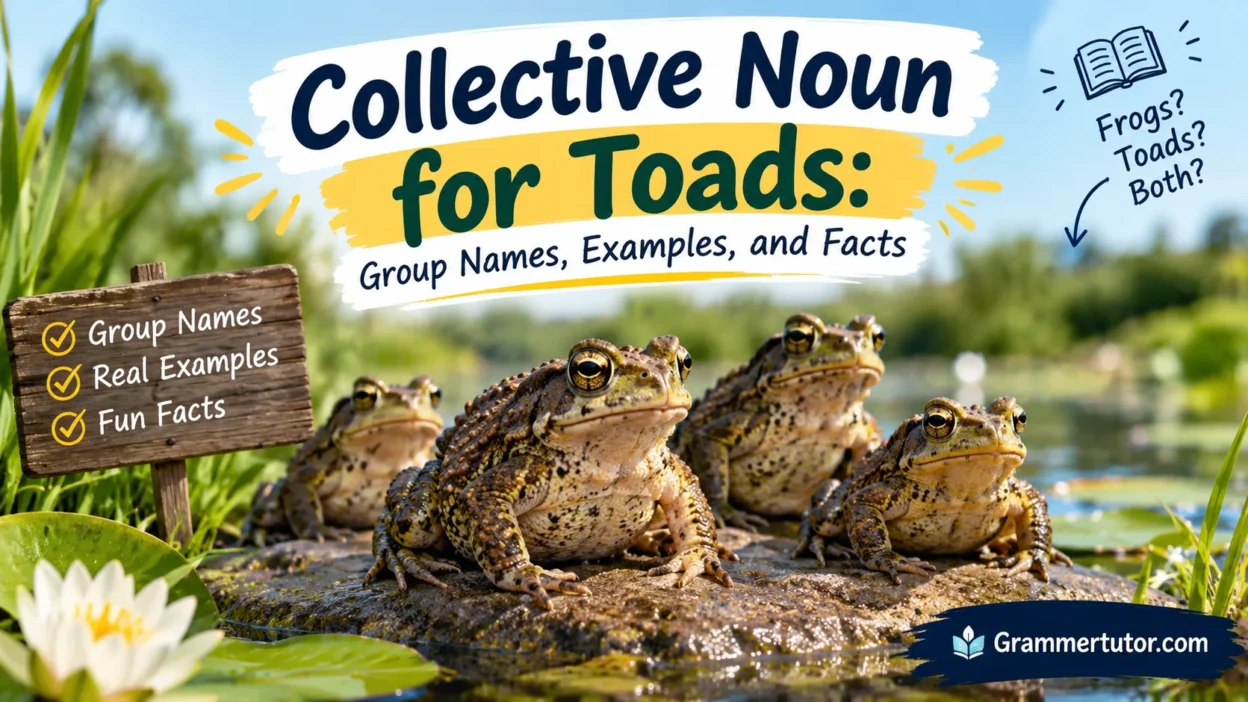
The collective noun for toads helps you describe toads that gather together in ponds, gardens, and other suitable habitats. In English vocabulary, a collective noun is a word that describes several similar animals as one group. Toads may also live or gather in wetlands, forests, and other places where they find the right conditions. These different contexts help explain why several expressions can describe a group of toads.
A knot of toads is a traditional collective term used for a group of toads. You may also see a group of toads as a simple and clear expression. Another term is congregation of toads, which can be a useful description when many toads gather in one place, particularly around water during breeding periods. The word knot is strongly associated with this animal group, while congregation gives the idea of several animals coming together.
Knowing these group names can make your English more descriptive when writing about wildlife, studying animal vocabulary, or describing toads in nature. Understanding the collective noun for toads gives you several ways to express the idea of a group, and choosing the right term can make your description clearer and more natural.
Why Do We Use Collective Nouns for Toads?
Toads are often solitary for parts of their lives, but they can gather in noticeable numbers when conditions are suitable. During breeding seasons, for example, many toads may move toward ponds or other bodies of water at approximately the same time.
A collective noun allows us to describe several toads without repeatedly saying “a group of toads.” These expressions can make sentences shorter and more interesting.
The term knot is especially distinctive because it suggests a tightly gathered group. Congregation is another descriptive choice for toads gathered together, while group remains a simple and general option.
The exact expression can depend on the context and the style of writing. For everyday English, a group of toads is always clear, while traditional collective nouns can add variety to wildlife writing.
Collective Nouns for Toads
| Collective Noun | Used For | Simple Example |
| Knot | A gathered group of toads | A knot of toads sat near the pond. |
| Congregation | Many toads gathered together | A congregation of toads formed near the water. |
| Group | A general gathering of toads | A group of toads crossed the path. |
| Colony | Toads living or gathering in an area | A colony of toads lived near the wetland. |
| Cluster | Toads gathered closely together | A cluster of toads rested under the leaves. |
Knot of Toads
A knot of toads is a traditional and distinctive expression used for a group of toads. The word “knot” gives the impression of several toads gathered closely together.
It can be particularly effective in descriptive or wildlife writing when you want to use a more colorful collective noun instead of the ordinary word “group.”
Examples of “Knot of Toads”
- A knot of toads gathered beside the pond.
- We noticed a knot of toads near the wetland.
- A knot of toads rested beneath the leaves.
- The knot of toads moved toward the water.
- A knot of toads appeared after the rain.
- The children spotted a knot of toads in the garden.
- A knot of toads gathered near the muddy bank.
- The knot of toads stayed close to the pond.
- We watched a knot of toads from a distance.
- A knot of toads disappeared into the grass.
Congregation of Toads
A congregation of toads is a descriptive expression for several toads gathered in the same place. The word “congregation” usually suggests a gathering, making it suitable for describing a noticeable number of toads together.
This expression can work well in nature writing, especially when describing toads gathering around ponds, streams, or other damp locations.
Examples of “Congregation of Toads”
- A congregation of toads gathered near the pond.
- We saw a congregation of toads beside the stream.
- A congregation of toads appeared after the rain.
- The congregation of toads moved toward the water.
- A large congregation of toads rested near the wetland.
- The photographer observed a congregation of toads.
- A congregation of toads gathered under the bushes.
- The congregation of toads became active after sunset.
- We found a congregation of toads near the muddy bank.
- A congregation of toads remained close to the pond.
Group of Toads
A group of toads is the simplest general expression. Unlike some traditional animal collective nouns, the word “group” does not suggest a particular arrangement or behavior.
It is useful when you want your sentence to be straightforward and easy for every reader to understand.
Examples of “Group of Toads”
- A group of toads crossed the garden path.
- We saw a group of toads near the pond.
- A group of toads rested under the plants.
- The group of toads moved through the wet grass.
- A group of toads appeared after the rain.
- We found a group of toads beside the stream.
- The group of toads gathered near the water.
- A group of toads lived around the garden.
- The children watched a group of toads from a distance.
- A group of toads disappeared beneath the leaves.
Colony of Toads
A colony of toads can be used as a general description for toads occupying the same habitat or area. It is more of a descriptive group expression than a universally established specialized collective noun.
The term may be useful when discussing a population of toads living around a wetland, pond, garden, or other suitable environment.
Examples of “Colony of Toads”
- A colony of toads lived near the pond.
- We discovered a colony of toads in the wetland.
- A colony of toads occupied the damp garden area.
- The colony of toads became active after dark.
- Researchers studied a colony of toads near the stream.
- A colony of toads gathered around the breeding pond.
- The colony of toads survived in the forest habitat.
- We noticed a colony of toads beneath the plants.
- A colony of toads lived around the small lake.
- The colony of toads moved toward the water.
Cluster of Toads
A cluster of toads describes several toads positioned close together. The word “cluster” focuses on their physical arrangement rather than giving a special name to their social structure.
It can be useful when describing a group of toads sitting together beneath vegetation, near water, or in a damp hiding place.
Examples of “Cluster of Toads”
- A cluster of toads rested under the leaves.
- We found a cluster of toads near the pond.
- A cluster of toads gathered beside the rocks.
- The cluster of toads stayed in the shade.
- A cluster of toads appeared after heavy rain.
- We noticed a cluster of toads near the garden wall.
- The cluster of toads moved slowly through the grass.
- A cluster of toads remained close to the water.
- The children saw a cluster of toads beneath a plant.
- A cluster of toads disappeared into the wet soil.
Types of Toads and Their Characteristics
Toads belong to the amphibian group and are closely related to frogs. They are found in many different environments around the world, although the exact species and their characteristics vary by region. Toads generally have short, sturdy bodies, relatively dry or bumpy skin, and strong hind legs.
One noticeable feature of many toads is their rough-looking skin. Their skin can help reduce water loss compared with the smoother skin commonly associated with many frogs. Toads still need moisture and suitable environments to survive and reproduce.
Toads also have specialized glands behind their eyes called parotoid glands in many species. These glands can produce defensive substances that may discourage predators from attacking them.
Examples of Toad Characteristics
- Toads are amphibians.
- Toads are closely related to frogs.
- Many toads have rough or bumpy skin.
- Toads usually have strong hind legs.
- Many toads are active at night.
- Toads often prefer damp environments.
- Many species eat insects and other small animals.
- Some toads have parotid glands behind their eyes.
- Toads can use ponds for reproduction.
- Different toad species have different colors and markings.
Interesting Facts About Toads
Toads are fascinating amphibians with biological features that help them survive in a variety of environments. Their longevity depends on the species, habitat, predators, disease, food supply, and other environmental conditions. Some toads can live for several years, and certain species can survive considerably longer under favorable conditions.
One of the most recognizable physiological characteristics of many toads is their rough, textured skin. Unlike many frogs with smooth, moist skin, toads often have a more dry-looking and bumpy appearance. Their skin helps them cope with life on land, although they still need access to moisture and water for important parts of their life cycle.
Many toads also possess parotoid glands behind their eyes. These glands can release defensive chemicals when a predator attempts to eat them. This is one reason why some predators avoid certain toads. Toads also have powerful hind legs that allow them to hop and move quickly when threatened.
Their dietary habits are another interesting feature. Toads are generally carnivorous, feeding on insects and other small creatures. Their food may include beetles, ants, flies, moths, spiders, and other small invertebrates. By consuming insects, toads can contribute to the natural control of insect populations.
Toads also return to suitable water sources for reproduction. During breeding periods, large numbers may gather around ponds and other bodies of water. This behavior makes collective expressions particularly useful when describing a gathering of toads in nature.
READ MORE: Collective Noun for Pelicans: A Complete Guide with Examples
Conclusion
The collective noun for toads can be expressed with terms such as knot of toads, group of toads, and congregation of toads. Among these, knot of toads is a traditional term, while the other expressions can be useful depending on the context. Understanding these group names can make your English more descriptive when writing about wildlife and nature.
FAQs
Q1. What is the collective noun for toads?
The traditional collective noun for toads is a knot of toads. You can also use a group of toads or a congregation of toads.
Q2. What is a group of toads called?
A group of toads can be called a knot of toads. “Group of toads” is also a simple and clear expression.
Q3. Is “knot of toads” correct?
Yes. Knot of toads is a traditional collective term used to describe a group of toads.
Q4. Can I say “a congregation of toads”?
Yes. A congregation of toads can describe many toads gathered together in one place, especially around water.
Q5. Where do toads usually gather?
Toads may gather around ponds, wetlands, gardens, forests, and other suitable habitats, particularly where food, shelter, and water are available.
Q6. Why do toads gather together?
Toads may gather for reasons such as breeding, finding food, seeking shelter, or staying near suitable water sources.
Q7. What does “knot” mean in “knot of toads”?
Here, knot is a collective term that refers to a group of toads. It does not mean that the animals are physically tied together.
Q8. Is “group of toads” grammatically correct?
Yes. A group of toads is grammatically correct and is an easy expression to use in everyday English.
Q9. Which collective noun for toads is most traditional?
A knot of toads is the most traditional expression among the terms commonly associated with groups of toads.
Q10. How can I use a collective noun for toads in a sentence?
You can write: “A knot of toads gathered near the pond after the rain.” This clearly shows a group of toads in a natural setting.