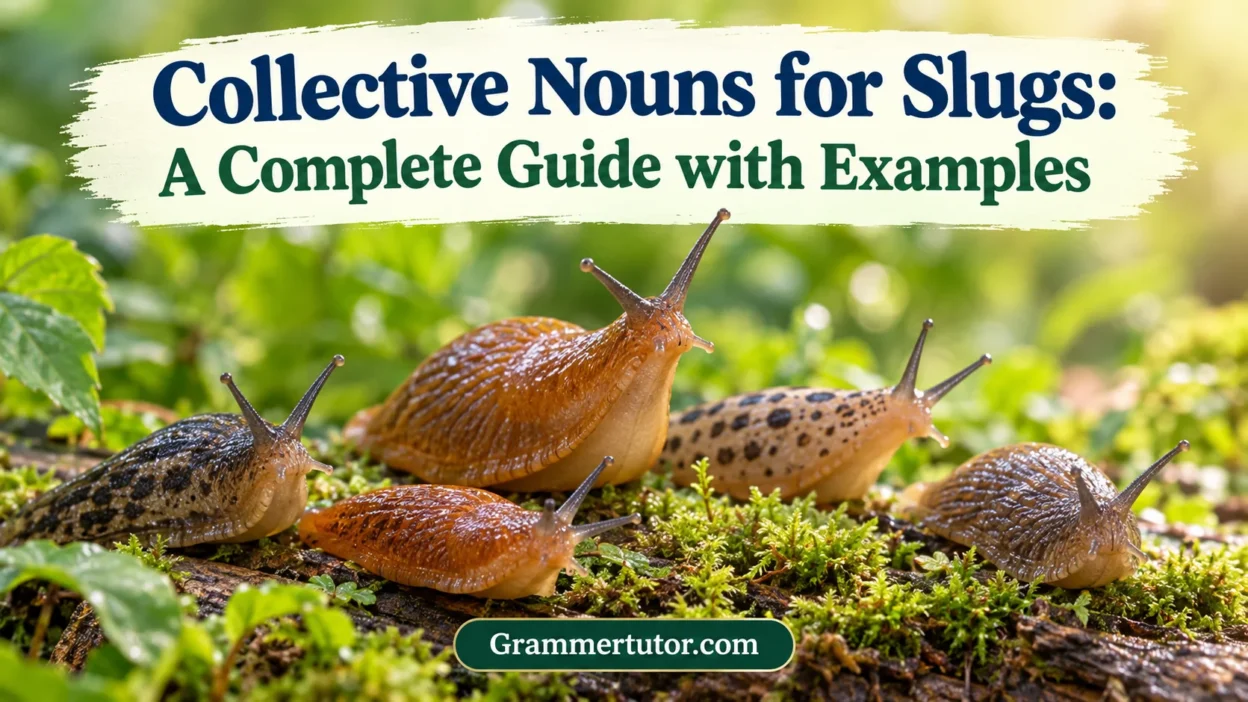
A collective noun for slugs gives you a simple way to describe several slugs together while making animal vocabulary more interesting and useful. These small, soft-bodied creatures often appear together in gardens, forests, fields, and other damp environments. Instead of using only the simple phrase a group of slugs, you can explore different ways to describe how they gather and behave.
Slugs are usually more active when conditions are cool and moist. When food and moisture are available, several slugs may gather in the same area. These descriptive expressions can create a clearer picture of how slugs gather, move, and feed, while connecting English vocabulary with their natural behavior. Learning these terms can be useful for understanding unusual animal language.
For students, writers, and nature lovers, these terms offer an interesting look at unusual animal group names. A good guide can introduce the common expressions associated with slugs, along with simple examples, interesting facts, and answers to frequently asked questions. This makes the topic easier to understand while showing how everyday observations can add meaning to English vocabulary.
Why Collective Nouns Are Used for Slugs
Slugs are small mollusks that often appear together in places where moisture and food are plentiful. Although they don’t form highly organized social groups in the same way as some mammals or birds, several slugs may gather in the same environment.
Collective nouns make descriptions more vivid because they allow writers to describe a collection of animals with fewer words. Some expressions emphasize the number of slugs, while others can create an image of their slow movement or close grouping.
For everyday writing, group is always safe and clear, while descriptive terms can be useful in creative or nature-focused writing.
Collective Nouns for Slugs
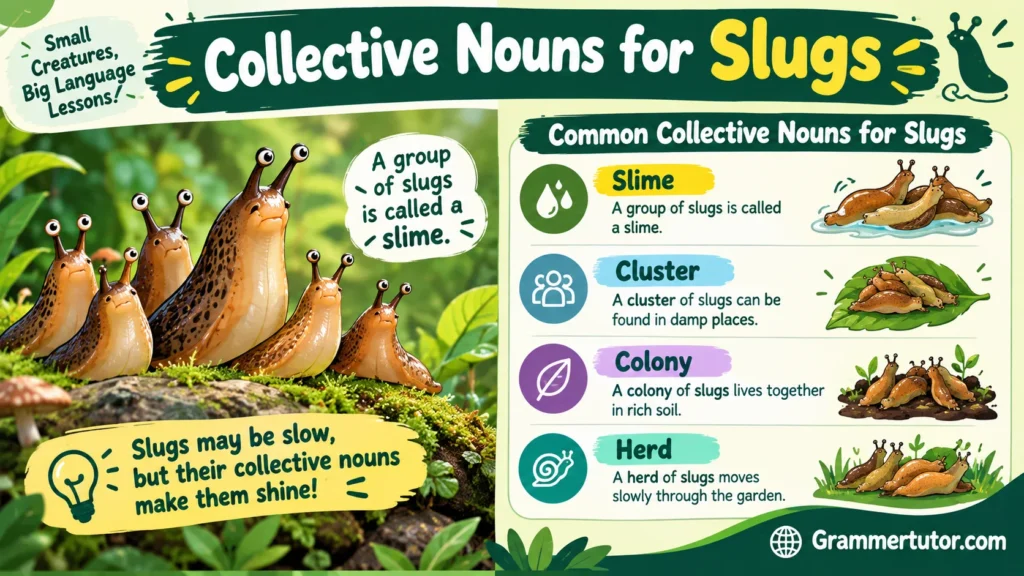
| Collective Noun | Used For | Simple Example |
| Colony | Slugs living together in a suitable habitat | A colony of slugs lived beneath the leaves. |
| Cluster | Slugs gathered closely together | A cluster of slugs rested on the wet soil. |
| Group | A general collection of slugs | A group of slugs moved through the garden. |
| Horde | A large number of slugs gathered together | A horde of slugs covered the damp ground. |
| Trail | Slugs moving along an area, emphasizing their movement | A trail of slugs crossed the garden path. |
| Gathering | Slugs collected in one place | A gathering of slugs appeared after the rain. |
| Mass | A large collection of slugs viewed as one body | A mass of slugs gathered beneath the plants. |
Colony of Slugs
A colony can describe slugs living or gathering in the same suitable environment. Damp soil, fallen leaves, logs, gardens, and other sheltered places can provide the moisture and food that slugs need.
The word colony gives the impression of slugs occupying the same habitat, although it doesn’t necessarily mean they have a highly organized social structure.
Examples of “Colony of Slugs”
- A colony of slugs lived beneath the fallen leaves.
- We discovered a colony of slugs in the damp garden.
- The colony of slugs became active after the rain.
- A large colony of slugs gathered beneath the logs.
- The gardener noticed a colony of slugs near the plants.
- The colony of slugs remained hidden during the day.
- A colony of slugs moved through the wet soil.
- Researchers observed a colony of slugs in the forest.
- The colony of slugs appeared after several rainy days.
- The colony of slugs stayed beneath the vegetation.
Cluster of Slugs
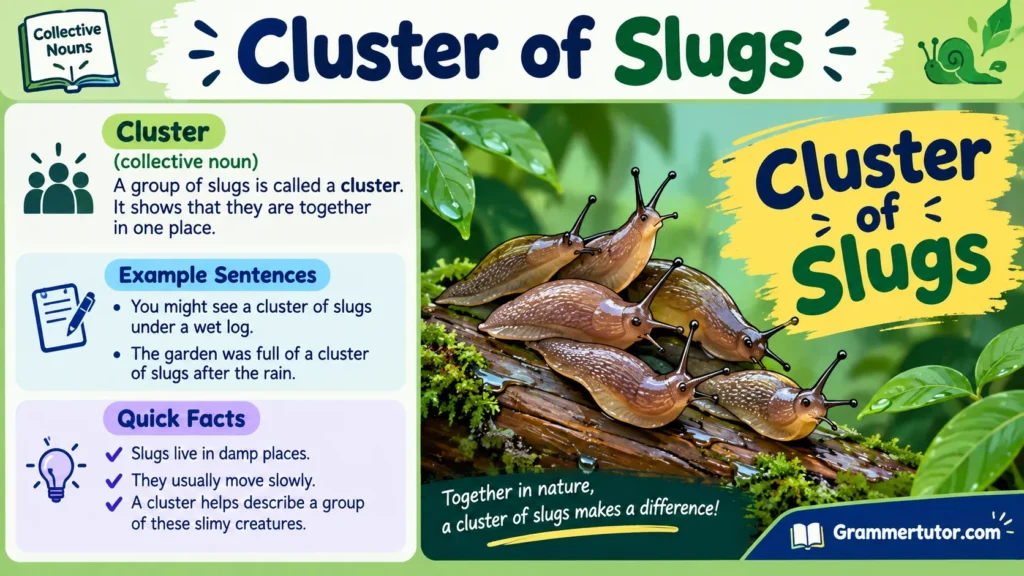
A cluster describes slugs that are gathered closely together in one location. Because slugs often seek moist and sheltered places, several individuals may be found close to one another beneath leaves, stones, logs, or vegetation.
This expression focuses more on their physical grouping than on a permanent social organization.
Examples of “Cluster of Slugs”
- A cluster of slugs rested beneath the leaves.
- We found a cluster of slugs on the wet ground.
- The cluster of slugs appeared after the rain.
- A cluster of slugs gathered near the garden plants.
- The gardener noticed a cluster of slugs under a log.
- The cluster of slugs remained hidden from the sunlight.
- A cluster of slugs moved slowly across the soil.
- The cluster of slugs disappeared beneath the leaves.
- Several slugs formed a cluster near the damp stones.
- The cluster of slugs became active at night.
Group of Slugs
A group of slugs is the simplest and clearest expression for several slugs found together. Unlike some specialized animal collective nouns, group can be used naturally in almost any situation.
It works well in everyday conversation, school assignments, scientific descriptions, and general writing.
Examples of “Group of Slugs”
- A group of slugs moved across the garden.
- We saw a group of slugs after the rain.
- The group of slugs stayed beneath the leaves.
- A group of slugs gathered near the vegetables.
- The gardener found a group of slugs under a stone.
- A group of slugs appeared during the night.
- The group of slugs moved toward the damp soil.
- A group of slugs rested beside the plants.
- We photographed a group of slugs in the forest.
- The group of slugs disappeared into the vegetation.
Horde of Slugs
A horde of slugs can be used descriptively for a large number of slugs gathered in one place. The word horde creates a strong image of a large mass moving or spreading across an area.
This expression is especially suitable for creative, humorous, or dramatic writing rather than formal scientific descriptions.
Examples of “Horde of Slugs”
- A horde of slugs covered the damp garden.
- The gardener discovered a horde of slugs after the rain.
- A horde of slugs moved across the wet ground.
- The horde of slugs gathered beneath the plants.
- A horde of slugs appeared during the humid night.
- The horde of slugs spread across the garden bed.
- We noticed a horde of slugs near the vegetables.
- The horde of slugs disappeared beneath the leaves.
- A horde of slugs covered the forest floor.
- The gardener carefully inspected the area for the horde of slugs.
Trail of Slugs
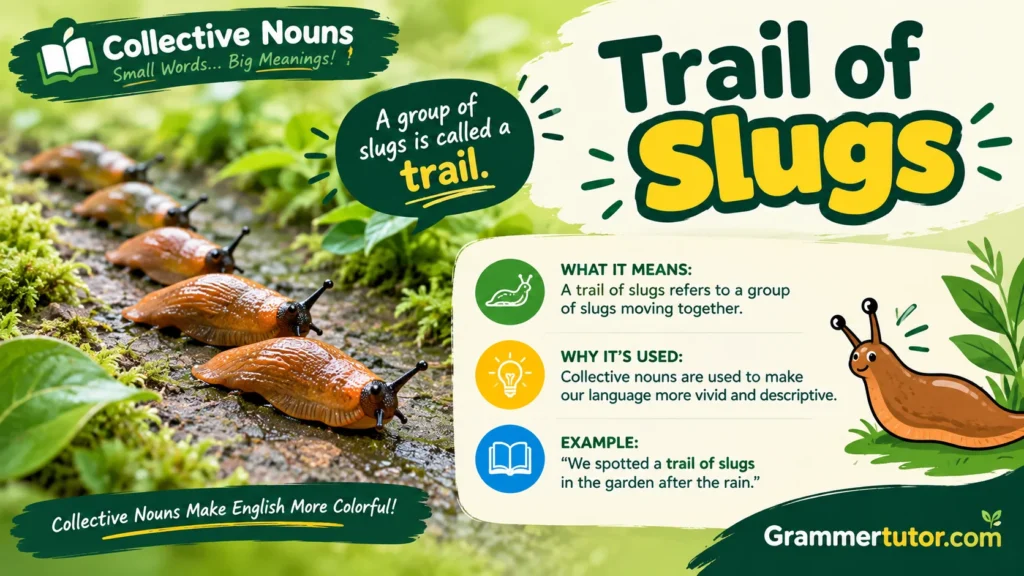
A trail of slugs is a descriptive expression that focuses on the way slugs move across a surface. Slugs leave behind a thin layer of mucus as they travel, making their paths noticeable on soil, leaves, stones, and other surfaces.
The expression trail of slugs is particularly useful when several slugs appear to be moving in the same direction.
Examples of “Trail of Slugs”
- A trail of slugs crossed the garden path.
- We followed a trail of slugs toward the flower bed.
- A trail of slugs appeared after the rain.
- The trail of slugs led beneath the leaves.
- A trail of slugs moved across the wet soil.
- The gardener noticed a trail of slugs near the vegetables.
- A trail of slugs stretched across the stone wall.
- The trail of slugs disappeared into the grass.
- We found a trail of slugs beside the garden fence.
- A trail of slugs crossed the damp ground.
Mass of Slugs
A mass of slugs describes a large collection of slugs viewed together as one noticeable group. The expression emphasizes the number or concentration of slugs rather than their social behavior.
It can be useful when a large number of slugs gather in a damp location with plenty of food or shelter.
Examples of “Mass of Slugs”
- A mass of slugs gathered beneath the leaves.
- We discovered a mass of slugs in the garden.
- The mass of slugs covered the damp soil.
- A mass of slugs appeared after the heavy rain.
- The gardener found a mass of slugs under the boards.
- The mass of slugs moved slowly across the ground.
- A mass of slugs gathered around the plants.
- The mass of slugs remained hidden during the day.
- A mass of slugs covered part of the forest floor.
- The mass of slugs disappeared into the vegetation.
Gathering of Slugs
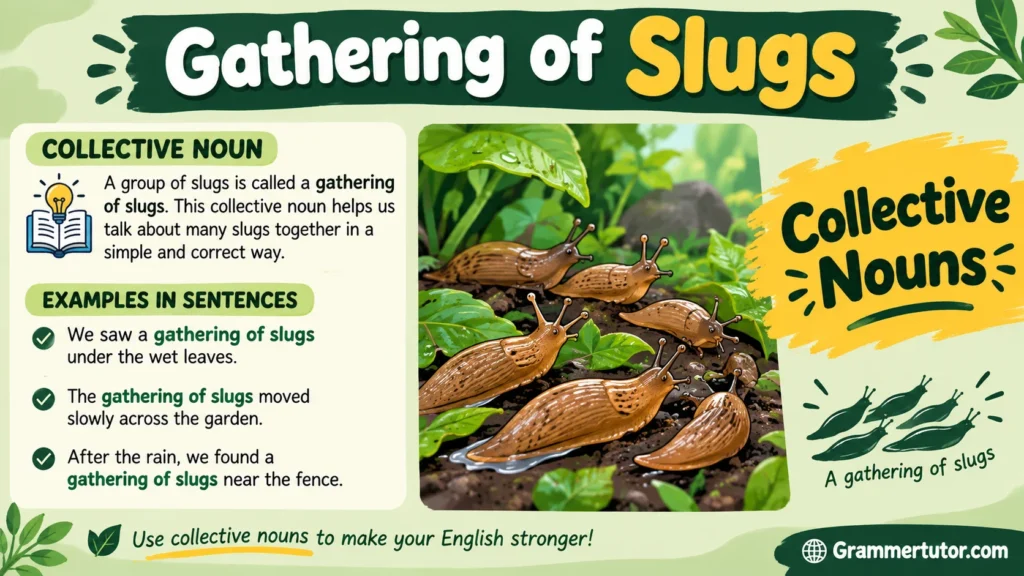
A gathering of slugs is a general descriptive expression for several slugs collected in the same place. It doesn’t imply a formal social structure, but it can make nature writing sound more vivid.
This expression works particularly well when describing slugs that appear together after rain or during damp nighttime conditions.
Examples of “Gathering of Slugs”
- A gathering of slugs appeared after the rain.
- We noticed a gathering of slugs beneath the leaves.
- The gathering of slugs moved slowly across the soil.
- A gathering of slugs formed near the garden plants.
- The gardener discovered a gathering of slugs under a log.
- The gathering of slugs became active after sunset.
- A gathering of slugs rested in the damp grass.
- We observed a gathering of slugs beside the pathway.
- The gathering of slugs disappeared before morning.
- A gathering of slugs appeared near the vegetables.
Interesting Facts About Slugs
Slugs are soft-bodied gastropod mollusks and are closely related to snails. Unlike snails, most slugs don’t have a prominent external shell, although some species have a small internal shell or shell remnant. Their bodies are flexible and covered with mucus, which helps them move across surfaces and reduces the risk of drying out. Slugs generally prefer damp conditions because their soft bodies can lose moisture easily. Their lifespan varies considerably by species and environment, with some living for several months and others surviving for longer periods under suitable conditions.
One of the most interesting physiological features of slugs is their muscular foot. This broad structure runs along the underside of the body and produces waves of muscular movement that help the slug glide forward. The mucus secreted by the slug reduces friction and helps it move over rough surfaces. Slugs also have sensitive tentacles on their heads. Their upper tentacles contain eyes, while other sensory structures help them detect their surroundings.
Another fascinating feature is the radula, a specialized feeding structure found in many mollusks. It contains numerous tiny tooth-like structures that help slugs scrape and consume food. Their feeding behavior allows them to process plant material and other food sources efficiently.
Slugs are also important parts of food webs. Although gardeners may sometimes consider them unwanted visitors, they contribute to nutrient cycling by consuming and breaking down organic material. Their presence supports other animals that depend on them as a food source.
Examples of Slug Facts
- Slugs are gastropod mollusks.
- Slugs are closely related to snails.
- Most slugs don’t have a prominent external shell.
- Slugs have a muscular foot for movement.
- Slugs produce mucus while moving.
- Many slugs prefer damp environments.
- Slugs can feed on plants and decaying organic material.
- Some slugs are important decomposers.
- Slugs can serve as food for many predators.
- Slugs have sensory tentacles.
- Many slugs use a radula to scrape food.
- Slugs play a role in natural food webs.
READ MORE: Collective Noun for Chinchillas: A Complete Guide with Examples
Conclusion
A collective noun for slugs adds variety to English vocabulary and gives writers different ways to describe groups of these small, soft-bodied creatures. Since slugs often gather in cool, moist, and damp environments, understanding their natural behavior can make these unusual terms easier to remember and use correctly.
FAQs
Q1. What is a collective noun for slugs?
A collective noun for slugs is a word or expression used to describe a group of slugs appearing together.
Q2. Where are slugs commonly found?
Slugs are commonly found in gardens, forests, fields, and other damp environments.
Q3. When are slugs most active?
Slugs generally become more active when conditions are cool and moist.
Q4. Why do slugs gather together?
Slugs may gather in the same area when food and moisture are available.
Q5. Are collective nouns for slugs common in everyday English?
Some expressions for groups of slugs are unusual, so people often simply say “a group of slugs.”
Q6. Why are collective nouns interesting?
They make animal vocabulary more varied and provide descriptive ways to talk about animals in groups.
Q7. Can students use slug collective nouns in writing?
Yes. Students can use them when writing about nature, animals, gardens, or unusual vocabulary.
Q8. Do collective nouns describe slug behavior?
They can help create a clearer picture of how slugs gather, move, and feed, depending on the expression used.
Q9. Are slugs considered animals?
Yes. Slugs are animals belonging to the mollusk group.
Q10. Why should I learn unusual animal group names?
Learning unusual group names can expand your English vocabulary and make descriptive writing more interesting.