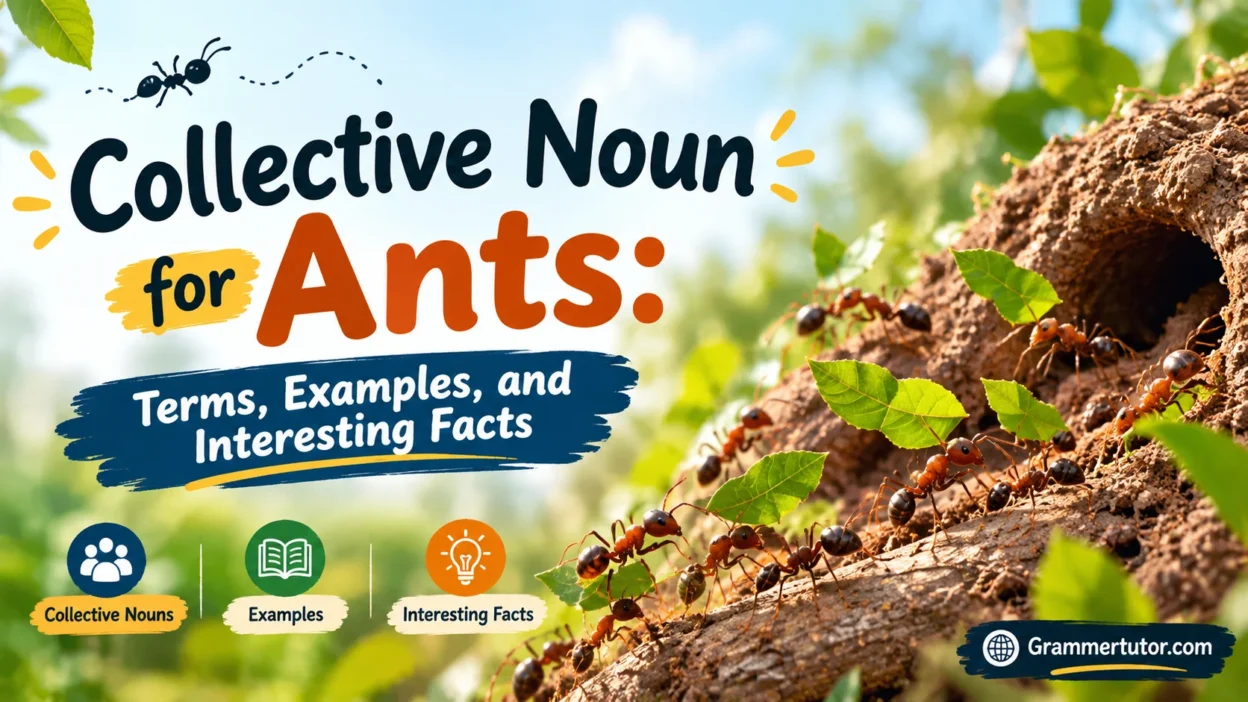
The collective noun for ants is colony, a common term for ants living and working together in organized communities, rather than moving alone.Ants are fascinating animals because they spend much of their time working and moving together.
A collective noun is a word that represents several individuals as one group. For ants, colony is the most common and appropriate term because these small insects live and work together in organized communities. As a writer, I find this word useful when explaining how ants cooperate and share their daily tasks.You may also find expressions such as army of ants, swarm of ants, and nest of ants in different contexts.
An army of ants can describe a large group moving in an organized way, while a swarm of ants highlights the way they move. A nest of ants describes where they live. Understanding the behavior of a large group helps students, writers, teachers, and anyone interested in animals learn the difference between these expressions. This makes it easier to describe ants naturally and accurately.
Why Do We Use Collective Nouns for Ants?
Ants are highly social insects that normally live in organized communities. A single colony may contain many individuals, with different ants performing different tasks such as finding food, caring for young, building tunnels, or defending the nest.
Because ants frequently appear in large numbers, collective expressions make descriptions easier. Instead of repeatedly saying “many ants,” we can say a colony of ants or, in a suitable context, an army of ants.
The expression you choose depends on what you want to describe. Colony is best when referring to ants living together as a social community, while army creates an image of ants moving or working together in large numbers.
Collective Nouns for Ants
| Collective Noun | Used For | Simple Example |
| Colony | Ants living as an organized community | A colony of ants lived under the tree. |
| Army | A large group of ants moving together | An army of ants crossed the path. |
| Swarm | A large number of ants moving together | A swarm of ants appeared near the food. |
| Nest | Ants associated with their home | A nest of ants was hidden underground. |
| Group | A general collection of ants | A group of ants carried a leaf. |
Colony of Ants
A colony of ants is the most useful collective expression when talking about ants as a social community. A colony usually includes ants with different roles, and they cooperate to maintain their shared home.
The word colony is particularly suitable when discussing the organized lifestyle of ants rather than simply describing ants that happen to be close together.
Examples of “Colony of Ants”
- A colony of ants lived beneath the old tree.
- We discovered a colony of ants in the garden.
- The colony of ants worked together to find food.
- A large colony of ants occupied the underground nest.
- The researchers observed a colony of ants.
- A colony of ants built tunnels beneath the soil.
- The colony of ants returned to its nest before nightfall.
- We watched a colony of ants carrying food.
- A colony of ants was hiding under the stones.
- The colony of ants protected its young carefully.
Army of Ants
An army of ants is a vivid expression used to describe a large number of ants moving or working together. The word army highlights their organized movement and cooperation.
It is especially effective in descriptive writing because a long line of ants can look like a tiny marching army.
Examples of “Army of Ants”
- An army of ants marched across the garden.
- We saw an army of ants moving toward the food.
- An army of ants crossed the kitchen floor.
- The army of ants followed a narrow trail.
- An army of ants moved beneath the leaves.
- We watched an army of ants carrying pieces of food.
- An army of ants appeared after the rain.
- The army of ants disappeared into a small opening.
- An army of ants traveled across the forest floor.
- The children watched an army of ants at work.
Swarm of Ants
A swarm of ants can be used to describe a large number of ants gathered or moving together. The word swarm emphasizes the large number and movement of the insects.
It is more descriptive than the general word “group” and can be useful when many ants suddenly appear in one place.
Examples of “Swarm of Ants”
- A swarm of ants appeared near the food.
- We noticed a swarm of ants around the tree.
- A swarm of ants moved across the ground.
- The swarm of ants entered a small crack.
- A swarm of ants gathered near the fallen fruit.
- The children saw a swarm of ants in the garden.
- A swarm of ants covered part of the forest floor.
- The swarm of ants moved toward the nest.
- A swarm of ants appeared after the weather became warmer.
- We watched the swarm of ants disappear beneath the soil.
Nest of Ants
A nest of ants refers to ants associated with their nest or living place. Unlike a colony, which emphasizes the social community, the nest draws attention to the place where ants live and carry out their activities.
Ant nests can be found underground, beneath rocks, inside trees, or in other protected locations depending on the species.
Examples of “Nest of Ants”
- A nest of ants was hidden beneath the rock.
- We found a nest of ants in the garden.
- A nest of ants was located under the tree.
- The children noticed a nest of ants near the path.
- A nest of ants occupied the space beneath the soil.
- We carefully walked around the nest of ants.
- A nest of ants was discovered beside the old wall.
- The gardener noticed a nest of ants near the plants.
- A nest of ants was hidden under fallen leaves.
- We observed the ants entering their nest.
Group of Ants
A group of ants is a straightforward expression that can be used when you simply want to describe several ants together. It does not emphasize a particular social structure, movement pattern, or living arrangement.
Although the colony is usually more specific, the group is perfectly understandable in ordinary descriptions.
Examples of “Group of Ants”
- A group of ants carried a small piece of food.
- We saw a group of ants near the plant.
- A group of ants moved across the table.
- The group of ants followed a narrow trail.
- A group of ants gathered around a crumb.
- We watched a group of ants working together.
- A group of ants disappeared into a hole.
- The group of ants moved beneath the leaves.
- A group of ants was searching for food.
- The group of ants returned to the nest.
Types of Ants and Their Roles
Ants belong to the insect family Formicidae, and there are thousands of known species with different appearances, habitats, and behaviors. Although individual species vary greatly, many ants live in colonies with a division of labor.
A typical ant colony may contain workers that search for food, maintain the nest, care for young, and perform other tasks. Some colonies also have reproductive individuals, including queens and males. In certain species, the organization of the colony can be extremely complex.
Ants can be found in many environments, including forests, grasslands, gardens, deserts, and urban areas. Their ability to cooperate allows them to survive in environments ranging from dry landscapes to tropical forests.
Examples of Ant Characteristics
- Ants are social insects.
- Ants belong to the family Formicidae.
- Many ants live in colonies.
- Worker ants often search for food.
- Ants can build underground tunnels.
- Different ant species have different diets.
- Some ants protect their nests from intruders.
- Ants communicate with chemical signals.
- Ant colonies can contain many individuals.
- Ants can cooperate to move objects larger than themselves.
Interesting Facts About Ants
Ants are among the most successful social insects on Earth, and their ability to cooperate is one of their most remarkable characteristics. Their lifespan varies according to species and role within the colony. Worker ants often live for a relatively limited period, while queens of some species can survive for several years. This difference allows a colony to maintain reproduction while workers perform daily tasks.
One of the most fascinating physiological features of ants is their strength relative to their body size. Many ants can carry or move objects that are much heavier than their own bodies. Their small but powerful bodies, jointed legs, and strong mandibles allow them to perform tasks that would be difficult for an insect of their size.
Ants also have interesting dietary habits. Depending on the species, they may consume insects, seeds, nectar, fruits, fungi, or other organic materials. Some ants even maintain relationships with other organisms to obtain food. Certain species protect aphids and collect the sugary substance they produce.
Communication is another important feature of ant life. Ants commonly use chemical signals called pheromones to leave trails, identify members of their colony, warn others of danger, and locate food. This chemical communication helps thousands of individuals coordinate their activities without a central leader giving direct instructions.
The social organization of ants explains why colony is such an appropriate collective noun. Each individual contributes to the survival of the wider community, making an ant colony an excellent example of cooperation and specialized behavior in the natural world.
READ MORE: Collective Noun for Butterflies: Common Terms and Example Sentences
Conclusion
The collective noun for ants is colony, the most common term for a group of ants living and working together. Other expressions, such as army of ants, swarm of ants, and nest of ants, help describe their movement, behavior, and living place. Understanding these terms makes your English vocabulary richer and helps you describe ants naturally and accurately.
FAQs
Q1. What is the collective noun for ants?
The most common collective noun for ants is colony. It describes a group of ants living and working together.
Q2. What do you call a group of ants?
A group of ants is commonly called a colony of ants. You may also hear army of ants or swarm of ants in different contexts.
Q3. Is colony the correct collective noun for ants?
Yes, colony is the most appropriate and widely used term for ants living together in an organized community.
Q4. Can we say an army of ants?
Yes. Army of ants is an expression used to describe a large group of ants moving or working together in an organized way.
Q5. What is a swarm of ants?
A swarm of ants describes a group of ants moving together. The expression focuses on their movement rather than their home.
Q6. What does a nest of ants mean?
A nest of ants refers to ants living in or around their nest. It focuses on their living place.
Q7. Why do ants live in colonies?
Ants live in colonies to cooperate, find food, protect their nest, and complete tasks that help the group survive.
Q8. What is the plural of ant?
The plural of ant is ants. For example, “Several ants are carrying food.”
Q9. How do you use the colony of ants in a sentence?
Here is an example: “A colony of ants was busy collecting food near the garden.”
Q10. Why is learning collective nouns for ants useful?
Learning collective nouns helps students, writers, and teachers improve their English vocabulary and describe groups of animals more naturally.