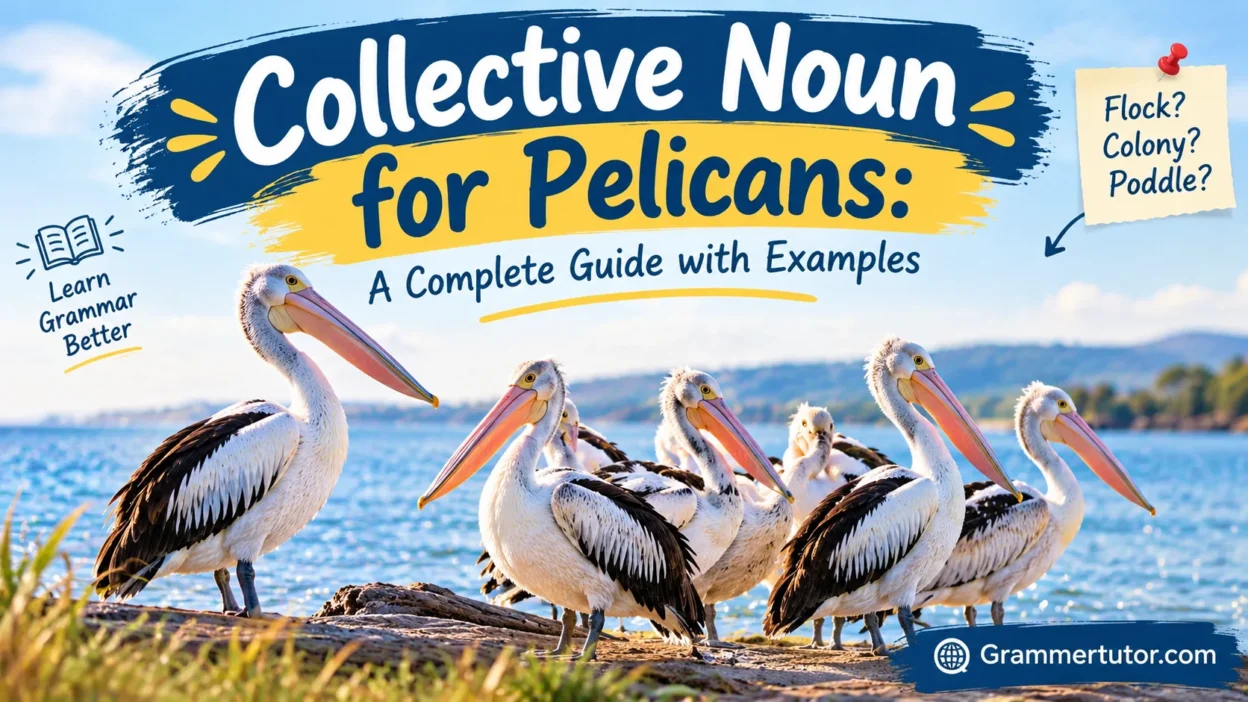
The collective noun for pelicans helps describe groups of these large water birds when they gather near water to feed, rest, or travel.Pelicans are easily recognized by their long bills, expandable throat pouches, and graceful movement.
They commonly gather around lakes, rivers, coastal waters, and other aquatic habitats. When these bird groups come together, they may be searching for fish, resting, or preparing to travel together. Their natural behavior makes them interesting examples when learning how collective nouns describe animals in the English vocabulary.
Knowing these common collective nouns can improve your vocabulary and help you write naturally about birds and wildlife. These terms are useful in everyday sentences when discussing wildlife, nature, and the natural world. They also make it easier to describe a gathering of pelicans in different coastal environments and explain their behavior in a clear way.
Why Are Collective Nouns Used for Pelicans?
A collective noun is a word that refers to a group of similar people, animals, or things. Instead of saying “many pelicans,” you can use a more descriptive phrase such as a pod of pelicans or a flock of pelicans.
Collective nouns make language more colorful and precise. They can also describe the behavior, movement, or setting of a group. For example, pelicans resting together on a beach may be described differently from pelicans flying above the sea.
Pelicans are social birds. They often gather in groups around productive fishing areas, shallow waters, riverbanks, and coastal habitats. Because they frequently appear together, several collective nouns can describe them depending on the situation.
Common Collective Nouns for Pelicans
The following terms can be used to describe groups of pelicans. Flock is the most familiar general term, while other expressions may be more descriptive or context-based.
| Collective Noun | Used For | Simple Example |
| Flock of pelicans | A general group of pelicans | A flock of pelicans rested near the lake. |
| Pod of pelicans | A group gathered or moving together | A pod of pelicans floated across the water. |
| Squadron of pelicans | Pelicans flying in an organized formation | A squadron of pelicans crossed the shoreline. |
| Colony of pelicans | Pelicans living or nesting together | A colony of pelicans built nests on the island. |
| Group of pelicans | A simple and general expression | A group of pelicans searched for fish. |
| Gathering of pelicans | Pelicans collected in one place | A gathering of pelicans covered the riverbank. |
A Flock of Pelicans
A flock of pelicans is the most useful and widely understood collective noun for pelicans. It refers to several pelicans gathered together, whether they are flying, swimming, feeding, or resting.
Pelicans often form flocks when they search for food. They may work together to push fish into shallow water, making it easier to catch them. A flock can also move across the sky in a loose formation or settle together near a fishing area.
This term works well in general writing because it does not require a special situation. Whenever you see several pelicans together, a flock of pelicans is a safe and natural choice.
Examples of “A Flock of Pelicans”
- A flock of pelicans rested beside the quiet lake.
- We watched a flock of pelicans flying over the sea.
- A flock of pelicans gathered near the fishing boats.
- The photographer captured a flock of pelicans at sunrise.
- A flock of pelicans searched the shallow water for fish.
- The flock of pelicans moved slowly across the river.
- A large flock of pelicans settled on the sandy beach.
- The children were excited to see a flock of pelicans.
- A flock of pelicans followed the coastline.
- The flock of pelicans disappeared behind the distant trees.
A Pod of Pelicans
A pod of pelicans is a descriptive expression for pelicans gathered closely together, especially when they are floating or moving across water.
The word “pod” is commonly associated with certain marine animals, but it can also be used creatively for a group of birds that stay close together on water. Pelicans spend much of their time around rivers, lakes, lagoons, and oceans, so this expression can create a strong picture of them moving as a unit.
This term is especially suitable for nature writing, creative descriptions, and wildlife stories. It suggests a group that remains close while swimming, resting, or traveling.
Examples of “A Pod of Pelicans”
- A pod of pelicans floated peacefully on the lake.
- We saw a pod of pelicans near the rocky shore.
- A pod of pelicans moved toward the fishing boats.
- The pod of pelicans rested together after feeding.
- A pod of pelicans crossed the calm bay.
- The guide pointed toward a pod of pelicans in the distance.
- A pod of pelicans gathered around a small island.
- The sunset reflected behind a pod of pelicans.
- A pod of pelicans drifted along the river.
- The pod of pelicans entered the shallow water together.
A Squadron of Pelicans
A squadron of pelicans is a vivid term for a group of pelicans flying together, especially when they appear to move in a coordinated formation.
The word “squadron” is often connected with organized groups, particularly in aviation or military language. When used for pelicans, it highlights their impressive wingspans and synchronized flight.
Pelicans may glide over water with their wings spread wide. They sometimes travel in lines or loose formations, using air currents to save energy. Describing them as a squadron of pelicans gives the scene a sense of order and movement.
This expression is more imaginative than “flock,” so it works best in descriptive or creative writing.
Examples of “A Squadron of Pelicans”
- A squadron of pelicans flew above the ocean.
- We noticed a squadron of pelicans moving toward the island.
- A squadron of pelicans crossed the bright morning sky.
- The squadron of pelicans glided without much effort.
- A squadron of pelicans followed the curve of the coastline.
- The tourists watched a squadron of pelicans flying overhead.
- A squadron of pelicans landed near the wetland.
- The squadron of pelicans formed a beautiful pattern in the sky.
- A squadron of pelicans traveled over the wide river.
- The squadron of pelicans disappeared into the cloudy horizon.
A Colony of Pelicans
A colony of pelicans refers to pelicans that live, rest, or nest together in the same area. This term is particularly useful when discussing breeding sites or nesting locations.
Pelicans may create nesting colonies on islands, coastal platforms, wetlands, or protected areas. Living in a colony can offer advantages because many birds can watch for danger while others feed or care for their young.
A colony is different from a temporary flock. A flock may gather for a short time, while a colony usually suggests a more established living or nesting area.
Examples of “A Colony of Pelicans”
- A colony of pelicans nested on the small island.
- The researchers studied a colony of pelicans near the coast.
- A colony of pelicans returned to the same breeding area.
- The island protected a large colony of pelicans.
- A colony of pelicans filled the trees near the wetland.
- The wildlife team counted every pelican in the colony.
- A colony of pelicans raised their young beside the lake.
- The colony of pelicans became a popular sight for birdwatchers.
- A colony of pelicans gathered on the remote beach.
- The protected area provided shelter for a colony of pelicans.
A Gathering of Pelicans
A gathering of pelicans is a simple descriptive phrase for pelicans that come together in one place. It does not suggest a particular activity or permanent home.
You can use this term when pelicans gather around food, rest on a beach, or assemble near a riverbank. It is especially helpful when you want to describe a scene without choosing a more specific collective noun.
The phrase sounds natural in stories, reports, travel writing, and wildlife descriptions.
Examples of “A Gathering of Pelicans”
- A gathering of pelicans covered the edge of the river.
- We stopped to admire a gathering of pelicans near the harbor.
- A gathering of pelicans formed beside the fishing boats.
- The gathering of pelicans grew larger throughout the morning.
- A gathering of pelicans rested on the warm sand.
- The lake attracted a gathering of pelicans every winter.
- A gathering of pelicans moved toward the shallow water.
- The guide explained why the gathering of pelicans stayed together.
- A gathering of pelicans made the wetland look lively.
- The gathering of pelicans scattered when a boat approached.
A Group of Pelicans
A group of pelicans is the simplest and most general expression. It can describe pelicans in almost any situation.
Although “group” is not as colorful as “flock” or “squadron,” it is always easy to understand. Use it when you are unsure which collective noun fits the scene or when you want to keep your sentence straightforward.
For students and beginner writers, a group of pelicans is a reliable option.
Examples of “A Group of Pelicans”
- A group of pelicans stood near the water.
- We saw a group of pelicans on the beach.
- A group of pelicans searched for food together.
- The group of pelicans rested under the trees.
- A group of pelicans flew across the lake.
- The children counted a group of pelicans near the shore.
- A group of pelicans gathered beside the river.
- The group of pelicans moved away from the noisy crowd.
- A group of pelicans waited near the fishing area.
- The group of pelicans looked beautiful in the evening light.
How Pelicans Behave in Groups
Pelicans often gather because group living can make feeding, resting, and staying safe easier. Their behavior may change depending on the species, season, habitat, and availability of food.
Feeding Together
Pelicans are skilled fish hunters. Some species cooperate while fishing by forming a loose line and moving fish toward shallow water. Their large bills and expandable throat pouches help them scoop up fish.
When many pelicans feed in one place, the group may appear busy and energetic. They may dive, swim, flap their wings, or wait for the right moment to catch food.
Flying in Formation
Pelicans are strong fliers despite their large bodies. They often glide over water and use rising air currents to reduce the energy needed for flight.
A group of pelicans flying together creates an impressive sight. Their broad wings, long necks, and steady movements make them easy to recognize from a distance.
Resting Near Water
Pelicans spend considerable time resting on sandbars, docks, rocks, riverbanks, and floating platforms. They often gather in the same resting area because it provides access to food and water.
A resting group may look quiet, but the birds remain alert to approaching predators, people, or boats.
Nesting in Colonies
Many pelicans nest in colonies. A nesting colony may contain numerous pairs that build nests close to one another. The birds may use islands, coastal areas, wetlands, or other locations that provide protection.
Nesting together can help pelicans respond to danger. Adult birds also take turns feeding and protecting their chicks.
Interesting Facts About Pelicans
Pelicans are among the most recognizable water birds in the world. Their most noticeable feature is their long bill with a flexible throat pouch. This pouch helps them catch fish and move food, but it is not mainly used to store food for long periods.
Pelicans come in different species, including brown pelicans, white pelicans, Australian pelicans, and Dalmatian pelicans. Their size, color, habitat, and feeding habits vary from one species to another.
These birds are excellent fliers. Even though they look heavy on land, they can soar smoothly above lakes and oceans. Their large wings allow them to glide over long distances with less effort.
Pelicans usually eat fish, but their diet may also include amphibians, crustaceans, and other small aquatic animals. They often hunt in shallow water where they can use their bills effectively.
Some pelican species plunge into the water from the air to catch fish. Others swim along the surface and scoop prey into their pouches. Their hunting technique depends on the species and its environment.
Pelicans are also known for their strong parental care. Adult pelicans feed and protect their young until the chicks become more independent. Their nesting colonies may become very active during the breeding season.
Which Collective Noun for Pelicans Should You Use?
The best collective noun depends on the situation:
- Use a flock of pelicans for a normal group of pelicans.
- Use a pod of pelicans for pelicans floating or moving closely together on water.
- Use a squadron of pelicans for pelicans flying in formation.
- Use a colony of pelicans for pelicans living or nesting together.
- Use a gathering of pelicans for a descriptive scene involving many pelicans.
- Use a group of pelicans when you want a simple and general expression.
For everyday English, a flock of pelicans is the safest and most natural choice.
READ MORE: Collective Noun for Finches: A Complete Guide with Examples
Conclusion
The collective noun for pelicans helps us describe these social water birds when they gather in groups. Pelicans often come together around lakes, rivers, and coastal waters while feeding, resting, or traveling. Understanding the terms used for groups of pelicans can make your English more precise and help you describe wildlife and nature more naturally.
FAQs
Q1. What is the collective noun for pelicans?
A commonly used collective noun for pelicans is a pod of pelicans. However, collective nouns can vary depending on the source and context.
Q2. What do you call a group of pelicans?
A group of pelicans can be described using a collective noun such as a pod. You can also simply say “a group of pelicans” when you want a clear and general expression.
Q3. Do pelicans usually live in groups?
Yes. Pelicans are social birds and often gather in groups, particularly around places where they can find food and suitable water.
Q4. Why do pelicans gather together?
Pelicans may gather to feed, rest, travel, or find suitable fishing areas. Staying together can also make their movements easier to coordinate.
Q5. Where do groups of pelicans usually gather?
They commonly gather around lakes, rivers, wetlands, estuaries, and coastal waters where food and suitable resting areas are available.
Q6. Are pelicans social birds?
Yes. Many pelican species are highly social and may feed, rest, nest, or travel in groups.
Q7. What is special about a pelican’s bill?
A pelican has a long bill with a flexible throat pouch called a gular pouch. It helps the bird catch and hold fish.
Q8. Can I use “a group of pelicans” in everyday English?
Yes. A group of pelicans is completely natural and easy to understand, especially when you are not using a specific collective noun.
Q9. Are collective nouns for pelicans always the same?
No. Collective nouns can differ between dictionaries, references, regions, and writing styles. Some terms are more common than others.
Q10. Why should I learn collective nouns for birds?
Learning collective nouns can expand your English vocabulary and give you more precise ways to describe birds, animals, and groups in everyday writing.