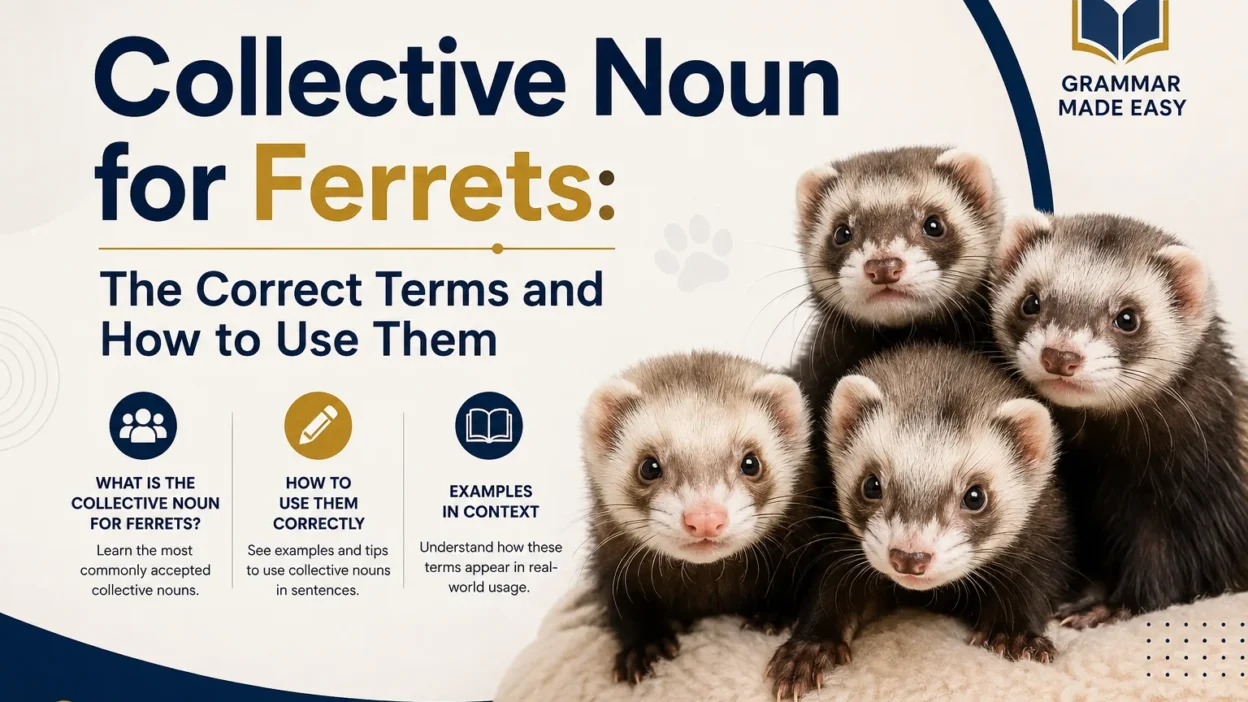
The collective noun for ferrets is business, a traditional term for a group of these small, active mammals known for their playful, curious, and energetic nature. The expression a business of ferrets gives the animals a special name and makes your English more expressive and distinctive.
Ferrets often explore their surroundings together, using their quick movements and lively behavior as they investigate new spaces. Their fascinating nature makes them interesting animals to observe, and learning this unusual collective noun can introduce you to remarkable facts about their habits and everyday behavior.
The phrase a business of ferrets has a long tradition in English animal vocabulary. This specialized term can be used alongside the ordinary phrase a group of ferrets, which simply describes several animals together. When writing sentences, you can also discuss their physical characteristics, lifespan, and diet to provide a clearer description of these fascinating animals.
Why Collective Nouns Are Used for Ferrets
Collective nouns give groups of animals memorable names. They can describe a group as a single unit and sometimes reflect traditional observations about an animal’s behavior or appearance.
Ferrets are members of the mustelid family, which also includes weasels, otters, badgers, and mink. Domestic ferrets are generally social and curious animals. They spend much of their time exploring, playing, sleeping, and interacting with their surroundings.
The traditional expression business of ferrets is especially distinctive. It gives a group of ferrets a memorable identity instead of using only the general phrase group. Although collective nouns can vary in how frequently people use them, business is the recognized traditional term most commonly associated with ferrets.
Collective Nouns for Ferrets
| Collective Noun | Used For | Simple Example |
| Business | A group of ferrets | A business of ferrets played in the room. |
| Group | A general collection of ferrets | A group of ferrets explored the enclosure. |
The traditional collective noun is:
A business of ferrets
Example: A business of ferrets explored the garden.
Unlike some animal collective nouns that are commonly heard in everyday conversation, the business of ferrets is more unusual. You may encounter it in vocabulary lists, animal books, educational materials, or writing about unusual collective nouns.
Business of Ferrets
A business is the traditional collective noun for a group of ferrets. The phrase a business of ferrets can describe several ferrets gathered together.
The expression is memorable because the word business normally refers to work, trade, or an organization. When it is used with ferrets, however, it has a completely different role as a traditional collective noun.
Examples of “Business of Ferrets”
- A business of ferrets played together.
- We watched a business of ferrets exploring the enclosure.
- A business of ferrets raced through the tunnel.
- The business of ferrets became active in the afternoon.
- A business of ferrets investigated the new toys.
- The keeper observed a business of ferrets.
- A business of ferrets explored every corner of the room.
- The business of ferrets rested after playing.
- A business of ferrets moved through the enclosure.
- We saw a business of ferrets playing together.
Group of Ferrets
Group is a general word that can be used for any collection of ferrets. It isn’t as distinctive as business, but it is simple, natural, and easy for everyone to understand.
In everyday conversation, saying a group of ferrets may sound more familiar than the traditional expression. However, if you’re specifically looking for the traditional collective noun, a business of ferrets is the answer.
Examples of “Group of Ferrets”
- A group of ferrets explored the room.
- We saw a group of ferrets near the enclosure.
- The group of ferrets played with a toy.
- A group of ferrets slept together.
- The group of ferrets became active after resting.
- A group of ferrets moved through the tunnel.
- The keeper watched a group of ferrets.
- A group of ferrets investigated the new surroundings.
- The group of ferrets gathered near the food.
- A group of ferrets returned to their shelter.
How to Use “Business of Ferrets” in a Sentence
The phrase a business of ferrets works like other collective noun expressions. The word business names the group, while of ferrets tell you which animals make up the group.
The basic structure is:
a business + of + ferrets
Example: A business of ferrets was playing in the enclosure.
When you focus on the group as one unit, a singular verb can be used.
Example: A business of ferrets was resting in the shelter.
If you focus on the individual ferrets, you can simply use the plural noun ferrets.
Example: The ferrets were playing in the enclosure.
This distinction is useful because collective nouns can sometimes be treated as singular or plural depending on whether the group is viewed as one unit or as individual members.
Examples of Correct Usage
- A business of ferrets was exploring the enclosure.
- A business of ferrets was resting together.
- A business of ferrets was playing with toys.
- The ferrets were exploring the enclosure.
- The ferrets were sleeping together.
- The ferrets were running through the tunnel.
- A business of ferrets was moving around the room.
- The ferrets were investigating their surroundings.
- A business of ferrets was gathered near the shelter.
- The ferrets were returning to their sleeping area.
Ferret Behavior and Social Life
Ferrets are known for their curiosity, playfulness, and energetic behavior. Domestic ferrets often enjoy interacting with people and other ferrets, especially when they have enough space and opportunities for exploration.
Play is an important part of ferret behavior. Ferrets may chase one another, wrestle, jump, investigate objects, and move rapidly around their environment. Their playful behavior can make a group of ferrets particularly entertaining to watch.
Ferrets also spend a considerable amount of time sleeping. They can sleep for many hours each day, although they become active during periods when they’re awake. Their activity often involves exploring and investigating objects around them.
One interesting behavior is sometimes called the “weasel war dance.” A ferret may hop, twist, jump, and move energetically when excited or playful. Despite its dramatic name, this behavior is often associated with excitement and play rather than actual aggression.
Ferrets are also natural explorers. Their long, flexible bodies allow them to investigate narrow spaces and tunnels. This ability is connected to their ancestry and the hunting behavior of their wild relatives.
Examples of Ferret Behavior
- Ferrets are naturally curious.
- Ferrets enjoy exploring their surroundings.
- Ferrets can be highly playful.
- Ferrets often interact with other ferrets.
- Ferrets may chase one another during play.
- Ferrets can sleep for many hours.
- Ferrets enjoy investigating tunnels.
- Ferrets have flexible, elongated bodies.
- Excited ferrets may perform playful jumps and twists.
- Ferrets use their environment as a place for exploration and play.
Interesting Facts About Ferrets
Ferrets are small mammals belonging to the mustelid family. Domestic ferrets are descended from the European polecat and have been associated with humans for centuries. Their long, narrow bodies and short legs give them a distinctive appearance. Their flexible shape is particularly useful for moving through tunnels and narrow spaces.
Ferrets generally have a lifespan of around 5 to 9 years, although individual lifespan can vary depending on genetics, nutrition, healthcare, living conditions, and other factors. Providing appropriate veterinary care, a suitable diet, safe housing, and regular mental stimulation can support their overall health and well-being.
One of the most noticeable physiological features of a ferret is its long, flexible body. Ferrets have short legs and a relatively elongated torso, making them well suited to exploring confined spaces. Their strong sense of smell also plays an important role in how they investigate their environment. Their sharp teeth and claws reflect their carnivorous ancestry.
Ferrets are obligate carnivores, meaning their natural nutritional needs are based primarily on animal-derived food. In the wild, their relatives consume prey such as small mammals and other animals. Domestic ferrets require food formulated to meet their specific nutritional requirements, with adequate animal protein and fat. Unlike omnivorous pets, ferrets aren’t naturally adapted to obtain their nutrition primarily from plant-based foods.
Their digestive systems are also adapted to a meat-based diet. Ferrets have a relatively short digestive tract and fast metabolism, which means they may eat small amounts frequently throughout the day. Fresh water should always be available to domestic ferrets.
Ferrets are also famous for their ability to investigate almost anything around them. Their intelligence and curiosity mean that owners need to provide safe enrichment, including appropriate toys, tunnels, supervised play areas, and opportunities to explore.
Quick Ferret Facts
- Ferrets are small mammals.
- They belong to the mustelid family.
- The traditional collective noun is a business of ferrets.
- Ferrets are related to animals such as weasels and otters.
- Ferrets have long, flexible bodies.
- Ferrets are naturally curious and playful.
- Ferrets can sleep for many hours each day.
- Ferrets are obligate carnivores.
- Their natural diet is based primarily on animal matter.
- Ferrets have a strong sense of smell.
- Their flexible bodies help them explore narrow spaces.
- Domestic ferrets generally live around 5 to 9 years.
Read More: Collective Noun for Geese: Complete Guide to Group Names, and Examples
Conclusion
The collective noun for ferrets is a business of ferrets, a traditional and distinctive expression in English. While a group of ferrets is perfectly clear in everyday writing, a business gives you a more specific way to describe several ferrets together. Knowing this unusual collective noun can make your vocabulary more varied and help you describe these playful animals with greater precision.
FAQs
Q1. What is the collective noun for ferrets?
The most commonly recognized collective noun for ferrets is a business. You can say, “A business of ferrets was exploring the area.”
Q2. Why are ferrets called a business?
Business is a traditional collective term found in English animal vocabulary. Its unusual use with ferrets has been preserved as a distinctive group name.
Q3. What is a group of ferrets called?
A group of ferrets can be called a business of ferrets. You can also simply say a group of ferrets in ordinary conversation.
Q4. Is “a business of ferrets” grammatically correct?
Yes. A business of ferrets is grammatically correct when business is used as a collective noun for several ferrets.
Q5. Can I use “group of ferrets” instead?
Yes. A group of ferrets is completely understandable and natural. The term a business of ferrets is more specialized and traditional.
Q6. Are ferrets social animals?
Ferrets can be social and often enjoy interacting with other ferrets. Their playful nature may include chasing, wrestling, and exploring together.
Q7. What makes ferrets interesting animals?
Ferrets are known for their curious, playful, and energetic behavior. Their quick movements and habit of investigating their surroundings make them fascinating to observe.
Q8. What do ferrets eat?
Ferrets are carnivorous animals and naturally require a diet based largely on animal protein and fat. A suitable ferret diet should meet their specific nutritional needs.
Q9. How can I use “a business of ferrets” in a sentence?
You could write: “A business of ferrets was playing together in the enclosure.” Here, business refers to the entire group.
Q10. Is “business” the only collective noun for ferrets?
A business of ferrets is the traditional specialized expression, but a group of ferrets can also be used when you simply want to describe several ferrets together.