The Collective Noun for Cattle helps describe several cows, bulls, calves, or other domesticated bovines together in simple, natural English. When writing about animals, I find that choosing the right term makes an animal description clearer and avoids repeating groups of cattle.
In everyday English, cattle refers to cows, bulls, calves, and other domesticated bovines, while a group of these animals can be described using different collective nouns. Students, writers, and farmers may use these terms when they need to describe animals clearly, whether they are talking about animals on a farm or explaining them in general English.
The choice of collective noun can change with particular situations and the type of descriptive expressions being used. Some common terms and expressions are natural in everyday usage, while others add a more specific meaning to animal terminology. In my experience, using a right collective noun where it fits makes the description more useful, natural, and interesting, especially when discussing a group of cattle together.
Why Are Collective Nouns Used for Cattle?
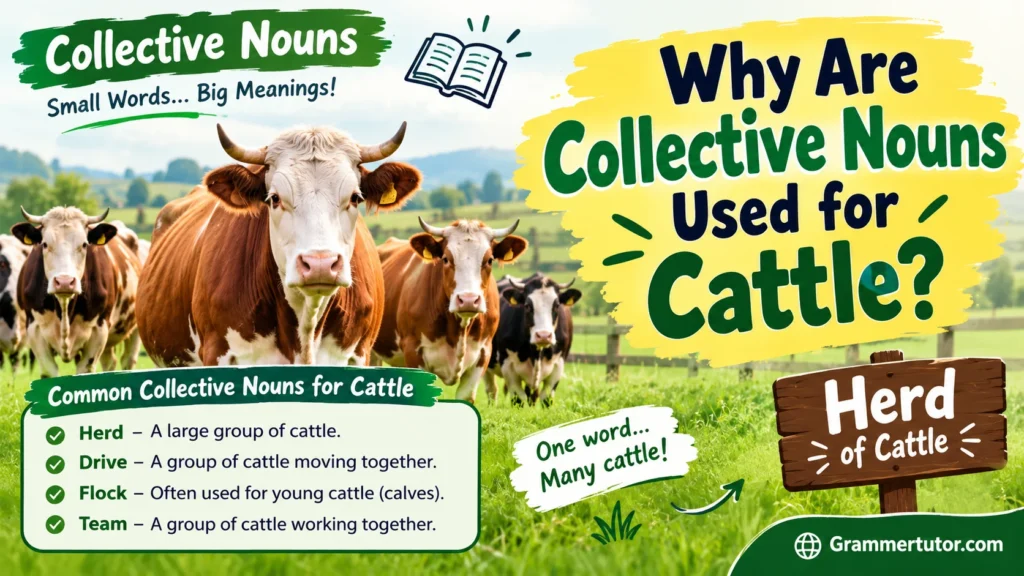
A collective noun is a word that describes a group of similar animals or people as one unit. With cattle, these words help us describe a group without repeating the word “cattle” in every sentence.
For example, herd is the most familiar collective noun for cattle. Instead of saying, “A group of cattle was grazing in the field,” you can say, “A herd of cattle was grazing in the field.”
These expressions also help add variety to writing. A farmer may talk about a herd, while a writer describing cattle being driven along a road may use a term that reflects their movement or situation.
Collective Nouns for Cattle
The following table shows some useful collective nouns associated with cattle:
| Collective Noun | Used For | Simple Example |
| Herd | A group of cattle | A herd of cattle grazed in the meadow. |
| Drove | Cattle being driven or moved together | A herd of cattle crossed the road. |
| Fold | Cattle kept together in an enclosed place | The cattle were gathered in a fold. |
| Mob | A large or loosely gathered group of cattle | A mob of cattle moved across the pasture. |
| Team | Cattle working together, especially draft animals | A team of cattle pulled the cart. |
| Yoke | Cattle paired or joined for work | A yoke of cattle pulled the plow. |
| Drift | A group of cattle moving or being driven together | A drift of cattle moved toward the barn. |
Among these, herd is by far the most familiar and widely used expression for a group of cattle.
Herd of Cattle
Herd is the most common and natural collective noun for cattle. It can describe cows, bulls, calves, and other cattle living, grazing, or moving together.
You can use a herd of cattle in everyday conversation, farming discussions, stories, and educational writing. The word doesn’t depend on whether the cattle are inside a pasture or moving from one location to another.
Examples of “Herd of Cattle”
- A herd of cattle was grazing in the green field.
- The farmer counted his herd of cattle before sunset.
- A large herd of cattle gathered near the water.
- We saw a herd of cattle beside the road.
- The herd of cattle moved slowly across the pasture.
- A herd of cattle rested under the trees.
- The farmer guided the herd of cattle toward the barn.
- The herd of cattle remained together during the storm.
- Several calves were walking with the herd of cattle.
- The rancher watched the herd of cattle from a distance.
Drove of Cattle
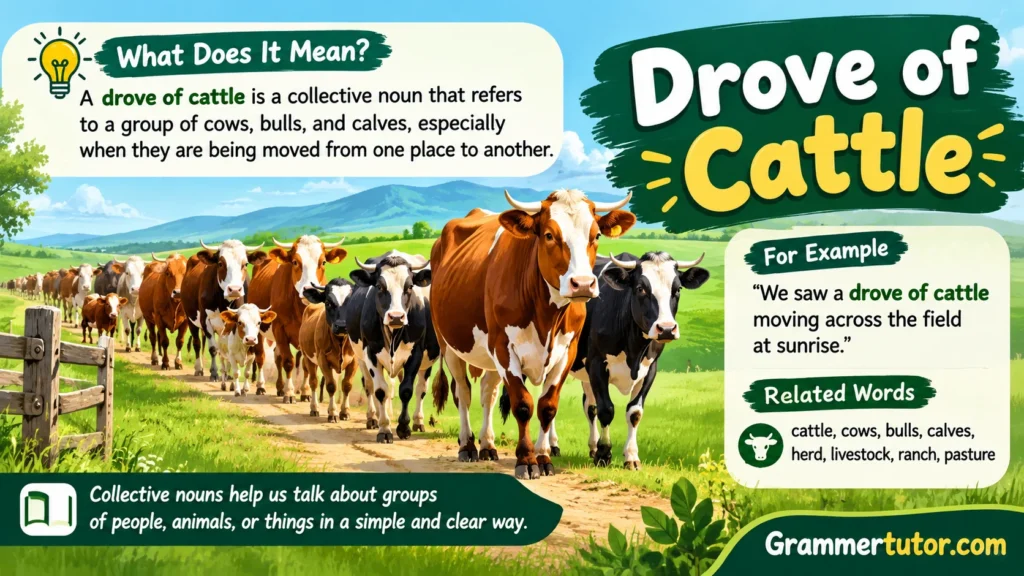
Drove is another collective term associated with cattle, especially when the animals are being driven or moved from one place to another. The word focuses more on the movement of the animals than simply their existence as a group.
For example, cattle being taken along a road, trail, or pasture can be described as a drive of cattle.
Examples of “Drove of Cattle”
- A drove of cattle traveled along the country road.
- The farmer led a drive of cattle toward the market.
- We watched a drove of cattle move across the valley.
- A drove of cattle approached the farm gate.
- The workers guided the drove of cattle into the pasture.
- A drove of cattle passed through the village.
- The rancher controlled the drove of cattle with the help of his dogs.
- The drove of cattle continued toward the next field.
- A large drove of cattle was being moved before nightfall.
- The farmer stopped the drove of cattle near the water trough.
Fold of Cattle
Fold can refer to a group of animals kept together in an enclosed area. With cattle, the term can be used when the animals are gathered or confined in a particular enclosure.
The word is especially useful when describing cattle that have been brought together for safety, management, or care.
Examples of “Fold of Cattle”
- The farmer brought the fold of cattle into the enclosure.
- A fold of cattle rested safely behind the fence.
- The workers checked the fold of cattle before feeding them.
- The fold of cattle remained near the shelter.
- The farmer opened the gate for the fold of cattle.
- A fold of cattle was gathered near the farmyard.
- The animals were placed in a fold of cattle for the night.
- The farmer inspected the fold of cattle early in the morning.
- The fold of cattle stayed together during the cold weather.
- The workers moved the fold of cattle to another enclosure.
Mob of Cattle
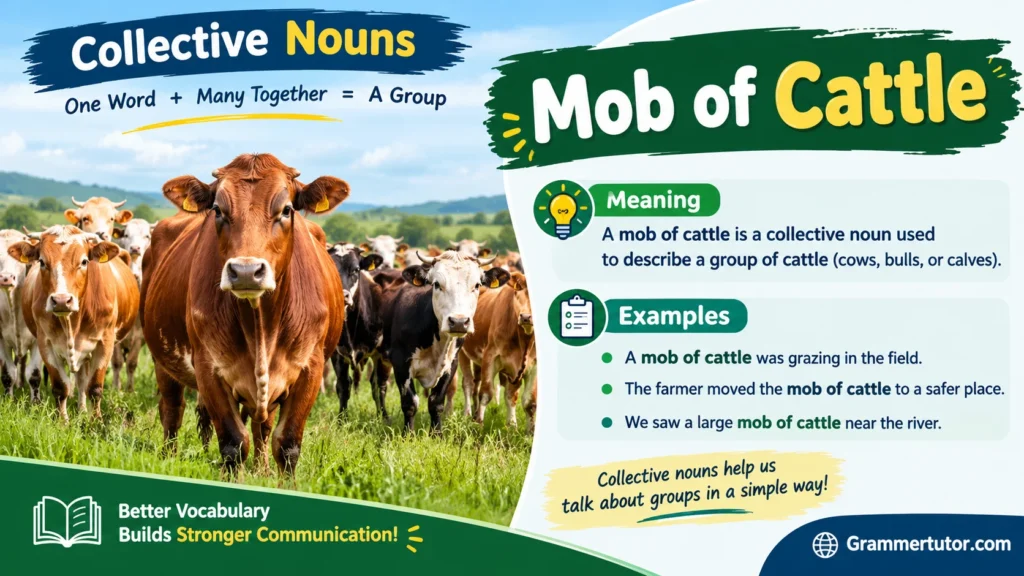
Mob can describe a large, loosely gathered group of cattle. It is more informal and less common than herd, but it can appear in farming contexts, particularly when many cattle are managed together.
The word emphasizes the size or somewhat loose organization of the group rather than a particular breed or type of cattle.
Examples of “Mob of Cattle”
- A mob of cattle moved across the open pasture.
- The rancher watched the mob of cattle from the hill.
- A large mob of cattle gathered near the water.
- The workers separated the mob of cattle into smaller groups.
- The mob of cattle crossed the field at sunrise.
- A mob of cattle wandered toward the fence.
- The farmer brought the mob of cattle back before dark.
- The mob of cattle spread across the wide pasture.
- Several calves remained in the middle of the mob of cattle.
- The rancher guided the mob of cattle toward fresh grass.
Team of Cattle
A team of cattle refers to cattle working together, particularly animals trained to perform tasks such as pulling a cart, wagon, or plow.
This term is different from herd because it focuses on the animals’ role as working animals. Cattle have historically been used as draft animals in many farming communities.
Examples of “Team of Cattle”
- A team of cattle pulled the wooden cart.
- The farmer trained a team of cattle for farm work.
- A strong team of cattle helped prepare the field.
- The team of cattle pulled the heavy load.
- The farmer guided the team of cattle across the field.
- A team of cattle worked together to move the wagon.
- The old farmer relied on his team of cattle.
- The team of cattle stopped near the barn.
- Two farmers worked with a team of cattle.
- The team of cattle slowly pulled the plow through the soil.
Yoke of Cattle
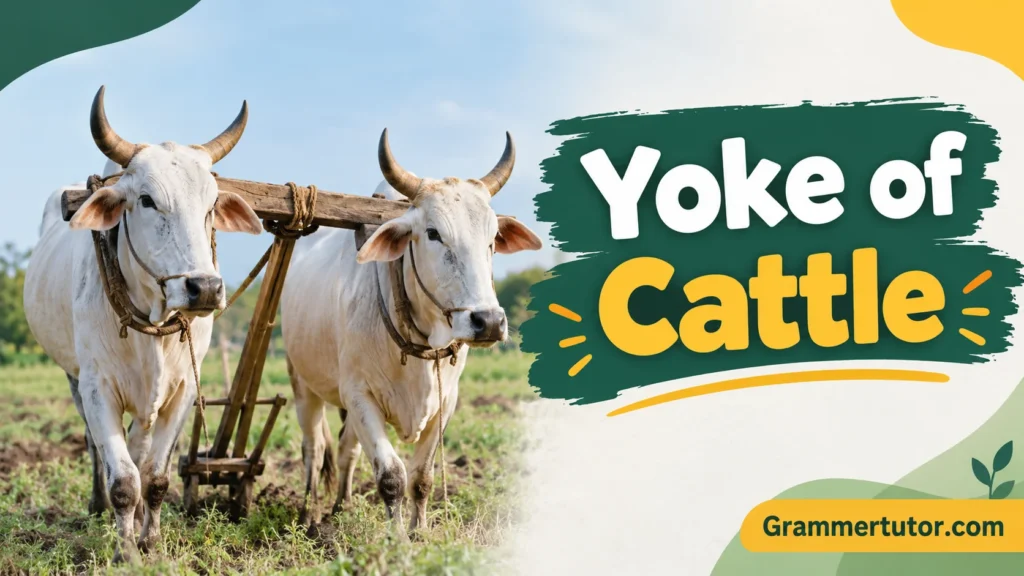
A yoke traditionally refers to a pair of cattle joined together for work. The animals are connected by a wooden or similar device called a yoke, allowing them to pull equipment or loads together.
Therefore, a yoke of cattle is especially appropriate when talking about two cattle working as a pair.
Examples of “Yoke of Cattle”
- A yoke of cattle pulled the farmer’s plow.
- The farmer prepared a yoke of cattle for the day’s work.
- A strong yoke of cattle moved the heavy cart.
- The yoke of cattle worked steadily across the field.
- The farmer guided the yoke of cattle along the furrow.
- A yoke of cattle stood beside the wooden wagon.
- The farmer rested his yoke of cattle after several hours of work.
- The yoke of cattle helped prepare the farmland.
- A trained yoke of cattle could pull heavy equipment.
- The farmer carefully selected a yoke of cattle for the task.
Drift of Cattle
Drift can be used as a descriptive collective term for cattle moving or being driven together. It highlights the group’s movement, particularly when cattle travel across an open area.
It isn’t as common in modern everyday English as herd, but it can add variety to descriptive or agricultural writing.
Examples of “Drift of Cattle”
- A drift of cattle moved toward the distant pasture.
- The rancher watched the drift of cattle from the fence.
- A drift of cattle crossed the open field.
- The farmer guided the drift of cattle toward the barn.
- The drift of cattle slowly moved through the valley.
- We saw a drift of cattle near the hillside.
- The workers followed the drift of cattle along the trail.
- A drift of cattle gathered near the water.
- The drift of cattle moved toward the greener grass.
- The rancher brought the drift of cattle back before sunset.
How Do Cattle Behave as a Group?
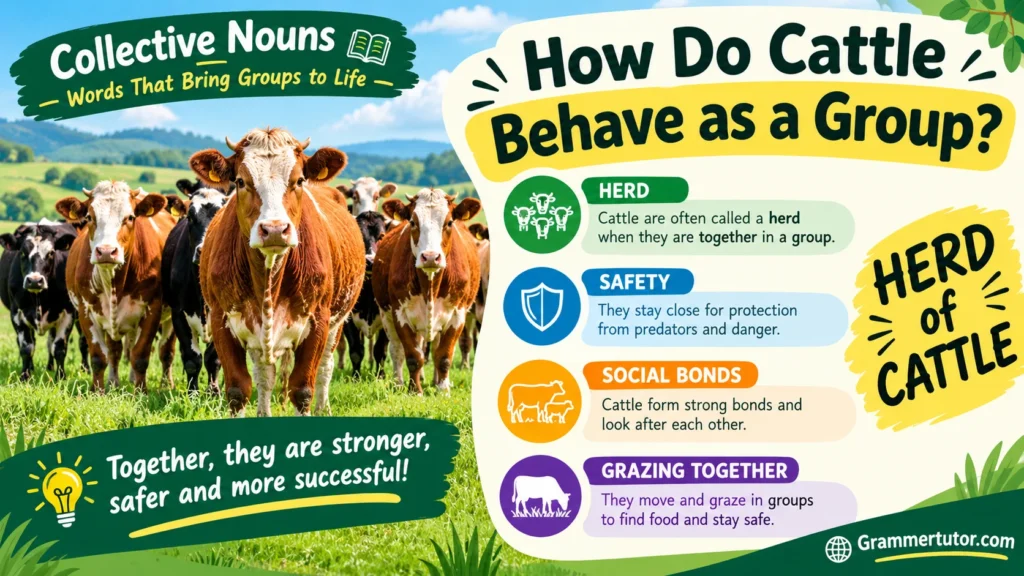
Cattle are social animals that naturally spend time around other members of their species. They often graze together, rest together, and move between feeding and watering areas as a group.
A herd can also develop a social structure in which individual animals recognize one another and respond to changes in their surroundings. Calves often stay close to adult cattle, while the group may move together when searching for food or water.
Group living can provide practical benefits. When several cattle stay together, they can respond collectively to changes in weather, unfamiliar surroundings, or possible threats. Their social behavior is one reason herd remains such a useful word when describing cattle.
Interesting Facts About Cattle
Cattle are fascinating domesticated animals with a long relationship with humans. Depending on breed and management, cattle can live for many years, and their bodies are specially adapted for grazing. Their digestive system allows them to process fibrous plant material through a complex process of fermentation. Cattle are also ruminants, which means they bring partially digested food back up and chew it again as cud. Their diet mainly consists of grasses, hay, and other plant-based feeds, although their exact diet depends on farming practices and available forage. Cattle also have a strong sense of smell and can recognize familiar individuals. Calves develop close relationships with their mothers, while adult cattle often maintain social connections within the group. These physical and social characteristics make cattle important not only in agriculture but also in the study of animal behavior.
Herd vs. Drove: What Is the Difference?
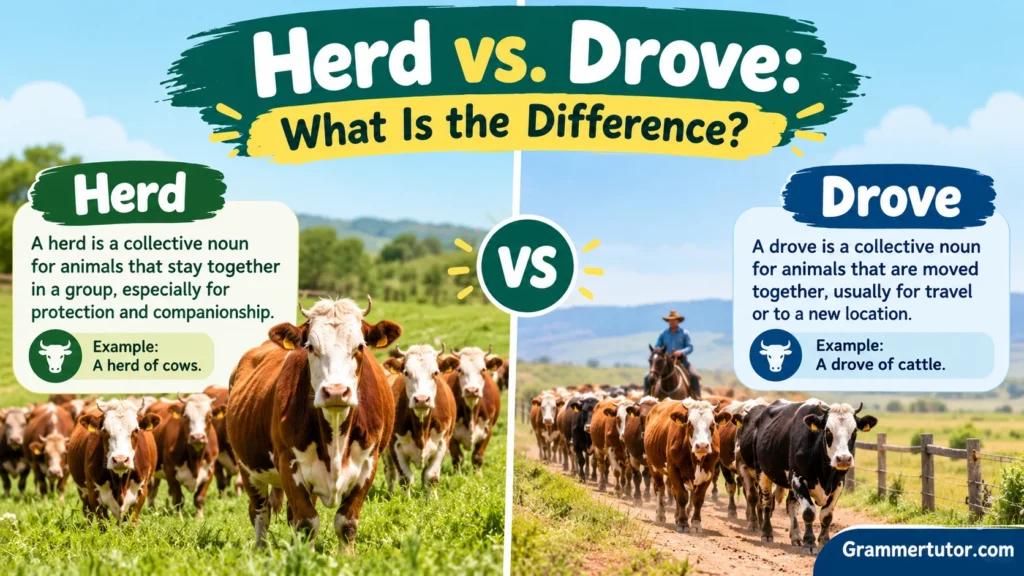
Although herd and drive can both describe groups of cattle, they don’t emphasize exactly the same situation.
Herd is the general term. You can use it when cattle are grazing, resting, standing together, or simply being discussed as a group.
Drove, on the other hand, puts more attention on cattle that are being driven or moved from one place to another.
For example:
- A herd of cattle grazed in the field.
- A drove of cattle was taken to the market.
When you’re unsure which term to choose, a herd of cattle is usually the safest and most natural choice.
Why Is “Herd” the Best Collective Noun for Cattle?
The word herd is the best general answer because it is widely understood and naturally describes cattle as a group. It works in everyday speech, educational writing, farming discussions, and general descriptions.
Other expressions have narrower meanings. Drove emphasizes movement, team emphasizes working cattle, and yoke usually refers to a pair working together.
So, if someone asks, “What is the collective noun for cattle?”, the simple answer is:
A herd of cattle.
READ MORE: Collective Nouns for Antelope: A Complete Guide with Examples
Conclusion
The Collective Noun for Cattle helps us describe a group of cattle in a clear and natural way. Cattle may include cows, bulls, calves, and other domesticated bovines. Choosing suitable collective terms can make everyday English and animal descriptions more interesting and precise.
FAQs
Q1. What is the collective noun for cattle?
A herd is the most common collective noun used for a group of cattle.
Q2. What is a group of cattle called?
A group of cattle is commonly called a herd of cattle.
Q3. Can cattle include cows and bulls?
Yes. Cattle is a general term that can include cows, bulls, calves, and other domesticated bovines.
Q4. What is the most common term for a group of cows?
A herd of cows is a common and natural expression.
Q5. Can I use “group of cattle” in English?
Yes. The group of cattle is clear and grammatically understandable, although the herd of cattle is more specific.
Q6. Why are collective nouns useful for cattle?
Collective nouns help writers describe several animals together without repeatedly listing each animal.
Q7. Is “herd” suitable for cattle?
Yes. Herd is widely used for cattle and is one of the most familiar collective nouns for these animals.
Q8. Can students use collective nouns for cattle?
Yes. Learning collective nouns helps students improve their vocabulary and write clearer sentences about animals.
Q9. Can “cattle” refer to calves?
Yes. Cattle can be used as a general term that includes calves, although “calf” specifically refers to a young bovine.
Q10. How can I use a collective noun for cattle in a sentence?
You can write: “A herd of cattle was grazing in the field.” This clearly shows that several cattle were together.