
A Collective Noun for Peasants describes people who work together in agriculture, cultivate land, and support rural communities through farming and shared activities. In everyday writing, a community of peasants describes people living and working together, while a gathering of peasants refers to people meeting in one place.
You can use a workforce of peasants when discussing agricultural work, crop production, and livestock raising. In my experience, choosing the right expression makes descriptions clearer and helps English learners improve their vocabulary.
These expressions also show the historical importance and social role of peasants in traditional communities. Their work supports local economies, strengthens farming communities, and contributes to rural life. Using suitable collective nouns in simple example sentences makes writing more natural, informative, and engaging.
Why Are Collective Nouns Used for Peasants?

A collective noun is a word used to describe several people, animals, or things as one group. For peasants, collective nouns help writers describe people who share a community, occupation, or activity without repeatedly using phrases such as “many peasants” or “a group of peasants.”
Peasants have traditionally worked together during planting, harvesting, irrigation, and other agricultural activities. In many rural communities, neighbors also share knowledge, tools, and labor to complete demanding tasks. These shared activities make collective expressions useful when describing their lives.
For example, instead of writing, “A group of peasants gathered to harvest the wheat,” you could write, “A workforce of peasants gathered to harvest the wheat.” The second sentence emphasizes their shared work.
Collective expressions can make stories, historical accounts, school assignments, and articles about rural communities more descriptive. However, not every expression is a fixed or traditional collective noun. Some are ordinary phrases that describe a group in a particular situation.
Collective Nouns for Peasants
Here are several useful collective expressions for peasants. The best choice depends on whether you want to emphasize their community, gathering, or shared work.
| Collective Noun | Used For | Simple Example |
| Community | Peasants living in the same area | A community of peasants worked together. |
| Group | Peasants gathered together | A group of peasants walked toward the fields. |
| Gathering | Peasants meeting in one place | A gathering of peasants discussed the harvest. |
| Workforce | Peasants working together | A workforce of peasants harvested the crops. |
| Team | Peasants cooperating on a task | A team of peasants planted the seeds. |
| Assembly | Peasants meeting for a discussion | An assembly of peasants discussed irrigation. |
| Crowd | A large number of peasants gathered together | A crowd of peasants gathered in the village square. |
Note: Unlike traditional animal collective nouns, there is no single universally recognized special collective noun for peasants. Group is the most general choice, while the other expressions emphasize specific social situations or activities.
Community of Peasants
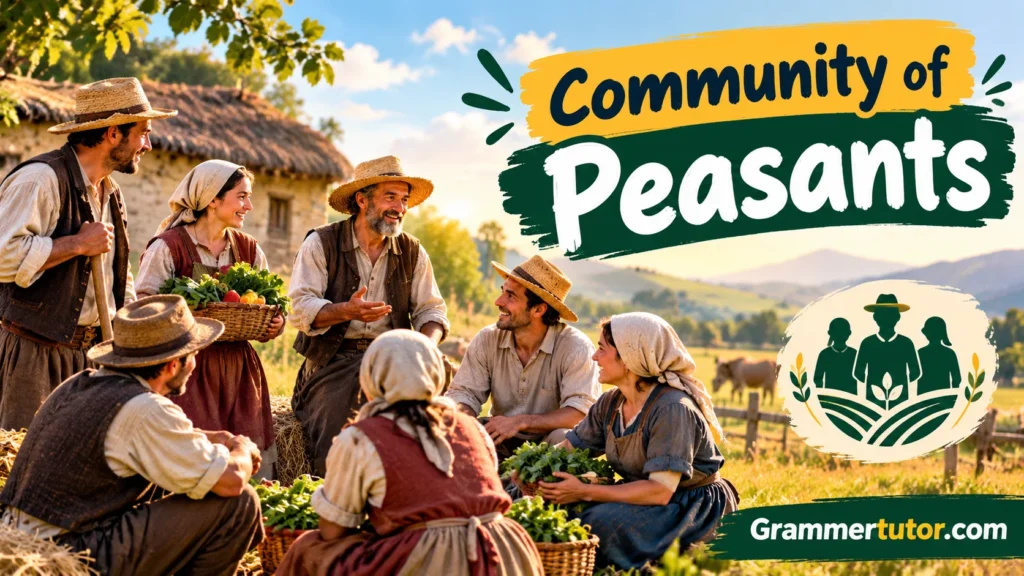
Community describes peasants who live in the same village or rural area and share aspects of daily life. They may have similar occupations, traditions, local resources, or cultural practices.
This expression works particularly well when discussing village life, agricultural traditions, and relationships among rural families. It emphasizes a shared social environment rather than simply the number of people.
Examples of “Community of Peasants”
- A community of peasants worked together during the harvest.
- The community of peasants depended on farming for its livelihood.
- A community of peasants celebrated the end of the planting season.
- The community of peasants shared water from a local well.
- A community of peasants prepared the fields for spring.
- The community of peasants gathered to discuss local problems.
- A community of peasants maintained its traditional farming practices.
- The community of peasants welcomed visitors to the village.
- A community of peasants helped repair damaged irrigation channels.
- The community of peasants worked hard to produce healthy crops.
Group of Peasants
Group is the simplest and most widely understood expression for several peasants together. It works in almost any context, including everyday conversations, historical writing, educational articles, and stories about rural life.
Unlike more specific terms, group does not suggest that the people are working, meeting, or living in the same community. It simply describes several people considered together.
Examples of “Group of Peasants”
- A group of peasants walked toward the fields.
- The group of peasants gathered beside the village well.
- A group of peasants planted seeds in the morning.
- We saw a group of peasants carrying baskets of vegetables.
- The group of peasants discussed the coming harvest.
- A group of peasants worked together in the rice fields.
- The group of peasants rested beneath a large tree.
- A group of peasants visited the local market.
- The group of peasants repaired a fence around the farmland.
- A group of peasants returned home after a long day.
Gathering of Peasants
Gathering describes peasants who come together in one place for a particular reason. They might meet to discuss agricultural issues, celebrate a local festival, share information, or solve a community problem.
This expression emphasizes the act of meeting rather than a permanent community or a working team. It is particularly useful in stories and descriptions of village events.
Examples of “Gathering of Peasants”
- A gathering of peasants took place in the village square.
- The gathering of peasants discussed the price of wheat.
- A gathering of peasants celebrated the successful harvest.
- The gathering of peasants listened to the village elder.
- A gathering of peasants shared ideas about irrigation.
- The gathering of peasants began early in the afternoon.
- A gathering of peasants discussed how to protect their crops.
- The gathering of peasants welcomed a visiting agricultural expert.
- A gathering of peasants organized a village celebration.
- The gathering of peasants ended after everyone shared their views.
Workforce of Peasants
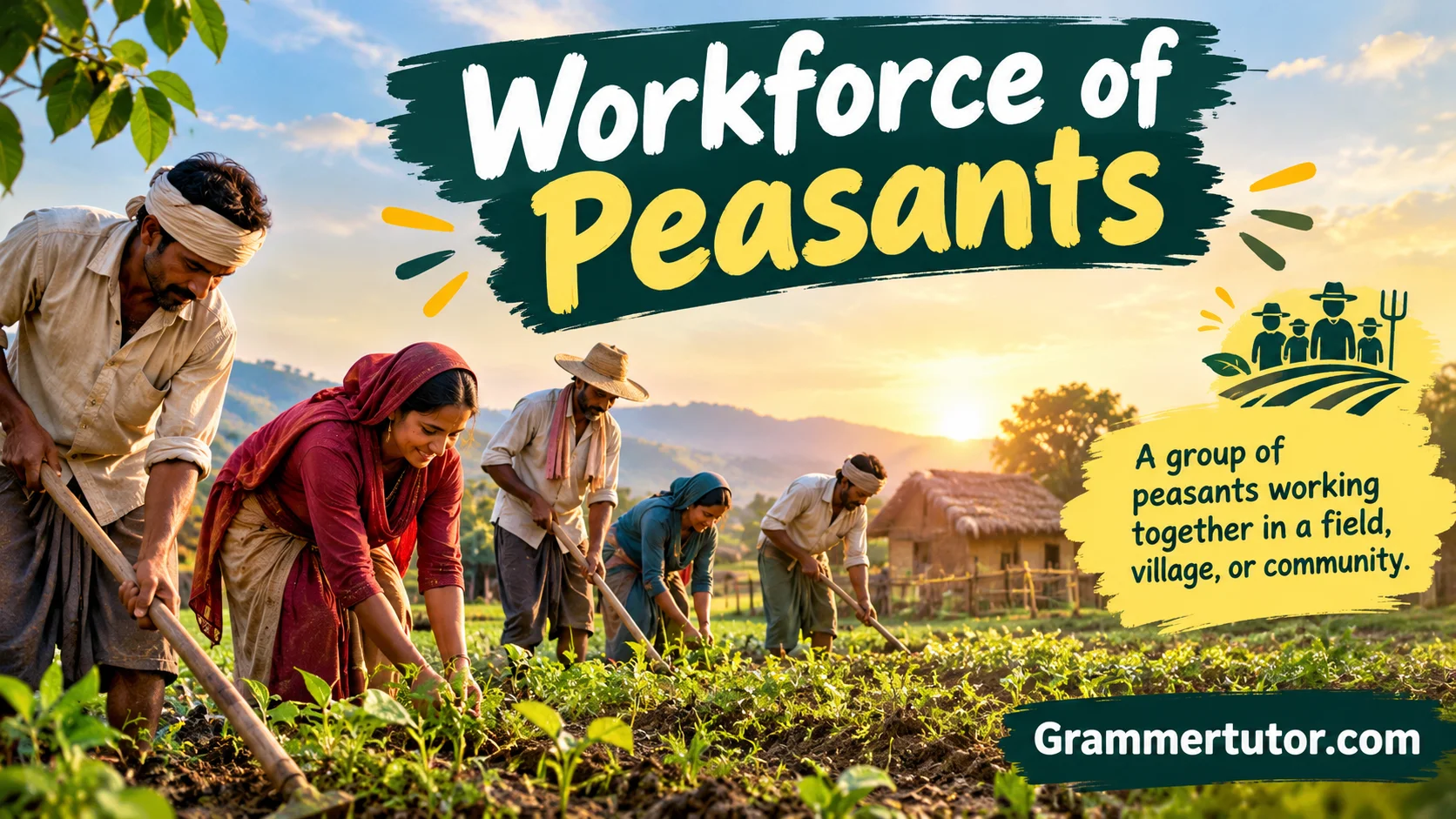
Workforce describes people who perform work together or contribute labor to an activity. When discussing peasants, this expression is useful for describing agricultural labor, crop production, and other farming tasks.
Peasants have historically contributed to food production through activities such as planting, weeding, harvesting, and tending livestock. The term workforce highlights their economic and practical contributions.
Examples of “Workforce of Peasants”
- A workforce of peasants harvested the wheat before sunset.
- The workforce of peasants prepared the soil for planting.
- A workforce of peasants gathered vegetables from the fields.
- The workforce of peasants repaired the irrigation channels.
- A workforce of peasants planted rice during the rainy season.
- The workforce of peasants worked carefully to protect young crops.
- A workforce of peasants cleared weeds from the farmland.
- The workforce of peasants carried the harvest to storage.
- A workforce of peasants helped restore damaged fields.
- The workforce of peasants completed the day’s agricultural tasks.
Team of Peasants
Team describes peasants cooperating to complete a shared task. For example, a small team might plant seedlings, repair a fence, collect vegetables, or prepare a field for cultivation.
The word emphasizes cooperation and a shared goal. It is especially useful when describing organized agricultural work rather than a general population of rural people.
Examples of “Team of Peasants”
- A team of peasants planted seeds in the field.
- The team of peasants repaired a broken fence.
- A team of peasants collected ripe tomatoes.
- The team of peasants prepared the land for wheat.
- A team of peasants carried baskets of fresh produce.
- The team of peasants worked together to clean an irrigation ditch.
- A team of peasants planted vegetables near the village.
- The team of peasants gathered hay for the livestock.
- A team of peasants finished harvesting before the rain.
- The team of peasants shared their tools and knowledge.
Assembly of Peasants
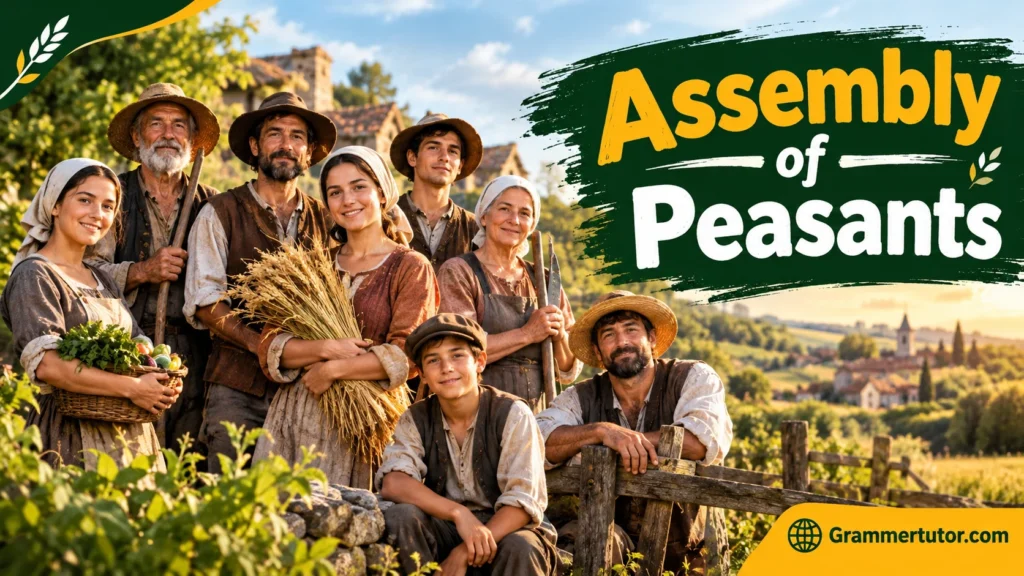
Assembly refers to a group of people who come together for a meeting or organized discussion. In a rural setting, an assembly of peasants might discuss land use, water supplies, crop prices, or local concerns.
This expression sounds more formal than group or gathering. It is useful in historical writing or descriptions of organized meetings, but it does not specifically refer to peasants as an occupation.
Examples of “Assembly of Peasants”
- An assembly of peasants discussed the village’s water supply.
- The assembly of peasants met near the community hall.
- An assembly of peasants considered new farming methods.
- The assembly of peasants listened to the local leader.
- An assembly of peasants discussed the distribution of farmland.
- The assembly of peasants shared concerns about crop prices.
- An assembly of peasants planned improvements to the irrigation system.
- The assembly of peasants welcomed a representative from the village council.
- An assembly of peasants agreed to repair the shared well.
- The assembly of peasants ended after a productive discussion.
Crowd of Peasants
Crowd describes a large number of people gathered in one place. It can describe peasants attending a public meeting, visiting a market, participating in a celebration, or responding to an important event.
Unlike community, which suggests an ongoing social connection, crowd focuses on the number of people present in a particular location. It is a general expression rather than a special collective noun for peasants.
Examples of “Crowd of Peasants”
- A crowd of peasants gathered in the village square.
- The crowd of peasants watched the harvest festival.
- A crowd of peasants visited the weekly market.
- The crowd of peasants listened to an announcement.
- A crowd of peasants gathered near the town hall.
- The crowd of peasants celebrated a successful farming season.
- A crowd of peasants waited outside the grain market.
- The crowd of peasants watched a traditional village performance.
- A crowd of peasants discussed the rising cost of seeds.
- The crowd of peasants slowly dispersed after the meeting.
How Peasants Work and Live in Communities
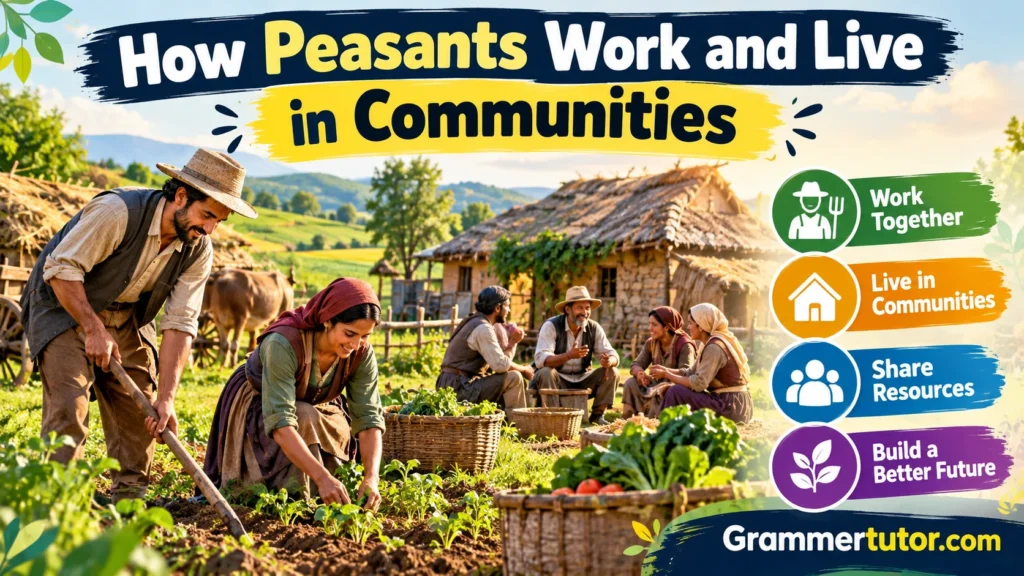
Peasants have played an important role in agricultural societies for centuries. Their work has traditionally included cultivating fields, growing crops, raising livestock, and maintaining the resources needed for rural life. In many places, farming families have passed down practical knowledge about soil, weather, seeds, and seasonal changes from one generation to the next.
Cooperation has often helped rural communities manage demanding tasks. Neighbors may exchange labor during planting and harvesting, share access to irrigation systems, or help one another after storms and crop failures. These practices vary across cultures and historical periods, but they show why words such as community, team, and workforce can be useful when describing people working together.
The word peasant also has a historical meaning. It often refers to a rural agricultural worker or small-scale farmer, particularly in historical societies where land ownership and social class shaped people’s lives. Today, the word can sound old-fashioned or carry social or economic implications. Depending on the context, farmer, agricultural worker, or rural worker may be more appropriate.
Interesting Facts About Peasants
Peasants have contributed significantly to the development of agriculture and the growth of human settlements. In many historical societies, they produced much of the food that sustained towns, cities, and ruling institutions. Their daily lives often followed seasonal patterns, with planting, irrigation, weeding, and harvesting shaped by local weather and soil conditions. Traditional farming communities developed practical knowledge about crop rotation, seed selection, animal care, and water management, passing these skills from one generation to the next. However, peasants’ living conditions differed greatly across regions and periods. Some owned or rented small plots of land, while others worked land controlled by landlords and faced rents, taxes, or other obligations. Today, rural agricultural workers continue to contribute to food production, although modern farming increasingly combines traditional knowledge with machinery, improved seeds, irrigation technology, and scientific methods. Understanding these differences helps us discuss peasants accurately rather than treating all rural workers as one identical group. It also shows how collective expressions such as community, gathering, and workforce can describe different aspects of rural society.
Conclusion
A collective noun for peasants helps you describe people who work together in agriculture, cultivate land, and support rural communities. Expressions such as a community of peasants, a gathering of peasants, and a workforce of peasants fit different situations. Choosing the right term makes your writing clearer and more engaging. These expressions also highlight the historical importance of peasants, their contribution to local economies, and their role in traditional communities. By learning these terms and using them in everyday sentences, you can improve your English vocabulary and describe rural life more naturally.
FAQs
Q1. What is the collective noun for peasants?
Group of peasants is the most general and widely understood expression. Other suitable phrases include community of peasants, gathering of peasants, and workforce of peasants, depending on the context.
Q2. Is there a special collective noun for peasants?
No single special collective noun is universally recognized for peasants. Unlike some traditional animal group names, people are usually described with general expressions such as group, community, or crowd.
Q3. Can I say “a community of peasants”?
Yes. A community of peasants describes rural people who share a village, location, or social environment. It is especially useful when discussing traditions and village life.
Q4. What is the difference between a group and a crowd of peasants?
A group is a general term for several people considered together. A crowd usually refers to a larger number of people gathered in one place, often temporarily.
Q5. Can “workforce” be used for peasants?
Yes. The work force emphasizes the people performing agricultural labor. For example, “The workforce of peasants harvested the crops before the rain.”
Q6. What collective noun describes peasants working together?
A team or workforce can describe peasants cooperating on agricultural tasks. A group of peasants is another suitable option.
Q7. What is a gathering of peasants?
A gathering of peasants describes peasants meeting in one place for a discussion, celebration, or shared activity. It emphasizes the act of coming together.
Q8. Why did peasants work together historically?
Peasants often cooperated to complete labor-intensive tasks, share resources, manage irrigation, and support neighbors during planting and harvesting. These practices varied across regions and historical periods.
Q9. Is the word “peasant” still used today?
Yes, but its meaning depends on context. It is common in historical writing and some discussions of rural societies. In modern everyday writing, a farmer or agricultural worker may be more suitable.
Q10. How can collective expressions improve writing about peasants?
Collective expressions help writers avoid repetition and describe social situations more precisely. For example, the community of peasants emphasizes shared life, while the workforce of peasants highlights agricultural labor.