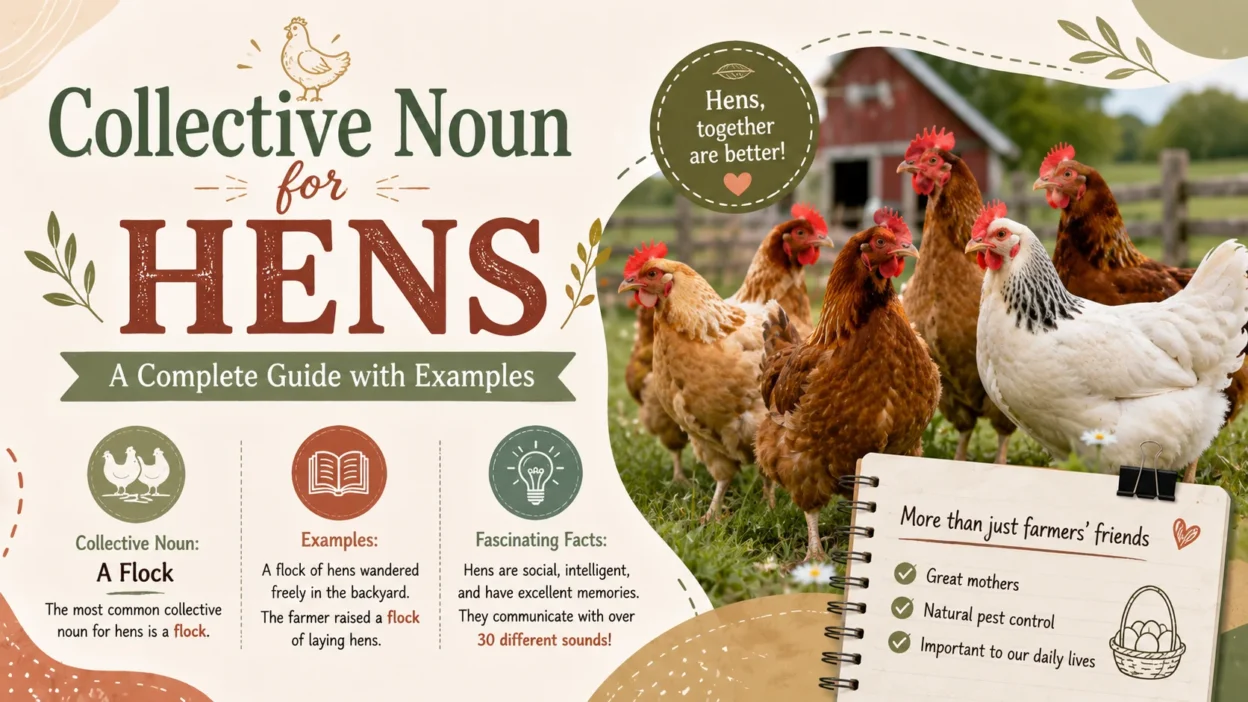
The Collective Noun for Hens helps describe domestic birds as a group, making everyday English clearer and more descriptive.
A flock of hens is the most common expression used when several hens gather, move, or live together. Other terms, such as brood and clutch, can appear in particular contexts, especially when discussing poultry. These animal group names give a specific name to groups of birds instead of using general expressions.
Learning these terms can make writing and conversation more engaging while improving your vocabulary. Understanding the behavior and lives of domestic hens also makes it easier to remember the right language for different descriptions.
Why Collective Nouns Are Used for Hens
Hens are social birds that often live and move together. They may gather around food, return to a shared shelter, forage in the same area, and interact through different sounds and body movements. Because they commonly live in groups, flock is a natural collective noun for hens.
Other terms can have more specific meanings. Brood is associated with a hen and her young chicks, while clutch generally refers to a group of eggs laid or incubated together rather than a general group of adult hens.
These expressions help make English more precise and allow you to describe hens according to their situation.
Collective Nouns for Hens
| Collective Noun | Used For | Simple Example |
| Flock | A group of hens | A flock of hens wandered around the farm. |
| Brood | A hen with her chicks | A brood of hens and chicks stayed together. |
| Clutch | A group of eggs | A clutch of eggs lay in the nest. |
| Group | A general group of hens | A group of hens gathered near the coop. |
Flock of Hens
A flock is the most common collective noun used for a group of hens. It describes hens living, feeding, walking, or moving together.
The expression a flock of hens is simple, familiar, and appropriate for everyday English.
Examples of “Flock of Hens”
- A flock of hens wandered around the farm.
- We saw a flock of hens near the coop.
- The flock of hens searched for food.
- A large flock of hens gathered in the yard.
- The flock of hens returned to the chicken coop.
- A flock of hens walked across the field.
- The farmer fed a flock of hens.
- The flock of hens rested under the trees.
- A flock of hens gathered around the feeder.
- The children watched a flock of hens in the garden.
Brood of Hens
A brood has a more specific meaning. It commonly refers to a hen with her young chicks or a group of young birds being cared for by a mother hen.
Because of this, brood isn’t normally the best choice when you’re simply talking about several adult hens.
Examples of “Brood of Hens”
- A brood of hens and chicks stayed near the coop.
- The mother hen protected her brood.
- The brood of chicks followed the hen.
- A brood of hens moved through the grass.
- The hen kept her brood close together.
- The farmer watched the brood carefully.
- The brood stayed beneath the mother hen.
- A brood of chicks searched for food.
- The mother hen called her brood.
- The brood returned to the shelter before sunset.
Clutch of Hens
Clutch is commonly associated with a group of eggs laid or incubated together rather than a group of adult hens. Therefore, when talking about hens themselves, flock is the better collective noun.
A clutch is useful when discussing reproduction and egg-laying.
Examples of “Clutch of Eggs”
- A clutch of eggs rested in the nest.
- The hen protected her clutch.
- The farmer carefully checked the clutch of eggs.
- A large clutch of eggs was found in the nesting box.
- The hen sat on her clutch.
- The clutch contained several eggs.
- The chicks hatched from the clutch.
- The farmer monitored the clutch during incubation.
- The hen kept her clutch warm.
- The clutch remained safely inside the nest.
Group of Hens
A group of hens is a general expression rather than a specialized traditional collective noun. It can be used whenever you want to describe several hens together.
Although flock is more specific, group is easy to understand and works in almost any situation.
Examples of “Group of Hens”
- A group of hens gathered near the barn.
- We saw a group of hens in the yard.
- The group of hens searched for food.
- A group of hens walked across the farm.
- The farmer watched the group of hens.
- The group of hens returned to the coop.
- A group of hens rested under the trees.
- The group of hens gathered around the feeder.
- A group of hens crossed the garden.
- The children observed a group of hens.
Hen and Chick Behavior
Hens are social birds that can form organized groups known as flocks. Within a flock, hens interact with one another and establish social relationships. They communicate using calls, body movements, posture, and other signals.
One of the most recognizable behaviors is the relationship between a mother hen and her chicks. A hen may use different calls to attract her chicks, warn them about potential danger, or guide them toward food. Chicks also respond to their mother’s calls and tend to remain close to her when they are young.
Hens spend much of their time foraging. They scratch the ground with their feet and use their beaks to investigate soil, vegetation, insects, seeds, and other food sources. This behavior is an important part of their natural feeding routine.
Flock behavior can also involve a social hierarchy commonly called a pecking order. Individual birds may establish dominance relationships that influence access to food, preferred resting areas, and other resources.
Examples of Hen Behavior
- Hens often live in flocks.
- A hen may protect her chicks.
- Hens communicate through different calls.
- Hens scratch the ground while foraging.
- A flock of hens searches for food together.
- Chicks often follow their mother.
- Hens can establish a social hierarchy.
- A mother hen may warn her chicks of danger.
- Hens gather around food sources.
- A flock may return to its shelter together.
Interesting Facts About Hens
Hens are female chickens and belong to the species Gallus gallus domesticus. Chickens have been domesticated for thousands of years and are now among the most widely kept domesticated birds in the world. Hens can live for several years, although their lifespan varies considerably depending on breed, genetics, nutrition, health, housing, and whether they are kept as pets, for eggs, or in commercial production.
Hens have several interesting physiological features. Their bodies are covered with feathers that provide insulation and protection. They have a beak rather than teeth and use it to pick up food. Their feet have claws that help them scratch the ground while foraging. Chickens also have a specialized digestive system that allows them to process a variety of foods.
Hens are omnivores, meaning they can eat both plant and animal material. Their natural diet can include seeds, grains, plants, insects, worms, and other small organisms. Domestic hens are commonly given balanced poultry feed, while they may also forage for insects and vegetation when they have access to outdoor areas.
One particularly interesting feature of chickens is their ability to communicate using a wide range of vocalizations. Hens use different calls for different situations, and mother hens can communicate with their chicks even before the chicks hatch. Chicks can respond to sounds from inside the egg, helping establish communication between the mother and developing young.
Hens also have a strong social structure. A flock can develop a pecking order in which birds establish dominance relationships. This social organization can influence how individual hens interact and access resources.
Examples of Hen Facts
- Hens are female chickens.
- Hens are social birds.
- A group of hens is commonly called a flock of hens.
- Hens are omnivores.
- Hens eat seeds, grains, plants, insects, and other food.
- Hens use their beaks to pick up food.
- Their claws help them scratch the ground.
- Mother hens communicate with their chicks.
- Hens can establish a social hierarchy.
- Chickens have been domesticated for thousands of years.
Conclusion
Learning the Collective Noun for Hens makes it easier to describe groups of these domestic birds accurately. Flock is the most common term, while brood and clutch can be useful in specific contexts. Knowing these terms can improve your English, strengthen your vocabulary, and make both writing and conversation more descriptive.
FAQs
Q1. What is the most common collective noun for hens?
The most common collective noun for hens is flock. You can say, “A flock of hens was walking around the farm.”
Q2. What do you call a group of hens?
A group of hens is commonly called a flock of hens. This is the clearest and most natural expression in everyday English.
Q3. Can “brood” be used for a group of hens?
Yes. Brood can refer to a group of young birds, particularly birds cared for by a mother hen. Its meaning depends on the context.
Q4. Can “clutch” describe a group of hens?
Clutch usually refers to a group of eggs produced or incubated together rather than a general group of adult hens.
Q5. Is “flock of hens” grammatically correct?
Yes. Flock of hens is grammatically correct and widely understood. The singular collective noun flock refers to the group as a whole.
Q6. Why are collective nouns used for hens?
Collective nouns provide a simple way to describe several animals as one group. They make descriptions more precise and interesting.
Q7. Is “herd of hens” correct?
No. Herd is normally used for groups of animals such as cattle, horses, and elephants. Flock is the more appropriate term for hens.
Q8. Is “gaggle of hens” correct?
No. Gaggle is traditionally associated with geese, especially when they are on the ground. For hens, flock is the standard choice.
Q9. Can I use “flock” for other birds?
Yes. Flock is a widely used collective noun for many kinds of birds, including chickens, sparrows, pigeons, and ducks.
Q10. What is the best collective noun to use in everyday English?
Flock is the safest and most natural choice. A flock of hens works well in everyday speech, general writing, and descriptions of poultry.