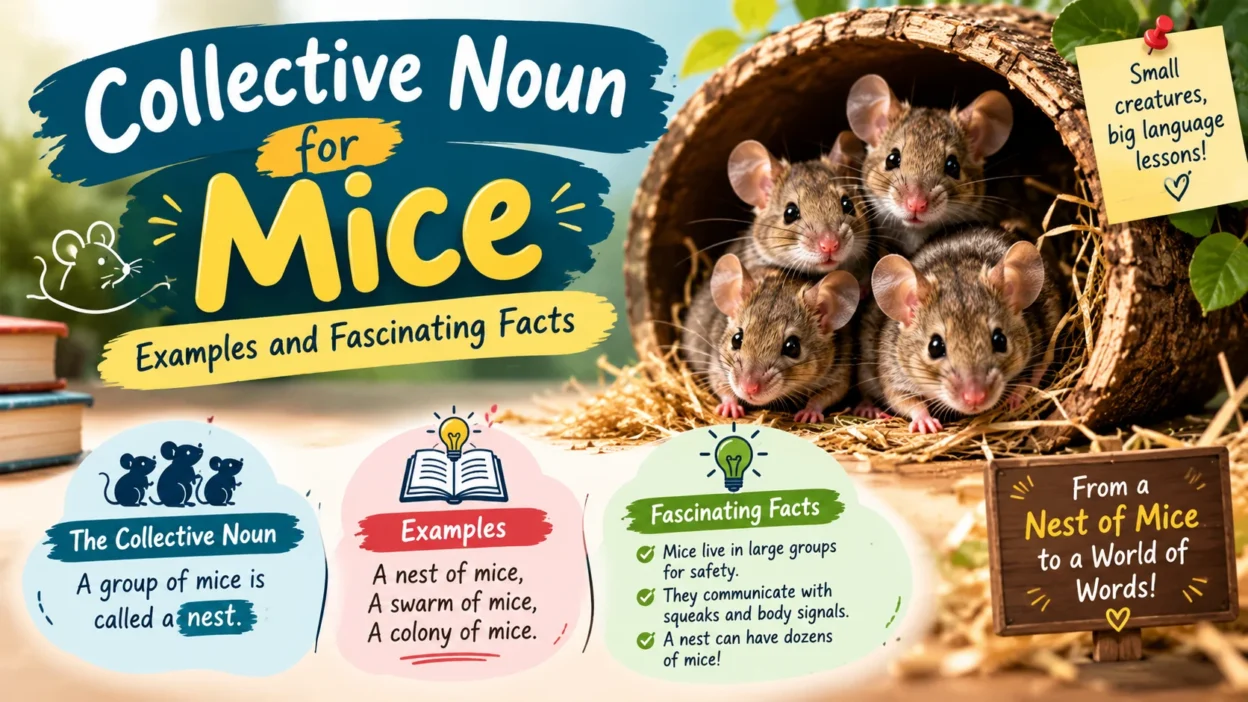
The Collective Noun for Mice is mischief, giving us the traditional expression a mischief of mice. The word mischief creates a memorable image of small, curious animals that move quickly, explore hidden spaces, and may cause damage while searching for food. When food and shelter are available, mice may live near other mice, although their social behavior can vary according to their species and environment. Their troublesome reputation helps make this unusual collective noun especially interesting and memorable.
Collective nouns are special words used to describe a group of animals, people, objects, or things as one unit. In English, familiar examples include a flock of birds, a herd of cattle, and a pack of wolves. These expressions make language more colorful and interesting. Learning the collective noun for mice also helps you connect vocabulary with animal behavior. The term mischief stands out because it combines a simple word with a lively image commonly associated with mice.
Understanding this expression can improve vocabulary, sentence formation, and communication while providing interesting information about mice. Their remarkable senses, adaptable diets, reproductive abilities, and social behaviors make them an excellent example of how language and animal characteristics can come together. Knowing the term also gives you a practical way to describe mice as a group while appreciating the unusual expressions found in English.
What Is the Collective Noun for Mice?
The traditional collective noun commonly associated with mice is mischief.
A Mischief of Mice
The expression “a mischief of mice” is a traditional collective expression for a group of mice. The word mischief gives the phrase a playful meaning and reflects the reputation mice have for sneaking into homes, exploring food supplies, and sometimes damaging materials.
A mischief of mice can describe several mice found together in a particular area.
Example: A mischief of mice appeared in the old barn.
| Type | Simple Example |
| Collective noun | Mischief |
| Animal | Mice |
| Complete phrase | A mischief of mice |
| Singular example | A mouse is hiding behind the box. |
| Plural example | Several mice are hiding behind the boxes. |
| Collective example | A group of mice gathered in the barn. |
The basic structure is:
a mischief + of + mice
For example:
A group of mice gathered near the grain.
Here, mischief identifies the group, while mice identify the animals belonging to it.
Simple Example Sentences
- A group of mice gathered in the barn.
- We noticed a mischief of mice near the grain.
- A group of mice appeared inside the old building.
- The farmer discovered mice mischief near the storage room.
- A group of mice moved through the walls.
- A group of mice searched for food.
- The children learned about the mischief of mice.
- A group of mice appeared near the field.
- A mischief of mice scattered when the door opened.
- The researcher observed a mischief of mice from a distance.
How to Use “A Mischief of Mice” Correctly
Using the mischief of mice is straightforward. The basic structure is:
a mischief + of + mice
For example:
A mouse was hiding inside the barn.
The word mischief acts as the collective noun, while mice identify the animals in the group.
When the group is treated as one unit, a singular verb can be used:
Example:
A mouse is moving through the building.
You can also focus on the individual mice:
Example:
The mice are moving through the building.
The first sentence emphasizes the group as a whole, while the second focuses on the individual animals.
Simple Example Sentences
- A mischief of mice is hiding in the barn.
- The mice are searching for food.
- A mischief of mice was seen near the field.
- The mice were running through the grass.
- A group of mice is gathering near the grain.
- The mice are exploring their surroundings.
- A mischief of mice was discovered inside the shed.
- The mice were moving toward the shelter.
- A mischief of mice is hiding behind the boxes.
- The mice are staying close to one another.
Can You Say “A Nest of Mice”?
Yes, a nest of mice can be used when you’re specifically describing mice living or resting together in a nest. However, nest describes their shelter or living place rather than functioning as the best-known traditional collective noun.
This expression is particularly useful when discussing baby mice, mothers, or mice occupying a constructed nest.
Example: A nest of mice was hidden beneath the pile of straw.
The phrase is descriptive rather than equivalent in status to the traditional expression a mischief of mice.
Simple Example Sentences
- A nest of mice was hidden under the straw.
- We discovered a nest of mice inside the shed.
- A mother mouse protected her nest.
- The nest of mice was carefully hidden.
- A nest of young mice was found beneath the woodpile.
- The mice returned to their nest.
- A nest of mice was located inside the wall.
- The farmer found a nest near the storage area.
- The mother mouse stayed close to her young.
- The young mice remained inside the nest.
Mischief of Mice vs. Other Expressions
Not every phrase used to describe several mice is a specialized collective noun. You can also use ordinary expressions such as a group of mice, several mice, a family of mice, or a nest of mice, depending on the context.
| Expression | Meaning | Simple Example |
| A mischief of mice | Traditional collective expression | A group of mice gathered near the grain. |
| A group of mice | General description | A group of mice moved through the barn. |
| Several mice | Simple plural expression | Several mice were hiding nearby. |
| A nest of mice | Mice living or resting in a nest | A nest of mice was found under the straw. |
| A family of mice | Related mice | A family of mice lived inside the shed. |
For traditional collective-noun vocabulary, the mischief of mice is the most distinctive expression. For everyday communication, a group of mice is often the simplest choice.
Simple Example Sentences
- A group of mice gathered near the food.
- Several mice were hiding behind the boxes.
- A family of mice lived inside the old shed.
- A nest of mice was found under the straw.
- A group of mice appeared near the grain.
- Several mice searched for food.
- The group of mice moved through the field.
- A family of mice stayed inside the nest.
- A mischief of mice scattered across the floor.
- The mice disappeared into their hiding places.
Mouse Behavior and Why “Mischief” Is Useful
The expression mischief of mice creates a playful image, but it doesn’t mean mice are naturally mischievous in a human sense. Mice are highly adaptable animals that spend much of their time searching for food, shelter, and safe places to reproduce.
Many mouse species are active during the night or around twilight, although their activity patterns can vary. Their small size allows them to enter narrow spaces and move through environments that larger animals cannot easily access.
Mice have strong senses of smell and hearing, which help them detect food, predators, and other animals. They also use scent and vocalizations as part of their communication.
Some mice are social and may live near other individuals, while social organization differs between species. House mice, for example, can establish social relationships and territories where resources are concentrated.
Food availability can influence where mice gather. Grain, seeds, fruits, insects, and other food sources can attract multiple mice to the same area. This is one reason groups of mice may sometimes be observed around farms, storage buildings, gardens, and other places containing accessible food.
The collective noun describes mice that are together, but it doesn’t necessarily indicate that every group has a permanent social structure.
Simple Example Sentences
- Mice often search for food during periods of activity.
- A group of mice gathered near the grain.
- Mice can move through very narrow spaces.
- The animals searched for a safe hiding place.
- A group of mice explored the barn.
- Mice use scent to communicate with one another.
- A group of mice moved through the storage area.
- The mice scattered when they detected danger.
- Several mice searched for seeds.
- Mice can adapt to many different environments.
Interesting Facts About Mice
Mice are small mammals belonging to the order Rodentia. The term “mouse” can refer to many different species, and mice are found in a wide variety of habitats around the world. Their small bodies and remarkable adaptability allow them to survive in forests, grasslands, agricultural areas, and human-made environments. Some species have adapted particularly well to living close to people, which is why house mice are familiar in many parts of the world.
Mice have several unique physiological features. Their front teeth, known as incisors, continue growing throughout their lives. They need to gnaw regularly to keep these teeth from becoming excessively long. Their small bodies also allow them to squeeze through surprisingly narrow openings. Mice have sensitive whiskers that help them detect objects and navigate their surroundings, particularly in dark or enclosed environments.
Their dietary habits are varied. Depending on the species and environment, mice may eat seeds, grains, fruits, nuts, plants, and insects. House mice are particularly adaptable and can consume many types of food available around human settlements. Their ability to exploit different food sources contributes to their success in a wide range of environments.
Mice also have impressive reproductive abilities. Female mice can reproduce at a relatively young age, and under favorable conditions they may produce multiple litters. This allows mouse populations to increase rapidly when food, water, and shelter are readily available. Predators, disease, competition, and environmental conditions can then influence population numbers.
Their communication and senses are equally fascinating. Mice communicate through sounds, body language, and chemical signals. Some of their vocalizations occur at frequencies that humans cannot easily hear. Their strong sense of smell helps them identify food, recognize individuals, locate territories, and respond to potential danger.
Mice also play important roles in ecosystems. They can serve as prey for owls, hawks, snakes, foxes, and other predators. At the same time, their feeding activities can influence seed movement and vegetation. This makes mice an important part of many food webs despite their small size.
Quick Mouse Facts
- Mice are mammals belonging to the order Rodentia.
- Their front incisors continue growing throughout life.
- Mice use gnawing to help maintain their teeth.
- They have highly sensitive whiskers.
- Many mice have excellent hearing and smell.
- Their diets can include seeds, grains, fruits, plants, and insects.
- Some mouse species are highly social.
- Mice can reproduce rapidly under favorable conditions.
- They provide an important food source for many predators.
- A mischief of mice is the traditional collective expression commonly associated with mice.
Conclusion
The collective noun for mice is mischief, as in a mischief of mice. This unusual expression reflects the curious and sometimes troublesome reputation of mice. Learning terms like this can make your vocabulary more interesting while helping you understand how language connects with animal behavior.
FAQs
Q1. What is the collective noun for mice?
The most commonly recognized collective noun for mice is mischief. The traditional expression is a mischief of mice.
Q2. Why are mice called a mischief?
The word mischief fits the traditional image of mice as curious, active animals that explore spaces and may cause trouble while looking for food.
Q3. What is a group of mice called?
A group of mice can be called a mischief of mice. In ordinary English, you can also simply say a group of mice.
Q4. Is “a mischief of mice” grammatically correct?
Yes. A mischief of mice follows the normal structure of a collective noun phrase and is a recognized traditional expression.
Q5. Is “mischief” the only collective noun for mice?
Mischief is the traditional collective noun associated with mice. In everyday writing, however, a group of mice is also perfectly natural.
Q6. Can I use “mischief of mice” in a sentence?
Yes. For example: “A mischief of mice appeared near the old barn.” The phrase works when you want a more colorful description.
Q7. Is “mischief” singular or plural?
Mischief is a singular collective noun in the phrase a mischief of mice. The word describes the group as one collective unit.
Q8. Where can I use “a mischief of mice”?
You can use the phrase in creative writing, educational material, animal descriptions, and informal contexts where an unusual collective noun adds interest.
Q9. Does “mischief” describe the behavior of mice?
The term is traditionally associated with the idea that mice can be curious, active, and troublesome. It doesn’t mean that every group of mice actually behaves mischievously.
Q10. What is an example of “a mischief of mice”?
“We noticed a mischief of mice moving through the storage room in search of food.”