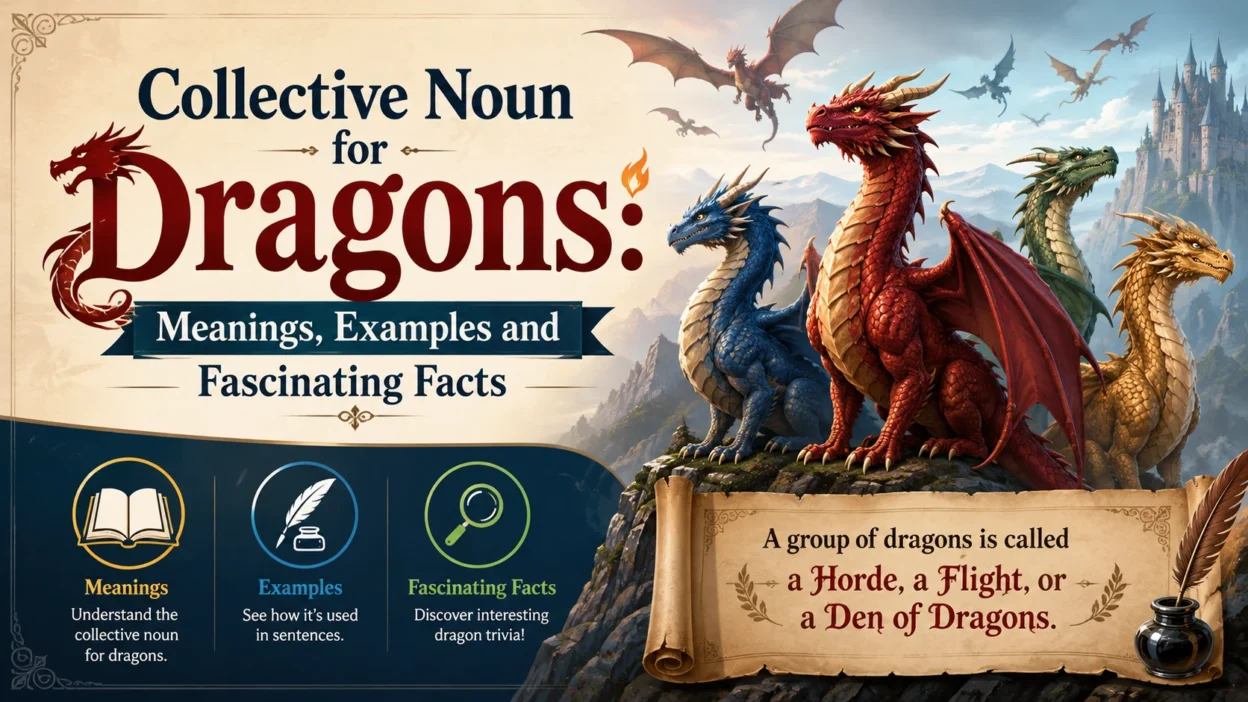
The collective noun for dragons can vary in fantasy writing, but flight is a natural choice when several dragons are flying together. Writers may also use wing, brood, horde, or weyr to describe dragon groups or communities. Unlike a fixed term for real animals, these expressions depend on the fantasy world, scene, and style of the writer.
Dragons are mythical creatures, so they aren’t a scientifically classified animal group with scientifically documented social behavior, dietary habits, or physiological characteristics. Their traits come from mythology, folklore, literature, films, games, and popular storytelling. A dragon may be solitary or live in families, broods, or organized communities, with fictional biology that includes long lifespans, scales, wings, horns, powerful claws, and fire-breathing abilities.
These dragon terms also show how the English language becomes more expressive and memorable through traditional animal expressions. For example, flock describes birds, pack describes wolves, and herd describes cattle. In the same way, dragon expressions connect language, storytelling, and fantasy culture, while adding useful vocabulary for describing these legendary creatures in dramatic landscapes such as mountains, castles, and forests.
What Is the Collective Noun for Dragons?
There isn’t one official scientific collective noun for dragons because dragons are legendary creatures rather than real animals. However, several expressions are commonly used in fantasy contexts.
A Flight of Dragons
The expression “a flight of dragons” is one of the clearest ways to describe a group of dragons, particularly when they are flying together. The word flight naturally connects with the wings and aerial movement traditionally associated with dragons.
A flight of dragons can refer to several dragons traveling through the sky, hunting together, approaching a battlefield, or moving from one territory to another. It works especially well in fantasy writing because readers can immediately understand the image it creates.
Simple Example Sentences
- A flight of dragons crossed the mountains.
- We watched a flight of dragons flying above the castle.
- A flight of dragons appeared over the distant valley.
- The villagers saw a flight of dragons approaching.
- A flight of dragons circled above the forest.
- The wizard watched a flight of dragons disappear into the clouds.
- A flight of dragons moved toward the northern mountains.
- The soldiers noticed a flight of dragons in the sky.
- A flight of dragons descended toward the ancient fortress.
- The story begins with a flight of dragons crossing the kingdom.
How to Use “A Flight of Dragons” Correctly
Using a flight of dragons is straightforward. The basic structure is:
a flight + of + dragons
For example:
A flight of dragons crossed the mountains.
Here, flight is the collective noun, while dragons identify the creatures belonging to the group.
The expression works best when you want to emphasize the dragons as a group moving through the air. If the dragons aren’t flying, you may prefer another expression or simply use a group of dragons.
Example:
A flight of dragons is approaching the castle.
This sentence treats the group as one unit.
You can also focus on the individual dragons.
Example:
The dragons are approaching the castle.
The first sentence emphasizes the group, while the second focuses on the individual creatures.
Simple Example Sentences
- A flight of dragons is approaching the castle.
- The dragons are flying toward the mountains.
- A flight of dragons was seen above the valley.
- The dragons were circling the fortress.
- A flight of dragons is moving across the sky.
- The dragons are searching for food.
- A flight of dragons was observed near the mountain.
- The dragons were heading toward the forest.
- A flight of dragons is crossing the kingdom.
- The dragons are disappearing into the clouds.
Other Collective Nouns and Expressions for Dragons
Because dragons are fictional creatures, writers sometimes use different expressions depending on the situation. These terms don’t all have the same level of traditional acceptance, so context matters.
A Weyr of Dragons
Weyr is strongly associated with dragon communities in fantasy literature. It can refer to a dragon settlement, dwelling, or community rather than simply a group of dragons flying together.
Example: A weyr of dragons lived inside the enormous mountain.
A Wing of Dragons
A wing of dragons can describe a group organized for flying, guarding, fighting, or another coordinated activity.
Example: A wing of dragons protected the ancient fortress.
A Horde of Dragons
A horde of dragons creates an image of a large, threatening, or destructive gathering.
Example: A horde of dragons descended upon the kingdom.
A Brood of Dragons
A brood of dragons is particularly useful when discussing young dragons or a group of offspring cared for by a parent.
Example: A brood of young dragons slept inside the cave.
A Clutch of Dragons
The word clutch is more naturally associated with a group of eggs produced at the same time. Therefore, a clutch of dragon eggs is more precise than using a clutch for adult dragons.
Example: A clutch of dragon eggs rested beneath the ancient tree.
A Hoard of Dragons
Hoard creates a strong connection with the traditional fantasy image of dragons guarding treasure. However, a dragon’s hoard usually means the treasure itself rather than a group of dragons.
Example: The dragons guarded a huge hoard of gold.
Simple Example Sentences
- A weyr of dragons occupied the mountain.
- A wing of dragons guarded the fortress.
- A horde of dragons attacked the city.
- A brood of dragons emerged from the cave.
- A clutch of dragon eggs was carefully protected.
- The dragon guarded its enormous hoard.
- A group of dragons gathered near the mountain.
- Several dragons flew over the valley.
- A family of dragons lived inside the cavern.
- The fantasy story described a large group of dragons.
Collective Noun for Dragons vs. Other Expressions
Not every phrase used to describe several dragons is a specialized collective noun. You can also use ordinary expressions such as a group of dragons, several dragons, a family of dragons, or a brood of dragons.
This distinction matters because dragons don’t have a standardized zoological collective noun in the same way that some real animals have traditional English expressions.
| Expression | Meaning | Simple Example |
| A flight of dragons | Group of dragons, especially flying together | A flight of dragons crossed the sky. |
| A weyr of dragons | Dragon community or settlement in fantasy | A weyr of dragons lived in the mountain. |
| A wing of dragons | Organized group or aerial formation | A wing of dragons guarded the castle. |
| A horde of dragons | Large or threatening group | A horde of dragons attacked the kingdom. |
| A brood of dragons | Young dragons or offspring | A brood of dragons slept in the cave. |
| A clutch of dragon eggs | Group of eggs laid together | A clutch of dragon eggs hatched. |
| A group of dragons | General description | A group of dragons gathered nearby. |
For general writing, a flight of dragons is a simple and understandable choice when the dragons are flying. When you’re not describing their movement, a group of dragons is often the clearest expression.
Simple Example Sentences
- A group of dragons gathered near the mountain.
- Several dragons were flying over the valley.
- A family of dragons lived inside the cave.
- A brood of young dragons rested near their mother.
- A flight of dragons crossed the clouds.
- A wing of dragons guarded the castle.
- A horde of dragons approached the battlefield.
- The dragons gathered around their treasure.
- A group of dragons disappeared into the forest.
- The young dragons remained close to their mother.
Dragon Behavior and Why “Flight” Is Useful
The expression a flight of dragons can create the impression that dragons naturally live together in permanent groups. However, fictional dragons don’t have one consistent social structure. Their behavior changes according to the mythology or fantasy world in which they appear.
Some stories portray dragons as solitary creatures that live in caves or isolated territories. They may interact with other dragons only during reproduction or territorial conflicts. Other fictional worlds portray dragons as highly social creatures that live in families, communities, or organized societies.
Flying together can provide another reason for dragons to appear in groups. A fictional dragon population might travel together during migration, search for food, defend territory, or attack a common enemy. In these situations, a flight of dragons becomes a particularly vivid expression.
Dragon parents and young can also form important family relationships. In many fantasy stories, a mother dragon protects her eggs or young dragons from predators, hunters, or rival creatures. This makes terms such as brood useful when the focus is on offspring.
The collective noun therefore describes dragons that appear together, but it doesn’t necessarily tell us that dragons have a permanent social structure. This is important because collective nouns can be linguistic expressions rather than scientific descriptions of animal behavior.
Simple Example Sentences
- Dragons may live alone in some fantasy stories.
- A flight of dragons crossed the mountains.
- Several dragons gathered around a food source.
- A mother dragon protected her young.
- The young dragons stayed close to their parents.
- The dragons defended their territory.
- A group of dragons moved toward the valley.
- The dragons separated after the danger disappeared.
- A flight of dragons traveled across the kingdom.
- Dragon behavior varies between different fantasy worlds.
Interesting Facts About Dragons
Dragons have fascinated people for centuries, but it’s important to remember that they are mythical creatures, so their biology isn’t scientifically established. Their longevity, physiology, and dietary habits vary widely across different myths and fictional stories. Many fantasy traditions portray dragons as exceptionally long-lived creatures, sometimes surviving for centuries or even thousands of years. Such extraordinary longevity allows fictional dragons to become symbols of wisdom, ancient knowledge, power, and experience. A dragon that has lived for hundreds of years may know the history of kingdoms that disappeared long before the human characters were born.
Dragons also have some of the most unusual physiological features found in fantasy. Depending on the story, they may possess scales, wings, horns, powerful claws, long tails, armored bodies, sharp teeth, and enormous physical strength. One of their most famous abilities is fire breathing. Some fictional explanations attempt to imagine a biological mechanism for producing or releasing fire, while other stories simply treat it as magical. Neither explanation represents established real-world biology. Dragon anatomy also varies considerably. Some dragons have four legs and two wings, while others are portrayed as serpentine creatures with no wings.
Their dietary habits also depend on the fictional setting. Many fantasy dragons are described as carnivores that eat livestock, fish, wild animals, or other creatures. Some stories portray dragons as capable of consuming enormous amounts of food because of their tremendous size, while others give them magical abilities that reduce or eliminate their need for ordinary food. The classic image of a dragon feeding on animals reinforces its role as a powerful predator. Other fantasy traditions give dragons unusual diets or magical sources of nourishment.
Another fascinating feature is the traditional connection between dragons and treasure. In many European-influenced fantasy stories, dragons collect and protect gold, jewels, weapons, and other valuable objects. This treasure collection is commonly called a hoard. The dragon’s hoard often becomes a major part of the story because heroes may attempt to steal it or defeat the dragon protecting it.
Dragons are also associated with different habitats. Fantasy stories place them in mountains, caves, forests, deserts, volcanoes, oceans, and magical kingdoms. Their fictional habitats often reflect their abilities and personalities. A fire-breathing dragon may live near volcanic regions, while a water dragon may inhabit lakes, rivers, or oceans.
Quick Dragon Facts
- Dragons are mythical creatures, not scientifically documented animals.
- Many fictional dragons are portrayed as extremely long-lived.
- Dragons may have scales, wings, horns, claws, and powerful tails.
- Fire breathing is one of their most famous fictional abilities.
- Dragon diets vary between different myths and fantasy worlds.
- Many fantasy dragons are portrayed as carnivorous.
- Dragons are often associated with gold and treasure.
- A dragon’s collection of treasure is commonly called a hoard.
- Some stories portray dragons as solitary, while others depict organized dragon societies.
- A flight of dragons is a useful expression when describing dragons flying together.
Conclusion
The collective noun for dragons doesn’t have one universally fixed answer because dragons belong to mythology, folklore, and fantasy rather than the scientific animal world. Flight is a natural and widely understandable choice for dragons flying together, while brood, wing, horde, and weyr can fit different fictional settings. The best term depends on the story, the behavior of the dragons, and the style you want to create.
FAQs
Q1. What is the collective noun for dragons?
Flight is a commonly used collective noun for dragons, especially when several dragons are flying together.
Q2. Is “flight of dragons” correct?
Yes. Flight of dragons is a natural expression in fantasy writing and works particularly well for a group of dragons flying through the air.
Q3. What are other collective nouns for dragons?
Other terms include wing, brood, horde, and weyr. Their suitability depends on the fictional setting and context.
Q4. Is there an official collective noun for dragons?
No. Dragons are mythical creatures, so English doesn’t have one scientifically established collective noun for them.
Q5. Can I use “brood” for dragons?
Yes. Brood can describe a group of dragons, particularly when the context suggests a family, offspring, or closely related dragons.
Q6. What does “flight of dragons” mean?
A flight of dragons means a group of dragons, usually imagined as flying together through the sky.
Q7. Can “horde” describe a group of dragons?
Yes. Horde can work when you want to emphasize a large, threatening, or powerful gathering of dragons.
Q8. What does “weyr” mean for dragons?
Weyr is a fantasy term associated with a dragon dwelling or community. It’s especially familiar from dragon-centered fantasy literature.
Q9. Which collective noun should I use in everyday writing?
Flight of dragons is probably the clearest choice because readers can understand it immediately without needing special fantasy-world knowledge.
Q10. Why do dragons have different collective nouns?
Dragons appear in many myths, stories, films, games, and fantasy worlds. Since their fictional behavior and communities vary, writers can choose different terms to match their setting.