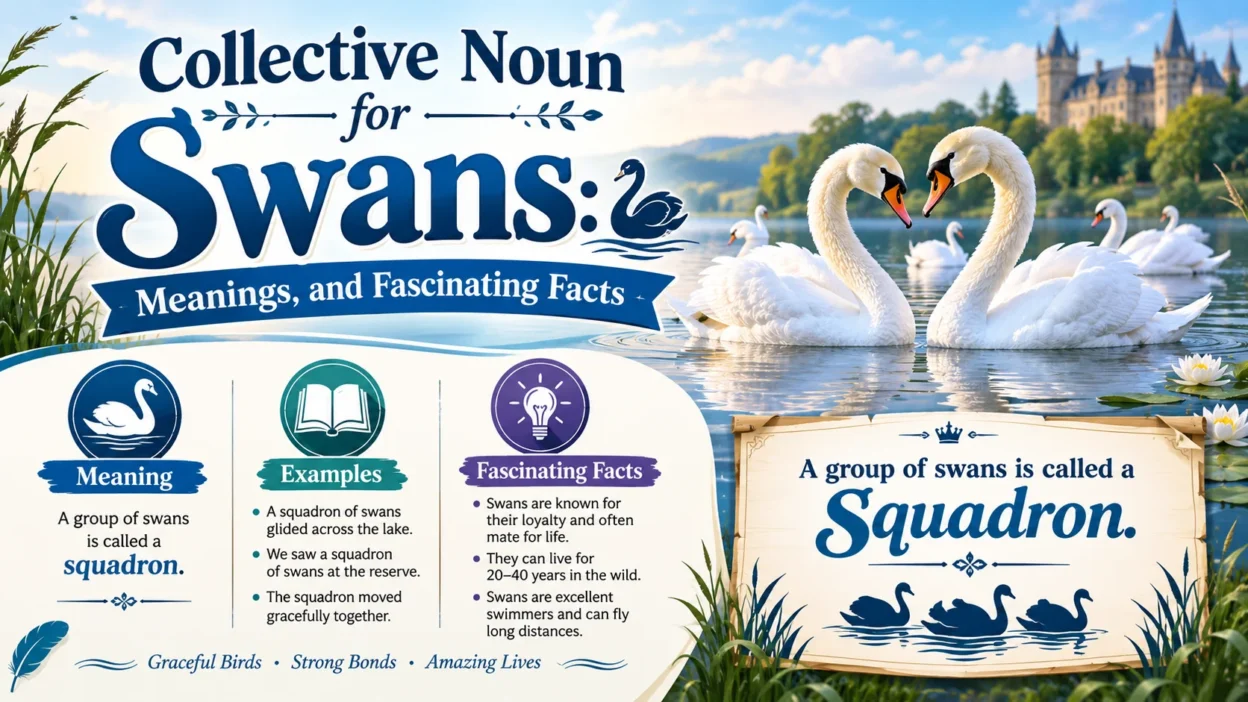
The collective noun for swans is often bevy, describing swans gathered together in suitable habitats for swimming, feeding, or resting. These large, graceful waterbirds are known for their long necks, powerful wings, and elegant movements. You may see pairs moving together because of their strong pair bonds, while family groups can gather in larger numbers when conditions are suitable.
When swans are flying, the word wedge is especially useful because they may travel in a V-shaped formation. This creates a memorable example of how collective nouns connect animal behavior with language. English uses many special words for groups, including a flock of birds, a herd of cattle, and a pack of wolves. These expressions make communication more descriptive and memorable, while also expanding your vocabulary.
Learning these words can improve sentence formation and communication while introducing interesting animal facts. Swans show how flight patterns, social relationships, and physical characteristics can inspire colorful expressions in the English language. Their relationships, patterns, movements, and group behavior help explain why terms such as bevy, wedge, flock, herd, and pack remain useful when describing animals.
What Is the Collective Noun for Swans?
The traditional collective noun commonly associated with swans is bevy.
A Bevy of Swans
The expression “a bevy of swans” is a traditional way to describe a group of swans. The word bevy has also been used historically for groups of people, but it is commonly included among traditional collective nouns for swans.
A bevy of swans can describe several swans gathered together on a lake, river, wetland, or other suitable body of water.
Example: A bevy of swans gathered on the lake.
| Type | Simple Example |
| Collective noun | Bevy |
| Animal | Swans |
| Complete phrase | A bevy of swans |
| Singular example | A swan is swimming on the lake. |
| Plural example | Several swans are swimming on the lake. |
| Collective example | A bevy of swans gathered on the lake. |
The basic structure is:
a bevy + of + swans
For example:
A bevy of swans gathered near the shore.
Here, bevy identifies the group, while swans identifies the birds belonging to that group.
Simple Example Sentences
- A bevy of swans gathered on the lake.
- We watched a bevy of swans swimming together.
- A bevy of swans rested near the riverbank.
- The photographer captured a bevy of swans at sunset.
- A bevy of swans moved slowly across the water.
- A bevy of swans appeared near the shore.
- The children watched a bevy of swans swimming nearby.
- A bevy of swans gathered where the water was calm.
- A bevy of swans moved toward the feeding area.
- The guide pointed out a bevy of swans on the lake.
How to Use “A Bevy of Swans” Correctly
Using a bevy of swans is simple. The basic structure is:
a bevy + of + swans
For example:
A bevy of swans is swimming across the lake.
When the group is treated as one unit, the collective noun can take a singular verb in American English.
Example:
A bevy of swans is resting near the shore.
You can also focus on the individual birds.
Example:
The swans are resting near the shore.
The first sentence emphasizes the group as a whole, while the second emphasizes the individual swans.
Simple Example Sentences
- A bevy of swans is swimming across the lake.
- The swans are swimming near the shore.
- A bevy of swans was seen on the river.
- The swans were resting in the grass.
- A bevy of swans is gathering near the water.
- The swans are feeding in the shallow water.
- A bevy of swans was observed at dawn.
- The swans were moving toward the shore.
- A bevy of swans is resting on the lake.
- The swans are flying toward the wetlands.
Can You Say “A Wedge of Swans”?
Yes. “A wedge of swans” is another traditional expression associated with swans, particularly when they are flying together.
The word wedge refers to the shape formed by birds flying in a V-shaped or triangular formation. Swans can travel in coordinated formations during flight, making this expression especially descriptive.
Example: A wedge of swans flew across the evening sky.
The expression is most useful when the swans are in flight rather than simply swimming together.
Simple Example Sentences
- A wedge of swans flew across the sky.
- We saw a wedge of swans migrating south.
- A wedge of swans passed above the lake.
- A wedge of swans appeared over the wetlands.
- The photographer watched a wedge of swans flying overhead.
- A wedge of swans crossed the valley.
- A wedge of swans moved toward the distant marsh.
- The birds formed a wedge as they flew.
- A wedge of swans disappeared beyond the hills.
- The travelers watched a wedge of swans in the sky.
Swans and Other Collective Expressions
Different collective expressions can emphasize different aspects of swan behavior. Bevy is a general traditional expression, while wedge is particularly descriptive when swans are flying together.
You can also use ordinary expressions such as a group of swans, several swans, or a family of swans when you want simple and direct language.
| Expression | Meaning | Simple Example |
| A bevy of swans | Traditional group expression | A bevy of swans gathered on the lake. |
| A wedge of swans | Swans flying in formation | A wedge of swans crossed the sky. |
| A group of swans | General description | A group of swans rested near the shore. |
| Several swans | Simple plural expression | Several swans were swimming nearby. |
| A family of swans | Parents and young | A family of swans moved across the lake. |
For general English writing, a bevy of swans is a useful traditional expression. When describing swans flying together, a wedge of swans creates a more vivid picture.
Simple Example Sentences
- A group of swans gathered near the river.
- Several swans were swimming across the lake.
- A family of swans rested near the shore.
- A bevy of swans moved across the water.
- A wedge of swans flew overhead.
- Several swans searched for food.
- A group of swans gathered in the wetland.
- The family of swans stayed close together.
- A bevy of swans appeared at sunrise.
- A wedge of swans disappeared into the distance.
Swan Behavior and Why “Bevy” Is Useful
The expression a bevy of swans describes a group of swans, but it doesn’t mean that swans always live together in large permanent groups. Swan social behavior can change according to species, season, habitat, food availability, breeding, and migration.
Many swans form strong pair bonds, and pairs can remain together for long periods. During breeding, a pair may establish and defend a territory. Parents also spend considerable time caring for their young, known as cygnets.
Outside the breeding season, swans may gather in larger groups where food and suitable habitat are available. Such gatherings can occur on lakes, rivers, wetlands, agricultural areas, and coastal habitats.
Flight behavior also provides an excellent reason for using wedge. Swans may fly in coordinated formations, particularly during movement between feeding and resting areas or during migration. Flying in formation can help birds coordinate their movement and may reduce the aerodynamic effort required for some birds in the group.
The collective noun therefore describes swans that are together without necessarily implying that every swan belongs to a permanent social group.
Simple Example Sentences
- Swans often form strong pair bonds.
- A bevy of swans gathered on the lake.
- A pair of swans defended its territory.
- Swan parents cared for their cygnets.
- Several swans gathered where food was abundant.
- A wedge of swans flew across the sky.
- The swans moved toward a quiet wetland.
- A family of swans stayed near the shoreline.
- The birds gathered together during the nonbreeding season.
- Swans can travel long distances during migration.
Interesting Facts About Swans
Swans are among the largest and most recognizable waterfowl. Their impressive size, long necks, broad wings, and graceful movements make them easy to identify. Different swan species have adapted to a variety of habitats, including lakes, rivers, wetlands, grasslands, and coastal environments. Their longevity can also be remarkable. Depending on the species and circumstances, swans can live for many years, with individuals in protected conditions sometimes reaching considerably older ages than those exposed to the dangers of the wild.
Swans have several unique physiological features. Their long necks help them reach aquatic vegetation below the surface, while their large, powerful wings allow them to fly despite their substantial body size. Their webbed feet help them move efficiently through water. Swans also have specialized bills that allow them to obtain aquatic plants and other foods. Their physical strength is considerable, and some species can be surprisingly defensive when protecting a nest or young.
Their dietary habits are primarily plant-based, although swans can consume other food items depending on species and availability. Many swans feed on aquatic vegetation, grasses, roots, leaves, seeds, and other plant material. They may feed by dipping their long necks beneath the water to reach submerged vegetation. Some species also consume small aquatic organisms incidentally while feeding.
Swans are also known for their distinctive vocalizations. Different species make a variety of calls, ranging from soft sounds between mates to loud calls used during social interactions or flight. Their communication helps maintain contact between individuals and can be particularly important when parents and young are together.
One of the most fascinating aspects of swan life is their parental behavior. Swan parents can be highly protective of their young. Cygnets remain with their parents while they develop their swimming, feeding, and other survival skills. The family relationship can last for a considerable part of the young birds’ development.
Quick Swan Facts
- Swans are waterfowl belonging to the family Anatidae.
- They are among the largest flying birds.
- Swans have long, flexible necks.
- Their feet are adapted for swimming with webbed toes.
- Many swans form strong pair bonds.
- Young swans are called cygnets.
- Swans commonly eat aquatic plants and grasses.
- Many swans can live for many years.
- Some swans travel long distances during migration.
- A bevy of swans is a traditional collective expression.
- A wedge of swans is particularly descriptive when they are flying together.
Conclusion
The collective noun for swans can make your writing more descriptive and interesting. Bevy is the most familiar general term, while wedge is commonly associated with swans flying in a V-shaped formation. Understanding these expressions also helps you connect English vocabulary with the natural behavior, movements, and social habits of swans.
FAQs
Q1. What is the collective noun for swans?
The most commonly used collective noun for swans is bevy, as in “a bevy of swans.”
Q2. What is a group of swans called?
A group of swans can be called a bevy. The term describes swans gathered together.
Q3. What is a wedge of swans?
A wedge of swans refers to swans flying together, particularly when they form a V-shaped formation.
Q4. Is “bevy of swans” correct?
Yes. A bevy of swans is a recognized traditional expression for a group of swans.
Q5. Can swans be called a flock?
Yes, flock can describe a group of birds, including swans, although bevy is the more traditional collective term specifically associated with swans.
Q6. Why do swans fly in a V-shaped formation?
Flying in a V-shaped formation can help birds use the airflow created by birds ahead of them, making long-distance flight more efficient.
Q7. Do swans usually stay in pairs?
Swans are well known for forming strong pair bonds, and many species commonly spend considerable time with a mate.
Q8. Can a family group of swans contain several birds?
Yes. Swans may form family groups, particularly when parents remain with their young.
Q9. What are some other collective nouns for birds?
Common examples include flock for birds, murder for crows, and gaggle for geese.
Q10. Why are collective nouns useful?
Collective nouns make English more descriptive and provide concise ways to describe groups of people, animals, objects, or things.