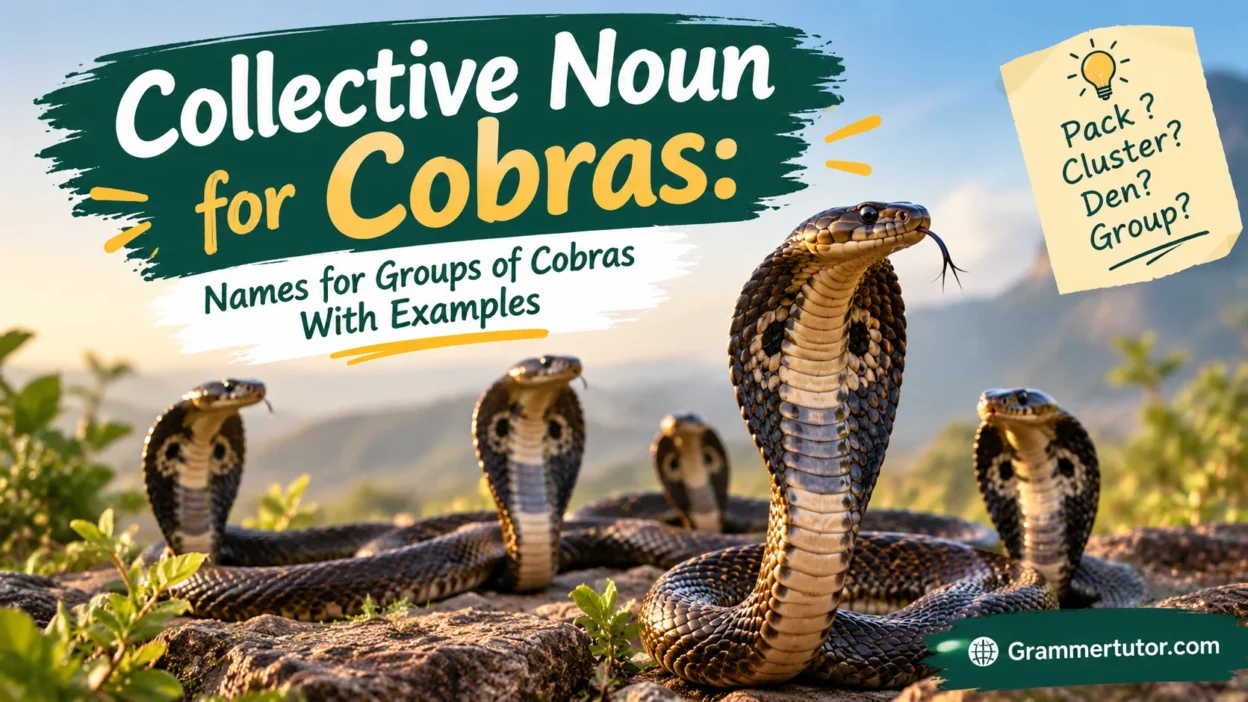
The collective noun for cobras can make English vocabulary more interesting by showing how snakes are described as one group. Common expressions include quiver of cobras, den of cobras, nest of cobras, and simply group of cobras. A collective noun is a word or expression used for several animals together. Among these terms, quiver is a distinctive traditional term associated with cobras, while group of cobras is often clearer in ordinary English.
These collective expressions can also connect with snake behavior, cobra behavior, and the natural environment where cobras live. In wildlife writing, descriptive writing, and descriptive language, words such as quiver create a vivid connection with snake movement and danger associated with these snakes. A natural habitat or snake habitat may be discussed when explaining animal grouping, group terminology, or how cobras behave in the wildlife around them. Den of cobras and nest of cobras may appear in descriptive contexts and traditional contexts, although their use can depend on the writer and situation.
When studying collective nouns, learners may encounter specialized collective noun expressions and specialized terminology, but these are not always necessary for ordinary usage. Understanding these terms supports vocabulary learning and gives writers several English expressions for how to describe a cobra group. Wildlife vocabulary, animal behavior, habitat, movement, and danger can all add useful context when discussing cobras. In practice, I find that using collective noun usage carefully keeps descriptions natural while still making the English language more varied and colorful.
How Collective Nouns Describe Cobras
Cobras are generally solitary snakes, so they are not always found in large groups in the same way as animals such as deer or birds. However, several cobras may occur in the same area because of suitable shelter, food, breeding conditions, or environmental factors.
A specialized expression can make a description more memorable. Quiver of cobras is a traditional-style expression, while den of cobras can emphasize a shared hiding or sheltering place. A simple group of cobras is useful when you want a neutral expression without suggesting a particular behavior.
The choice of expression therefore depends on the context. Understanding the difference between these terms helps writers choose language that sounds natural and fits the situation.
Collective Nouns for Cobras
| Collective Noun | Used For | Simple Example |
| Quiver | A traditional expression for cobras | A quiver of cobras was seen nearby. |
| Den | Cobras associated with a shared shelter | A den of cobras was found in the rocky area. |
| Nest | A group associated with a nesting or sheltered place | A nest of cobras was discovered in the area. |
| Group | A general collection of cobras | A group of cobras moved through the grass. |
| Cluster | Several cobras gathered closely | A cluster of cobras was spotted near the rocks. |
Quiver of Cobras
A quiver of cobras is a distinctive traditional expression used to describe a group of cobras. The word quiver is especially vivid because it can suggest movement or trembling, creating a strong image when describing these venomous snakes.
This expression is more literary or traditional than everyday speech. In general conversation, a group of cobras may sound more familiar, but quivers can add character to wildlife writing.
Examples of “Quiver of Cobras”
- A quiver of cobras was spotted near the rocks.
- The ranger noticed a quiver of cobras in the grass.
- A quiver of cobras moved through the dry field.
- We kept our distance from the quiver of cobras.
- A quiver of cobras was reported near the forest.
- The photographer carefully observed a quiver of cobras.
- A quiver of cobras disappeared beneath the bushes.
- The researchers recorded a quiver of cobras in the area.
- A quiver of cobras was seen at the edge of the woodland.
- The villagers were warned about a quiver of cobras nearby.
Den of Cobras
A den of cobras can describe cobras associated with a sheltered or hidden place. The word den is commonly connected with animals that use protected spaces for shelter, although cobras do not necessarily live together in a permanent den.
This expression works particularly well in descriptive writing when the focus is on a dark, concealed, or protected location where snakes have been found.
Examples of “Den of Cobras”
- A den of cobras was discovered near the rocks.
- The workers found a den of cobras underground.
- A den of cobras was hidden beneath the old structure.
- The ranger inspected the den of cobras carefully.
- A den of cobras was reported near the village.
- The cave was believed to shelter a den of cobras.
- We stayed away from the den of cobras.
- The researchers investigated the suspected den of cobras.
- A den of cobras was located near the hillside.
- The narrow opening led toward a den of cobras.
Nest of Cobras
A nest of cobras is a descriptive expression that may be used when cobras are associated with a sheltered location or nesting area. The term can be especially useful in wildlife descriptions, although cobra species differ in their reproductive behavior.
Some cobras show unusual parental behavior compared with many other snakes. The use of nest can therefore be relevant when discussing reproductive activity rather than simply describing any random gathering.
Examples of “Nest of Cobras”
- A nest of cobras was found near the vegetation.
- The researchers discovered a nest of cobras.
- A nest of cobras was hidden beneath the leaves.
- The ranger carefully examined the suspected nest of cobras.
- A nest of cobras was located near the forest floor.
- The area around the nest of cobras was kept clear.
- We learned about the nest of cobras during the wildlife tour.
- The researchers monitored the nest of cobras from a safe distance.
- A nest of cobras was reported near the woodland.
- The team recorded observations around the nest of cobras.
Group of Cobras
A group of cobras is the simplest general expression for several cobras. It does not imply that the snakes are permanently living together or that they are using a particular shelter.
This expression is especially useful when you want your sentence to be clear and straightforward. It can be used in general writing, school assignments, wildlife descriptions, and everyday conversation.
Examples of “Group of Cobras”
- A group of cobras moved through the grass.
- We saw a group of cobras near the rocks.
- The group of cobras disappeared into the bushes.
- A group of cobras was observed by the researchers.
- The ranger noticed a group of cobras nearby.
- A group of cobras was moving across the field.
- The group of cobras stayed close to the vegetation.
- We learned about a group of cobras during the wildlife study.
- A group of cobras was spotted near the dry ground.
- The researchers watched the group of cobras from a safe distance.
Cluster of Cobras
A cluster of cobras is a general descriptive expression for several snakes gathered relatively close together. Unlike a traditional animal collective noun, cluster mainly describes their physical arrangement.
It can be useful when several cobras are temporarily gathered in one location. However, it does not necessarily mean that cobras naturally form permanent social groups.
Examples of “Cluster of Cobras”
- A cluster of cobras was spotted near the rocks.
- The ranger noticed a cluster of cobras in the grass.
- A cluster of cobras appeared near the sheltered area.
- We carefully moved away from the cluster of cobras.
- A cluster of cobras was observed by the researchers.
- The cluster of cobras disappeared beneath the vegetation.
- A photographer recorded a cluster of cobras from a distance.
- A cluster of cobras was found near the hillside.
- The researchers studied the cluster of cobras carefully.
- A cluster of cobras was reported in the area.
Types of Cobras and Their Characteristics
Cobras belong to the snake family Elapidae and include several species found in Africa and Asia. They are famous for their ability to spread the skin around the neck into a hood when threatened. This recognizable display makes cobras some of the most easily identified snakes in the world.
Different cobra species vary in size, color, habitat, behavior, and defensive abilities. Some live in forests, while others can be found in grasslands, agricultural areas, rocky environments, or places close to human settlements.
Cobras are carnivorous reptiles. Their diets can include rodents, frogs, birds, lizards, and other small animals. Like other snakes, they swallow their prey rather than chewing it.
Examples of Cobra Characteristics
- Cobras are venomous snakes.
- Cobras belong to the family Elapidae.
- Many cobras can spread a hood around the neck.
- Cobras are carnivorous.
- Some cobra species live in forests.
- Other cobras can inhabit grasslands and open areas.
- Cobras may eat rodents and other small animals.
- Cobras use venom to subdue prey and defend themselves.
- Cobra species differ in size and appearance.
- Some cobras can adapt to environments near people.
Interesting Facts About Cobras
Cobras are remarkable reptiles with specialized physical features and behaviors. Their lifespan varies according to species, habitat, food availability, predators, disease, and environmental conditions. Some cobras can survive for many years when conditions are favorable, although their exact longevity differs among species.
One of the most recognizable physiological features of a cobra is its hood. When threatened, many cobra species can spread their neck ribs and surrounding skin, producing the famous hooded appearance. This display can make the snake appear larger and serves as an important warning signal to potential threats.
Cobras are also known for their venom. Their venom is produced by specialized glands and delivered through their fangs. Different species have venom with different effects, and some cobra venoms primarily affect the nervous system. This makes cobras important subjects for scientific and medical research.
Their dietary habits are also fascinating. Cobras are carnivores and may consume rodents, frogs, lizards, birds, eggs, and other small animals, depending on the species. Their flexible jaws and specialized body structure allow them to swallow prey whole.
Cobras also display interesting defensive behaviors. Besides spreading their hood, some species may raise part of their body, hiss, or make rapid defensive movements when threatened. These behaviors are reminders that cobras should be observed only from a safe distance in the wild.
READ MORE: Collective Nouns for Quail: What Do You Call a Group of Quail?
Conclusion
The collective noun for cobras includes traditional expressions such as quiver of cobras, den of cobras, and nest of cobras. Among these, quiver is the most distinctive traditional term. However, the group of cobras is simple, clear, and suitable for ordinary English. Learning these terms can improve vocabulary and help writers describe cobra groups more effectively.
FAQs
Q1. What is the collective noun for cobras?
The collective noun for cobras is commonly given as quiver, as in “a quiver of cobras.”
Q2. What is a group of cobras called?
A group of cobras can be called a quiver of cobras. You can also simply say a group of cobras.
Q3. Is “quiver of cobras” correct?
Yes. Quiver of cobras is a traditional collective expression associated with cobras.
Q4. Can I say “a den of cobras”?
Yes. Den of cobras can be used as a descriptive or traditional expression for cobras found together.
Q5. Can cobras be called a “nest”?
Nest of cobras is another expression that may appear in traditional or descriptive writing.
Q6. What does “quiver” mean in “quiver of cobras”?
Here, quiver functions as a collective noun describing a group of cobras. It also creates an image connected with movement and danger.
Q7. Is “group of cobras” grammatically correct?
Yes. The group of cobras is completely clear and natural when you do not need a specialized collective noun.
Q8. Which collective noun for cobras is most distinctive?
Quiver of cobras is the most distinctive traditional expression among the terms commonly associated with them.
Q9. Are collective nouns for cobras commonly used in everyday English?
Not usually. In everyday English, speakers often prefer the straightforward phrase group of cobras.
Q10. Why learn collective nouns for cobras?
Learning these terms can expand your English vocabulary, improve wildlife writing, and help you understand traditional forms of descriptive language.