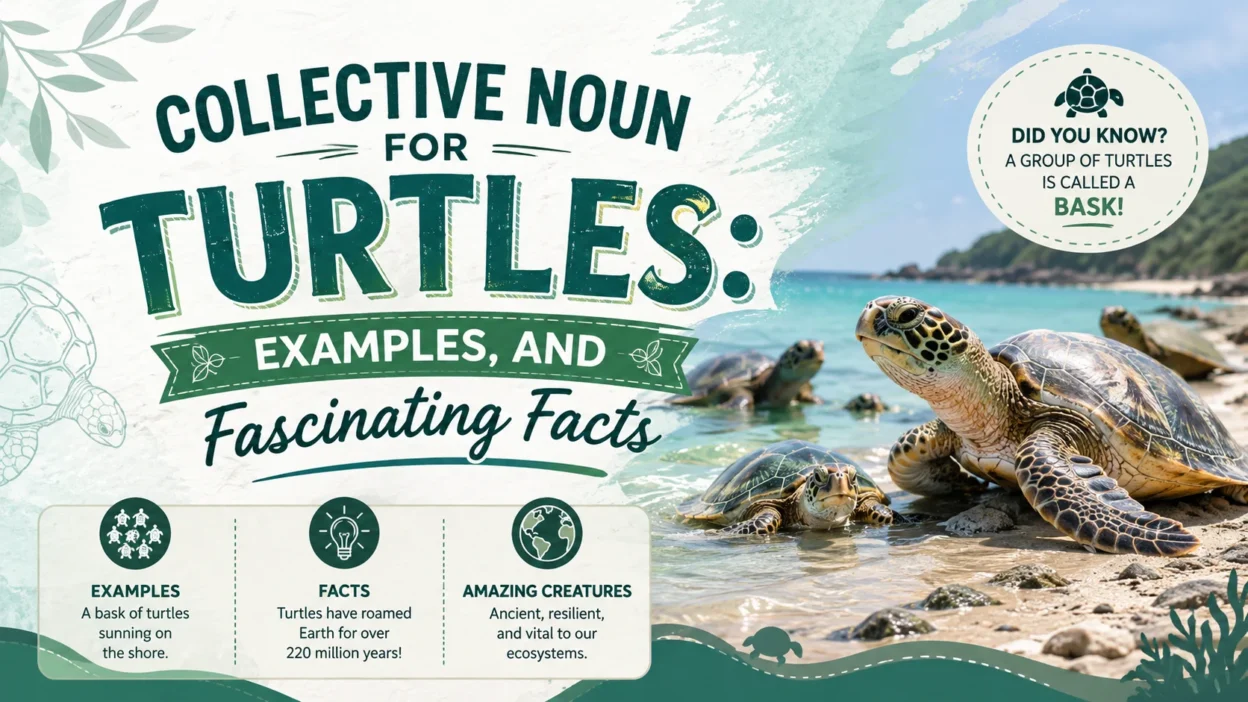
The Collective Noun for Turtles is bale, a simple term for describing a group of turtles in English. While turn and dole also appear in some traditional lists of animal collective nouns, bale is the most recognized choice. When you’re learning these terms, using bales of turtles is usually the clearest way to describe several turtles together.
Turtles are fascinating reptiles with protective shells, long lifespans, unusual body structures, and varied diets. Although many turtle species are solitary, they may gather in particular places when local conditions provide food, shelter, warmth, or suitable nesting opportunities. Their behavior can therefore vary depending on their species, habitat, and immediate needs.
Learning the different terms for groups of turtles can expand your English vocabulary while helping you understand turtles themselves. Looking at simple examples, fascinating facts, behavior, and biology together makes these expressions easier to understand and remember.
What Is a Collective Noun for Turtles?
A collective noun is a word used to describe a group of the same kind of people, animals, or things. Instead of saying “a group of turtles,” English can use a special collective expression to make the sentence shorter, clearer, and sometimes more vivid.
For turtles, the best-known collective noun is bale. You may also encounter terms such as turn and dole in lists of animal collective nouns. However, these terms aren’t equally common in everyday English. Bale of turtles is the most useful expression to know, especially when discussing a group of sea turtles.
Collective nouns are interesting because they can tell us something about how English speakers describe animals. Some terms have historical origins, while others became popular because they create a memorable image of a particular animal group.
For example:
- A bale of turtles rested near the shore.
- A turn of turtles moved slowly through the water.
- A dole of turtles gathered in the shallow lagoon.
The word turtles itself refers to reptiles belonging to the order Testudines. Turtles include many different species, from freshwater turtles and terrapins to large marine turtles and land-dwelling tortoises.
Why Do We Use Collective Nouns?
Collective nouns make language more precise and interesting. Compare these two sentences:
A group of turtles crossed the beach.
A bale of turtles crossed the beach.
The first sentence is completely understandable, while the second uses a traditional collective term that gives the sentence a more distinctive style.
Collective nouns are particularly useful in wildlife writing, nature documentaries, books, educational material, and descriptive storytelling.
Collective Nouns for Turtles: Quick Guide
The following table gives a simple overview. Keep in mind that some collective terms are uncommon, regional, or mainly found in traditional lists of animal group names.
| Collective Noun | Type | Simple Example |
| Bale | A group of turtles | A bale of turtles rested on the beach. |
| Turn | A group of turtles | A turn of turtles moved through the water. |
| Dole | A group of turtles | A dole of turtles gathered near the shore. |
| Nest | Turtles gathered around a nesting site | A nest of turtles was observed near the beach. |
Among these, bale is the most useful term to remember. Turn and dole appear in traditional or specialized lists but are much less familiar to modern speakers.
The word nest requires a little caution. It isn’t generally treated as a standard collective noun for turtles in the same way that “bale” is. It more naturally describes a nesting place or a group associated with nesting. Therefore, in ordinary writing, bale of turtles are the safest choice.
The Most Natural Expression
If you’re writing an essay, article, story, or educational sentence and want a recognized collective noun, use:
A bale of turtles
For example:
A bale of turtles swam toward the coral reef.
This expression is easy to understand and gives your writing a more natural wildlife-focused style.
Bale of Turtles: The Most Recognized Collective Noun
The phrase bale of turtles is the most widely recognized collective expression associated with turtles. A bale can refer to a group of turtles, particularly when they are gathered together.
You might see turtles grouped together while resting, feeding, swimming, or moving through a particular habitat. Sea turtles can sometimes appear together in suitable feeding or resting areas, although their social behavior differs considerably among species.
Example Sentences With “Bale of Turtles”
- A bale of turtles rested on the warm sand.
- We watched a bale of turtles swimming near the coral reef.
- A bale of turtles moved slowly toward the water.
- The researchers observed a bale of turtles from a safe distance.
- A bale of turtles gathered in the shallow water.
- The children saw a bale of turtles near the beach.
- A bale of turtles disappeared beneath the waves.
- The guide pointed out a bale of turtles in the lagoon.
- A bale of turtles rested together near the rocky shore.
- The photographer captured a beautiful picture of a bale of turtles.
Why “Bale” Is Useful
The word bale makes a sentence more concise. Instead of saying “a group of turtles,” you can say “a bale of turtles.”
However, don’t feel that you must use bale every time you mention several turtles. “A group of turtles” is perfectly correct and often sounds more natural in ordinary conversation.
For formal wildlife writing, the choice depends on your audience. If your readers may not know the expression, introducing it once and then using “group” afterward can make the article easier to understand.
Turn of Turtles: Meaning and Examples
Turn is another term that appears in traditional collections of animal group names for turtles. It is considerably less common than bale, so many native English speakers won’t immediately recognize it as a collective noun.
This is an important point when learning collective nouns: a word can exist as a traditional collective term without being common in modern everyday English.
If you encounter “turn of turtles” in a wildlife book, word list, or language resource, the meaning is essentially a group of turtles.
Example Sentences With “Turn of Turtles”
- A turn of turtles moved slowly across the sandy beach.
- We saw a turn of turtles swimming in the clear water.
- The photographer waited for a turn of turtles to approach the reef.
- A turn of turtles gathered near the rocks.
- The guide noticed a turn of turtles along the shoreline.
- A turn of turtles disappeared into the deeper water.
- Researchers recorded a turn of turtles near the feeding area.
- A turn of turtles rested in the shallow lagoon.
- The children watched a turn of turtles from the pier.
- A turn of turtles slowly crossed the muddy riverbank.
Is “Turn of Turtles” Common?
Not really. Although the expression appears in traditional lists, it isn’t something most people use in everyday speech.
For that reason, bale of turtles is usually a better choice when you want a recognizable collective noun.
If your goal is simply to communicate clearly, you can always say:
A group of turtles
There’s nothing grammatically wrong with that expression.
Dole of Turtles: Meaning and Examples
Dole is another collective term that can be found in traditional animal-group terminology associated with turtles. Like turn, however, it isn’t common in modern conversational English.
This distinction is useful because websites and word lists sometimes present every traditional collective noun as though it were equally popular. That’s not how collective nouns actually work in everyday language.
Some terms are familiar, such as:
- a flock of birds
- a herd of cattle
- a pack of wolves
- a school of fish
Other expressions are much less familiar. Dole of turtles belong to the latter category.
Example Sentences With “Dole of Turtles”
- A dole of turtles rested beside the quiet pond.
- We noticed a dole of turtles near the riverbank.
- A dole of turtles moved toward the water.
- The wildlife team observed a dole of turtles in the wetland.
- A dole of turtles gathered in a sheltered area.
- The children quietly watched a dole of turtles near the pond.
- A dole of turtles crossed the muddy ground.
- The researcher photographed a dole of turtles in the marsh.
- A dole of turtles rested under the shade.
- We saw a dole of turtles moving through the shallow water.
Should You Use “Dole” in Everyday English?
Usually, no. If your primary goal is clarity, a group of turtles is much more natural.
If you’re specifically discussing collective nouns, vocabulary, or traditional animal terminology, dole can be interesting to mention.
This is one of the most important lessons about collective nouns: recognition and actual usage aren’t always the same thing.
Interesting Facts About Turtles and Their Behavior
Turtles are among the most distinctive reptiles on Earth, and their biology helps explain why groups of turtles can be so fascinating to observe. One of their most remarkable characteristics is their longevity. Some turtle species can live for several decades, while certain tortoises can survive for well over a century under favorable conditions. Their slow growth, metabolism, and life-history strategies contribute to their reputation for exceptionally long lives.
Another striking feature is the turtle’s shell. The shell isn’t simply an external shield that sits on top of the animal. It is a complex part of the turtle’s skeleton. The upper portion is called the carapace, while the lower portion is called the plastron. The ribs and vertebrae are closely associated with the shell, making it a fundamental part of the turtle’s body.
Turtles also have unusual adaptations for survival. Sea turtles have streamlined bodies and powerful flippers that allow them to travel through oceans. Freshwater turtles are adapted for swimming in ponds, rivers, lakes, and wetlands. Land turtles and tortoises have sturdier limbs suited to life on land.
Their diets vary greatly depending on the species. Some turtles are primarily herbivorous, eating grasses, leaves, algae, fruits, and other plant material. Others are omnivorous and consume a mixture of plants and animals. Some species may eat insects, worms, crustaceans, mollusks, fish, or carrion.
Turtles also have fascinating reproductive behavior. Female sea turtles often return to beaches to lay their eggs, sometimes traveling remarkable distances between feeding areas and nesting locations. After laying eggs, many species leave the nest, meaning young turtles must survive largely on their own after hatching.
Their social behavior is also more complicated than the simple image of a solitary reptile might suggest. Some turtles spend much of their lives alone, but individuals may gather when environmental conditions provide a useful resource. They can congregate around feeding grounds, basking areas, nesting locations, or suitable habitats.
This is why collective nouns can be useful even when an animal isn’t strongly social. A bale of turtles doesn’t necessarily mean that turtles have a permanent social group like wolves or some primates. It simply provides a descriptive way to refer to several turtles together.
Conclusion
The collective noun for turtles is most commonly given as “bale,” making “a bale of turtles” the key expression to remember. Other traditional terms, such as “turn” and “dole,” may also appear in collective-noun lists, but they are much less common in modern English.Learning these expressions is a simple way to make your vocabulary richer while discovering more about turtles. These remarkable reptiles are known for their long lifespans, protective shells, specialized bodies, and varied diets. Although many turtles are solitary, they can gather when their environment provides suitable food, shelter, warmth, or nesting opportunities.Ultimately, understanding collective nouns isn’t just about memorizing unusual words. It connects language with the natural world, helping us describe animals more creatively while appreciating the fascinating biological traits and behaviors that make turtles unique.
FAQs
Q1. What is the collective noun for turtles?
The most commonly recognized collective noun for turtles is bale. You can say “a bale of turtles.”
Q2. Is “bale of turtles” correct?
Yes. “Bale of turtles” is a recognized collective expression for a group of turtles.
Q3. Can I say “a group of turtles”?
Yes. “A group of turtles” is completely correct and is often more natural in everyday English.
Q4. What is a group of sea turtles called?
A group of sea turtles can be called “a bale of turtles.” However, “a group of sea turtles” is also perfectly acceptable.
Q5. Is “turn of turtles” a collective noun?
Yes. “Turn” appears in traditional lists of collective nouns associated with turtles. However, it isn’t commonly used in modern everyday English.
Q6. Is “dole of turtles” a collective noun?
Yes, “dole” is another traditional term that appears in lists of collective nouns for turtles. Like “turn,” it is uncommon in ordinary conversation.
Q7. Do turtles normally live in groups?
Not always. Many turtle species are relatively solitary. However, turtles may gather around food sources, basking areas, nesting sites, or suitable habitats.
Q8. Why are turtles sometimes found together?
Turtles may gather when environmental conditions provide important resources such as food, warmth, shelter, or suitable nesting locations. Their gathering doesn’t necessarily mean they form permanent social groups.
Q9. What is the easiest collective noun for turtles to remember?
“Bale” is the best term to remember. “A bale of turtles” is the most useful traditional expression when you specifically want a collective noun.
Q10. Why should I learn collective nouns for turtles?
Learning collective nouns improves your English vocabulary while also making your wildlife writing more descriptive. It can also encourage you to learn about the behavior, habitat, and biology of turtles.