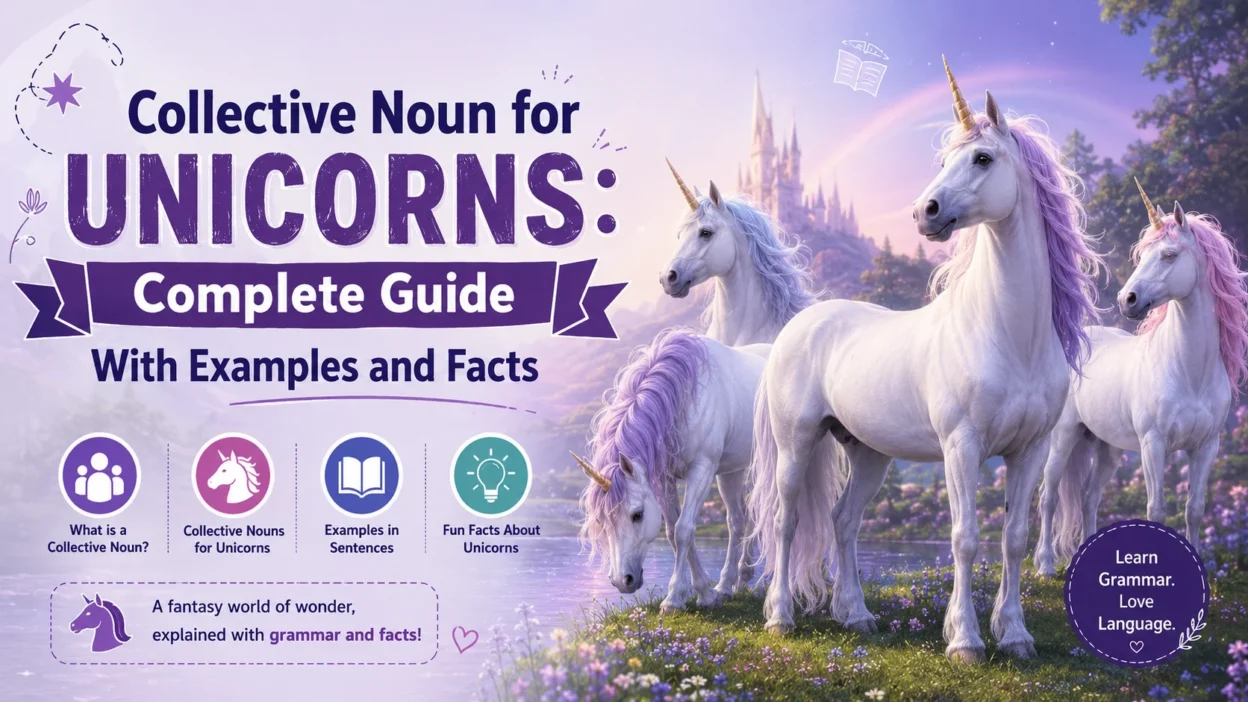
When learning the collective noun for unicorns, it helps to know that unicorns are mythical creatures without one universally accepted scientific or zoological group term. In everyday English, you can use group or herd, while fantasy writing often uses imaginative expressions such as blessing, shimmer, wonder, and rainbow. These creative and literary choices add a magical feeling and make descriptions more colorful and engaging. A blessing suggests something fortunate, while a shimmer focuses on a unicorn’s sparkling and beautiful appearance, including its shiny coats and beautiful horns. Since unicorns are often imagined as horse-like creatures, herds can sound natural in ordinary descriptions.
The history of unicorns stretches across centuries of mythology, folklore, literature, art, and modern fantasy. These legendary creatures have fascinated people because of their joy, magic, charm, and enchantment. In adventure-filled lands, language can give groups special names, just as a flock describes birds and a school describes fish. Fantasy sources may use Blessing, Glory, or Marvel to describe a group. A herd of unicorns galloping across a misty meadow and shimmering beneath moonlight creates a vivid image. In Unicornland or dusty, old bestiaries, each name can serve a particular purpose, although usage may vary between sources. Listings, examples, sentences, and phrases in context can therefore help students, teachers, and writers understand these rare, graceful, and imaginative creatures.
Unicorns have inspired writers, lovers of language, and people interested in storytelling throughout the ages. Their awe, ethereal beauty, spiraling horns, and symbolic purity make them especially useful in imaginative descriptions. When exploring their world, writers can add layers of fascination and magic to stories, art, and everyday dreams. These expressions can help inspire creative descriptions, express the essence of unicorns, and capture their charm. By observing how unicorns might live, move, and behave together, you can see how collective nouns enrich your vocabulary and make a transporting adventure feel more vivid. For a fantasy enthusiast, such language can create happiness and help fill hearts with a stronger sense of wonder.
What Are Collective Nouns?
Collective nouns are words used to describe a collection or group of people, animals, objects, or things as one unit. They make language shorter, clearer, and sometimes more expressive.
For example:
- A flock of birds
- A school of fish
- A pride of lions
- A herd of deer
- A pack of wolves
When talking about unicorns, the situation is different because unicorns belong to mythology rather than zoology. As a result, there is no single official collective noun comparable to herd of deer or pride of lions. Writers may choose different poetic expressions depending on the image or feeling they want to create.
Collective Nouns for Unicorns
| Collective Noun | Simple Example |
| Blessing | A blessing of unicorns crossed the meadow. |
| Shimmer | A shimmer of unicorns appeared near the forest. |
| Wonder | A wonder of unicorns gathered by the lake. |
| Rainbow | A rainbow of unicorns ran across the valley. |
| Dream | A dream of unicorns appeared in the story. |
| Magic | A magic of unicorns entered the enchanted forest. |
| Enchantment | An enchantment of unicorns appeared at sunset. |
Note: These are creative or literary expressions. There is no universally standardized collective noun for unicorns. In ordinary English, a group of unicorns or a herd of unicorns is also clear and understandable.
Blessing of Unicorns
The expression blessing of unicorns is one of the most attractive creative ways to describe a group of unicorns. The word blessing suggests something fortunate, beautiful, rare, and special.
Because unicorns are traditionally connected with purity, goodness, magic, and good fortune, this expression fits naturally into fantasy stories, poems, children’s books, and imaginative descriptions.
Examples of “Blessing of Unicorns”
- A blessing of unicorns crossed the green meadow.
- We watched a blessing of unicorns near the sparkling lake.
- The princess discovered a blessing of unicorns in the forest.
- A blessing of unicorns appeared at sunrise.
- The children saw a blessing of unicorns beside the castle.
- A blessing of unicorns wandered through the enchanted valley.
- The wizard protected a blessing of unicorns from danger.
- A blessing of unicorns gathered beneath the ancient trees.
- Tourists photographed a blessing of unicorns in the fantasy park.
- The story begins when a blessing of unicorns enters the kingdom.
Shimmer of Unicorns
Shimmer is a descriptive and imaginative collective noun that focuses on the sparkling appearance traditionally associated with unicorns. Modern fantasy often portrays unicorns with shining coats, glowing horns, magical colors, or sparkling surroundings.
The phrase a shimmer of unicorns therefore creates a strong visual image and works particularly well in creative writing.
Examples of “Shimmer of Unicorns”
- A shimmer of unicorns appeared beyond the trees.
- We saw a shimmer of unicorns near the river.
- A shimmer of unicorns crossed the moonlit meadow.
- The children followed a shimmer of unicorns through the garden.
- A shimmer of unicorns gathered beside the waterfall.
- The painting showed a shimmer of unicorns under the stars.
- A shimmer of unicorns moved quietly through the forest.
- The princess encountered a shimmer of unicorns at dawn.
- A shimmer of unicorns surrounded the magical castle.
- At sunset, a shimmer of unicorns appeared in the distance.
Wonder of Unicorns
The word wonder emphasizes the feeling of amazement and excitement that people might experience when seeing mythical creatures. A wonder of unicorns is therefore a suitable poetic expression for fantasy writing.
It can make a sentence sound more imaginative without suggesting that the expression is an official zoological term.
Examples of “Wonder of Unicorns”
- A wonder of unicorns stood quietly in the meadow.
- The traveler discovered a wonder of unicorns in the hidden valley.
- A wonder of unicorns appeared near the magical fountain.
- The children watched a wonder of unicorns cross the bridge.
- A wonder of unicorns gathered outside the castle.
- The old book described a wonder of unicorns in the mountains.
- A wonder of unicorns wandered through the enchanted forest.
- The artist painted a wonder of unicorns beneath a rainbow.
- A wonder of unicorns appeared during the festival.
- The legend tells of a wonder of unicorns protecting the kingdom.
Rainbow of Unicorns
Rainbow is a colorful and imaginative expression that can describe a group of unicorns with different colors, markings, or magical appearances.
Although it isn’t an established English collective noun, a rainbow of unicorns can be especially effective in children’s stories, fantasy descriptions, and creative writing.
Examples of “Rainbow of Unicorns”
- A rainbow of unicorns ran across the meadow.
- We saw a rainbow of unicorns near the enchanted castle.
- A rainbow of unicorns appeared after the magical storm.
- The children watched a rainbow of unicorns cross the valley.
- A rainbow of unicorns gathered beside the waterfall.
- The artist drew a rainbow of unicorns beneath the stars.
- A rainbow of unicorns entered the royal garden.
- The story describes a rainbow of unicorns beyond the mountains.
- A rainbow of unicorns made the festival look magical.
- At sunset, a rainbow of unicorns crossed the distant hills.
Dream, Magic, and Enchantment of Unicorns
Other creative expressions can also be used to describe groups of unicorns. A dream of unicorns suggests beauty and imagination, while a magic of unicorns emphasizes supernatural qualities. An enchantment of unicorns gives the group a mysterious and fantasy-focused feeling.
These terms are especially useful in fiction, poetry, fantasy novels, children’s literature, and imaginative storytelling. However, they should not be presented as official scientific classifications.
Examples of “Dream of Unicorns”
- A dream of unicorns appeared in the story.
- She imagined a dream of unicorns running through the forest.
- A dream of unicorns filled the child’s imagination.
- The painting showed a dream of unicorns beneath the stars.
- A dream of unicorns appeared beyond the silver mountains.
- The poet wrote about a dream of unicorns.
- A dream of unicorns wandered through the fantasy kingdom.
- The children created a dream of unicorns in their drawing.
- A dream of unicorns appeared in the magical book.
- The tale ends with a dream of unicorns crossing the horizon.
Examples of “Magic of Unicorns”
- A magic of unicorns entered the enchanted forest.
- The wizard discovered a magic of unicorns near the castle.
- A magic of unicorns appeared beneath the full moon.
- The story describes a magic of unicorns beyond the mountains.
- A magic of unicorns surrounded the ancient fountain.
- The children imagined a magic of unicorns in their garden.
- A magic of unicorns crossed the glowing bridge.
- The legend tells of a magic of unicorns protecting the kingdom.
- A magic of unicorns appeared in the artist’s painting.
- The travelers encountered a magic of unicorns at sunset.
Examples of “Enchantment of Unicorns”
- An enchantment of unicorns appeared beside the lake.
- The queen welcomed an enchantment of unicorns to the palace.
- An enchantment of unicorns crossed the magical meadow.
- The book tells the story of an enchantment of unicorns.
- An enchantment of unicorns gathered near the ancient tree.
- The wizard watched an enchantment of unicorns disappear into the mist.
- An enchantment of unicorns filled the valley with mystery.
- The children imagined an enchantment of unicorns flying through the clouds.
- An enchantment of unicorns appeared in the royal garden.
- The legend describes an enchantment of unicorns guarding hidden treasure.
Interesting Facts About Unicorns
Unicorns are among the world’s most recognizable mythical creatures, but they don’t have a scientifically confirmed existence as a real animal species. Their stories have developed through ancient accounts, mythology, folklore, medieval literature, art, and modern fantasy. The traditional European unicorn is generally imagined as a horse-like animal with a single horn growing from its forehead.
When it comes to longevity, there is no scientifically established lifespan because unicorns aren’t a verified biological species. Fantasy stories sometimes portray them as exceptionally long-lived, wise, or even immortal. These ideas are part of mythology and storytelling rather than established zoological facts.
Their supposed physiological features are also largely fictional. Traditional depictions usually give unicorns four legs, a horse-like body, a mane, a tail, and one spiral horn. Modern fantasy may add wings, glowing coats, magical powers, unusual colors, or other features. Different cultures and stories can therefore portray unicorns in very different ways.
Unicorns also have no scientifically established diet. Since they are commonly depicted as horse-like creatures, writers often imagine them eating grass, leaves, flowers, herbs, fruit, grains, and other plant material. Fantasy stories sometimes take a more magical approach and portray unicorns as feeding on enchanted plants, moonlight, or other supernatural substances.
One particularly interesting fact is that the unicorn’s single horn has helped distinguish it from ordinary horse-like creatures in legends. In European folklore, the horn was sometimes believed to have extraordinary powers. This belief contributed to the unicorn’s association with purity, healing, protection, and magic.
Another fascinating point is that the idea of a unicorn has changed over time. Earlier descriptions were not always identical to the modern white, elegant horse-like creature familiar today. Different cultures have described one-horned creatures in different ways, showing how mythology can evolve as stories travel between languages, regions, and generations.
Why Learning Collective Nouns for Unicorns Matters
Learning the collective noun for unicorns is useful because it demonstrates how language can combine meaning, imagery, culture, and creativity. Unlike ordinary animal collective nouns, unicorn expressions often communicate an additional feeling.
For example, blessing suggests good fortune, shimmer suggests brightness, wonder suggests amazement, and rainbow suggests color and beauty. This makes collective expressions useful not only for identifying a group but also for creating a particular atmosphere.
Understanding the difference between standard vocabulary and creative language is equally important. You can confidently use a group of unicorns in general writing, while expressions such as a blessing of unicorns are more suitable for fantasy or poetic contexts.
Conclusion
The collective noun for unicorns doesn’t have one official scientific answer because unicorns are mythical creatures. In creative English, terms such as blessing, shimmer, wonder, rainbow, Glory, and Marvel can describe a group in an imaginative way. You can also use group or herd, especially when unicorns are imagined as horse-like animals. The best choice depends on your context, writing style, and the feeling you want to create.
FAQs
Q1. What is the collective noun for unicorns?
There is no universally accepted collective noun for unicorns. Blessing, shimmer, wonder, and rainbow are creative expressions sometimes used in fantasy writing.
Q2. What is the most common collective noun for unicorns?
Blessing is often presented as a popular imaginative collective noun for unicorns, although it isn’t an official zoological term.
Q3. Can I say a herd of unicorns?
Yes. A herd of unicorns is understandable and natural, especially because unicorns are traditionally imagined as horse-like creatures.
Q4. Is “a blessing of unicorns” correct?
Yes, a blessing of unicorns can be used in creative or literary writing. It gives the group a magical and fortunate quality.
Q5. Is “shimmer of unicorns” a real collective noun?
Shimmer of unicorns is a creative expression rather than a standardized scientific collective noun. It highlights their sparkling appearance.
Q6. Why don’t unicorns have an official collective noun?
Unicorns are mythical creatures, not a recognized living animal species. Therefore, they don’t have a standardized zoological collective noun.
Q7. What other names can describe a group of unicorns?
Creative writing may use Blessing, Glory, Marvel, shimmer, wonder, or rainbow of unicorns. Their use depends on the writer and context.
Q8. Can I use “group of unicorns” in formal writing?
Yes. A group of unicorns is clear, simple, and unlikely to confuse readers. It’s a good choice when you don’t need a poetic or imaginative expression.
Q9. Is “Glory of unicorns” grammatically correct?
Yes. A glory of unicorns can work as a creative collective expression. However, it shouldn’t be treated as an official zoological term.
Q10. Which collective noun should I use for unicorns?
Choose herd or group for straightforward writing and expressions such as blessing or shimmer for fantasy, literary, or creative descriptions.