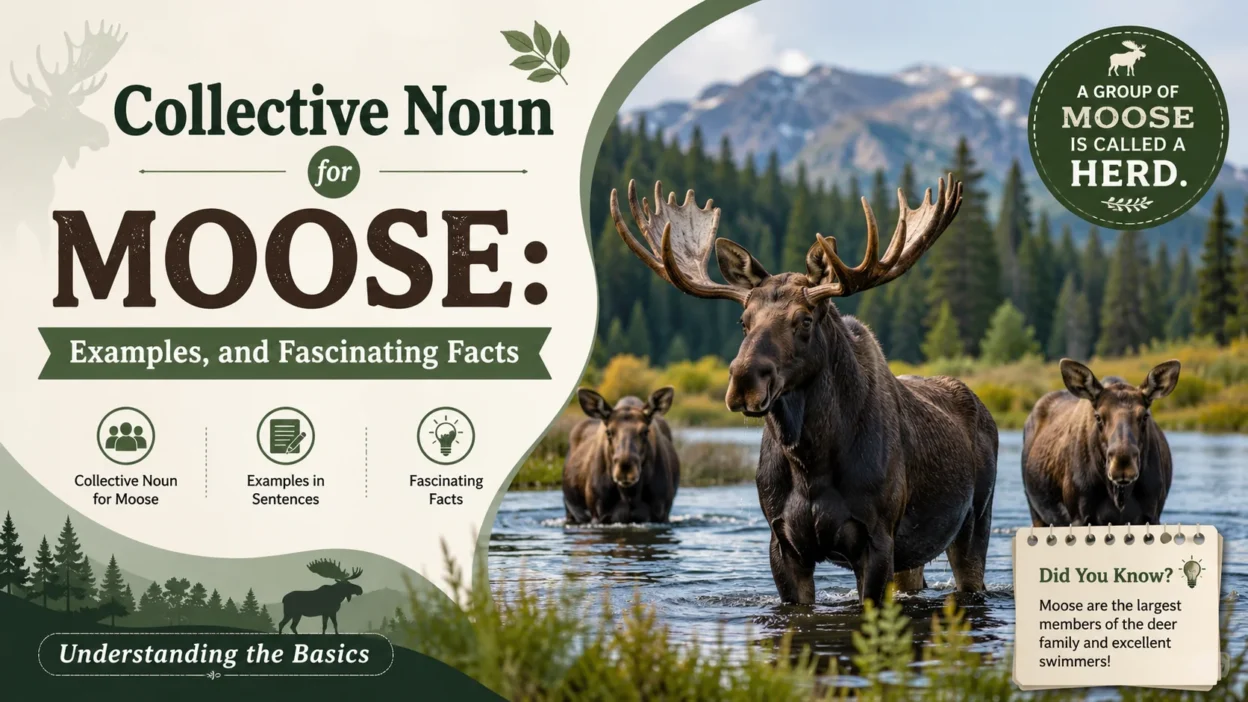
The Collective Noun for Moose is herd, which is the standard and widely recognized term for a group of moose. A collective noun helps describe animals as one unit, making language more precise and interesting. For example, English uses flock for birds, pack for wolves, and herd for deer. Therefore, a herd of moose is the most natural expression when referring to multiple moose together. Reputable collective-noun references also commonly list herds for moose.
Moose are the largest members of the deer family and usually live in northern forests, wetlands, and around lakes in cold regions. They can gather in groups, but they aren’t always strongly social animals. Unlike bison and some species of deer, moose don’t necessarily form a permanent social group. Because of this, the phrase a herd of moose describes several moose seen together without saying that they always stay together. This simple distinction makes the term useful when discussing animal behavior.
Learning the correct collective noun can help with English vocabulary and improve everyday writing. When you see several moose together, saying a herd of moose clearly identifies the animals as a group without repeating the individual noun. In my experience with English usage, this is one of those simple grammar points that becomes much easier once you connect the word herd with animals such as moose and deer. Understanding this connection also shows how language can reflect what we know about animals while making communication clearer and more natural.
What Is the Collective Noun for Moose?
The primary collective noun for moose is herd.
A Herd of Moose
The standard expression is “a herd of moose.” A herd refers to several animals of the same species that are together in one area or moving together. The word herd is commonly used for many large mammals, including deer, cattle, bison, and other hoofed animals.
| Type | Simple Example |
| Collective noun | Herd |
| Animal | Moose |
| Complete phrase | A herd of moose |
| Singular example | A moose is standing near the lake. |
| Plural example | Several moose are crossing the road. |
| Collective example | A herd of moose is moving through the forest. |
The word moose is unusual because its singular and plural forms are identical. We say one moose and ten moose, not “mooses.” The collective expression simply places the herd before of moose.
Simple Example Sentences
- A herd of moose crossed the quiet road.
- We saw a herd of moose near the lake.
- A herd of moose moved through the forest.
- The herd of moose was feeding on leaves.
- A herd of moose appeared at dawn.
- The photographer watched a herd of moose from a distance.
- A herd of moose rested beside the river.
- The guide spotted a herd of moose in the valley.
- A herd of moose walked slowly through the snow.
- The herd of moose disappeared into the trees.
How to Use “Herd of Moose” Correctly
Using a herd of moose correctly is simple. The structure is:
a herd + of + moose
For example:
A herd of moose is moving through the forest.
Here, herd is the collective noun, while moose identifies the animals in the group.
In American English, collective nouns such as herd are generally treated as singular when the group is being considered as one unit. Therefore, “The herd is moving” is the usual construction. British English can sometimes use plural agreement when attention is focused on the individual members, although singular agreement is also perfectly natural.
Simple Example Sentences
- The herd of moose is resting.
- A herd of moose is walking toward the water.
- The herd is eating leaves.
- We watched the herd from a safe distance.
- The herd of moose is moving slowly.
- A large herd of moose was seen near the highway.
- The herd entered the forest.
- The herd of moose stayed near the wetland.
- A small herd was feeding beside the trees.
- The herd moved away when people approached.
Can You Say “A Gang of Moose”?
Some animal-group lists also give gang as an alternative collective noun for moose. However, herd is the safer and more widely recognized choice, especially in formal writing, educational content, and general English.
This distinction matters because animal collective nouns found in word lists aren’t necessarily equally common in everyday English. Gang of moose can be encountered in lists of animal group names, but it shouldn’t be presented as being as standard or common as a herd of moose.
If you’re writing an article, school assignment, wildlife report, or general piece of English, “a herd of moose” is the best choice.
Simple Example Sentences
- A gang of moose was mentioned in the old animal-word list.
- The guide explained that some sources use “gang” for moose.
- We learned that “herd” is more common than “gang” for moose.
- The word “gang” sometimes appears in lists of animal group names.
- The children asked whether “gang of moose” was correct.
- The teacher recommended using “herd of moose” in the assignment.
- Some online lists describe a gang of moose.
- The wildlife article used “herd” instead of “gang.”
- A writer may encounter “gang” while researching collective nouns.
- “Herd of moose” remains the clearest choice for everyday English.
Herd of Moose vs. Other Expressions
Not every phrase used to describe multiple moose is a specialized collective noun. You can also use ordinary plural expressions such as a group of moose, several moose, or many moose.
The important point is that herd is the recognized collective noun specifically associated with moose. Collins, for example, lists gang for elk while its animal collective-noun list does not list moose separately, whereas other collective-noun references explicitly list herd of moose.
| Expression | Meaning | Example |
| A herd of moose | Standard collective expression | A herd of moose crossed the valley. |
| A group of moose | General description | A group of moose stood near the lake. |
| Several moose | Simple plural | Several moose were eating leaves. |
| Many moose | General plural expression | Many moose live in northern regions. |
| A gang of moose | Alternative found in some lists | Some sources use a gang of moose. |
Simple Example Sentences
- A group of moose stood near the lake.
- Several moose were eating beside the trees.
- Many moose live in northern forests.
- A herd of moose crossed the meadow.
- We saw several moose near the road.
- The group moved toward the water.
- A herd appeared between the trees.
- Many moose feed on plants and shrubs.
- Several moose were swimming across the lake.
- The herd slowly disappeared into the forest.
Moose Behavior and Why “Herd” Is Useful
The word herd describes a group of animals, but it doesn’t mean that every animal in the group has a permanently social lifestyle. Moose are generally more solitary than many other members of the deer family. They may come together in certain circumstances, especially around food, favorable habitats, or during the breeding season.
Male moose, called bulls, and female moose, called cows, generally have different patterns of behavior. During the autumn rut, bulls become more interested in finding mates and may interact aggressively with other males. Bulls also grow large, palmate antlers that they use during competition.
A group of moose may therefore be temporary rather than a permanent family unit. The phrase herd of moose describes the animals when they are gathered together, while it doesn’t necessarily claim that they maintain a constant group structure.
Simple Example Sentences
- The herd gathered near a rich feeding area.
- The moose moved through the forest separately.
- A herd appeared near the wetland.
- The animals came together near the water.
- The herd moved away when it heard a noise.
- Moose can spend much of their time alone.
- The herd was seen during the early morning.
- Several moose gathered near the plants.
- The bull moose stood apart from the others.
- The herd eventually disappeared into the woodland.
Interesting Facts About Moose
Moose have several remarkable biological characteristics that make them fascinating animals to study. Their size is one of their most obvious features. They are the largest members of the deer family, and adult bulls can develop enormous, broad antlers. These antlers are shed and regrown annually, making them an impressive example of seasonal biological growth.
Moose also have specialized physical features that help them survive in challenging environments. Their long legs allow them to move through deep snow, uneven ground, and wet habitats. Their large noses and lips help them browse on vegetation, while their bodies are well adapted to cold climates. Moose are also surprisingly capable swimmers and can travel through lakes and other bodies of water.
Their diet is another fascinating feature. Moose are herbivores, meaning they eat plants rather than meat. They browse on leaves, twigs, shoots, bark, and aquatic vegetation. During warmer months, they may enter ponds and lakes to feed on aquatic plants. Some aquatic vegetation provides minerals such as sodium that can be valuable to moose.
Moose generally live for many years in the wild, although lifespan varies depending on habitat, predators, disease, accidents, hunting pressure, and other environmental factors. Their survival depends heavily on access to suitable food, shelter, water, and safe habitat.
Simple Example Sentences
- Moose eat leaves, twigs, and other plants.
- A bull moose grows large antlers every year.
- Moose can swim across large lakes.
- Moose use their long legs to move through deep snow.
- Moose often feed near wetlands.
- A moose may eat aquatic plants during summer.
- Moose are herbivores.
- Their broad antlers are one of their most recognizable features.
- Moose are well adapted to cold environments.
- Their diet changes with the plants available in their habitat.
Conclusion
The collective noun for moose is herd, and a herd of moose is the most natural expression. Although moose may gather in groups, they aren’t always highly social or part of a permanent group. Using a herd correctly makes your English clearer and helps you describe moose naturally.
FAQs
Q1. What is the collective noun for moose?
The most widely recognized collective noun for moose is herd. You can say a herd of moose when referring to several moose together.
Q2. Is “herd of moose” grammatically correct?
Yes. A herd of moose is grammatically correct and is the standard expression used to describe a group of moose.
Q3. What do you call a group of moose?
A group of moose is commonly called a herd. For example: “We saw a herd of moose near the lake.”
Q4. Is “pack of moose” correct?
No. Pack isn’t the standard collective noun for moose. Herd is the more appropriate term.
Q5. Do moose always live in herds?
No. Moose can gather in groups, but they’re generally less social than some other animals. A group of moose doesn’t necessarily represent a permanent social unit.
Q6. Why is “herd” used for moose?
Herd is traditionally used for various hoofed mammals, including members of the deer family. Since moose belong to the deer family, herd is a natural term for them.
Q7. What is the plural of moose?
The plural of moose is also moose. You can say “one moose” or “several moose,” rather than “mooses.”
Q8. Can I say “a herd of mooses”?
No. The correct expression is “a herd of moose” because moose has the same singular and plural form.
Q9. Is “herd” the only possible word for a group of moose?
Herd is the standard and widely recognized choice. Other creative terms may appear in informal or unusual sources, but here is the safest choice in standard English.
Q10. What is an example of “herd of moose” in a sentence?
A simple example is: “A herd of moose was grazing near the wetlands.” Here, the herd identifies the group, while moose names the animals.