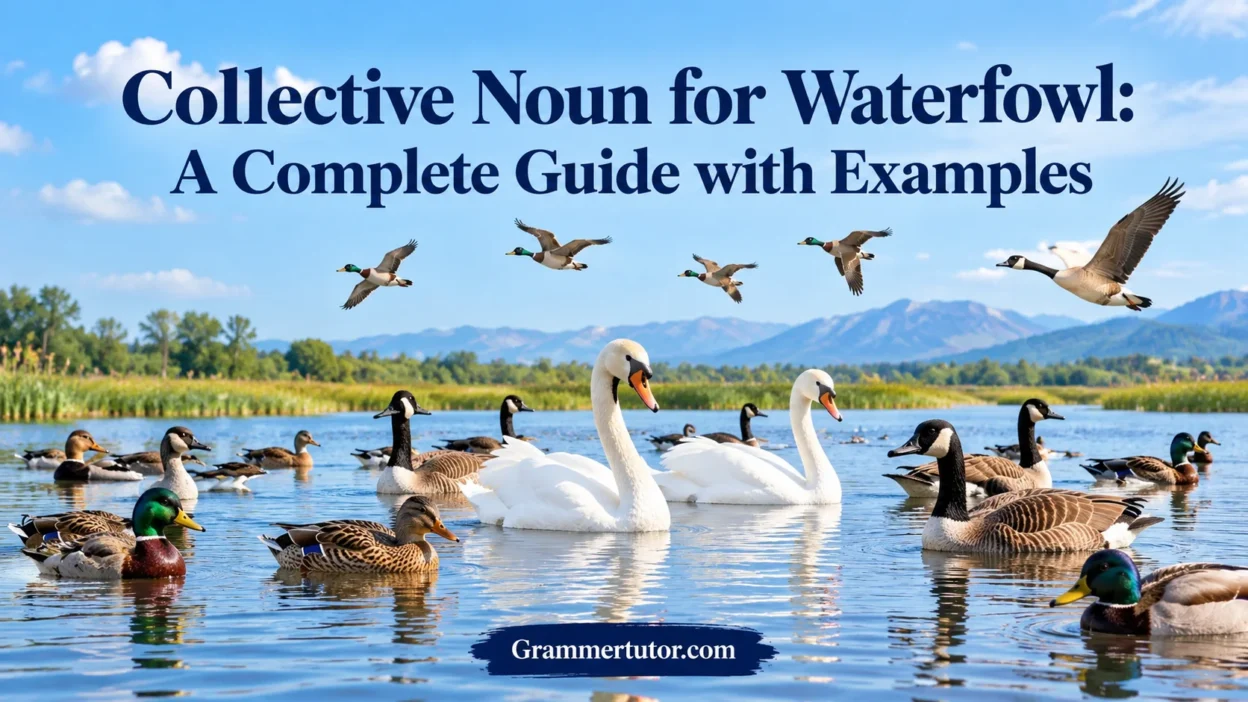
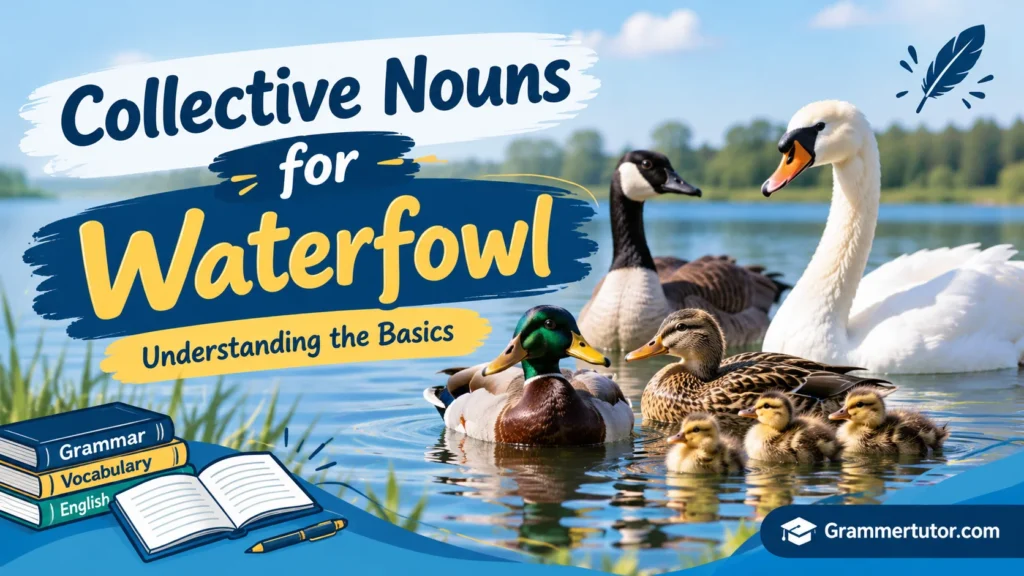
The collective noun for waterfowl helps describe groups of water-loving birds, including ducks, geese, and swans, in a clear and natural way. A collective noun is a word that refers to several people, animals, or things as one group. Waterfowl live around aquatic habitats such as lakes, rivers, ponds, and wetlands. Common terms include flock, raft, gaggle, and skein, although the correct term depends on the type of bird and what it is doing.
Each expression can describe a different gathering. A raft of ducks usually refers to ducks swimming together on the water, while a gaggle of geese often describes geese gathered on the ground. A flock is a more general term for a group of birds, and skein is commonly used for geese or other birds flying in a line or formation. Learning these expressions helps you describe bird behavior and groups of birds accurately when writing about wildlife, studying grammar, or observing birds in nature.
Learning collective nouns for waterfowl can improve vocabulary and make your writing more interesting. Instead of using the same general words repeatedly, choose a term that suits the situation. For example, “A raft of ducks moved across the lake” creates a clearer picture than simply saying “birds were in the water.” Using suitable English vocabulary helps you describe birds and write accurate descriptions, clearer descriptions, and interesting descriptions of different bird groups in their waterfowl habitats. These terms are useful when talking about water birds, including ducks, geese, and swans.
Why Collective Nouns Are Used for Waterfowl
Waterfowl often gather in groups to feed, rest, swim, migrate, and protect themselves from predators. Since these birds frequently live or travel together, collective nouns provide convenient ways to describe their behavior.
The word flock is a general term for a group of waterfowl. Other expressions can be more specific. For example, raft is commonly used for ducks floating together on water, while gaggle traditionally refers to geese on the ground. A group of geese flying together may be described as a skein, especially when they form a loose line or formation.
These terms make everyday English more descriptive and help readers picture how the birds are gathered.
Collective Nouns for Waterfowl
| Collective Noun | Used For | Simple Example |
| Flock | A general group of waterfowl | A flock of waterfowl flew over the lake. |
| Raft | Ducks floating together on water | A raft of ducks rested on the pond. |
| Gaggle | Geese gathered on the ground | A gaggle of geese walked across the grass. |
| Skein | Geese flying together | A skein of geese crossed the sky. |
| Team | A general group in a descriptive context | A team of waterfowl moved across the wetland. |
Flock of Waterfowl
A flock of waterfowl is the most widely understood general expression for a group of ducks, geese, swans, or other water-associated birds. It can be used when the birds are flying, feeding, resting, or gathering near water.
This is the safest and most natural choice when you do not need to identify a particular bird species or activity.
Examples of “Flock of Waterfowl”
- A flock of waterfowl flew across the lake.
- We saw a flock of waterfowl near the river.
- A flock of waterfowl rested beside the pond.
- The flock of waterfowl moved toward the wetlands.
- A flock of waterfowl searched for food.
- The children watched a flock of waterfowl swimming together.
- A flock of waterfowl landed on the water.
- The flock of waterfowl flew south for the winter.
- A flock of waterfowl gathered near the reeds.
- We photographed a flock of waterfowl at sunrise.
Raft of Ducks
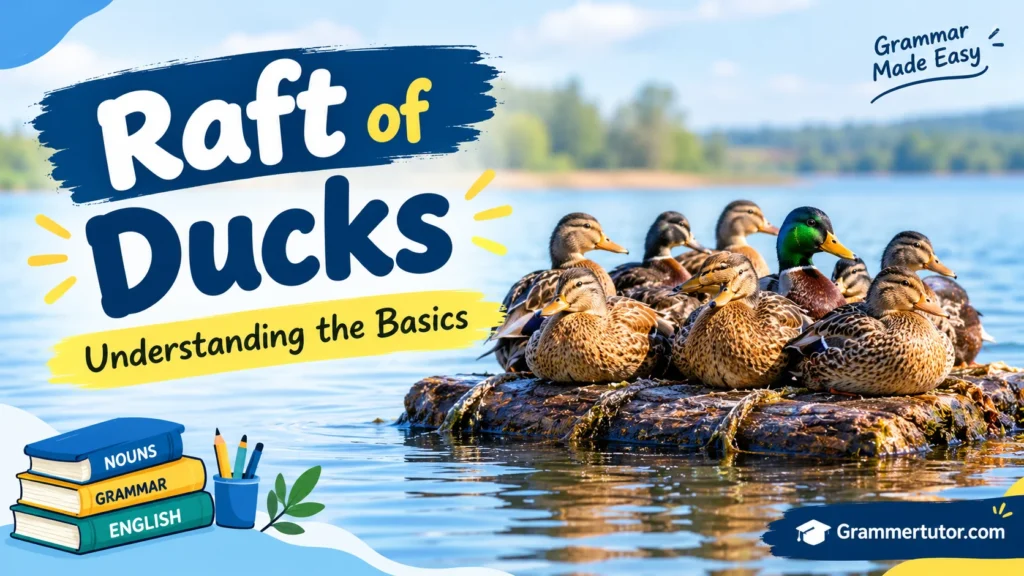
A raft of ducks refers to a group of ducks floating together on water. The word raft creates a clear picture of ducks gathered closely on a pond, lake, or river.
This expression is especially useful when describing ducks resting, swimming, or feeding on the water.
Examples of “Raft of Ducks”
- A raft of ducks floated across the pond.
- We watched a raft of ducks near the shore.
- A raft of ducks rested on the calm lake.
- The raft of ducks moved toward the reeds.
- A raft of ducks gathered in the middle of the river.
- The children observed a raft of ducks from the bridge.
- A raft of ducks swam around the pond.
- The raft of ducks searched for food in the water.
- A raft of ducks drifted peacefully beneath the trees.
- We photographed a raft of ducks on a sunny morning.
Gaggle of Geese
A gaggle of geese is a traditional collective noun for geese gathered on the ground. Geese often gather in parks, fields, grassy areas, and near lakes to feed or rest.
The term is particularly associated with geese on land. When geese are flying, other expressions, including skein, may be used.
Examples of “Gaggle of Geese”
- A gaggle of geese walked across the field.
- We saw a gaggle of geese beside the lake.
- A gaggle of geese searched for grass.
- The gaggle of geese rested near the pond.
- A gaggle of geese gathered in the park.
- The farmer watched a gaggle of geese near the barn.
- A gaggle of geese crossed the grassy path.
- The gaggle of geese made loud honking sounds.
- A gaggle of geese moved toward the water.
- We photographed a gaggle of geese in the meadow.
Skein of Geese
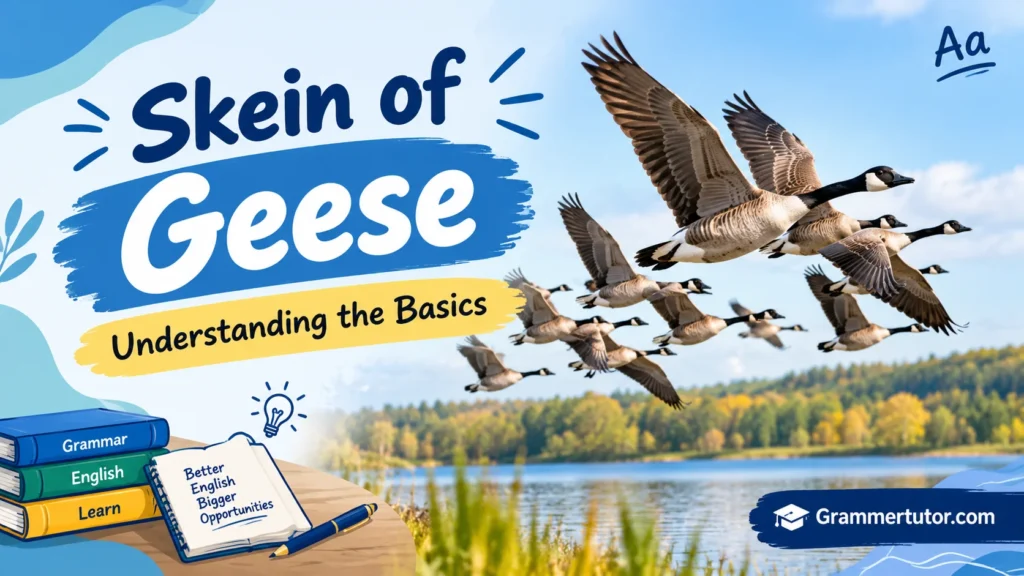
A skein of geese is a collective noun used for geese flying together, particularly in a line or loose formation across the sky. Geese often fly in recognizable formations during migration.
This expression is useful in wildlife writing because it describes both the group and the way the birds appear in flight.
Examples of “Skein of Geese”
- A skein of geese flew across the sky.
- We watched a skein of geese above the lake.
- A skein of geese traveled south for the winter.
- The skein of geese passed over the village.
- A skein of geese appeared at sunset.
- The photographer captured a skein of geese in flight.
- A skein of geese flew above the fields.
- The skein of geese followed the river.
- We heard a skein of geese honking overhead.
- A skein of geese disappeared beyond the mountains.
Group of Waterfowl
A group of waterfowl is a simple, general expression for several water-associated birds gathered together. It is not a specialized collective noun, but it is completely correct and useful when the species or activity is unknown.
You can use this phrase when describing ducks, geese, swans, or mixed groups of water birds.
Examples of “Group of Waterfowl”
- A group of waterfowl gathered near the lake.
- We saw a group of waterfowl in the wetland.
- A group of waterfowl swam across the river.
- The group of waterfowl rested beside the reeds.
- A group of waterfowl searched for food.
- The photographer observed a group of waterfowl.
- A group of waterfowl landed on the pond.
- The group of waterfowl moved toward the shore.
- We watched a group of waterfowl at sunrise.
- A group of waterfowl flew over the marsh.
Types of Waterfowl and Their Characteristics
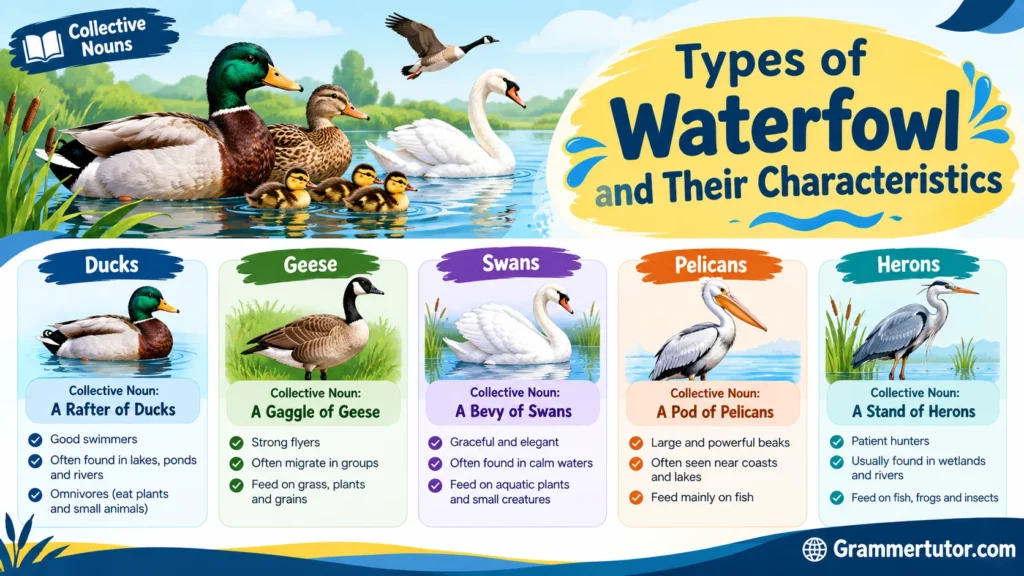
Waterfowl include several kinds of birds adapted to life in or around water. Ducks are often recognized by their broad bills, webbed feet, and ability to swim. Geese are generally larger than many ducks and are known for their strong social bonds and distinctive honking calls. Swans are large waterbirds with long necks and graceful movements.
Many waterfowl have waterproof feathers that help keep their bodies insulated while swimming. They also have webbed feet that provide propulsion in water. Depending on the species, their diets may include aquatic plants, seeds, grasses, insects, small aquatic animals, and other food sources.
Some waterfowl migrate seasonally to find suitable breeding grounds and food. During migration, large groups may travel together, making collective nouns such as flock and skein useful for describing their movements.
Examples of Waterfowl Characteristics
- Ducks commonly have broad bills.
- Many waterfowl have webbed feet.
- Geese often produce loud honking calls.
- Swans are known for their long necks.
- Many waterfowl have waterproof feathers.
- Some waterfowl migrate seasonally.
- Waterfowl can live in lakes and wetlands.
- Many species feed on aquatic plants.
- Some waterfowl eat insects and small aquatic animals.
- Waterfowl may gather in large flocks.
Interesting Facts About Waterfowl
Waterfowl are remarkable birds with a variety of physical adaptations and behaviors. Their lifespans vary considerably depending on the species, habitat, food supply, predators, and other environmental conditions. Some ducks live for several years in the wild, while certain geese and swans can survive for decades under favorable conditions.
One of their most useful physical features is their water-resistant plumage. Waterfowl use oil from a gland near the base of the tail to help maintain their feathers, supporting insulation and water resistance. Their webbed feet also help many species paddle efficiently, while their bills are adapted to different feeding methods. Some ducks filter small organisms and plant material from water, whereas other species graze on grasses or search for aquatic animals.
Waterfowl have varied dietary habits. Depending on the species, they may eat seeds, grains, grasses, leaves, aquatic plants, insects, mollusks, and small fish. Their feeding behavior can change with the seasons and the availability of food.
Their social behavior is another interesting feature. Many waterfowl gather in groups for feeding, resting, breeding, and migration. Some species form strong pair bonds, and many gather in large flocks outside the breeding season. These habits explain why English uses different group expressions, such as flock of waterfowl, raft of ducks, and gaggle of geese.
READ MORE: Collective Nouns for Barracuda: A Complete Guide with Examples
Conclusion
The collective noun for waterfowl depends on the type of bird and the situation. Common terms include flock, raft, gaggle, and skein. For example, a raft of ducks describes ducks swimming together, while a gaggle of geese often refers to geese gathered on the ground. Learning these collective nouns improves your English vocabulary and helps you describe birds more clearly and accurately in everyday conversations, school assignments, and wildlife writing.
FAQs
Q1. What is the collective noun for waterfowl?
The most common general collective noun is flock. For example, a flock of waterfowl flew over the lake.
Q2. What is a group of ducks called?
A group of ducks is generally called a flock. When ducks are floating together on water, the expression raft of ducks is also commonly used.
Q3. What is a group of geese called?
A group of geese on the ground is traditionally called a gaggle of geese. Geese flying together may be described as a skein of geese.
Q4. Why do waterfowl gather in groups?
Waterfowl gather for several reasons, including feeding, resting, migration, breeding, and protection from predators. Their behavior varies by species and season.
Q5. Are ducks, geese, and swans all waterfowl?
Yes. Ducks, geese, and swans are all commonly classified as waterfowl. They are adapted to aquatic or wetland environments, although their habitats and feeding behaviors differ.