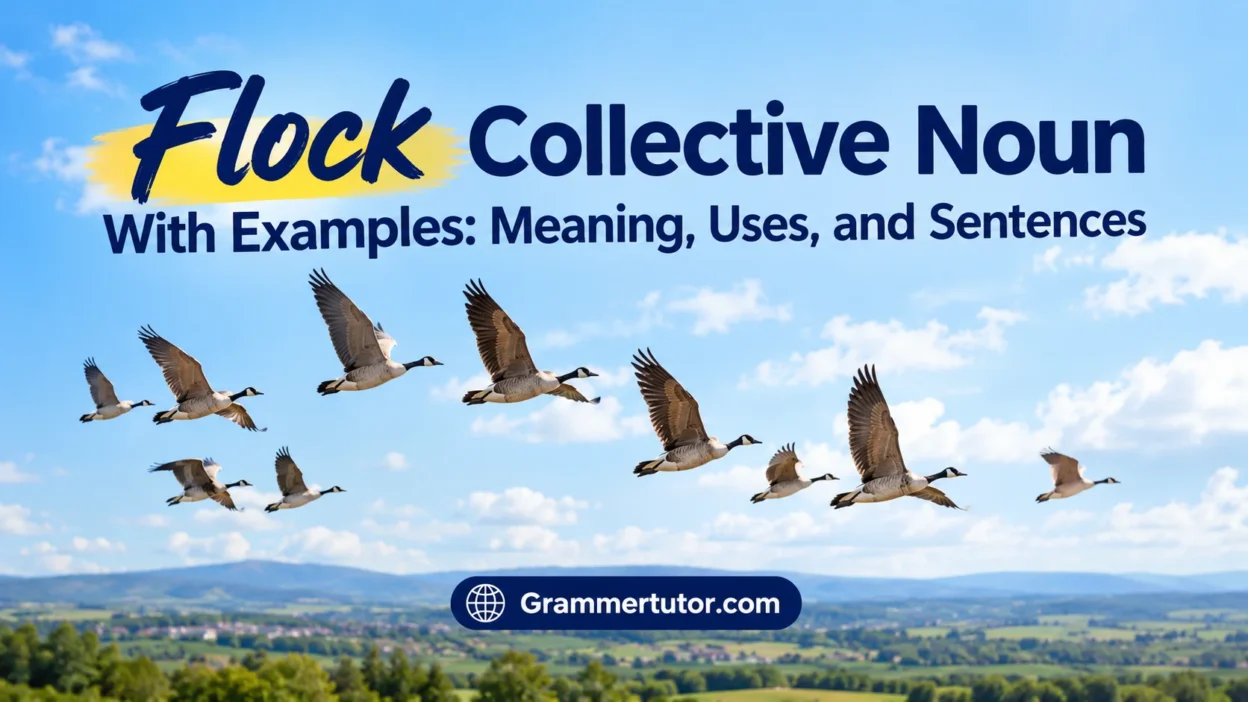
The flock collective noun with examples helps explain how flock describes a group or number of birds or animals moving together naturally. You may use it with pigeons, sparrows, geese, ducks, and sheep. Instead of mentioning every animal separately, flock lets you describe the whole group in a short, natural way.
For example, twenty birds flying together can be called a flock of birds. This makes the sentence easier to read and gives a clearer picture of birds moving or staying together. In everyday English and descriptive writing, this collective noun makes descriptions simple and clear. From my experience explaining English terms, using a familiar scene like birds flying together makes the meaning easier to remember.
The word flock also works in different situations, depending on the context. Animals may be traveling, feeding, resting, or moving together, and learning how to use this word can improve your English. You can therefore describe a number of animals, number of birds, group of animals, or group of birds without repeating each individual animal.
What Does Flock Mean as a Collective Noun?
A flock is a collective noun because it represents multiple individuals as one group. The expression a flock of birds is one of the most familiar examples of a collective noun in English.
Flock is especially common with birds that naturally gather together. It can describe a group flying through the sky, sitting on trees, searching for food, or resting on the ground.
The word is also commonly used for sheep. In this case, a flock of sheep refers to several sheep being kept or moving together, often under the care of a shepherd.
The exact meaning of flock depends on the context, but the main idea remains the same: several animals are being considered as a group.
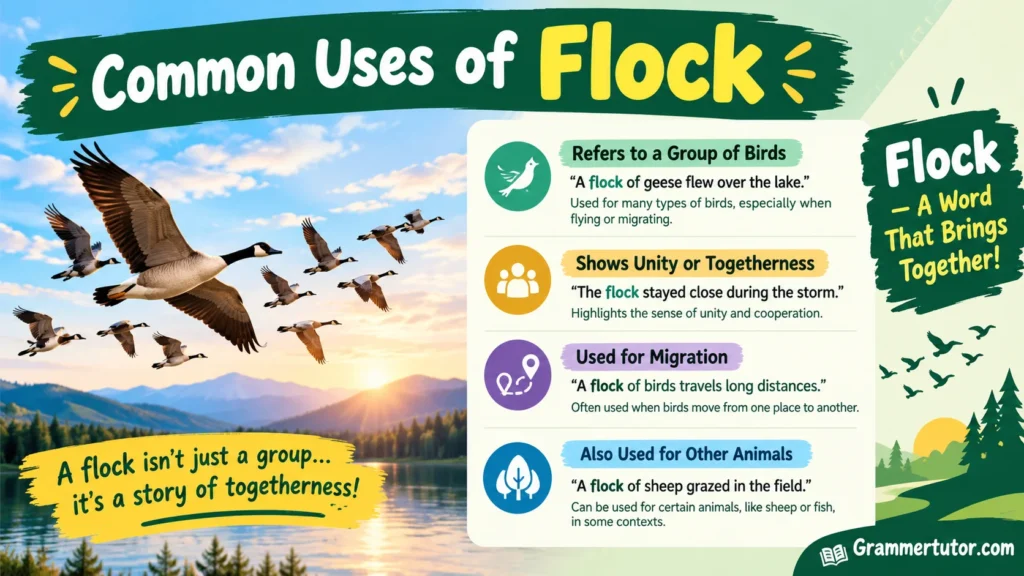
Common Uses of Flock
| Collective Noun | Used For | Simple Example |
| Flock of birds | Several birds together | A flock of birds flew over the lake. |
| Flock of pigeons | Several pigeons together | A flock of pigeons landed in the square. |
| Flock of geese | Several geese together | A flock of geese crossed the field. |
| Flock of ducks | Several ducks together | A flock of ducks swam across the pond. |
| Flock of sheep | Several sheep together | A flock of sheep grazed on the hill. |
Flock of Birds
A flock of birds is one of the most common uses of the word flock. It can refer to birds flying together, feeding together, resting in the same place, or moving from one location to another.
Examples of “Flock of Birds”
- A flock of birds flew across the blue sky.
- We watched a flock of birds near the lake.
- A flock of birds landed on the trees.
- The flock of birds moved toward the mountains.
- A flock of birds gathered in the garden.
- She photographed a flock of birds at sunrise.
- The flock of birds suddenly changed direction.
- A flock of birds rested on the branches.
- We saw a flock of birds flying above the field.
- The flock of birds disappeared into the distance.
Flock of Pigeons
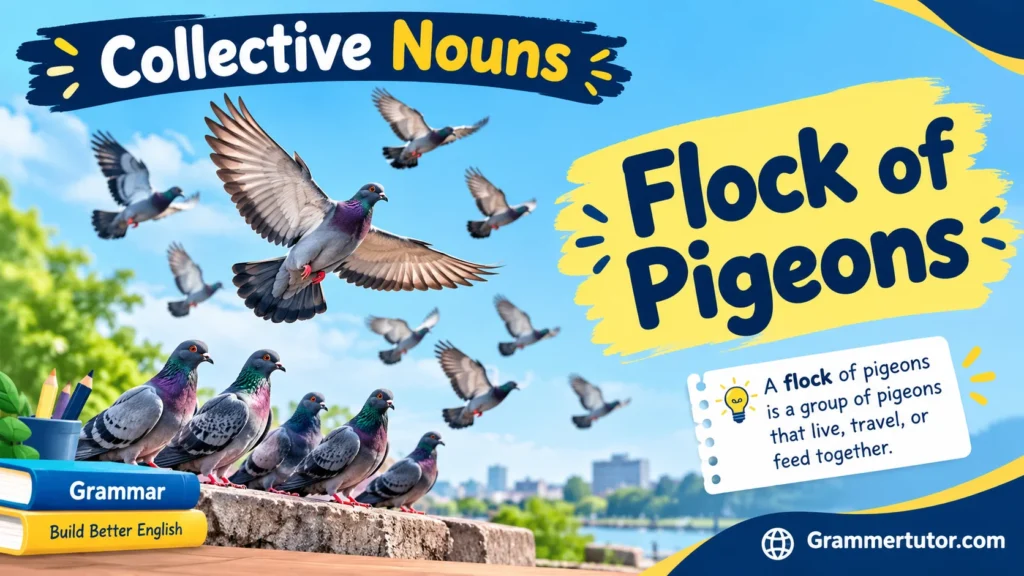
The phrase a flock of pigeons describes several pigeons gathered together. Pigeons often move in groups while searching for food, resting, or flying between locations.
Examples of “Flock of Pigeons”
- A flock of pigeons gathered in the town square.
- We saw a flock of pigeons near the fountain.
- A flock of pigeons flew over the building.
- The flock of pigeons landed on the roof.
- A flock of pigeons searched for food.
- The children watched a flock of pigeons in the park.
- A flock of pigeons rose into the air.
- The flock of pigeons moved toward the trees.
- A flock of pigeons rested on the pavement.
- We photographed a flock of pigeons near the station.
Flock of Geese
A flock of geese refers to several geese gathered together. Geese may travel in groups, particularly when moving between feeding and resting areas or during migration.
Examples of “Flock of Geese”
- A flock of geese flew over the lake.
- We saw a flock of geese near the river.
- A flock of geese landed in the field.
- The flock of geese moved toward the water.
- A flock of geese crossed the open grassland.
- The farmer watched a flock of geese nearby.
- A flock of geese rested beside the pond.
- The flock of geese flew away at sunset.
- We heard a flock of geese calling from the lake.
- A flock of geese gathered near the wetland.
Flock of Ducks
The expression a flock of ducks can be used for several ducks considered as one group. Ducks may gather together while swimming, feeding, resting, or moving around wetlands.
Examples of “Flock of Ducks”
- A flock of ducks swam across the pond.
- We noticed a flock of ducks near the river.
- A flock of ducks gathered beside the lake.
- The flock of ducks moved toward the shore.
- A flock of ducks searched for food.
- The children watched a flock of ducks swimming.
- A flock of ducks flew over the water.
- The flock of ducks rested near the reeds.
- We photographed a flock of ducks at the lake.
- A flock of ducks disappeared behind the bushes.
Flock of Sheep
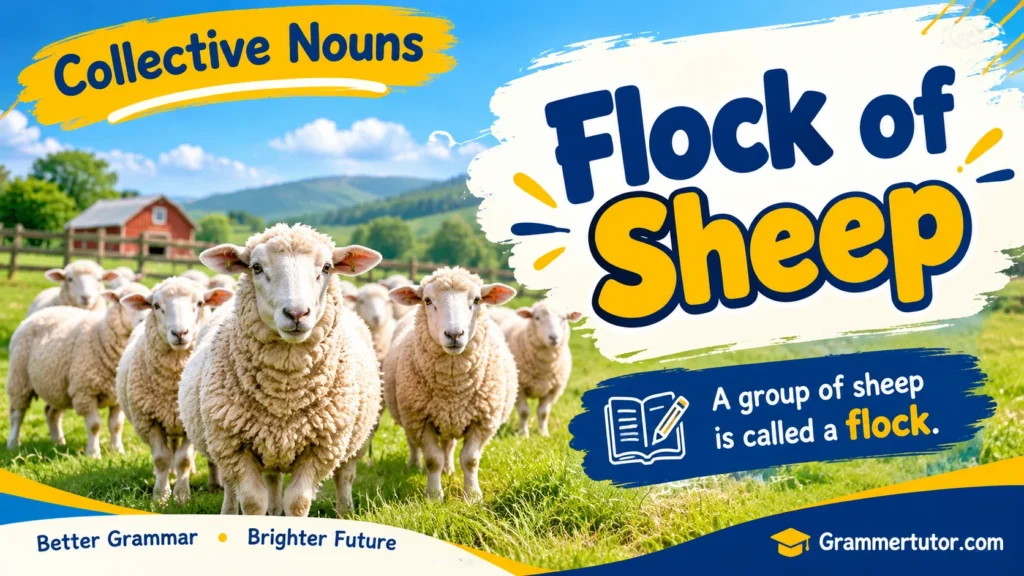
The phrase a flock of sheep is another well-known use of the word flock. Unlike birds, sheep do not fly, but they commonly stay and move together as a managed group.
Examples of “Flock of Sheep”
- A flock of sheep grazed on the hillside.
- The shepherd watched his flock of sheep.
- A flock of sheep crossed the road.
- We saw a flock of sheep in the field.
- The flock of sheep moved toward the barn.
- A flock of sheep rested beneath the trees.
- The farmer guided the flock of sheep home.
- The flock of sheep was eating fresh grass.
- A flock of sheep gathered near the fence.
- The shepherd led the flock of sheep across the pasture.
Why Is Flock Used for Groups of Animals?
The word flock is useful because it allows speakers and writers to describe many animals with a single expression. It is especially helpful when the animals are behaving as a group.
For example, a flock of birds immediately suggests several birds gathered or moving together. The expression is shorter than saying many birds that are flying together.
Flock is also useful in descriptive writing because it can make a scene easier to imagine. A sentence such as “A flock of birds suddenly rose from the trees” creates a clear picture of coordinated movement.
The word does not necessarily mean that every member of the group is behaving in exactly the same way. It simply identifies the animals as a group.
Interesting Facts About Flocks and Group Behavior
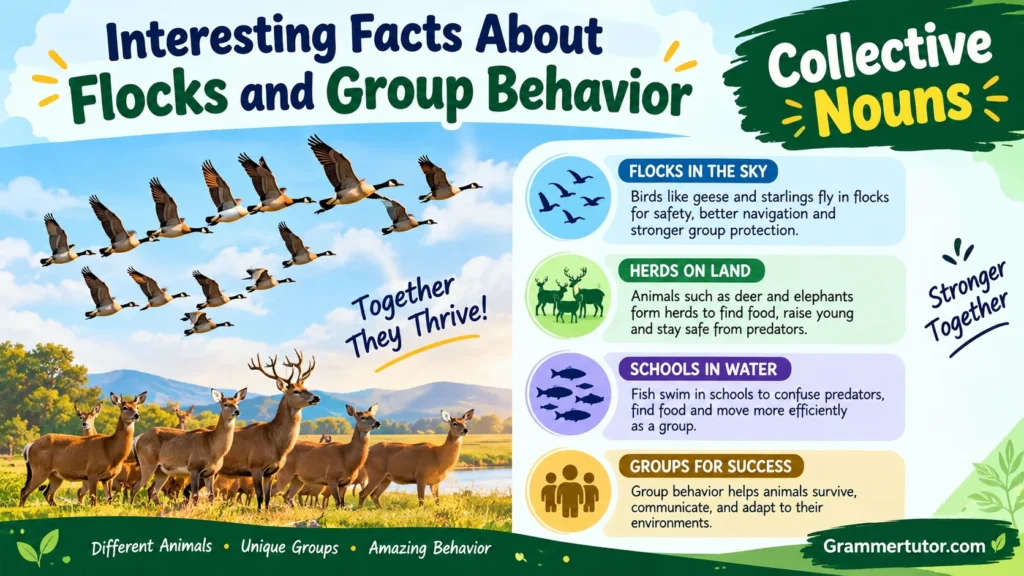
Many animals form groups because living or moving together can provide different advantages. Birds, for example, may gather in flocks while searching for food, resting, communicating, or traveling. Some birds also form large groups during seasonal movements and migration.
One interesting feature of bird flocks is their coordinated movement. Large groups can sometimes turn or change direction almost simultaneously. Individual birds respond to nearby birds, creating patterns that can look highly organized even though the flock does not necessarily have a single leader directing every movement.
Flocks can also provide protection. A bird in a group may have more opportunities to detect approaching predators because many individuals are watching their surroundings. Group living can also make it easier for animals to locate food or suitable resting places.
Sheep show a different type of flock behavior. Sheep are social animals and commonly remain close to other sheep. A flock can therefore move between grazing areas, rest together, and follow a shepherd or other familiar animals.
The word flock is therefore more than a vocabulary item. It is a useful way to describe the social nature and group behavior of animals in everyday English.
READ MORE: Collective Nouns for Larks: A Complete Guide with Examples
Conclusion
The word flock is a useful collective noun for describing a group of birds or certain animals that stay, move, feed, or travel together. Common examples include a flock of birds, a flock of geese, and a flock of sheep. Using flock instead of naming each animal separately makes your sentences shorter, clearer, and more natural. Once you understand the context, using this collective noun becomes simple in both everyday English and descriptive writing.
FAQs
Q1. What is a flock collective noun?
Flock is a collective noun used to describe a group of birds or animals considered as one group.
Q2. What animals can be called a flock?
You can commonly use flock for birds such as pigeons, sparrows, geese, and ducks. It is also commonly used for sheep.
Q3. Is “flock” a collective noun for birds?
Yes. Flock is one of the most common collective nouns for birds, especially when they are flying, feeding, or moving together.
Q4. What is an example of a flock?
A flock of birds was flying across the sky. Here, “flock” refers to the birds as one group.
Q5. Can we say “a flock of sheep”?
Yes. A flock of sheep is a standard expression used to describe sheep as a group.
Q6. Can “flock” be used for ducks?
Yes. A flock of ducks is a natural expression, particularly when several ducks are together or moving as a group.
Q7. What is the plural of flock?
The plural form is flocks. For example, several flocks of birds were seen near the lake.
Q8. Is “flock of birds” grammatically correct?
Yes. Flock of birds is grammatically correct when you want to describe several birds as one group.
Q9. What is the difference between “flock” and “group”?
Group is a general word for several people, animals, or things. Flock is more specific and is commonly used for birds and some animals, such as sheep.
Q10. How do you use flock in a sentence?
You can say, “A flock of sparrows gathered near the trees.” The word flock shows that the sparrows are being described as one group.