
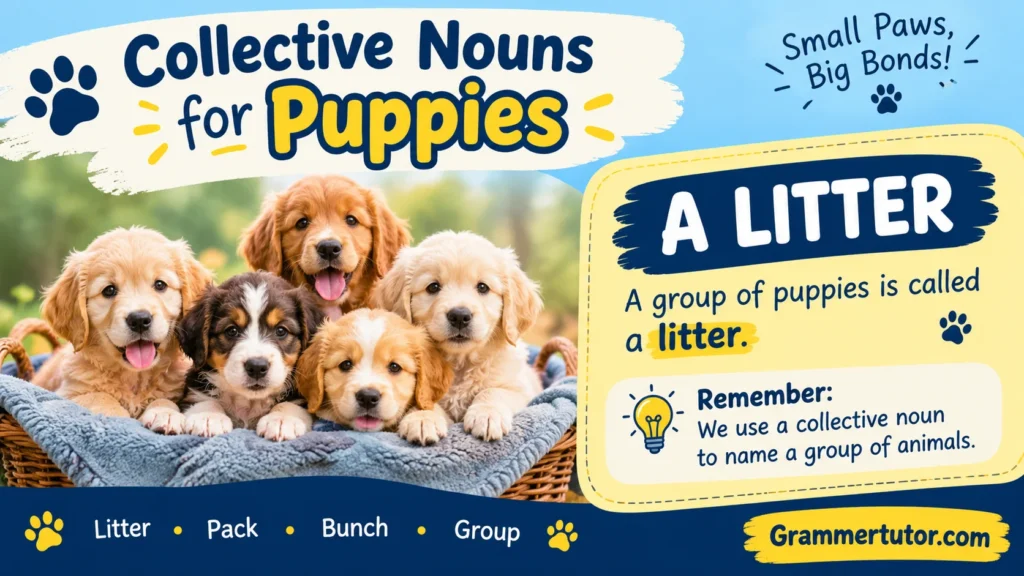
A collective noun for puppies gives you a simple way to describe a group of young dogs without repeating the same phrase. The most common term is litter, especially for puppies born to the same mother during the same birth. In English, this expression is useful when talking about puppies and their age, behavior, or how they stay together.
Puppies are playful, social, and curious animals, so their behavior can make group descriptions more interesting. When puppies are playing, gathering, or behaving as a group, these terms can make your English vocabulary more varied. If you are learning English, writing about pets, or simply interested in dogs, choosing a natural expression helps you describe young dogs clearly.
During their early lives, puppies spend time learning from their mother and interacting with their brothers and sisters. Their energetic behavior makes group descriptions more vivid, while the right terms can make your descriptions sound natural. From my experience with English vocabulary, these expressions are especially helpful when you want to describe a group of puppies in a clear and engaging way.
Why Collective Nouns Are Used for Puppies
Puppies often stay together during their early development. A mother dog may care for several puppies at once, and the young dogs eat, sleep, play, and explore together. Because of this close relationship, English has several ways to describe groups of puppies.
Some expressions are more precise than others. Litter is the standard term for puppies born from the same mother at around the same time. Pack can describe dogs living or moving together, although it is more commonly associated with dogs generally rather than specifically with young puppies.
Other words, such as bundle, bunch, or group, can be used informally when several puppies are gathered together. These expressions can be useful in everyday speech and creative writing.
Collective Nouns for Puppies
| Collective Noun | Used For | Simple Example |
| Litter | Puppies born to the same mother | A litter of puppies slept together. |
| Pack | Puppies or dogs living or moving together | A pack of puppies played outside. |
| Brood | A group of young animals raised together | A brood of puppies stayed close to their mother. |
| Bundle | Several puppies gathered closely together | A bundle of puppies slept in the basket. |
| Bunch | An informal group of puppies | A bunch of puppies ran across the yard. |
| Gang | A playful group of puppies | A gang of puppies chased each other. |
| Group | A general collection of puppies | A group of puppies played in the garden. |
Litter of Puppies
A litter is the most common and accurate collective noun for puppies. It generally refers to a group of puppies born to the same mother during one reproductive event.
A litter can contain only a few puppies or several puppies, depending on the dog’s breed, age, health, and other factors. Because the puppies share the same mother and are usually raised together during their earliest weeks, litter is the best term when talking specifically about siblings.
Examples of “Litter of Puppies”
- A litter of puppies slept beside their mother.
- The breeder cared for a healthy litter of puppies.
- We watched a litter of puppies playing together.
- The litter of puppies was born during the night.
- A litter of puppies gathered around their mother.
- The children carefully observed the litter of puppies.
- The litter of puppies began exploring the room.
- A litter of puppies rested in a warm basket.
- The mother dog protected her litter of puppies.
- The litter of puppies grew stronger every week.
Pack of Puppies

A pack describes a group of dogs that live, travel, or behave together. It can be applied to puppies when they are acting as a group, although litter is more precise when the puppies are siblings born to the same mother.
The word pack emphasizes social behavior and group interaction rather than birth or family relationship.
Examples of “Pack of Puppies”
- A pack of puppies played in the garden.
- The pack of puppies ran across the yard.
- A playful pack of puppies followed the older dog.
- The pack of puppies explored their surroundings.
- A pack of puppies gathered near the food bowl.
- The puppies moved together like a small pack.
- A pack of puppies chased a ball across the grass.
- The pack of puppies rested after playing.
- A pack of puppies followed their mother.
- The pack of puppies became excited when visitors arrived.
Brood of Puppies
Brood is traditionally used for a group of young animals being cared for by a mother. Although it is more commonly associated with birds and some other animals, it can be used descriptively for young puppies in certain contexts.
When talking specifically about puppies born to one mother, litter remains the clearer and more standard choice.
Examples of “Brood of Puppies”
- A brood of puppies stayed close to their mother.
- The mother dog watched over her brood.
- The brood of puppies slept together.
- A brood of puppies followed the mother around the yard.
- The owner carefully cared for the brood.
- The brood of puppies became active after feeding.
- The mother protected her brood from danger.
- A brood of puppies rested in a warm corner.
- The brood stayed together during their early weeks.
- The mother dog gently cleaned her brood.
Bundle of Puppies
A bundle of puppies is an informal and descriptive expression for several puppies gathered closely together. The word bundle creates an image of puppies curled up, sleeping, or piling on top of one another.
It isn’t as specific as litter, but it works well in everyday descriptions and creative writing.
Examples of “Bundle of Puppies”
- A bundle of puppies slept in the basket.
- We found a bundle of puppies resting together.
- The bundle of puppies curled up beside their mother.
- A warm bundle of puppies filled the small bed.
- The children admired the bundle of puppies.
- A bundle of puppies piled together after playing.
- The bundle of puppies slept peacefully.
- A bundle of puppies rested near the fireplace.
- The mother dog watched her bundle of puppies.
- A bundle of puppies woke up at feeding time.
Bunch of Puppies

A bunch of puppies is an informal expression used for several puppies gathered together. It is common in casual conversation because bunch simply means a collection of things or animals.
Unlike litter, it doesn’t tell us that the puppies are siblings or were born to the same mother.
Examples of “Bunch of Puppies”
- A bunch of puppies ran around the garden.
- We saw a bunch of puppies near the shelter.
- The bunch of puppies played with a toy.
- A bunch of puppies gathered around the trainer.
- The children watched a bunch of puppies playing.
- A bunch of puppies chased one another.
- The bunch of puppies became excited at lunchtime.
- A bunch of puppies slept near the door.
- The trainer called the bunch of puppies inside.
- A bunch of puppies explored the new playground.
Gang of Puppies
A gang of puppies is a playful and informal expression for a group of energetic puppies. The word gang is not the standard biological collective noun, but it can be used creatively to emphasize their lively behavior.
This expression works especially well when puppies are running, chasing one another, or getting into playful mischief.
Examples of “Gang of Puppies”
- A gang of puppies raced across the lawn.
- The gang of puppies chased a toy.
- A playful gang of puppies explored the garden.
- The gang of puppies followed the children.
- A gang of puppies created a lot of noise.
- The puppies formed a lively gang around the ball.
- A gang of puppies ran toward their owner.
- The gang of puppies played together all afternoon.
- A gang of puppies climbed over their bed.
- The playful gang of puppies soon became tired.
Group of Puppies
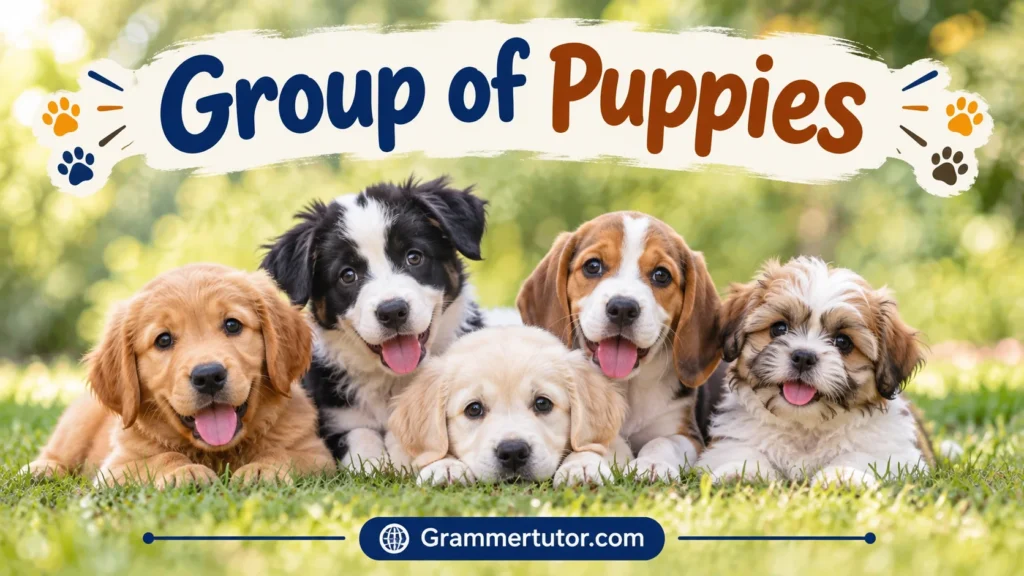
A group of puppies is a simple and general expression that can be used whenever several puppies are together. It doesn’t indicate whether they are siblings, part of the same litter, or simply gathered in the same place.
Although it isn’t a distinctive animal collective noun, group is always clear and grammatically correct.
Examples of “Group of Puppies”
- A group of puppies played in the garden.
- We saw a group of puppies at the shelter.
- The group of puppies gathered around the trainer.
- A group of puppies slept together.
- The group of puppies followed their mother.
- A group of puppies ran across the yard.
- The children watched a group of puppies.
- A group of puppies gathered near the food bowl.
- The group of puppies explored the new room.
- A group of puppies rested after playing.
Interesting Facts About Puppies
Puppies are the young offspring of dogs and go through remarkable physical and behavioral changes during their early lives. Their lifespan eventually depends on factors such as breed, genetics, nutrition, exercise, healthcare, and living conditions. Dogs can live for many years, although lifespan varies considerably between breeds and individual animals. Smaller dog breeds often have different growth patterns and longevity compared with larger breeds.
One of the most interesting physiological features of puppies is their rapid development. During their early weeks, puppies gradually develop stronger muscles, improved coordination, better vision, and greater control over their movements. Their senses also become more developed as they grow. Puppies use their noses extensively to investigate their surroundings because dogs possess an exceptionally sensitive sense of smell.
Puppies are omnivores, meaning dogs can consume and digest both animal- and plant-based foods. Young puppies need nutritionally balanced food that supports their rapid growth. Their nutritional requirements differ from those of adult dogs because developing puppies need appropriate amounts of energy, protein, fats, vitamins, and minerals.
Social development is another important part of puppyhood. Puppies learn many behaviors through interaction with their mother and littermates. Playing with siblings can help puppies develop coordination and learn how to control behaviors such as biting. They also begin learning how to respond to different sounds, environments, people, and other animals.
Puppies are naturally curious and energetic. They use play, movement, scent, vocalizations, and body language to explore the world around them. Their playful behavior is one reason expressions such as a bunch of puppies or a gang of puppies can create such a vivid image.
Examples of Puppy Facts
- Puppies are young dogs.
- A group of siblings born to one mother is called a litter.
- Puppies develop rapidly during their early weeks.
- Puppies have a highly sensitive sense of smell.
- Puppies are generally considered omnivores.
- Puppies need balanced nutrition for healthy growth.
- Playing helps puppies develop coordination.
- Puppies learn social behaviors from their mother and littermates.
- Puppies communicate through sounds and body language.
- Early experiences can influence a puppy’s later behavior.
READ MORE: Collective Noun for Rattlesnakes: A Complete Guide with Examples
Conclusion
The most common collective noun for puppies is litter, especially when several puppies are born to the same mother at the same time. Understanding this term makes your English more natural when you talk about young dogs as a group. Puppies can also be described according to their playful behavior, social nature, and the way they interact with one another. Using the right collective term helps you write and speak about puppies more clearly and naturally.
FAQs
Q1. What is the most common collective noun for puppies?
The most common collective noun for puppies is litter. It usually refers to puppies born to the same mother during the same birth.
Q2. What do you call a group of puppies?
A group of puppies is commonly called a litter, particularly when the puppies are siblings from the same birth.
Q3. Is “litter” a collective noun for dogs?
Yes. Litter is commonly used as a collective noun for puppies or other young animals born together to the same mother.
Q4. Can “litter” refer to puppies from different mothers?
Usually, litter refers to puppies born to the same mother during one birth. Puppies from different mothers would not normally be called one litter.
Q5. Why are puppies called a litter?
The word litter is traditionally used for a group of young animals born to the same mother at about the same time.
Q6. Is “pack” a collective noun for puppies?
Pack can describe a group of dogs, but litter is more specific when referring to puppies born together. A pack focuses more on dogs living or moving together.
Q7. What is the difference between a litter and a pack?
A litter usually refers to puppies from the same mother and birth. A pack refers to a group of dogs that live, travel, or function together.
Q8. Can I use “group of puppies” in English?
Yes. The group of puppies is completely understandable and grammatically correct. However, litter is more precise when the puppies share the same mother and birth.
Q9. Are there other words for a group of puppies?
Depending on the situation, you can use general expressions such as group of puppies or pack of dogs. However, litter is the most familiar term for puppies born together.
Q10. How can I use “litter” in a sentence?
You can say, “The dog gave birth to a litter of puppies.” This clearly shows that several puppies were born to the same mother.