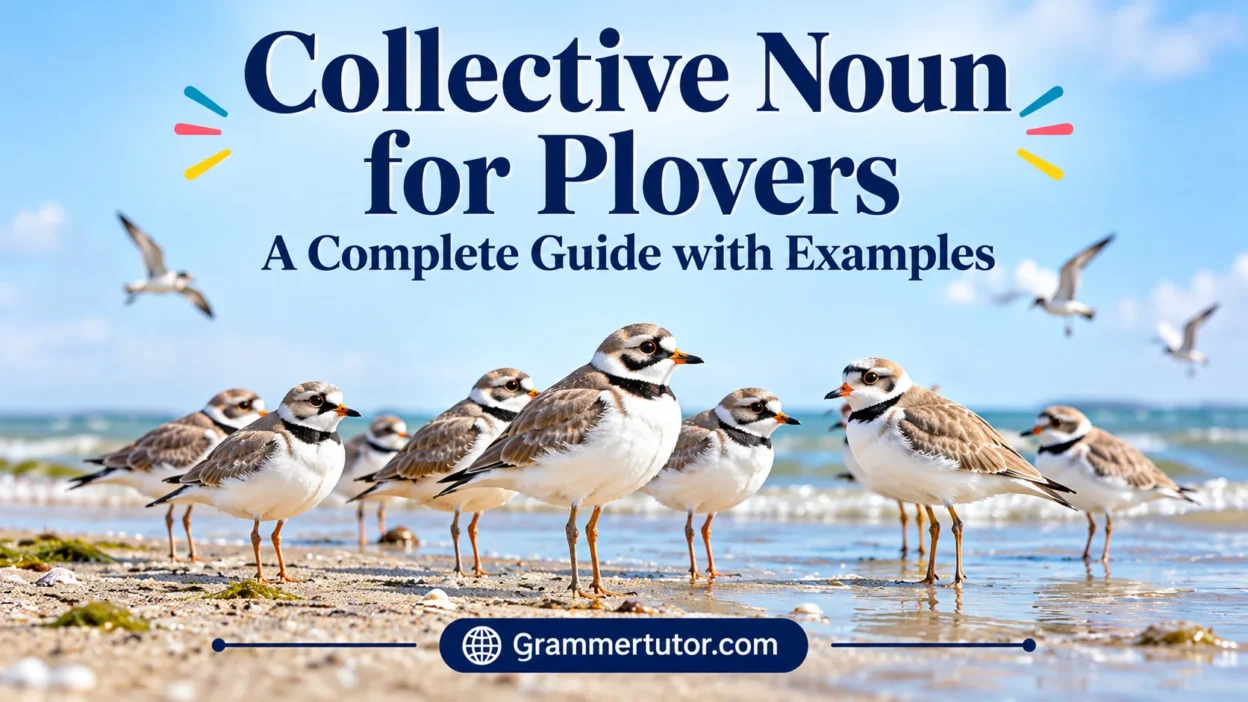
The collective noun for plovers is usually a flock of plovers, a simple phrase for describing these shorebirds when they gather together. This expression is easy to use in everyday English. Plovers are small birds or medium-sized birds often found near beaches, wetlands, grasslands, and mudflats.
These shorebirds use open habitats for feeding, resting, and migrating. When they gather together, they may stay alert to predators while protecting themselves. Like a flock of birds, a herd of deer, or a colony of penguins, a flock of plovers describes several animals as one group. This familiar expression helps you describe their fascinating behavior in clear English and natural English.
You may also see congregation of plovers among traditional bird-group terms, although flock of plovers remains a widely understood choice for everyday writing. The most suitable expression depends on the context and what you want to explain. Learning these collective nouns can improve English vocabulary and make descriptions of birds easier to understand. In my experience explaining grammar, comparing these terms with familiar examples makes them easier to remember.
Why Collective Nouns Are Used for Plovers
Plovers sometimes gather in groups to search for food, rest near water, or travel between seasonal habitats. A collective noun allows us to describe several birds together without listing each individual bird.
For example, instead of saying, “Many plovers were resting near the shore,” you can say, “A flock of plovers was resting near the shore.”
These expressions make sentences shorter, clearer, and more interesting. They are useful for students, English learners, writers, birdwatchers, and anyone who enjoys learning about wildlife.
Collective Nouns for Plovers
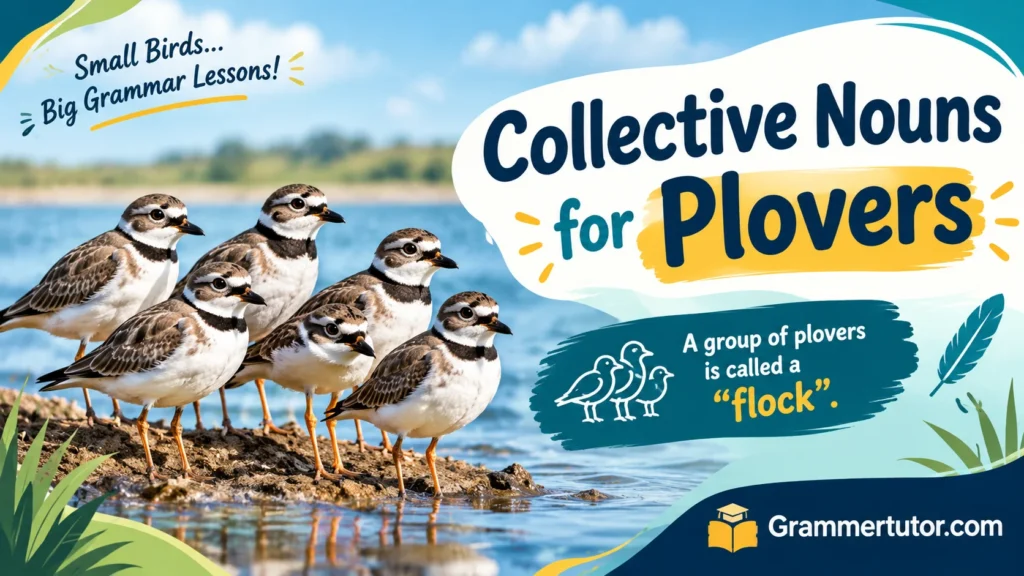
Several collective nouns are associated with plovers in traditional bird-name lists. The following table includes common everyday wording and traditional alternatives. Some of the specialized names are historical or literary rather than terms commonly used by birdwatchers today.
| Collective Noun | Used For | Simple Example |
| Flock | A general group of plovers | A flock of plovers rested on the beach. |
| Congregation | A traditional name for a group of plovers | A congregation of plovers gathered near the shore. |
| Wing | A traditional collective noun for plovers | A wing of plovers flew over the marsh. |
| Band | A group of plovers | A band of plovers searched for food. |
| Flight | Plovers flying together | A flight of plovers crossed the sky. |
Flock of Plovers
A flock of plovers is the simplest and most natural expression for a group of these birds. Plovers may gather on beaches, mudflats, fields, and wetlands while searching for food or resting during migration.
This expression is suitable for everyday conversation, school assignments, wildlife descriptions, and English-learning articles.
Examples of “Flock of Plovers”
- A flock of plovers rested on the sandy beach.
- We watched a flock of plovers near the water.
- A flock of plovers searched for food on the mudflat.
- The flock of plovers flew across the open sky.
- A flock of plovers gathered beside the wetland.
- The children spotted a flock of plovers during their nature walk.
- A flock of plovers landed near the shoreline.
- The flock of plovers moved across the grassy field.
- A flock of plovers flew away when people approached.
- We photographed a flock of plovers at sunrise.
Congregation of Plovers
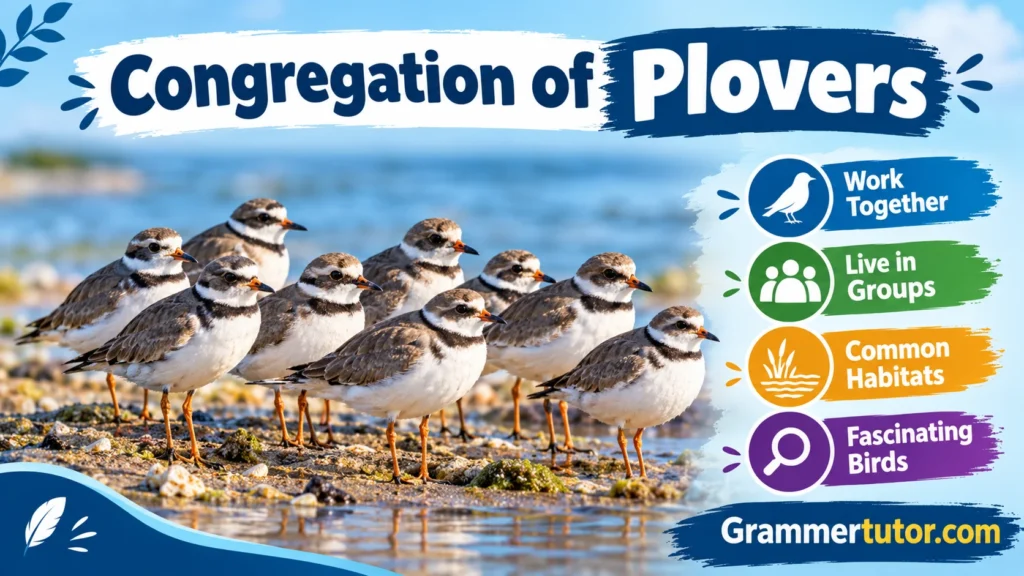
A congregation of plovers is a traditional collective noun found in historical lists of bird group names. The word congregation suggests birds gathered together in one place.
Although it is an interesting expression for vocabulary learners, it is less common in modern everyday English than flock of plovers.
Examples of “Congregation of Plovers”
- A congregation of plovers gathered near the shore.
- We observed a congregation of plovers on the mudflat.
- A congregation of plovers rested beside the lagoon.
- The congregation of plovers searched for small insects.
- A congregation of plovers moved along the beach.
- The birdwatcher photographed a congregation of plovers.
- A congregation of plovers stood near the wetland.
- The congregation of plovers flew over the shallow water.
- We saw a congregation of plovers during our coastal visit.
- A congregation of plovers gathered in the open field.
Wing of Plovers
A wing of plovers is another traditional collective noun associated with these birds. The word wing is especially easy to connect with birds because it brings to mind their ability to fly together across open landscapes.
This expression is mainly useful when learning traditional collective nouns. In ordinary writing, flock of plovers remains the more familiar choice.
Examples of “Wing of Plovers”
- A wing of plovers flew over the marsh.
- We watched a wing of plovers cross the sky.
- A wing of plovers moved toward the coastline.
- The wings of plovers flew above the wetland.
- A wing of plovers passed over the grassy field.
- The photographer captured a wing of plovers in flight.
- A wing of plovers traveled across the open sky.
- We spotted a wing of plovers near the river.
- The wing of plovers disappeared beyond the hills.
- A wing of plovers flew toward the beach.
Band of Plovers
A band of plovers is another expression appearing in lists of bird collective nouns. The word band can describe a group of birds moving or gathering together.
It is understandable in general English, although it is not as commonly used as flock of plovers. You can use it when discussing traditional animal group names or writing creatively about birds.
Examples of “Band of Plovers”
- A band of plovers walked along the beach.
- We saw a band of plovers near the river.
- A band of plovers gathered in the field.
- The band of plovers searched for food.
- A band of plovers rested beside the wetland.
- The birdwatcher observed a band of plovers.
- A band of plovers moved across the muddy shore.
- We photographed a band of plovers near the water.
- The band of plovers flew over the meadow.
- A band of plovers gathered near the coastline.
Flight of Plovers
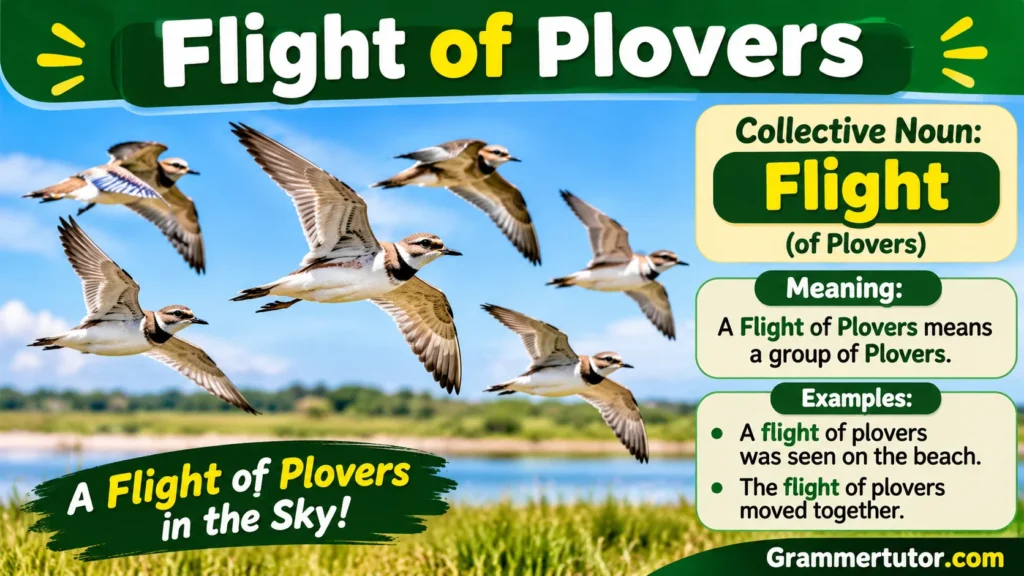
A flight of plovers describes a group of plovers in the air. The word flight is a useful bird-related term because it emphasizes movement through the sky.
This expression is easy to understand and works well when describing plovers flying together. It can also be used as a general descriptive phrase rather than a specialized collective noun.
Examples of “Flight of Plovers”
- A flight of plovers crossed the blue sky.
- We watched a flight of plovers above the beach.
- A flight of plovers flew toward the wetlands.
- The flight of plovers passed over the river.
- A flight of plovers appeared at sunrise.
- The photographer captured a flight of plovers in the distance.
- A flight of plovers traveled across the coastline.
- We saw a flight of plovers flying over the fields.
- The flight of plovers disappeared behind the clouds.
- A flight of plovers returned to the marsh.
Types of Plovers and Their Characteristics
Plovers are shorebirds belonging to the family Charadriidae. They include many species with different sizes, colors, and habitat preferences. Examples include the piping plover, killdeer, European golden plover, black-bellied plover, and Kentish plover. Some species are commonly associated with beaches and mudflats, while others also inhabit grasslands, agricultural fields, and tundra.
Many plovers have relatively short bills, rounded heads, and bodies adapted for moving quickly across open ground. Their feeding behavior is particularly interesting: they often run a short distance, stop, and then peck at the ground to catch small invertebrates. Depending on the species and habitat, their diet may include insects, worms, crustaceans, and other small animals.
Plovers also display fascinating nesting behavior. Many species nest on the ground, where their eggs can blend into the surrounding sand, gravel, or vegetation. Some species use distraction displays to draw potential predators away from their nests. These adaptations help plovers survive in environments where shelter may be limited.
Examples of Plovers’ Characteristics
- Plovers belong to the family Charadriidae.
- Many plovers have short bills.
- Plovers often feed on small invertebrates.
- Some plovers live near beaches and mudflats.
- Other species inhabit grasslands and open fields.
- Many plovers build their nests on the ground.
- Their eggs are often camouflaged.
- Some species use distraction displays to protect their nests.
- Plovers may gather in flocks during migration.
- Different plover species have different habitat preferences.
Interesting Facts About Plovers
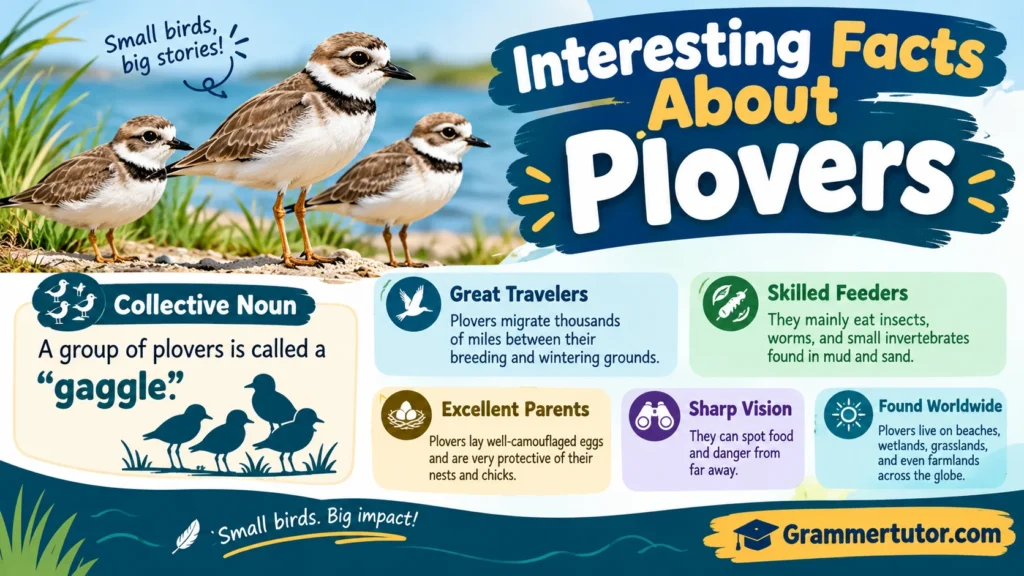
Plovers are remarkable birds whose lifespan varies by species, environmental conditions, and exposure to predators. Some individuals survive for many years, and certain well-studied species have recorded lifespans extending well beyond a decade. Their survival depends on suitable nesting sites, available food, weather, and protection during breeding and migration.
One of the most distinctive features of plovers is their combination of quick movements and alert behavior. Many species use a run-stop-peck feeding technique, allowing them to locate small prey efficiently on beaches, mudflats, and grassy ground. Their bills, legs, and body shapes vary among species according to their particular habitats and feeding habits. Plovers generally eat insects and other small invertebrates, although their diets can include crustaceans, worms, and other suitable prey.
Plovers also have fascinating reproductive adaptations. Many species lay eggs directly on the ground, often in shallow scrapes rather than elaborate nests. Their eggs can blend into the surrounding environment, helping reduce the risk of detection by predators. Some adults use distraction displays, including behaviors that make them appear injured, to draw attention away from their eggs or chicks. Their social behavior also makes collective nouns useful: groups may gather to feed, rest, or migrate, and a flock of plovers is the clearest everyday expression for describing them.
READ MORE: Collective Noun for Dogfish: A Complete Guide with Examples
Conclusion
The collective noun “a flock of plovers” is the most familiar and widely understood way to describe a group of these shorebirds. Plovers often gather in wetlands, grasslands, mudflats, and coastal areas while feeding, resting, or migrating. Learning this collective noun helps you improve your English vocabulary and describe bird behavior clearly. You can also encounter the expression “a congregation of plovers,” but “a flock of plovers” is a simple, natural choice for everyday writing.
FAQs
Q1. What is the collective noun for plovers?
The most familiar everyday expression is a flock of plovers. A traditional collective noun is a congregation of plovers.
Q2. Can I say “a flock of plovers”?
Yes. A flock of plovers is a clear and natural expression for a group of these birds.
Q3. What is a congregation of plovers?
A congregation of plovers is a traditional collective noun recorded in historical lists of bird group names. It is less common in everyday English than flock.
Q4. What do plovers eat?
Plovers commonly eat insects, worms, crustaceans, and other small invertebrates. Their diets depend on the species and the habitat in which they live.
Q5. Where do plovers live?
Plovers inhabit a range of environments, including beaches, mudflats, wetlands, grasslands, and tundra. Different species prefer different habitats.