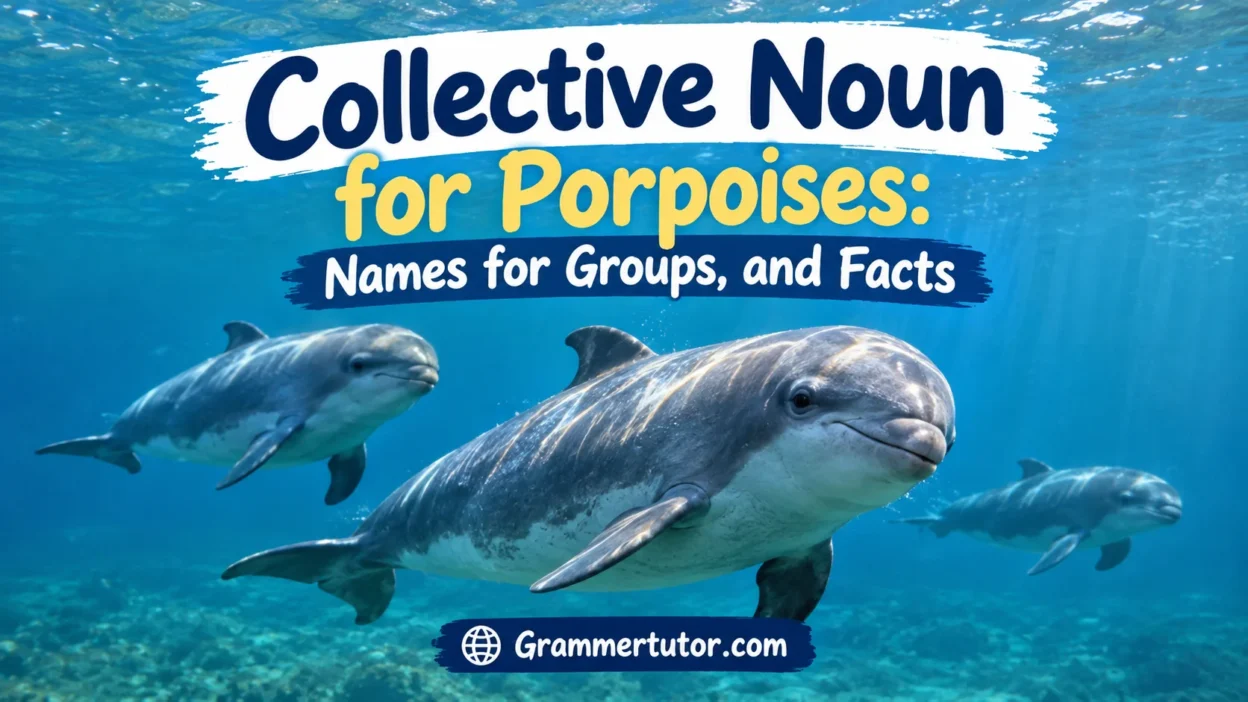
The collective noun for porpoises is commonly a pod of porpoises, a phrase used to describe these fascinating marine mammals when they swim together. Porpoises have compact bodies, rounded heads, and quick movements that help them travel through coastal waters. This natural expression makes it easier to describe their group and explain their group behavior in clear, simple English.
Porpoises belong to the cetacean group, which also includes whales and dolphins. Although porpoises and dolphins may look similar, they have noticeable differences in body shape, teeth, and facial features. Depending on their species, environment, and activity, porpoises may travel alone or move in small groups. Understanding these terms helps readers describe marine animals and learn more about marine life through accurate wildlife writing.
For students, writers, and wildlife enthusiasts, learning collective nouns for porpoises can improve English vocabulary and support engaging writing. A collective noun is a word used to refer to a group of people, animals, or things as one unit. For example, “A pod of porpoises moved through the water” shows how a collective noun works in a sentence. This simple collective noun definition helps readers understand the term and use it naturally.
What Do We Call a Group of Porpoises?
The most familiar expression for a group of porpoises is a pod of porpoises. The word pod is widely used for groups of cetaceans, including porpoises, dolphins, and some whales.
A pod may consist of a few individuals traveling together or a larger gathering formed around feeding, social interaction, or other activities. Group size and social behavior vary among porpoise species. For example, harbor porpoises are often seen alone or in small groups, while larger gatherings may occur where food is abundant.
Other words, such as group, school, and herd, may appear in general descriptions of marine animals, but they do not all have the same level of conventional use for porpoises. For clear, natural English, pod of porpoises is an excellent choice.
Common Terms for Groups of Porpoises
| Collective Term | Meaning or Use | Simple Example |
| Pod | A group of porpoises traveling or gathering together | A pod of porpoises swam near the coast. |
| Group | A general term for several porpoises | A group of porpoises surfaced together. |
| School | A term sometimes used for marine animals moving together | A school of porpoises moved through the water. |
| Herd | A general grouping term, less conventional for porpoises | A herd of porpoises appeared in the story. |
| Gathering | A descriptive word for porpoises assembled in one area | A gathering of porpoises appeared offshore. |
Note: Pod is the preferred conventional term for porpoises. Group and gathering are straightforward descriptive alternatives. School is used more often for fish, though it may appear in broader descriptions of aquatic animals. Herd is not a standard choice for porpoises and is better suited to many land mammals.
Pod of Porpoises
A pod of porpoises refers to several porpoises found together in the water. This is the most useful expression for everyday writing, wildlife descriptions, and educational material.
Porpoises may form small groups while traveling, feeding, or interacting. Their social patterns depend on the species and local conditions. Some porpoises spend much of their time alone, while others may gather temporarily where prey is plentiful.
A pod does not always represent a permanent family group. Its members may remain together for a short time and then separate as their activities change.
Examples of “Pod of Porpoises”
- A pod of porpoises swam through the calm coastal water.
- We spotted a pod of porpoises from the research boat.
- A pod of porpoises surfaced near the rocky shoreline.
- The marine biologist observed a pod of porpoises searching for food.
- A pod of porpoises moved gracefully beneath the waves.
- The tourists watched a pod of porpoises from a safe distance.
- A pod of porpoises traveled through the cool ocean current.
- The photographer captured a pod of porpoises near the harbor.
- A pod of porpoises appeared beside the moving vessel.
- The documentary followed a pod of porpoises in their natural habitat.
Group of Porpoises
A group of porpoises is a general expression for two or more porpoises in the same area. Although group is not a specialized collective noun, it is grammatically correct and easy for readers to understand.
This phrase is particularly useful when the animals are seen together but their social relationship is unknown. For instance, researchers may record a group of porpoises during a survey without knowing whether the individuals regularly travel together.
The expression also works well in school assignments, introductory wildlife articles, and general descriptions of marine mammals.
Examples of “Group of Porpoises”
- A group of porpoises appeared beyond the breakwater.
- The research team counted a group of porpoises near the coast.
- A group of porpoises moved across the bay.
- We watched a group of porpoises from the observation deck.
- A group of porpoises surfaced briefly before diving again.
- The students learned about a group of porpoises in science class.
- A group of porpoises searched the water for small fish.
- The wildlife photographer recorded a group of porpoises offshore.
- A group of porpoises passed through the sheltered inlet.
- The report described a group of porpoises living in coastal waters.
School of Porpoises
A school of porpoises is an understandable descriptive expression for porpoises moving together through the water, but school is more strongly associated with fish. When writing about porpoises, pod is generally the more natural and established term.
The word school emphasizes coordinated movement, especially when animals travel in the same direction. If used in a creative description or an informal account, readers may understand the intended meaning. However, in scientific writing, a writer should prefer established terminology and describe the animals’ behavior accurately.
Examples of “School of Porpoises”
- A school of porpoises moved through the bay in the story.
- The observer described a school of porpoises swimming offshore.
- A school of porpoises appeared in the educational illustration.
- We watched what the narrator called a school of porpoises.
- The fictional account described a school of porpoises beneath the waves.
Usage tip: For formal wildlife writing, use pod of porpoises instead of school of porpoises unless you are discussing the term itself or quoting a source.
Gathering of Porpoises
A gathering of porpoises is a descriptive phrase for several porpoises found in the same area. Unlike pod, it is not a specialized animal collective noun. It simply emphasizes that the animals have come together or are present in one location.
Porpoises may appear close to one another where prey is concentrated or where environmental conditions bring them into the same area. A gathering might be temporary, and it does not necessarily indicate a stable social group.
This phrase can be useful in nature writing when the emphasis is on what an observer sees rather than the animals’ long-term social relationships.
Examples of “Gathering of Porpoises”
- A gathering of porpoises was visible in the distance.
- The naturalist recorded a gathering of porpoises near the headland.
- A gathering of porpoises appeared in the quiet bay.
- The research vessel approached the area where a gathering of porpoises had been reported.
- A gathering of porpoises attracted the attention of wildlife observers.
How Porpoises Differ From Dolphins
Porpoises and dolphins are both marine mammals belonging to the cetacean group, but they are not the same animals. Their similarities can make identification difficult at first, especially when they surface briefly.
Most porpoises have relatively short, rounded snouts, compact bodies, and flattened, spade-shaped teeth. Many dolphins have more elongated snouts and cone-shaped teeth. Porpoises also tend to have smaller, more robust bodies, although characteristics vary by species.
Their social behavior differs as well. Many dolphin species are known for forming complex social groups, while several porpoise species are often observed alone or in small groups. These patterns are not identical across every species, so it is best to avoid assuming that all porpoises behave alike.
| Feature | Porpoises | Dolphins |
| Snout | Usually short and rounded | Often elongated, depending on species |
| Teeth | Generally flattened or spade-shaped | Generally conical |
| Body shape | Often compact and robust | Varies, often more streamlined |
| Group term | Pod | Pod |
| Social patterns | Many species travel alone or in small groups | Many species form social groups, sometimes large ones |
| Diet | Mainly fish and other small marine prey | Fish, squid, and other prey, depending on species |
Both animals are important parts of marine ecosystems, and their presence can provide useful information about the health of their habitats.
Fascinating Facts About Porpoises
Porpoises have evolved specialized features that help them survive underwater. They are warm-blooded mammals that breathe air through a blowhole and must return to the surface to breathe. Their streamlined bodies reduce resistance as they swim, while a thick layer of blubber provides insulation in cold water. Many porpoises use echolocation, producing high-frequency sounds and interpreting returning echoes to locate prey and navigate in environments where visibility is limited.
Their lifespan varies by species and environmental conditions. Harbor porpoises often live for around 8 to 12 years, although some individuals live longer. Other porpoise species have different life expectancies, and survival can be affected by food availability, disease, pollution, fishing gear, and habitat changes. Porpoises generally feed on small fish and other marine animals, including squid and crustaceans, depending on the species and location. They need to consume enough prey to support their high metabolic demands. Although porpoises are sometimes mistaken for dolphins, their rounded snouts and distinctive teeth help distinguish them. Their quiet, fast movements and ability to detect prey through echolocation make them remarkable marine mammals.
READ MORE: Collective Noun for Cats: A Complete Guide with Examples
Conclusion
The collective noun for porpoises is commonly a pod of porpoises. This phrase helps describe porpoises when they swim together and makes sentences clearer and more natural. Learning collective nouns also improves English vocabulary and helps students, writers, and wildlife enthusiasts describe marine life accurately.
FAQs
Q1. What is the collective noun for porpoises?
The most common collective noun for porpoises is a pod of porpoises. It describes several porpoises traveling or gathering together.
Q2. What is a group of porpoises called?
A group of porpoises is generally called a pod. The word group is also correct when you want a simple, general description.
Q3. Is “pod of porpoises” grammatically correct?
Yes. Pod of porpoises is a natural and widely accepted expression for a group of these marine mammals.
Q4. Can I use “school of porpoises”?
You can use it descriptively, particularly in informal or creative writing, but school is more commonly associated with fish. Pod of porpoises is the better choice for standard usage.
Q5. Is “herd of porpoises” correct?
Although readers may understand the phrase, herd is not the conventional collective noun for porpoises. Use pods of porpoises for a more natural expression.