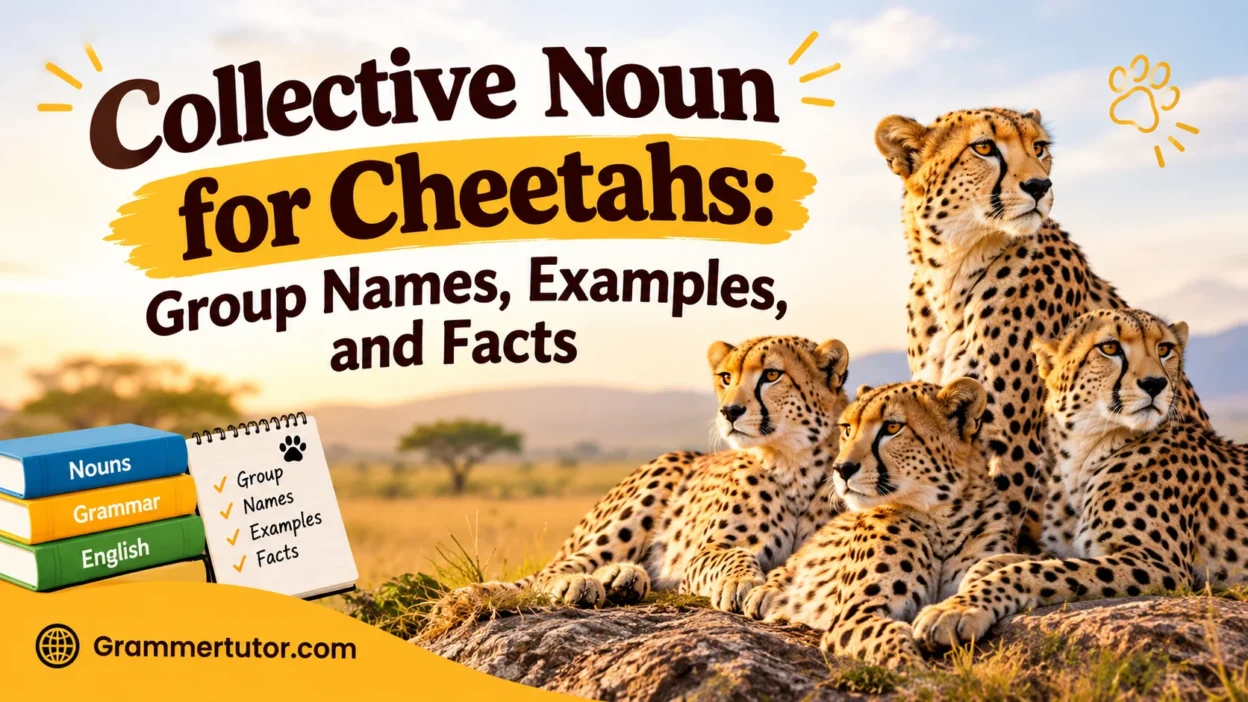
The collective noun for cheetahs is coalition, a useful term for describing male cheetahs that live and hunt together in stable groups in the wild. In English vocabulary, a collective noun is a word that represents several animals as one group. Coalition is the most recognized term for male cheetahs, especially when brothers from the same litter stay together and form a social unit.
There are also general expressions such as group or family, and the best choice can change depending on the situation. A group of cheetahs may be suitable when discussing animals in nature, while a family can describe cheetahs with a closer social connection. In wildlife writing, these expressions make descriptions more interesting and help English learners understand animal behavior more accurately.
Learning the right group name can be useful when improving your vocabulary and writing clearer sentences. When discussing cheetahs and their social lives, choosing the right expression gives readers a better idea of how these animals live. From an English-learning perspective, using coalition in the right context makes wildlife writing sound more natural and precise.
Why Are Collective Nouns Used for Cheetahs?
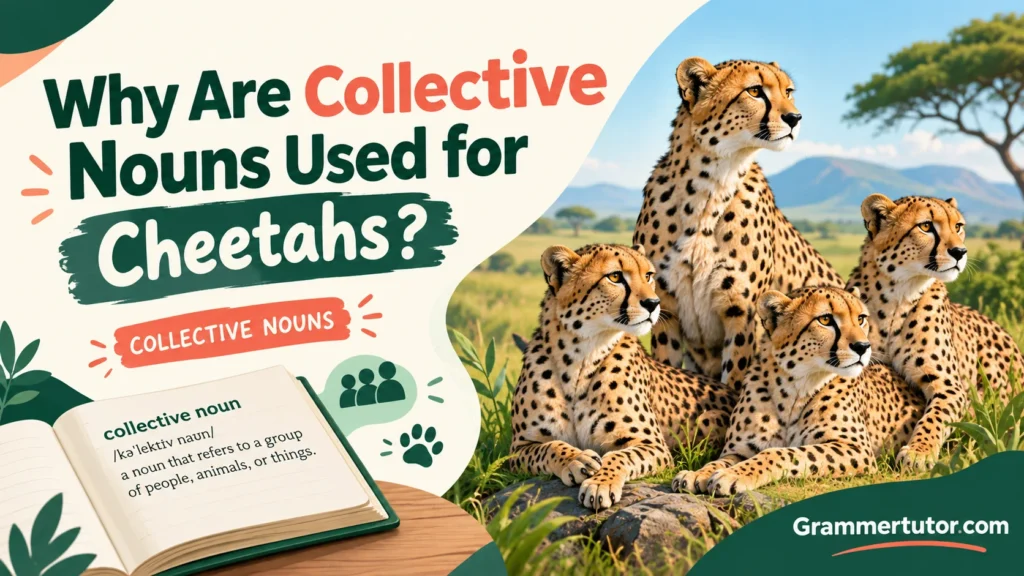
Cheetahs are not always solitary animals. Their social behavior can vary according to their sex, age, and family relationships. Adult females often live alone or with their young, while males may form small social groups called coalitions.
A collective noun gives us a convenient way to describe several cheetahs as one unit. Instead of repeatedly saying “a group of male cheetahs,” the word coalition can provide a shorter and more specific description.
The way cheetahs live together also makes these expressions meaningful. Male coalitions may cooperate when defending territory, finding food, or competing with other males.
Collective Nouns for Cheetahs
| Collective Noun | Used For | Simple Example |
| Coalition | A group of male cheetahs | A coalition of cheetahs moved across the grassland. |
| Group | Several cheetahs together | A group of cheetahs rested under a tree. |
| Family | Cheetahs related to one another | A family of cheetahs stayed near the den. |
| Team | Cheetahs cooperating together | A team of cheetahs moved across the open land. |
Coalition of Cheetahs
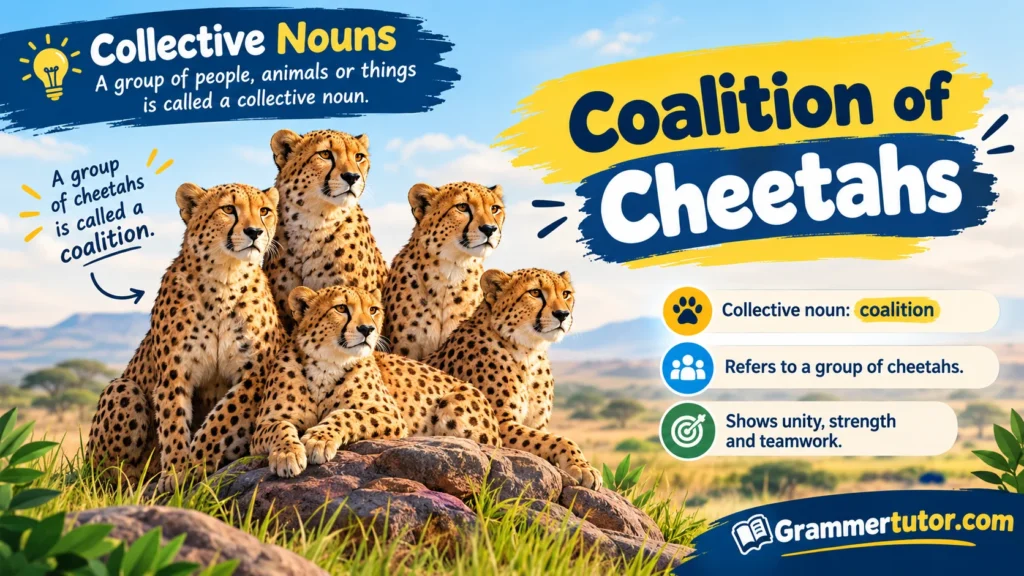
A coalition of cheetahs is the most distinctive expression associated with a group of cheetahs. It is particularly used for male cheetahs that form a social unit. These coalitions are often made up of brothers that remain together after leaving their mother.
Male coalitions may cooperate in activities such as hunting, defending territory, and competing with other males. This social arrangement is one of the most interesting features of cheetah behavior.
Examples of “Coalition of Cheetahs”
- A coalition of cheetahs moved across the grassland.
- We watched a coalition of cheetahs near the watering hole.
- The coalition of cheetahs rested beneath a tree.
- A coalition of cheetahs traveled across the open plain.
- The researchers observed a coalition of cheetahs.
- A coalition of cheetahs approached the edge of the woodland.
- The coalition of cheetahs searched for food.
- We saw a coalition of cheetahs at sunrise.
- A coalition of cheetahs moved quietly through the grass.
- The coalition of cheetahs disappeared into the tall grass.
Group of Cheetahs
A group of cheetahs is a simple and general expression for several cheetahs together. Unlike coalition, the word group does not specifically describe the social relationship between the animals.
It can be useful when the sex, age, or family connection of the cheetahs is unknown or unimportant. This makes it a flexible expression for general wildlife descriptions.
Examples of “Group of Cheetahs”
- A group of cheetahs rested near the trees.
- We spotted a group of cheetahs on the plain.
- A group of cheetahs moved through the grass.
- The group of cheetahs stayed close to the water.
- A group of cheetahs watched the surrounding area.
- The photographer followed a group of cheetahs from a distance.
- A group of cheetahs crossed the open field.
- We saw a group of cheetahs during our safari.
- The group of cheetahs moved toward the shade.
- A group of cheetahs disappeared behind the bushes.
Family of Cheetahs
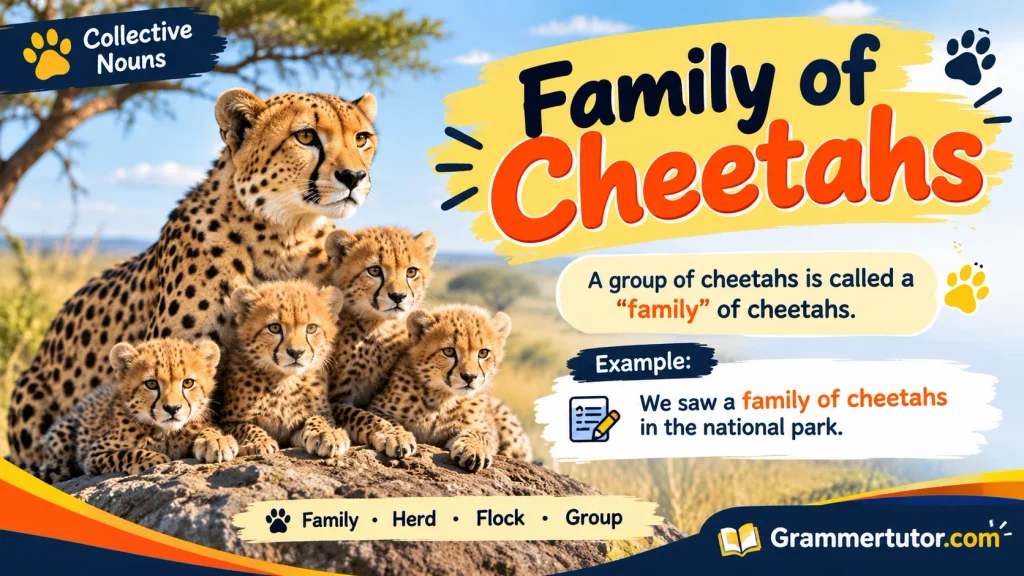
A family of cheetahs is an appropriate general expression when referring to a mother and her cubs or other closely related cheetahs. Female cheetahs commonly raise their cubs alone, so a mother and her young can naturally be described as a family.
The expression focuses on the relationship between the animals rather than simply counting them as a group.
Examples of “Family of Cheetahs”
- A family of cheetahs rested beneath a tree.
- We saw a family of cheetahs near the grassland.
- The family of cheetahs stayed close together.
- A family of cheetahs moved through the tall grass.
- The photographer observed a family of cheetahs.
- A family of cheetahs approached the watering hole.
- The family of cheetahs searched for a safe place.
- We watched a family of cheetahs from far away.
- A family of cheetahs crossed the open plain.
- The family of cheetahs disappeared into the grass.
Team of Cheetahs
A team of cheetahs is a general descriptive expression that can be used when several cheetahs appear to be cooperating. It is not as established as a coalition, but it can help explain coordinated behavior in simple English.
Cheetahs can cooperate in social groups, particularly male coalitions. Using a team in an informal description can highlight their cooperation.
Examples of “Team of Cheetahs”
- A team of cheetahs moved across the plain.
- We watched a team of cheetahs near the trees.
- The team of cheetahs traveled together.
- A team of cheetahs rested in the shade.
- The photographer spotted a team of cheetahs.
- A team of cheetahs moved through the grass.
- The team of cheetahs searched the area for food.
- We observed a team of cheetahs from a safe distance.
- A team of cheetahs crossed the open land.
- The team of cheetahs disappeared into the tall grass.
Types of Cheetahs and Their Characteristics
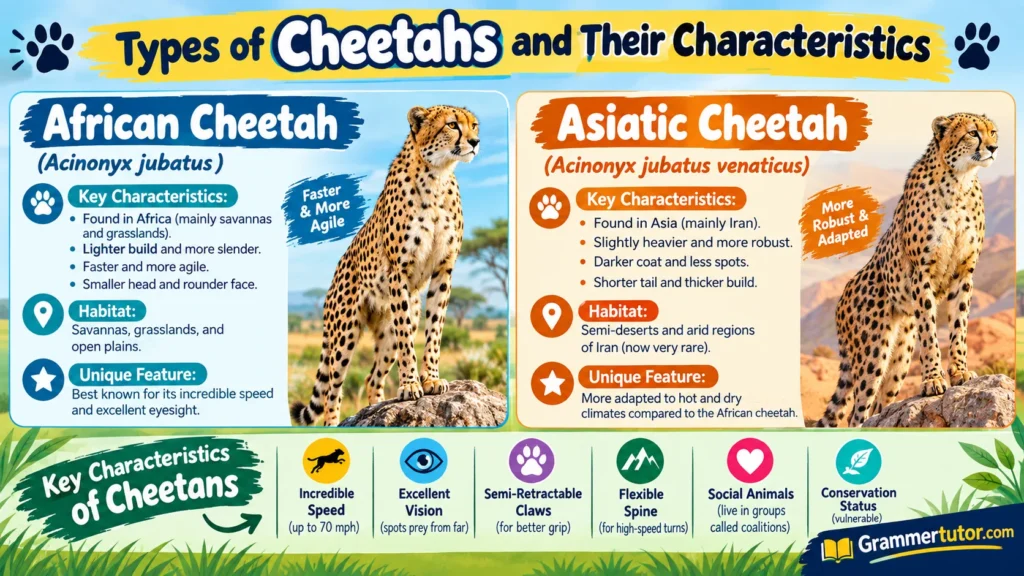
Cheetahs are large cats known for their slender bodies, long legs, spotted coats, and exceptional speed. They are specially adapted for short bursts of rapid movement rather than long-distance running.
Their long legs and flexible spine help them extend their bodies during a fast sprint. Their large nasal passages allow them to take in substantial amounts of air, while their long tail helps with balance and rapid changes in direction.
Cheetahs also have distinctive facial markings called tear marks. These dark lines extend from the inner corners of their eyes toward their mouths and may help reduce glare while they are hunting in bright sunlight.
Examples of Cheetah Characteristics
- Cheetahs have spotted coats.
- Cheetahs have long, slender legs.
- Cheetahs are adapted for short bursts of speed.
- Their long tails help with balance.
- Cheetahs have flexible spines.
- Their claws provide traction while running.
- Cheetahs have distinctive facial tear marks.
- Cheetahs mainly hunt during the day.
- Many cheetahs live in open grasslands.
- Male cheetahs can form social coalitions.
Interesting Facts About Cheetahs
Cheetahs are remarkable animals with a number of specialized physical features. Their bodies are built for speed, with lightweight frames, long legs, flexible spines, and large muscles that help them accelerate rapidly. Their semi-retractable claws provide additional grip when they are chasing prey, while their long tails act like steering mechanisms during fast turns.
The longevity of cheetahs varies depending on their environment and living conditions. Wild cheetahs face threats from predators, competition, habitat loss, disease, and limited food resources. Individuals in protected environments can sometimes live longer because they have access to regular food and veterinary care.
Cheetahs are carnivores and primarily eat other animals. Their prey can include smaller and medium-sized mammals such as gazelles, hares, and young antelope. Unlike some larger predators, cheetahs generally rely on speed and surprise to catch prey rather than prolonged physical fights.
One of the most interesting aspects of cheetah social behavior is the formation of male coalitions. Brothers from the same litter may remain together after becoming independent from their mother. These coalitions can cooperate in defending territories and competing with other males.
Female cheetahs usually have a different social lifestyle. An adult female often lives alone except when she is raising cubs. Mothers spend considerable time protecting, teaching, and caring for their young before the cubs eventually become independent.
READ MORE: Collective Noun for Dolphins: A Complete Guide With Examples
Conclusion
The collective noun for cheetahs is commonly coalition, especially when referring to a group of male cheetahs that live and hunt together. Other terms such as group or family may also be used depending on the context. Understanding these expressions helps English learners improve their vocabulary and describe cheetah behavior more clearly.
FAQs
Q1. What is the collective noun for cheetahs?
The most recognized collective noun for cheetahs is coalition, particularly for a group of male cheetahs.
Q2. What is a group of male cheetahs called?
A group of male cheetahs is commonly called a coalition.
Q3. Why are male cheetahs called a coalition?
Male cheetahs often form stable social groups, especially when brothers from the same litter remain together.
Q4. Can we say “a group of cheetahs”?
Yes. A group of cheetahs is a general expression that can be used when a more specific term is not needed.
Q5. Can “family” be used for cheetahs?
Yes, family of cheetahs can be used when the context focuses on related animals or their family relationship.
Q6. What does “coalition” mean for cheetahs?
In this context, coalition refers to a social group of male cheetahs that live and cooperate together.
Q7. Do female cheetahs form coalitions?
Female cheetahs generally live alone or with their cubs, while coalitions are most commonly associated with male cheetahs.
Q8. Why are collective nouns useful?
Collective nouns make sentences shorter and clearer by providing one term for several animals considered as a group.
Q9. How can I use “coalition” in a sentence?
You can write: “A coalition of cheetahs moved across the grassland while searching for prey.”
Q10. Is “coalition” the only term for cheetahs?
No. Group and family may also be used in suitable contexts, but coalition is the recognized term for groups of male cheetahs.