A collective noun for lambs helps you describe several young sheep as one group. In everyday English, flock of lambs is the most familiar term. Lambs often stay close to their mothers and other sheep, especially when grazing or resting. Their gentle behavior, playful movements, and strong social instincts make it natural to describe them as a group.
The word flock works well when lambs move and live together. You may use it when describing a farm scene, a children’s story, or a wildlife-related passage. Using the right group noun can make your sentence clearer and more vivid, while also helping you write more naturally and accurately. The best expression can sometimes depend on the lambs’ age, activity, or setting.
Learning these collective nouns makes it easier to choose suitable expressions when you describe groups of lambs. In my experience with English usage, learners usually remember flock of lambs quickly when they connect the phrase with the familiar sight of lambs staying together. Although other expressions may appear in particular contexts, flock of lambs remains a clear and natural choice.
Why Do We Use Collective Nouns for Lambs?
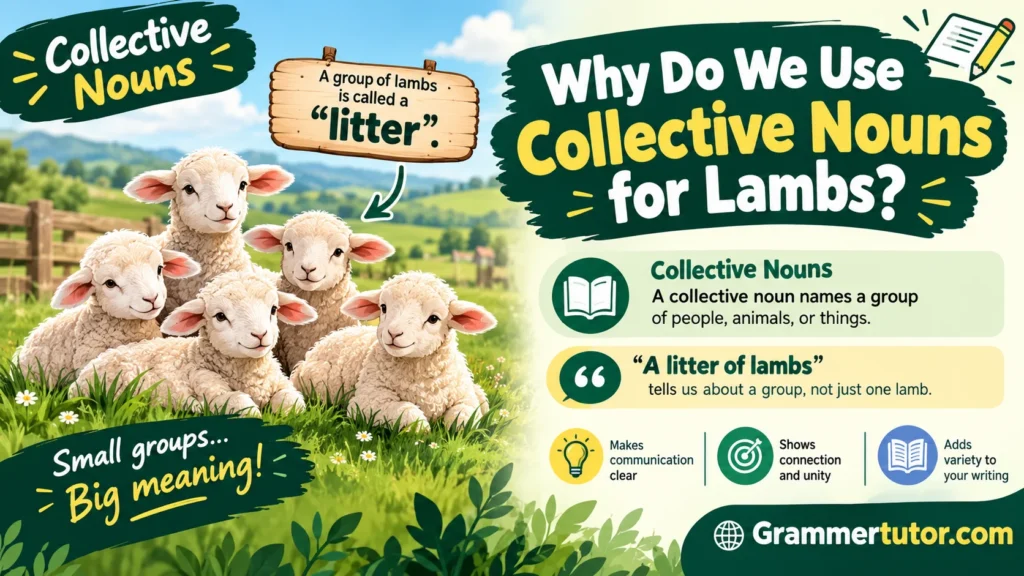
A collective noun is a word that refers to a group of people, animals, or things as one unit. For lambs, these nouns help us describe several young sheep without repeating the word “lambs” again and again.
For example, instead of saying, “Twenty lambs were walking across the field,” you can say, “A flock of lambs was walking across the field.”
The word flock immediately tells the reader that many sheep or lambs are together. It also gives the sentence a more natural and descriptive feel.
Lambs often gather while feeding, resting, playing, or following their mothers. Their group behavior makes collective nouns especially useful when talking about farm animals.
Common Collective Nouns for Lambs
Here are some useful expressions you may see when describing a group of lambs:
| Collective Noun | Used For | Simple Example |
| Flock of Lambs | A group of lambs | A flock of lambs grazed in the meadow. |
| Herd of Lambs | A group moving or grazing together | A herd of lambs crossed the field. |
| Group of Lambs | A general expression | A group of lambs rested near the barn. |
| Fold of Lambs | Lambs kept together in an enclosed area | A fold of lambs stayed safely inside the pen. |
| Bunch of Lambs | An informal description of lambs gathered together | A bunch of lambs played near the fence. |
Among these, flock of lambs is the most natural and widely used expression. Some other terms are more general or depend on the context.
Flock of Lambs
The most common collective noun for lambs is flock. A flock refers to a group of sheep, including young sheep or lambs.
Lambs often stay together with their mothers and other sheep. You may see a flock moving across a pasture, gathering near a shelter, or resting in the shade.
The expression flock of lambs works well in everyday English as well as descriptive writing.
Examples of “Flock of Lambs”
- A flock of lambs grazed quietly in the green pasture.
- We saw a flock of lambs near the old barn.
- The farmer watched the flock of lambs from a distance.
- A flock of lambs followed their mothers across the field.
- The children enjoyed watching the flock of lambs play.
- A small flock of lambs rested beneath the trees.
- The flock of lambs moved toward the water trough.
- Several lambs joined the flock of lambs near the fence.
- The shepherd guided the flock of lambs back to the farm.
- A flock of lambs wandered across the hillside.
Herd of Lambs
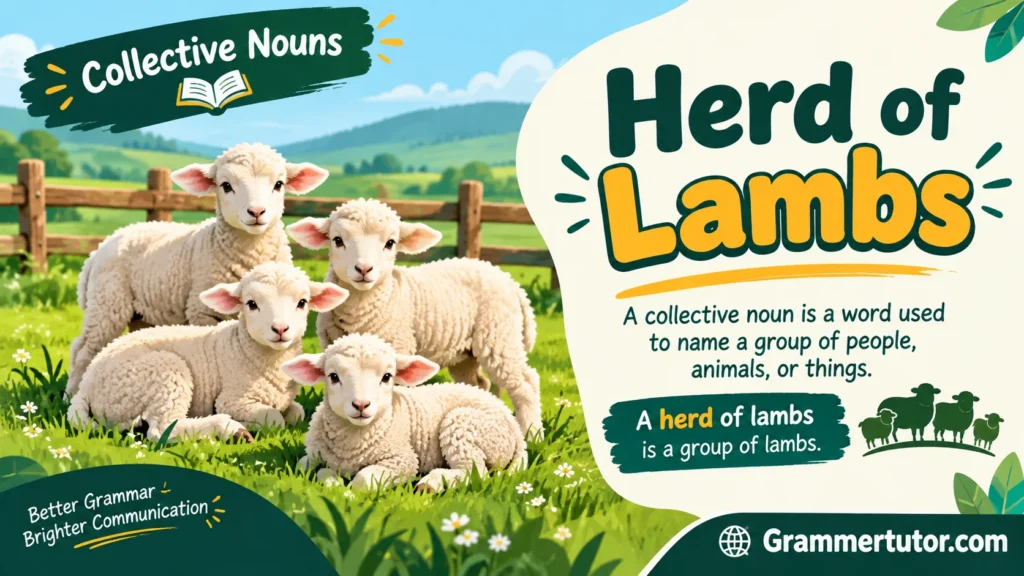
Herd is another general collective term that can describe animals moving or feeding together. Although flock is more characteristic of sheep, a herd of lambs can appear when the emphasis is on the animals moving or gathering as a group.
This expression may be useful in descriptive writing when you want to focus on the movement of the lambs rather than simply identifying them as sheep.
Examples of “Herd of Lambs”
- A herd of lambs moved slowly across the pasture.
- The herd of lambs followed the farmer toward the shelter.
- We watched a herd of lambs crossing the grassy field.
- A small herd of lambs gathered near the gate.
- The herd of lambs moved together toward the hill.
- The farmer counted the herd of lambs before sunset.
- A herd of lambs followed their mothers through the meadow.
- The herd of lambs stopped beside the fence.
- We could hear the herd of lambs from the nearby field.
- The shepherd carefully watched the herd of lambs.
Group of Lambs
Sometimes you don’t need a specialized collective noun. Group of lambs is a simple and completely clear expression.
It works especially well when you’re writing for children, explaining something, or describing a particular gathering without emphasizing traditional animal terminology.
For example, “A group of lambs was playing near the barn” is simple and easy for everyone to understand.
Examples of “Group of Lambs”
- A group of lambs played beside the barn.
- We found a group of lambs resting in the shade.
- A group of lambs followed the shepherd.
- The farmer fed a group of lambs in the morning.
- A group of lambs gathered near the gate.
- The children watched a group of lambs in the field.
- A group of lambs walked behind their mothers.
- The group of lambs stayed close together.
- We saw a group of lambs near the stream.
- A group of lambs wandered around the pasture.
Fold of Lambs
The word fold has a special connection with sheep. A fold is an enclosure or sheltered place where sheep are kept, especially at night or for protection.
Because of this meaning, fold can sometimes be used when referring to sheep gathered within such an enclosure. When writing specifically about lambs, however, flock of lambs remains the more straightforward choice.
Examples of “Fold of Lambs”
- The farmer placed the lambs in the fold before dark.
- A fold of lambs rested safely inside the enclosure.
- The shepherd checked the fold of lambs in the evening.
- The young sheep gathered in the fold during the cold night.
- The farmer prepared a clean fold for the lambs.
- The lambs stayed together inside the fold.
- A small fold of lambs was kept near the farmhouse.
- The shepherd counted the lambs in the fold.
- The fold of lambs remained warm and protected.
- The farmer opened the gate so the lambs could leave the fold.
Bunch of Lambs
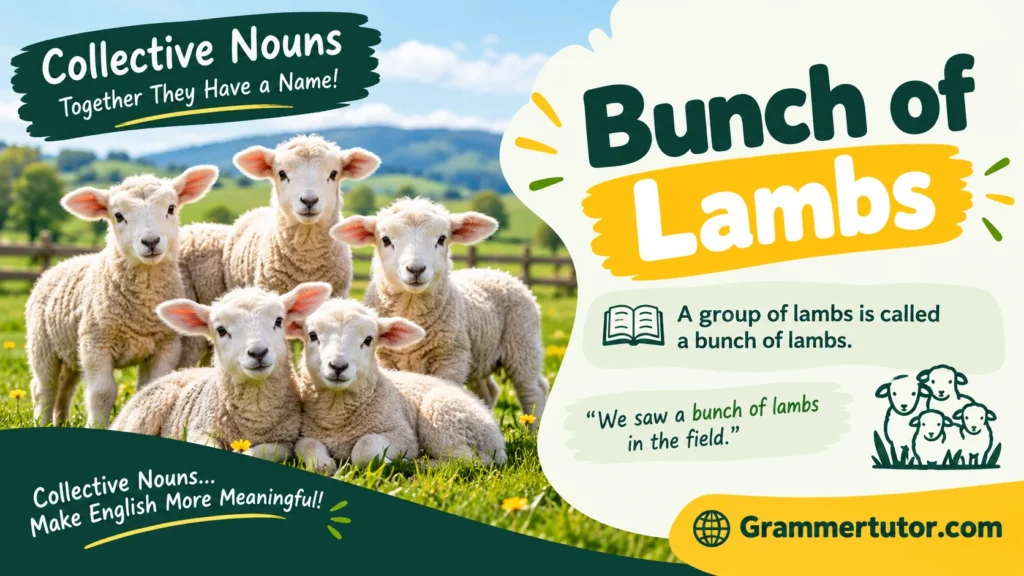
Bunch is an informal word for a collection of things or animals gathered together. You may use it in casual descriptions, especially when several lambs are playing or standing close to one another.
However, a bunch of lambs isn’t as established as a flock of lambs. If you’re looking for the standard collective expression, flock is the better choice.
Examples of “Bunch of Lambs”
- A bunch of lambs played near the wooden fence.
- We noticed a bunch of lambs in the corner of the field.
- A bunch of lambs ran toward their mothers.
- The children laughed as a bunch of lambs jumped around.
- A bunch of lambs gathered beside the barn.
- The farmer saw a bunch of lambs near the gate.
- A bunch of lambs rested under the warm sun.
- We watched a bunch of lambs move across the meadow.
- A bunch of lambs followed the shepherd.
- The playful bunch of lambs raced around the pasture.
How Lambs Behave in Groups
Lambs are social animals and generally stay close to other sheep. Young lambs often remain near their mothers for safety, feeding, and warmth.
When they become more active, lambs may run, jump, and play with one another. A group can suddenly move from one part of a pasture to another, especially when the older sheep begin moving.
Their social behavior is one reason flock of lambs is such a useful expression. It describes not only their number but also the way sheep naturally gather and move together.
On a farm, a flock of lambs may spend part of the day grazing, resting, or following adult sheep. Farmers also monitor young lambs carefully because they are more vulnerable than mature sheep.
Interesting Facts About Lambs
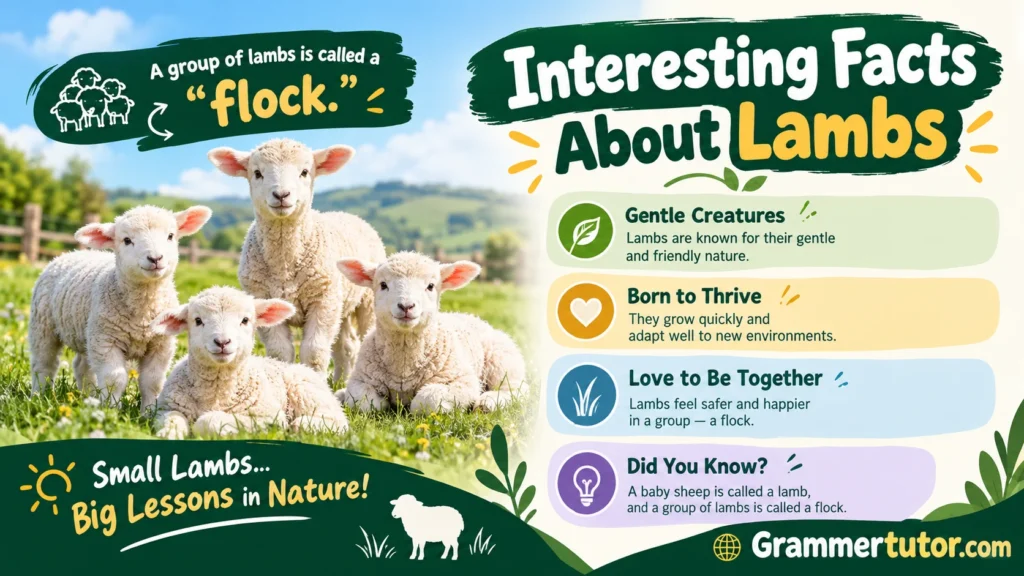
Lambs are baby sheep, and the word lamb is generally used for a young sheep during its early stage of life. Their appearance is often easy to recognize because they have soft wool, smaller bodies, and youthful behavior.
One interesting feature of lambs is their rapid development. They grow considerably during their first months and gradually become more independent. Their early nutrition is especially important because healthy growth depends on adequate feeding and care.
Lambs also have strong social instincts. They learn to recognize their mothers and tend to remain close to familiar sheep. On farms, this behavior makes it easier to observe how young sheep interact with the rest of the flock.
Their diet changes as they grow. Young lambs initially depend heavily on their mother’s milk. As they mature, they gradually begin eating grass and other plant material. This transition allows them to develop the feeding habits of adult sheep.
Lambs are also known for their energetic behavior. They may jump, run, and play with other young sheep. Watching several lambs playing together can make a farm pasture look especially lively.
READ MORE: Collective Noun for Cheetahs: Group Names, Examples, and Facts
Conclusion
The most common collective noun for lambs is flock of lambs. It is a simple, natural expression for describing young sheep that stay, move, graze, or rest together. Using this term can make your writing more accurate, clearer, and more natural.
FAQs
Q1. What is the collective noun for lambs?
The most common collective noun is flock of lambs.
Q2. Can I say a flock of lambs?
Yes. A flock of lambs is a natural and widely understood expression.
Q3. What does flock mean?
Flock is a collective noun used for a group of birds or certain animals, including sheep.
Q4. Are lambs young sheep?
Yes. Lambs are young sheep, generally referring to sheep in their early stage of life.
Q5. Do lambs usually stay together?
Yes. Lambs commonly stay close to their mothers and other sheep.
Q6. When can I use “flock of lambs”?
You can use it when describing lambs together on a farm, in a story, or in another suitable setting.
Q7. Is “flock of lambs” grammatically correct?
Yes. Flock of lambs is grammatically correct and commonly used to describe a group of lambs.
Q8. Why are collective nouns useful?
Collective nouns make it easier to describe several individuals as one group and can make sentences more concise.
Q9. Can other expressions describe lambs?
Other expressions may occur depending on the setting, activity, or context, but flock of lambs is the familiar choice.
Q10. What is an example of “flock of lambs” in a sentence?
A flock of lambs was grazing peacefully beside the farmhouse.