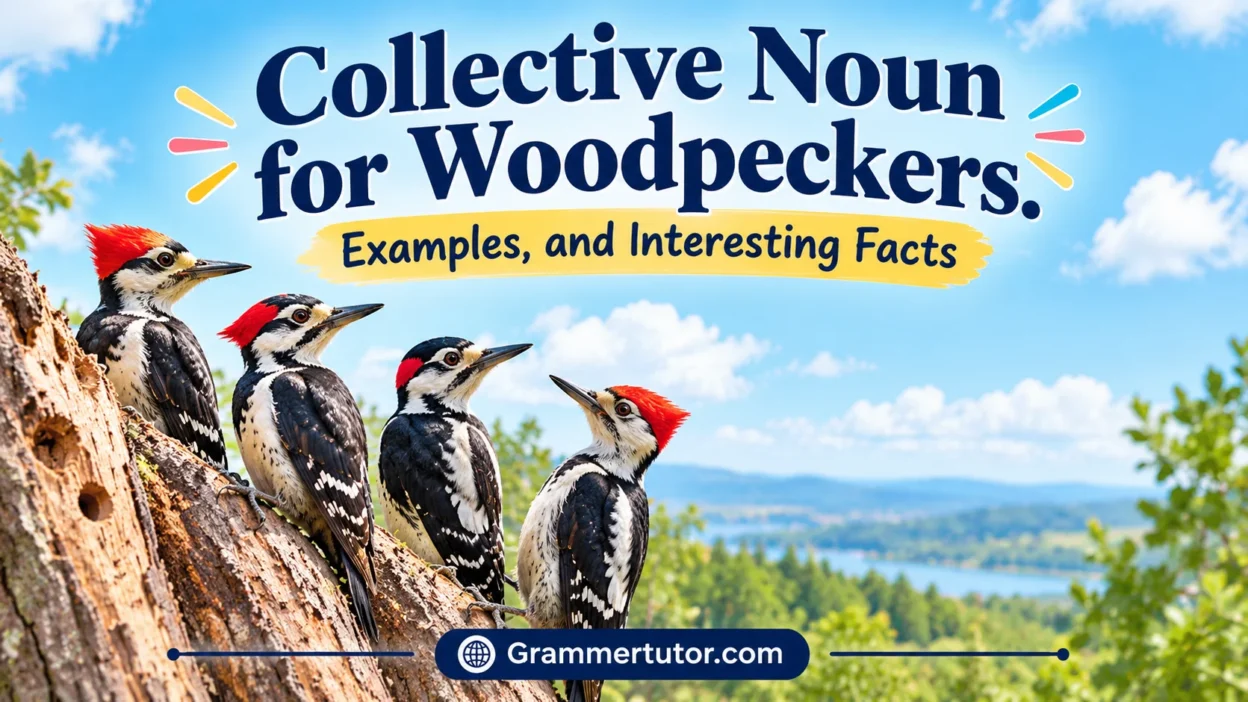
When you use the collective noun for woodpeckers, you can describe several woodpeckers that appear together as a group in a clear and specific way. The phrase a group of woodpeckers is simple, but a descent of woodpeckers is the traditional collective noun linked with these birds. This gives your language more character and makes descriptions of their behavior more interesting.
Woodpeckers are interesting birds to observe because they spend time climbing tree trunks, searching for insects, creating nesting cavities, and communicating through calls and drumming. When more than one woodpecker appears in the same area, choosing the right collective expression can make your sentence more vivid. These groups can be described differently depending on the situation, especially when you are writing about their natural activities.
The traditional expression associated with woodpeckers is a descent of woodpeckers, although other expressions may describe groups in a particular situation. Descent remains the term most often associated with these birds in lists of bird collective nouns. Using this distinctive expression can help you avoid repeating ordinary phrases and add variety when describing woodpeckers and their behavior.
Why Are Collective Nouns Used for Waqoodpeckers?
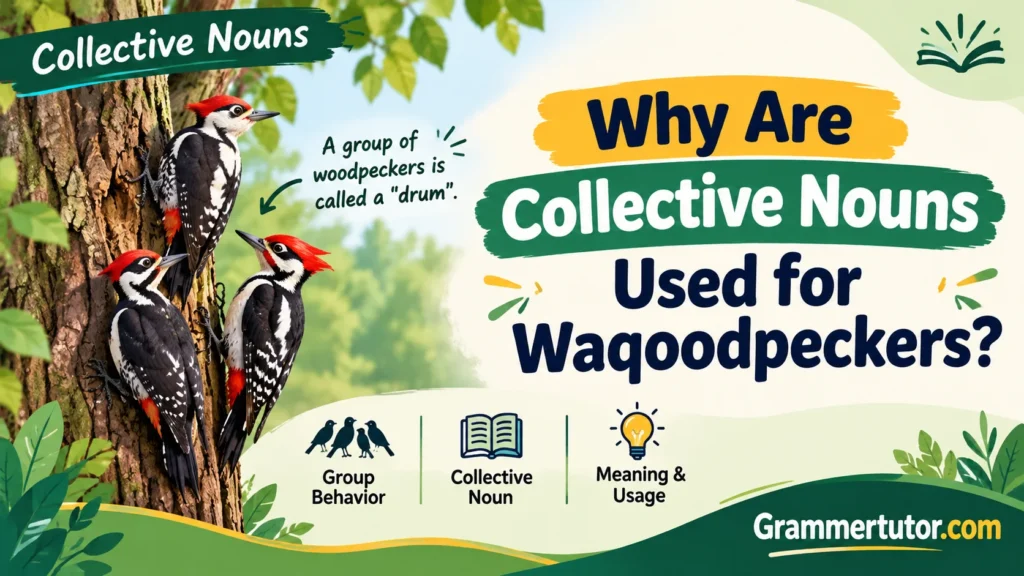
Collective nouns are used to describe several members of the same kind as one group. Instead of repeatedly saying “many woodpeckers,” a collective noun gives the sentence a more natural and descriptive style.
For woodpeckers, a collective noun can be particularly useful when describing several birds gathering around trees, moving through a woodland, or appearing in the same habitat.
For example, compare these two sentences:
- Several woodpeckers were feeding on the old tree.c
- A descent of woodpeckers was feeding among the trees.
The second sentence sounds more distinctive because it gives the group a specific name.
Collective nouns are useful in creative writing, birdwatching descriptions, educational articles, nature reports, and everyday language. They also help readers connect a group of animals with their typical behavior.
Collective Nouns for Woodpeckers
The following table shows the main collective expression associated with woodpeckers and some descriptive alternatives that may appear in context.
| Collective Noun | Used For | Simple Example |
| Descent | A group of woodpeckers | A descent of woodpeckers moved through the woodland. |
| Group | Several woodpeckers together | A group of woodpeckers gathered near the trees. |
| Flock | A number of birds together | A flock of woodpeckers was seen in the forest. |
| Pair | Two woodpeckers | A pair of woodpeckers nested in the old tree. |
| Family | Parents and young woodpeckers | A family of woodpeckers lived near the woodland edge. |
| Colony | Woodpeckers living or nesting in the same area | A colony of woodpeckers occupied the forest habitat. |
| Gathering | A descriptive term for several woodpeckers together | A gathering of woodpeckers appeared around the trees. |
Among these, descent is the distinctive traditional collective noun specifically associated with woodpeckers. Terms such as group, pair, family, or gathering are more general and should be understood according to the context.
Descent of Woodpeckers
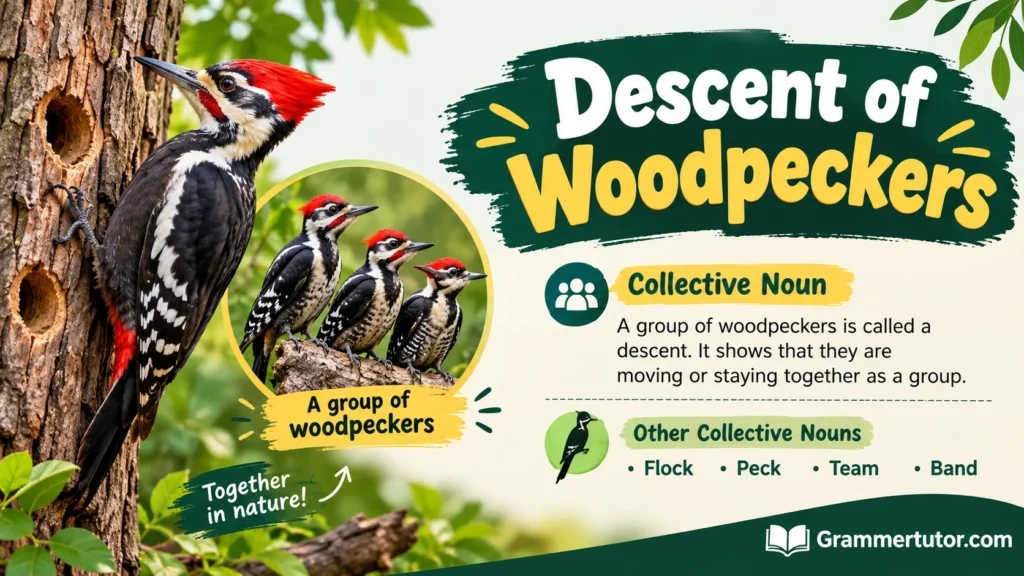
Descent of woodpeckers is the traditional collective noun commonly associated with these birds. It gives a group of woodpeckers a memorable and somewhat literary description.
The word “descent” can also create an interesting image of birds coming down onto trees or an area together. However, you won’t hear this expression in everyday conversation as often as the simple phrase “a group of woodpeckers.”
For writers and bird enthusiasts, though, a descent of woodpeckers can make a sentence more colorful.
Examples of “Descent of Woodpeckers”
- A descent of woodpeckers arrived in the woodland at sunrise.
- We noticed a descent of woodpeckers near the old oak trees.
- A descent of woodpeckers moved from one tree to another.
- The photographer captured a descent of woodpeckers in the forest.
- A descent of woodpeckers gathered where insects were plentiful.
- The children watched a descent of woodpeckers from a safe distance.
- A descent of woodpeckers explored the fallen logs.
- We heard the birds before seeing the descent of woodpeckers overhead.
- The woodland became lively when a descent of woodpeckers appeared.
- A descent of woodpeckers searched the tree trunks for food.
Group of Woodpeckers
Group of woodpeckers is a simple and completely understandable way to refer to several woodpeckers. Unlike “descent,” it isn’t a specialized collective noun, but it works naturally in ordinary speech and writing.
You can use “group” when you don’t need a traditional bird collective noun or when the exact behavior of the birds isn’t important.
For example, if several woodpeckers are visible in a park, saying “a group of woodpeckers” is clear and straightforward.
Examples of “Group of Woodpeckers”
- A group of woodpeckers was feeding in the forest.
- We saw a group of woodpeckers near the hiking trail.
- A group of woodpeckers moved between several trees.
- The ranger pointed out a group of woodpeckers in the distance.
- A group of woodpeckers searched the bark for insects.
- Several visitors stopped to watch the group of woodpeckers.
- A group of woodpeckers occupied the trees beside the stream.
- The group of woodpeckers became active after sunrise.
- A group of woodpeckers flew toward the woodland.
- We quietly observed the group of woodpeckers from the path.
Flock of Woodpeckers
Flock is a general collective noun for birds. Although “descent” is the traditional term specifically connected with woodpeckers, “flock” can be used descriptively when several woodpeckers are together.
The word is especially useful when you are focusing on the birds as a group rather than on the traditional collective noun.
However, woodpeckers often behave differently from birds that naturally travel in large, coordinated flocks. They are frequently observed individually or in smaller groups.
Examples of “Flock of Woodpeckers”
- A flock of woodpeckers was visible among the trees.
- We spotted a flock of woodpeckers near the forest edge.
- A flock of woodpeckers moved through the woodland.
- The flock of woodpeckers searched the branches for insects.
- A photographer waited quietly for the flock of woodpeckers to return.
- A flock of woodpeckers appeared around the old trees.
- The flock of woodpeckers made the forest unusually lively.
- We watched a flock of woodpeckers from the observation point.
- A flock of woodpeckers moved between the trees.
- The flock of woodpeckers disappeared deeper into the forest.
Pair of Woodpeckers
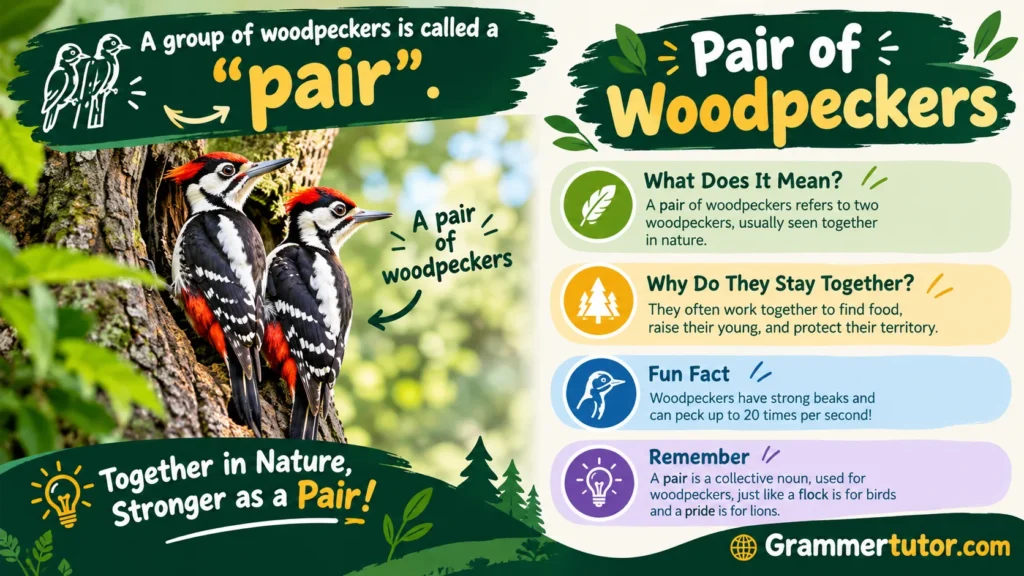
A pair of woodpeckers refers to two birds. This expression is useful because woodpeckers may be seen in pairs, particularly during breeding or nesting activities.
Unlike “descent,” the word “pair” isn’t a special collective noun for woodpeckers. Instead, it simply describes two birds considered together.
A pair may share a territory, investigate a nesting site, or remain near each other while raising young.
Examples of “Pair of Woodpeckers”
- A pair of woodpeckers nested in the old tree.
- We watched a pair of woodpeckers searching for insects.
- A pair of woodpeckers landed on the same branch.
- The pair of woodpeckers returned to the nesting area.
- A pair of woodpeckers was feeding near the woodland path.
- The photographer followed a pair of woodpeckers with a camera.
- A pair of woodpeckers inspected a damaged tree trunk.
- We heard a pair of woodpeckers drumming nearby.
- The pair of woodpeckers disappeared behind the branches.
- A pair of woodpeckers stayed close to their nesting tree.
Family of Woodpeckers
A family of woodpeckers describes parents and their young. This expression is especially appropriate when adult birds are seen caring for chicks or recently fledged young.
Woodpeckers create nesting cavities in trees, and these spaces can provide shelter for their offspring. Once the young birds begin becoming independent, you may see the family moving around the same general area.
“Family” is therefore a useful descriptive term when the relationship between the birds is known.
Examples of “Family of Woodpeckers”
- A family of woodpeckers lived in the woodland.
- We discovered a family of woodpeckers near the nesting tree.
- The family of woodpeckers searched for food together.
- A family of woodpeckers moved through the branches.
- The family of woodpeckers returned to the same area.
- A family of woodpeckers was observed near the forest edge.
- The young birds stayed close to their parents.
- We quietly watched a family of woodpeckers feeding.
- A family of woodpeckers occupied several nearby trees.
- The family of woodpeckers disappeared into the woodland.
Colony of Woodpeckers
The word colony can describe birds living or nesting in the same general area, although it isn’t the traditional collective noun specifically associated with woodpeckers.
This term is most useful when the emphasis is on a shared habitat or nesting area rather than a temporary gathering. It should not be treated as a fixed special name for every group of woodpeckers.
Woodpeckers can establish territories and nesting sites in suitable woodland, particularly where food and mature trees are available.
Examples of “Colony of Woodpeckers”
- A colony of woodpeckers occupied the mature woodland.
- Researchers observed a colony of woodpeckers in the forest.
- The colony of woodpeckers used several trees for nesting.
- A colony of woodpeckers lived near the protected area.
- The forest provided food for the colony of woodpeckers.
- We observed the colony of woodpeckers from a distance.
- The colony of woodpeckers remained active throughout the morning.
- Several trees supported the colony of woodpeckers.
- The colony of woodpeckers moved around the woodland.
- Conservationists monitored the colony of woodpeckers carefully.
Gathering of Woodpeckers
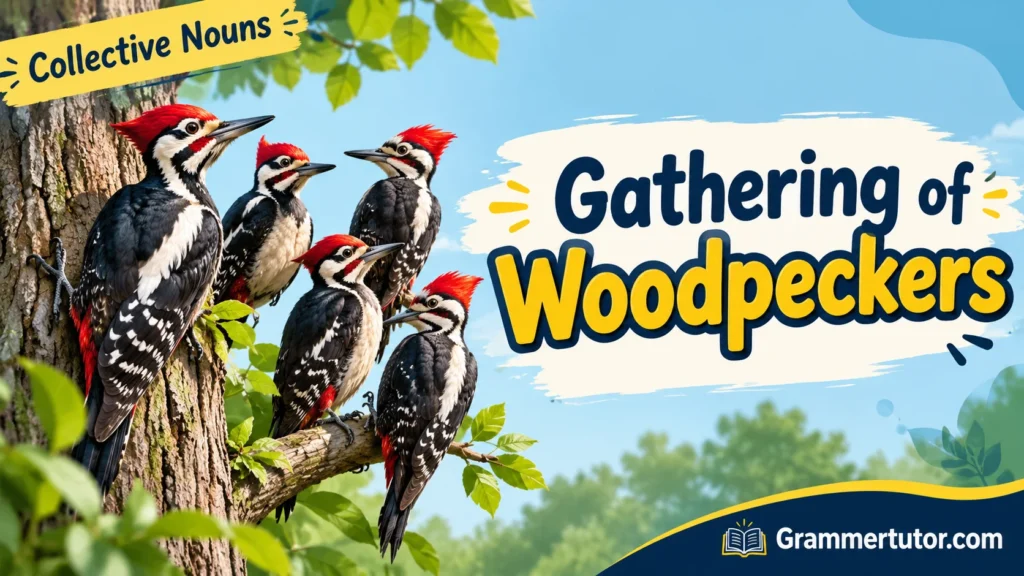
Gathering of woodpeckers is a descriptive phrase rather than a specialized traditional collective noun. It works well when several birds happen to be together in one location.
This expression is useful in nature writing because it doesn’t suggest a particular social structure. You can use it when the birds have gathered around trees, feeding areas, or other suitable habitats.
Examples of “Gathering of Woodpeckers”
- A gathering of woodpeckers appeared near the old forest.
- We watched a gathering of woodpeckers from the trail.
- A gathering of woodpeckers searched the tree trunks.
- The gathering of woodpeckers became active at dawn.
- A gathering of woodpeckers moved through the branches.
- The photographer captured a gathering of woodpeckers in the woodland.
- A gathering of woodpeckers formed around several old trees.
- We noticed a gathering of woodpeckers near the feeding area.
- The gathering of woodpeckers soon moved farther into the forest.
- A gathering of woodpeckers created a lively scene in the woodland.
How Do Woodpeckers Behave in Groups?
Woodpeckers aren’t usually known for forming enormous, tightly coordinated groups like some other bird species. Many species spend considerable time alone while searching for food or defending a territory.
Still, several woodpeckers can occur in the same habitat when food and nesting opportunities are available. During certain seasons, young birds may remain close to adults, while different individuals may also gather around areas with abundant insects or suitable trees.
Their famous drumming behavior is another important part of their lives. A woodpecker may rapidly strike its bill against a tree or another resonant surface. This can help communicate with other woodpeckers and establish territorial presence.
So, when you describe a group of woodpeckers, consider what the birds are actually doing. A descent of woodpeckers gives your writing a traditional collective-noun flavor, while “a pair,” “family,” or “group” may provide more specific information about the situation.
Interesting Facts About Woodpeckers
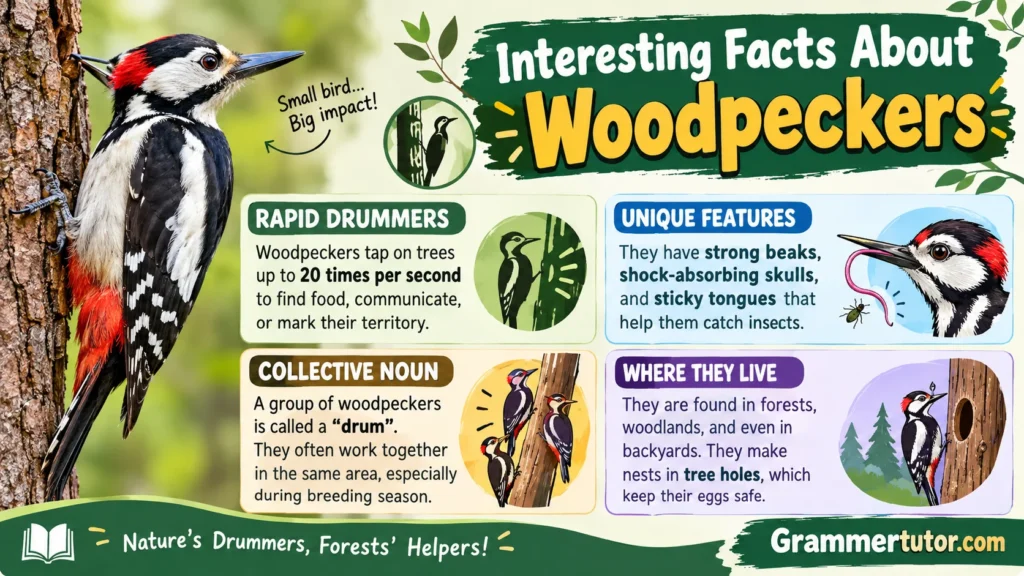
Woodpeckers are specially adapted for life on tree trunks. Their strong bills allow them to break into wood and reach insects hidden beneath bark. Their tongues are also highly specialized, and in many species the tongue can extend a considerable distance beyond the bill to help capture food.
Their feet are another important adaptation. Woodpeckers generally have strong toes and sharp claws that help them grip vertical surfaces. Their stiff tail feathers can also provide support as they climb and work against tree trunks.
Woodpeckers eat a varied diet. Insects and their larvae are important foods for many species, while some also consume fruits, berries, nuts, seeds, and sap. Their diet can change according to the species, season, and available food.
Another fascinating feature is their ability to repeatedly strike wood without suffering the same kind of injury a human would experience. Their skull and body have adaptations that help them handle the forces produced by repeated pecking.
Woodpeckers also play an important role in woodland ecosystems. Their feeding activity can help control insect populations, while the holes they excavate in trees may later provide nesting or shelter sites for other animals.
Their lifespan varies considerably by species and environmental conditions. Some woodpeckers can live for several years in the wild when they have access to suitable food, nesting sites, and protection from predators.
READ MORE: Collective Noun for Cheetahs: Group Names, Examples, and Facts
Conclusion
The traditional collective noun for woodpeckers is a descent of woodpeckers. While a group of woodpeckers is also clear and natural, the term descent gives your writing a more distinctive way to describe these birds when they appear together. Understanding this expression can make your English more precise when discussing woodpeckers, their behavior, and their groups.
FAQs
Q1. What is the collective noun for woodpeckers?
The traditional collective noun is the descent of woodpeckers.
Q2. Can I say a group of woodpeckers?
Yes. A group of woodpeckers is a simple and understandable expression.
Q3. Why are woodpeckers given a collective noun?
Collective nouns provide specific terms for describing groups of animals or birds.
Q4. What does “a descent of woodpeckers” mean?
It refers to a group of woodpeckers and is a traditional collective expression associated with these birds.
Q5. Is “descent” commonly used in everyday English?
Not usually. Descent is more likely to appear in lists or discussions of traditional bird collective nouns.
Q6. Do woodpeckers live in groups?
Woodpeckers can be seen together, although their social behavior varies among species and situations.
Q7. What do woodpeckers do when they gather?
They may search for food, communicate through calls or drumming, and move around the same habitat.
Q8. What do woodpeckers use their beaks for?
They use their strong beaks for activities such as finding insects, creating nesting cavities, and drumming on trees.
Q9. Is “a descent” the only expression for woodpeckers?
No. A descent of woodpeckers is the traditional term, while a group of woodpeckers is a general alternative.
Q10. How can I use the collective noun in a sentence?
You can write: “We saw a descent of woodpeckers moving between the trees.”