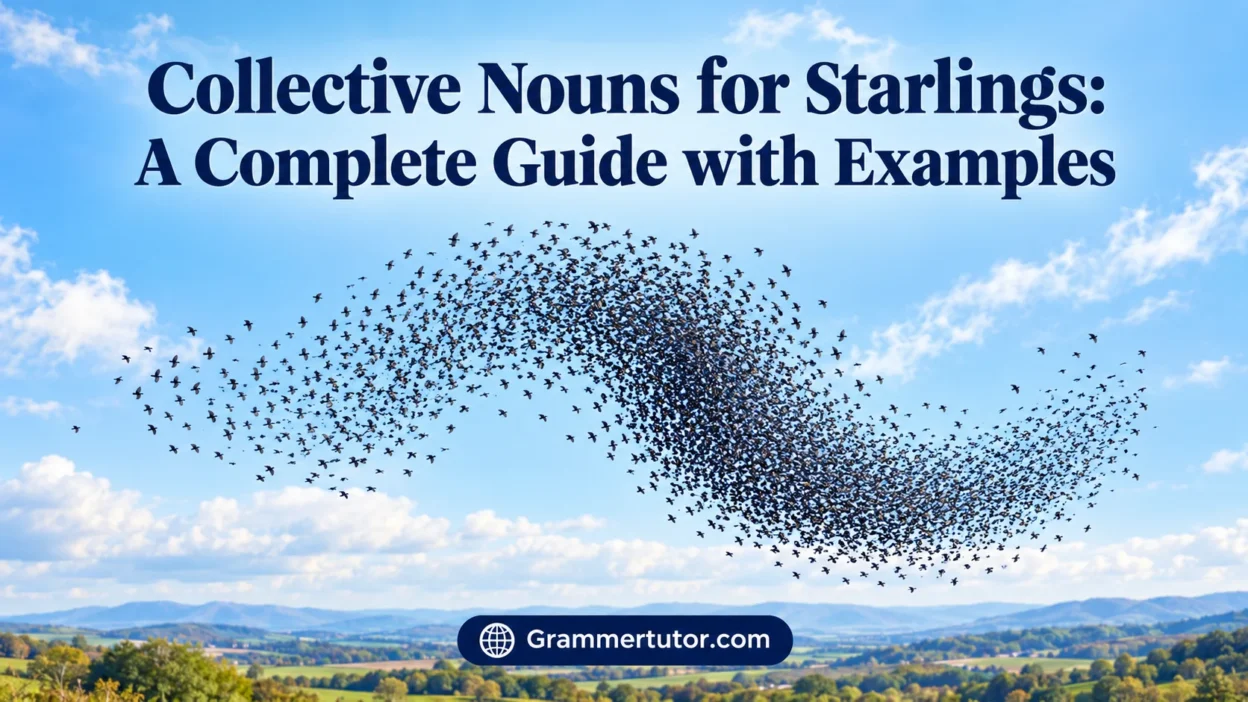
A collective noun for starlings helps describe these small birds when they gather and move as a group. These lively birds have glossy feathers, sharp calls, and an incredible ability to move together in large groups. When hundreds or thousands gather in the sky, their coordinated movements can create a remarkable sight.
English gives us a special way to describe birds that gather closely, and starlings are a good example. Instead of only saying group of starlings, you can use expressive terms that relate to their behavior. Their sharp calls, glossy feathers, and lively movement make the group easy to recognize, especially when they fly together.
When I describe starlings, I find that focusing on how they move together makes the meaning clearer. Their incredible ability to coordinate their movements while flying creates a memorable sight in the sky. These birds can gather in impressive numbers, making their group behavior a useful way to understand why English uses special terms for them.
Why Collective Nouns Are Used for Starlings
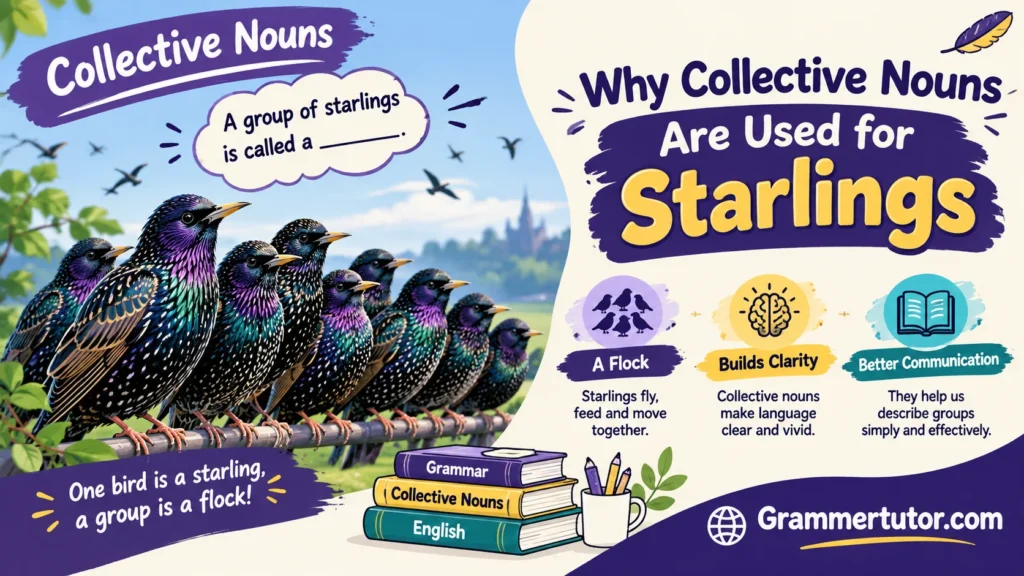
Collective nouns make language more descriptive and interesting. They help us explain not only how many birds are together, but sometimes also what they are doing.
Starlings are particularly suitable for collective nouns because they often gather in large numbers. Before sunset, they may come together in trees, fields, wetlands, or other safe places. During flight, they can twist, turn, and change direction almost simultaneously.
The most familiar collective noun for starlings is murmuration. This word is strongly associated with the dramatic formations created when large groups of starlings fly together. Other terms can also describe groups of these birds depending on the situation.
Collective Nouns for Starlings
Here are some useful collective nouns associated with starlings:
| Collective Noun | Used For | Simple Example |
| Murmuration | A large group of starlings flying together | A murmuration of starlings filled the evening sky. |
| Flock | Starlings gathered or moving together | A flock of starlings landed in the field. |
| Chattering | A group of noisy starlings | A chattering of starlings gathered in the trees. |
| Congregation | A large gathering of starlings | A congregation of starlings settled near the wetland. |
| Host | A very large number of starlings | A host of starlings crossed the open field. |
| Cloud | A large group seen moving through the sky | A cloud of starlings rose above the trees. |
| Cluster | Starlings gathered closely together | A cluster of starlings rested on the branches. |
Murmuration of Starlings
Murmuration is the most famous collective noun associated with starlings. It describes the spectacular formation created when a large number of starlings fly together and rapidly change direction.
A murmuration may look like a dark cloud moving across the sky. The birds can expand, contract, twist, and turn as a coordinated group. These movements are one of the most fascinating sights associated with starlings.
The word is especially appropriate when you want to emphasize the birds’ aerial movement and coordination rather than simply their presence as a group.
Examples of “Murmuration of Starlings”
- A murmuration of starlings appeared above the meadow.
- We watched a murmuration of starlings at sunset.
- A huge murmuration of starlings moved across the sky.
- The murmuration of starlings changed shape within seconds.
- A photographer captured a beautiful murmuration of starlings.
- The murmuration of starlings swept over the fields.
- Hundreds of birds formed a murmuration of starlings.
- The evening sky came alive with a murmuration of starlings.
- We stood quietly while a murmuration of starlings flew overhead.
- The murmuration of starlings disappeared behind the trees.
Flock of Starlings
Flock is the general collective noun that can be used for starlings. It works in many ordinary situations, whether the birds are flying, feeding, resting, or moving from one place to another.
Unlike murmuration, the word flock doesn’t specifically describe an impressive flying formation. It simply tells the reader that several starlings are together.
For everyday writing, flock of starlings is a clear and natural expression.
Examples of “Flock of Starlings”
- A flock of starlings flew over the garden.
- We saw a flock of starlings near the farm.
- A flock of starlings landed on the grass.
- The flock of starlings searched for food.
- A large flock of starlings gathered near the trees.
- The farmer noticed a flock of starlings in the field.
- A flock of starlings suddenly rose into the air.
- The flock of starlings moved toward the lake.
- Several flocks of starlings were visible in the distance.
- A flock of starlings rested on the roof.
Chattering of Starlings
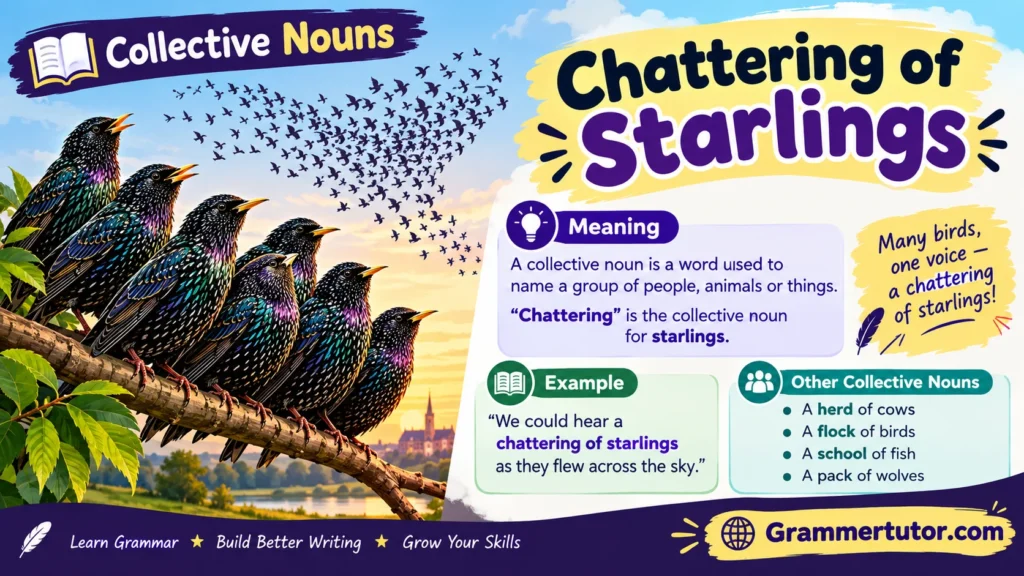
Chattering is a descriptive term that focuses on the noisy nature of starlings. These birds can produce a variety of calls, whistles, and other sounds, particularly when many of them gather together.
The expression chattering of starlings is useful when the sound of the birds is an important part of the scene. It gives the sentence a more vivid feeling than simply saying “a group of starlings.”
Examples of “Chattering of Starlings”
- A chattering of starlings filled the trees.
- We heard the chattering of starlings before seeing them.
- The chattering of starlings echoed across the garden.
- A noisy chattering of starlings gathered near the barn.
- The children listened to the chattering of starlings.
- A chattering of starlings settled on the branches.
- The morning began with the chattering of starlings.
- A loud chattering of starlings flew toward the woodland.
- The chattering of starlings continued throughout the afternoon.
- We watched the chattering of starlings move between the trees.
Congregation of Starlings
Congregation can describe a large gathering of starlings, particularly when many birds come together in one location. The word gives the group a sense of size and togetherness.
You might use this expression when describing starlings gathered around a feeding area, roosting place, field, or wetland.
It is more descriptive than the simple word group, although flock remains the more ordinary term for general use.
Examples of “Congregation of Starlings”
- A congregation of starlings gathered near the wetland.
- We saw a large congregation of starlings in the field.
- The congregation of starlings settled among the trees.
- A congregation of starlings appeared before sunset.
- The farmer watched a congregation of starlings cross the field.
- A noisy congregation of starlings gathered near the barn.
- The congregation of starlings moved toward the woodland.
- Hundreds of birds formed a congregation of starlings.
- A congregation of starlings rested near the river.
- The evening light shone over the congregation of starlings.
Host of Starlings
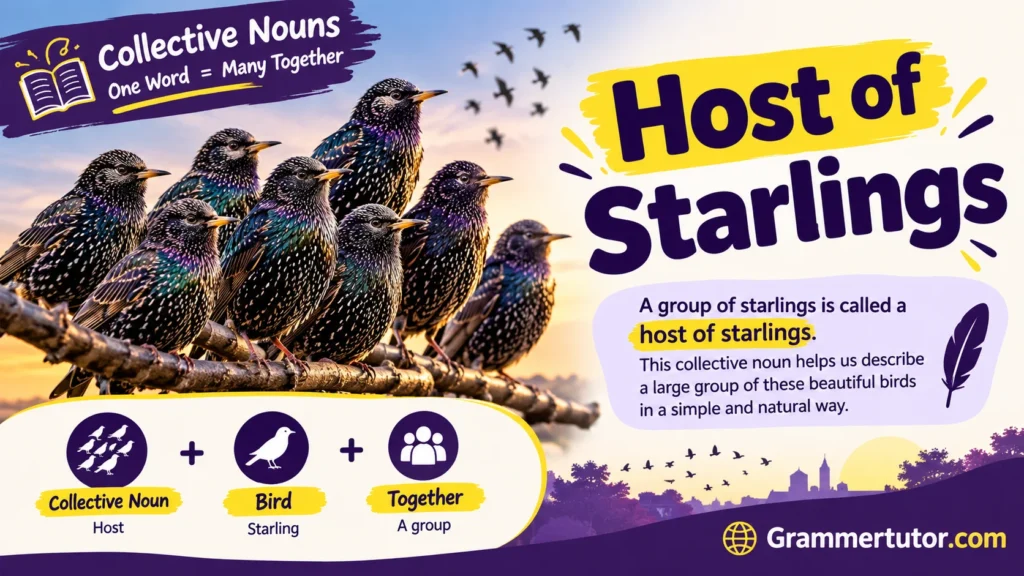
Host is a literary or descriptive collective term that can be used for a very large number of birds. It creates the impression of a sizable gathering rather than a small group.
For starlings, this expression can work particularly well when describing large numbers gathered in open spaces or moving across the landscape.
Examples of “Host of Starlings”
- A host of starlings covered the field.
- A host of starlings flew across the valley.
- We watched a host of starlings gather near the trees.
- A dark host of starlings appeared in the evening sky.
- The host of starlings moved toward the fields.
- A host of starlings descended on the woodland.
- The farmer saw a host of starlings near the crops.
- A host of starlings rose from the meadow.
- The host of starlings filled the branches.
- Hundreds of birds made up a host of starlings.
Cloud of Starlings
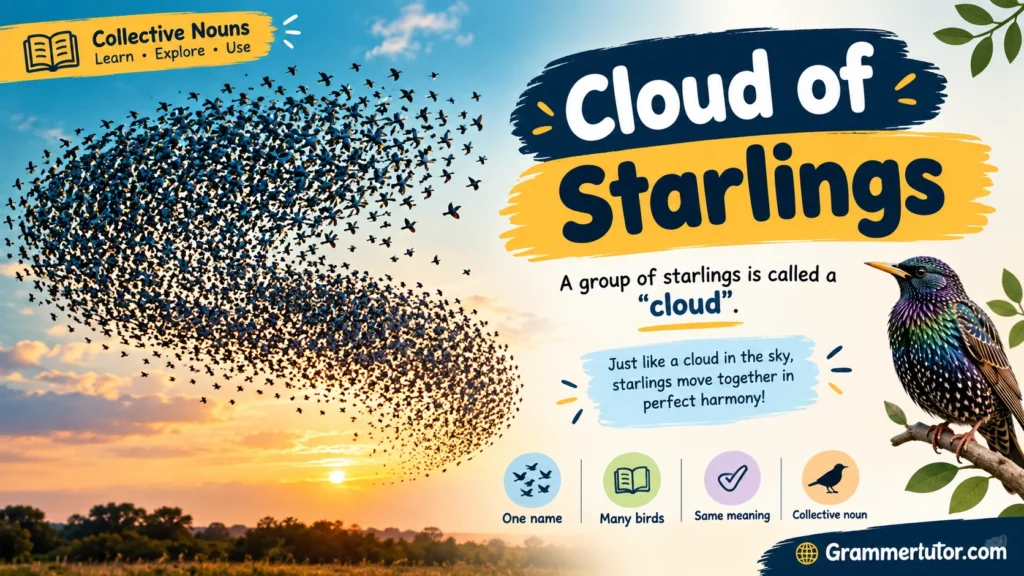
Cloud is a vivid descriptive expression for starlings when a large number of them move together through the air. Their dark bodies can create the appearance of a moving cloud, especially when viewed from a distance.
This term works particularly well in nature writing because it helps readers visualize the birds’ movement.
Examples of “Cloud of Starlings”
- A cloud of starlings crossed the evening sky.
- We watched a cloud of starlings rise above the field.
- A dark cloud of starlings moved over the village.
- The cloud of starlings suddenly changed direction.
- A cloud of starlings gathered above the trees.
- The sunset revealed a cloud of starlings in the distance.
- A huge cloud of starlings swept across the valley.
- The cloud of starlings disappeared behind the hill.
- We photographed a cloud of starlings near the wetland.
- A moving cloud of starlings filled the sky.
Cluster of Starlings
Cluster describes starlings that are gathered closely together. It can be used when the birds are sitting on branches, roofs, wires, or other places where they form a compact group.
Unlike murmuration, this word doesn’t focus on complicated flight patterns. Instead, it highlights how closely the birds are gathered.
Examples of “Cluster of Starlings”
- A cluster of starlings rested on the branches.
- We noticed a cluster of starlings on the roof.
- A small cluster of starlings gathered near the fence.
- The cluster of starlings moved from one tree to another.
- A cluster of starlings sat quietly on the wires.
- The children pointed at a cluster of starlings above them.
- A dark cluster of starlings formed on the branches.
- The cluster of starlings suddenly took flight.
- We saw a cluster of starlings near the farm.
- A large cluster of starlings gathered before dusk.
How Starlings Behave in Groups
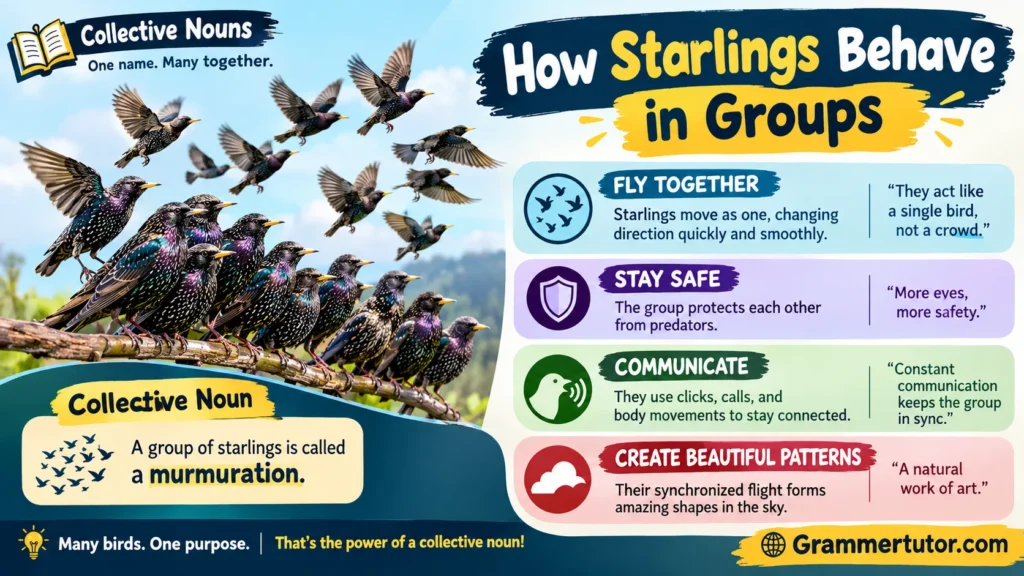
Starlings are highly social birds, and their group behavior is one of the reasons they have such interesting collective nouns. They often gather to feed, rest, communicate, and find safe places to spend the night.
One of their most remarkable behaviors is murmuration. Large numbers of starlings may fly together while changing direction rapidly. The group can appear to stretch, contract, split, and reconnect within moments.
Their movements also help create some of the most memorable scenes in the natural world. A single starling may look like an ordinary small bird, but thousands moving together can create an extraordinary display.
Interesting Facts About Starlings
Starlings are adaptable birds that can live in a variety of environments. They commonly use open areas for feeding and trees, buildings, or other sheltered locations for resting and nesting.
Their diet is varied. Starlings may eat insects, worms, fruits, seeds, and other plant material. This flexible diet helps them take advantage of different food sources throughout the year.
Starlings are also known for their ability to imitate sounds. Some can reproduce sounds from their surroundings and incorporate different noises into their vocalizations. Their calls help them communicate while living and moving in groups.
Another interesting feature is their coordinated flight. During a murmuration, each bird responds to the movements of nearby birds. This can produce the impression that the entire group is acting as one enormous organism.
The social nature of starlings makes them especially interesting to birdwatchers. Seeing a large group gather can reveal behaviors that are difficult to notice when observing a single bird.
READ MORE: Collective Noun for Lambs: A Complete Guide with Examples
Conclusion
The collective noun for starlings gives us an expressive way to describe these lively birds when they gather and fly together. Their coordinated movements, sharp calls, and ability to form large groups make them fascinating to observe. Whether you use a general phrase such as group of starlings or a more specific collective term, the context helps explain how these birds behave.
FAQs
Q1. What is a collective noun for starlings?
A collective noun for starlings is a special term used to describe a group of starlings.
Q2. What is the common phrase for a group of starlings?
The simple phrase group of starlings is always understandable and can be used in general writing.
Q3. Why do starlings gather in large groups?
Starlings gather for reasons such as finding food, staying safer from predators, and preparing to roost.
Q4. Can hundreds of starlings gather together?
Yes. Hundreds of starlings can gather together, and very large gatherings may contain thousands of birds.
Q5. What makes a group of starlings interesting to watch?
Their coordinated movements can create remarkable patterns as they fly together across the sky.
Q6. What do starlings look like?
Starlings are relatively small birds with often glossy feathers and distinctive markings that can appear especially noticeable in good light.
Q7. Do starlings communicate with each other?
Yes. Starlings use different calls and other sounds to communicate with one another.
Q8. When do starlings usually gather?
They may gather at feeding areas and communal roosting sites, particularly before settling down for the night.
Q9. Are starlings social birds?
Yes. Starlings are highly social and often interact with other members of their species in groups.
Q10. What is the best way to use a collective noun for starlings in a sentence?
Use the collective term according to the context. For example, you can describe a group of starlings when several birds gather, or choose a more specific collective expression when discussing their behavior.