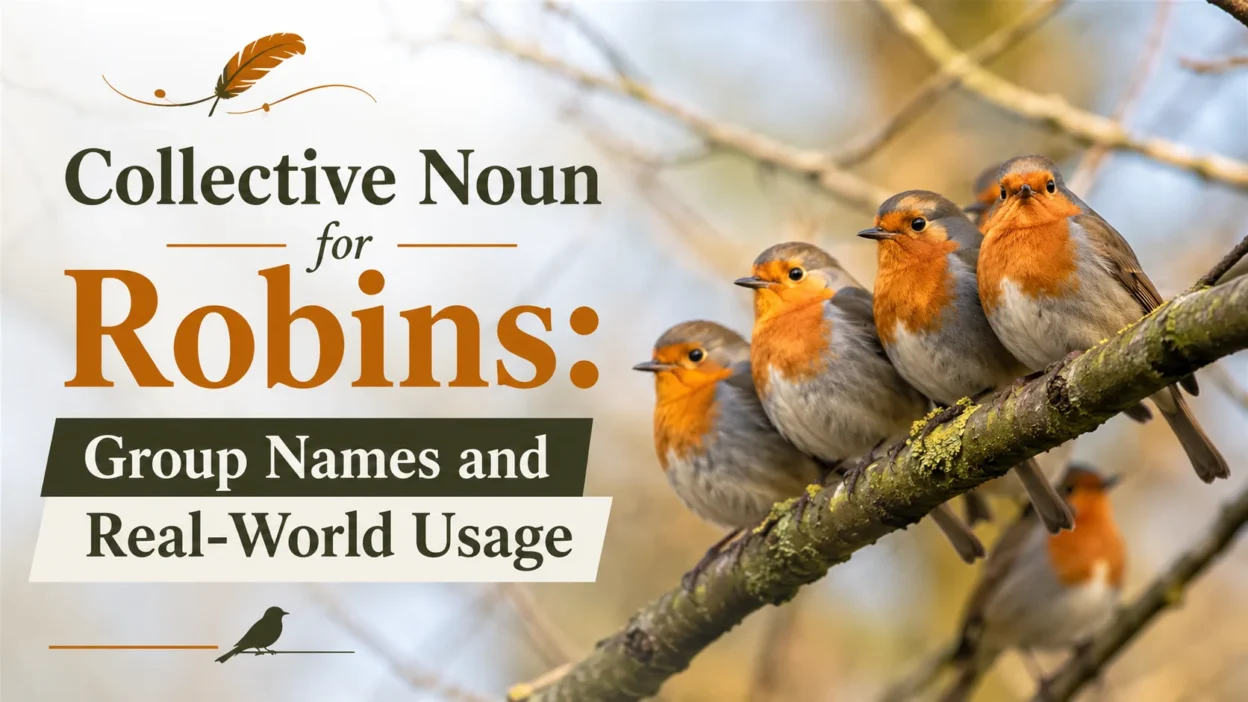
The collective noun for robins helps you describe a group of these small, active birds in clear, everyday English. A flock of robins is the most familiar expression, making your writing and conversation more descriptive and engaging.
English also has special expressions for birds based on how they gather, move, or behave. A round of robins is a traditional collective term found in bird vocabulary, while flock of robins remains the more familiar choice for describing a group.
In wildlife writing, these expressions create more vivid descriptions by connecting language with the social behavior and movement of robins. If you’re studying birds or curious about animal terms, learning these expressions can enrich your vocabulary and help you describe robins naturally.
Why Collective Nouns Are Used for Robins
Robins are active birds that may gather in groups, particularly when feeding or moving between suitable habitats. Although many robins are territorial during the breeding season, they can become more social at other times of the year.
Because birds can gather and move together, flock provides a simple and widely understood way to describe several robins. Traditional bird terminology also includes more unusual collective expressions that add variety to English.
These terms help writers describe groups of birds without repeatedly using the phrase a group of robins.
Collective Nouns for Robins
| Collective Noun | Used For | Simple Example |
| Flock | A group of robins | A flock of robins flew across the garden. |
| Round | A traditional term for robins | A round of robins gathered in the trees. |
| Group | A general group of robins | A group of robins searched for food. |
| Colony | A group living or nesting in one area | A colony of robins settled near the woodland. |
Flock of Robins
A flock is the simplest and most familiar collective noun for robins. It describes several robins gathered or moving together.
The expression a flock of robins works well in everyday English and is easy for readers to understand.
Examples of “Flock of Robins”
- A flock of robins flew across the garden.
- We watched a flock of robins in the trees.
- The flock of robins searched for food.
- A large flock of robins gathered near the bushes.
- The flock of robins flew over the meadow.
- A flock of robins rested in the branches.
- The children watched a flock of robins.
- The flock of robins moved toward the woodland.
- A flock of robins gathered near the feeder.
- The flock of robins disappeared into the trees.
Round of Robins
A round of robins is a traditional and less common collective expression. It gives the group a distinctive, literary feel and can be useful in writing about birds.
Unlike flock, which is a general term, round is more specialized and isn’t commonly used in everyday conversation.
Examples of “Round of Robins”
- A round of robins gathered in the trees.
- We spotted a round of robins near the woodland.
- The round of robins moved across the meadow.
- A round of robins searched for berries.
- The round of robins flew between the branches.
- A round of robins rested near the garden.
- The round of robins scattered when a hawk appeared.
- We watched a round of robins at sunrise.
- A round of robins gathered near the bushes.
- The round of robins disappeared into the forest.
Group of Robins
A group of robins is a general expression rather than a specialized collective noun. It can be used whenever several robins are together.
This expression is particularly useful when you want to keep your writing simple and avoid less familiar traditional terms.
Examples of “Group of Robins”
- A group of robins gathered in the garden.
- We saw a group of robins near the trees.
- The group of robins searched for insects.
- A group of robins flew across the field.
- The group of robins rested in the bushes.
- A group of robins gathered around the food.
- The children observed a group of robins.
- A group of robins moved through the grass.
- The group of robins returned to the woodland.
- A group of robins scattered across the garden.
Colony of Robins
A colony of robins can be used descriptively for robins occupying the same general area, although it isn’t the usual everyday collective noun for these birds. Flock is generally a clearer choice when describing robins gathered together.
The word colony is more commonly associated with animals or birds that live or nest in organized groups.
Examples of “Colony of Robins”
- A colony of robins settled near the woodland.
- We observed a colony of robins in the area.
- The colony of robins searched for food.
- A colony of robins lived around the garden.
- The colony of robins became active in the morning.
- Researchers observed the colony of robins.
- A colony of robins occupied the woodland.
- The colony of robins moved through the trees.
- A colony of robins gathered near the bushes.
- The colony of robins remained in the area.
Group Behavior of Robins
Robins are small birds known for their bright orange-red breasts, upright posture, and energetic movements. Their social behavior changes depending on the season and circumstances. During the breeding season, robins can be strongly territorial and may defend feeding or nesting areas from other robins.
Outside the breeding season, some robins become more tolerant of one another and may gather where food is plentiful. They can be seen searching through lawns, woodland edges, gardens, and other habitats for insects and other food.
Robins communicate through songs and calls. Their songs are especially important during territorial and breeding behavior. A robin may use vocal signals to communicate its presence and warn other birds to stay away from its territory.
Examples of Robin Behavior
- Robins can be territorial during breeding.
- Robins communicate through songs and calls.
- Robins search the ground for insects.
- Robins may gather where food is plentiful.
- Robins often live near gardens and woodland.
- Robins can defend nesting territories.
- Robins use their songs during breeding.
- Robins may move between different feeding areas.
- Robins have excellent awareness of their surroundings.
- Robins can become more social outside the breeding season.
Interesting Facts About Robins
Robins are small passerine birds found in different parts of the world, and the name robin can refer to different species depending on the region. The European robin and American robin, for example, belong to different genera. Their lifespans vary according to species and environmental conditions, with wild birds facing threats such as predators, disease, harsh weather, and limited food.
Robins have several interesting physiological features. The American robin is known for its orange-red breast, while the European robin has a distinctive reddish-orange face and breast. Their lightweight bodies, wings, and strong flight muscles allow them to move efficiently between feeding and nesting areas. Their sharp vision also helps them locate food on the ground.
Robins have a varied diet. They commonly eat insects, earthworms, spiders, and other invertebrates. They also consume fruits and berries, particularly when insects are less available. Their feeding behavior makes them familiar sights in gardens and grassy areas, where they search the ground for prey.
Robins are also fascinating because of their territorial behavior. During breeding periods, individuals may defend territories using songs, displays, and physical actions. The familiar robin song is therefore more than a pleasant sound—it can play an important role in communication and territory defense.
Examples of Robin Facts
- Robins are passerine birds.
- Robins can have distinctive reddish or orange-red breasts.
- Robins eat insects and other invertebrates.
- Many robins also eat fruits and berries.
- Robins often search for food on the ground.
- Robins communicate through songs and calls.
- Some robins are strongly territorial during breeding.
- Robins can live in gardens, woodland, parks, and other habitats.
- Robin species differ depending on the region.
- Robins are familiar birds in many human environments.
Conclusion
Understanding the collective noun for robins makes it easier to describe these lively birds naturally. Flock of robins is the most familiar expression, while round of robins is a traditional collective term that adds variety to bird vocabulary. Knowing both expressions can make your English clearer and your wildlife writing more interesting.
FAQs
Q1. What is the collective noun for robins?
The most familiar collective noun for robins is flock. You can say a flock of robins when referring to a group.
Q2. Can I say “a flock of robins”?
Yes. A flock of robins is a natural and understandable way to describe several robins together.
Q3. Is “round of robins” a collective noun?
Yes. Round of robins is a traditional collective term, although it isn’t as commonly used in everyday English as flock of robins.
Q4. Which is more common: flock or round of robins?
Flock of robins is the more familiar expression in modern English. Round of robins has a more traditional or literary feel.
Q5. Why are collective nouns used for robins?
Collective nouns provide a convenient way to describe a group of animals. They can also make writing more precise and interesting.
Q6. What is a simple sentence using “flock of robins”?
A simple example is: “A flock of robins gathered in the garden.”
Q7. Are robins social birds?
Robins can gather in groups, particularly in suitable feeding or roosting areas. However, their social behavior can vary depending on circumstances.
Q8. Can I use “flock” in formal writing?
Yes. Flock is a standard English word and can be used naturally in both general and formal writing when describing groups of birds.
Q9. Is “group of robins” grammatically correct?
Yes. A group of robins is completely correct. However, a flock of robins gives a more specific description.
Q10. What should I use when learning English?
For everyday English, a flock of robins is the easiest and most natural expression to remember.