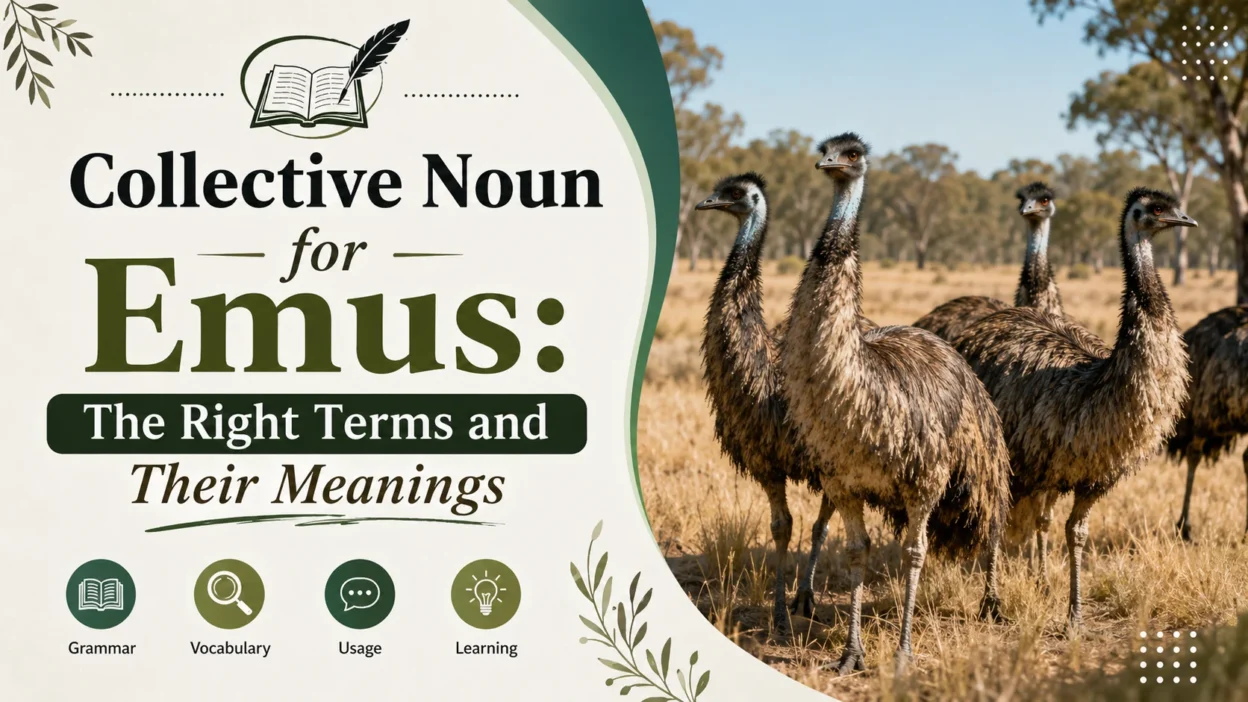
The collective noun for emus is a mob, a simple term used for a group of these large, flightless birds. In everyday English, it gives your writing and conversation a clear and descriptive way to talk about emus when they gather or move together.
A mob of emus is commonly linked with the way these birds travel and forage together. This collective noun connects language with their behavior, movement, and social lives, making wildlife writing more vivid and helping readers understand how the animals act.
For people learning English or studying birds, knowing the right collective noun can enrich your vocabulary and make animal group names more interesting. If you’re curious about emus, learning these terms can make your use of English more engaging and natural.
Why Collective Nouns Are Used for Emus
Emus are social birds, particularly when they gather to feed, travel, or search for water. They can form groups and move across large areas in search of food and suitable conditions.
Because emus can travel together in groups, mob is the most distinctive collective noun associated with them. The expression a mob of emus gives a clear picture of several emus moving or gathering together.
Using a specific collective noun also makes sentences more interesting than repeatedly saying a group of emus. It connects the language with the natural behavior of these remarkable Australian birds.
Collective Nouns for Emus
| Collective Noun | Used For | Simple Example |
| Mob | A group of emus | A mob of emus crossed the field. |
| Flock | A group of emus | A flock of emus moved across the plain. |
| Group | A general group of emus | A group of emus searched for food. |
| Herd | Emus moving together | A herd of emus traveled across the grassland. |
Mob of Emus
A mob is the most distinctive collective noun associated with emus. It can describe a group of emus that gathers, travels, or searches for food together.
The expression a mob of emus is particularly useful when describing these birds in their natural Australian environment.
Examples of “Mob of Emus”
- A mob of emus crossed the open field.
- We saw a mob of emus near the road.
- The mob of emus moved across the grassland.
- A large mob of emus searched for food.
- The mob of emus traveled toward the water.
- A mob of emus wandered across the plain.
- The farmer noticed a mob of emus nearby.
- The mob of emus disappeared into the bush.
- A mob of emus moved quickly across the land.
- We watched a mob of emus from a distance.
Flock of Emus
A flock is a general collective noun used for groups of birds. It can be used to describe several emus together, although mob is more distinctive for emus.
The expression a flock of emus is easy to understand and can work in general descriptions of several birds.
Examples of “Flock of Emus”
- A flock of emus moved across the plain.
- We saw a flock of emus near the trees.
- The flock of emus searched for food.
- A flock of emus crossed the grassland.
- The flock of emus traveled toward the river.
- A large flock of emus gathered near the water.
- The flock of emus disappeared into the bush.
- We watched a flock of emus from afar.
- A flock of emus wandered across the field.
- The flock of emus moved toward the hills.
Group of Emus
A group of emus is a simple general expression rather than a specialized collective noun. It can be used whenever you want to describe several emus together without focusing on a particular behavior.
Although mob is more distinctive, the group is completely clear and works in almost any context.
Examples of “Group of Emus”
- A group of emus gathered near the trees.
- We saw a group of emus in the field.
- The group of emus searched for food.
- A group of emus crossed the road.
- The group of emus moved toward the water.
- A group of emus walked across the plain.
- The farmer watched a group of emus.
- A group of emus rested near the bushes.
- The group of emus disappeared into the grassland.
- We photographed a group of emus.
Herd of Emus
A herd is normally associated with grazing mammals, but it can sometimes be used descriptively for a group of emus moving across open land. Because emus are large, long-legged birds that often travel together, the term can create an understandable image.
However, mob of emus is the more distinctive choice when you’re looking for a specific collective noun.
Examples of “Herd of Emus”
- A herd of emus moved across the grassland.
- We watched a herd of emus near the hills.
- The herd of emus traveled toward the water.
- A herd of emus crossed the open plain.
- The herd of emus searched for food.
- A herd of emus moved through the bush.
- The herd of emus disappeared over the hill.
- We saw a herd of emus at sunrise.
- A herd of emus walked across the field.
- The herd of emus continued toward the valley.
Emu Social Behavior
Emus can be social and may gather in groups, particularly when food and water are available. They are capable of traveling long distances and can move across open landscapes while searching for resources.
Their behavior can change according to environmental conditions. During periods when resources are plentiful, several emus may gather in the same area. They use their excellent eyesight and hearing to remain aware of their surroundings while moving through their habitat.
Emus don’t form permanent family groups in the same way throughout their lives. Their social patterns can change with age, breeding behavior, food availability, and environmental conditions. This flexible behavior helps explain why groups of emus can sometimes be seen traveling together across large areas.
Examples of Emu Behavior
- Emus can gather in groups.
- Emus travel across large areas.
- Emus search for food and water.
- Emus have strong legs for walking and running.
- Emus communicate through vocal sounds.
- Emus have excellent eyesight.
- Groups can form around available resources.
- Emus can move quickly across open land.
- Emus are adapted to Australian environments.
- Emus can travel long distances while foraging.
Interesting Facts About Emus
Emus are among the world’s largest birds and are native to Australia. They are flightless birds, meaning their wings aren’t capable of producing powered flight. Despite this limitation, emus are excellent runners. Their long legs and powerful muscles allow them to cover large distances and reach impressive running speeds when necessary.
Emus have several unique physiological features. Their long necks and strong legs give them a distinctive appearance, while their three-toed feet provide stability and traction as they move across different types of terrain. Their feathers have a shaggy appearance and help provide insulation in Australia’s varied climate.
Emus are omnivores, meaning they consume both plant and animal material. Their diet can include grasses, leaves, fruits, seeds, flowers, and insects. They may also swallow small stones or other hard materials that help grind food inside their digestive system.
One of the most unusual aspects of emu biology is their breeding behavior. After the female lays her eggs, the male takes primary responsibility for incubating them. The male can remain with the eggs for several weeks, eating very little while protecting and incubating the developing chicks.
Emus can also survive in a variety of Australian habitats, including grasslands, woodlands, and semi-arid regions. Their ability to travel long distances and make use of different food sources helps them adapt to changing environmental conditions.
Examples of Emu Facts
- Emus are flightless birds.
- Emus are native to Australia.
- Emus are among the world’s largest birds.
- Emus have long, powerful legs.
- Emus are excellent runners.
- Emus have three-toed feet.
- Emus are omnivores.
- Emus eat plants, fruits, seeds, and insects.
- Male emus incubate the eggs.
- Emus can travel long distances while searching for resources.
Conclusion
The collective noun for emus is mob, and it provides a simple, natural way to describe these large, flightless birds when they gather, travel, or forage together. Learning this term can make your writing more descriptive, enrich your vocabulary, and help you speak about animal groups with greater confidence.
FAQs
Q1. What is the collective noun for emus?
The most commonly used collective noun for emus is mob. You can say a mob of emus when referring to a group of these birds.
Q2. What do you call a group of emus?
A group of emus is commonly called a mob of emus.
Q3. Why is “mob” used for emus?
The word mob describes a group of emus and connects naturally with their tendency to travel and forage together.
Q4. Is “mob of emus” grammatically correct?
Yes. A mob of emus is a grammatically correct phrase for describing a group of emus.
Q5. Are emus flightless birds?
Yes. Emus are large, flightless birds native to Australia.
Q6. Can I use “group of emus” instead of “mob of emus”?
Yes. Group of emus is perfectly understandable, but mob of emus is the more specific collective expression.
Q7. Is “mob” only used for emus?
No. Mob can have several meanings in English, but it is also used as a collective term for certain groups of animals, including emus.
Q8. How can I use “mob of emus” in a sentence?
You could write: “We saw a mob of emus moving across the open grassland.”
Q9. Does learning collective nouns improve English vocabulary?
Yes. Learning collective nouns can expand your vocabulary and help make your writing and conversation more precise and descriptive.
Q10. What is the plural of emu?
The plural of emu is emus. For example, “Several emus were walking across the field.”