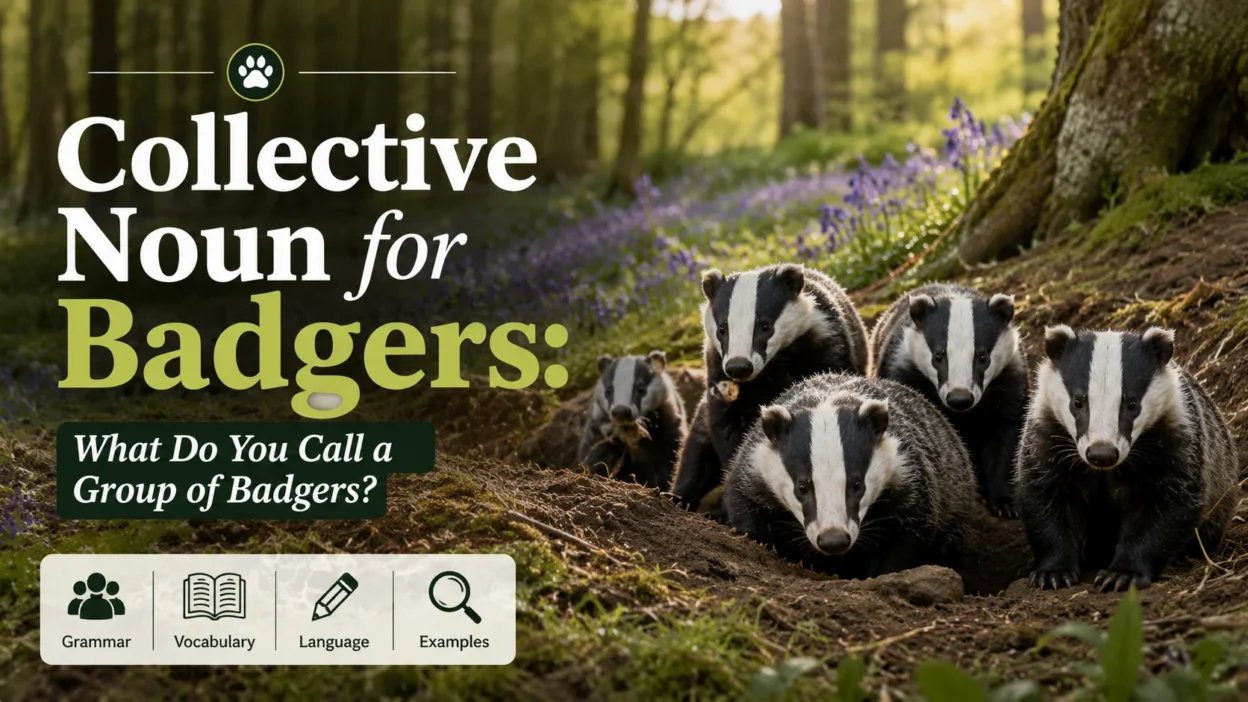
The Collective Noun for Badgers is cete, a traditional collective noun used for a group of badgers in English. This distinctive term makes learning animal group names more interesting and gives wildlife writing a more precise and engaging style.
Badgers are fascinating mammals known for their strong digging abilities, varied diets, and interesting social behavior. While cete of badgers is the traditional term associated with them, general expressions such as group and colony may also be used depending on the situation. Learning this terminology helps you describe these animals clearly and understand useful English vocabulary connected with wildlife.
From a practical language perspective, knowing cete is useful when you want to make your writing more specific rather than simply using the word group. It also connects the animal’s name with its behavior, diet, and social life, making the vocabulary easier to remember and more engaging.
Why Collective Nouns Are Used for Badgers
Collective nouns give groups of animals specific names and can make descriptions shorter and more vivid. For badgers, the traditional word cete is especially interesting because it has been associated with groups of badgers for centuries.
Badgers don’t always live in large social groups. Their social behavior varies between species. Some badgers are relatively solitary, while others may live in family groups or social communities. This makes the word cete useful when describing a group without suggesting that every badger species always lives socially.
Collective Nouns for Badgers
| Collective Noun | Used For | Simple Example |
| Cete | A group of badgers | A cete of badgers lived near the woodland. |
| Group | A general group of badgers | A group of badgers crossed the field. |
| Colony | A group living in a shared area | A colony of badgers occupied the set. |
Cete of Badgers
A cete is the traditional and best-known collective noun for badgers. The expression a cete of badgers is commonly found in lists of animal collective nouns and is particularly useful in educational and wildlife writing.
A cete may refer to several badgers associated with the same area or set. The word gives your writing a distinctive alternative to the general phrase group of badgers.
Examples of “Cete of Badgers”
- A cete of badgers lived near the woodland.
- We spotted a site of badgers at dusk.
- The site of badgers emerged from the set.
- A cete of badgers searched for food.
- The wildlife team observed a cete of badgers.
- A cete of badgers moved through the forest.
- The center of badgers returned to the set.
- We watched a cete of badgers from a safe distance.
- A cete of badgers explored the meadow.
- The site of badgers became active after sunset.
Group of Badgers
A group of badgers is a simple general expression rather than a traditional specialized collective noun. It can be used when you want your meaning to be immediately clear.
Although cete is the traditional collective noun, group works naturally in everyday English.
Examples of “Group of Badgers”
- A group of badgers crossed the field.
- We saw a group of badgers near the woods.
- The group of badgers searched for food.
- A group of badgers emerged after sunset.
- The group of badgers entered the set.
- A group of badgers moved through the grass.
- The farmer noticed a group of badgers nearby.
- The group of badgers disappeared into the woodland.
- A group of badgers rested near the set.
- We observed a group of badgers at night.
Colony of Badgers
A colony of badgers can be used descriptively for badgers living in the same general area or associated with a shared set. However, the colony isn’t as traditional or specific as cete.
When you’re looking for the recognized collective noun specifically associated with badgers, cete remains the better choice.
Examples of “Colony of Badgers”
- A colony of badgers lived near the woodland.
- The colony of badgers used the same area.
- We observed a colony of badgers near the set.
- The colony of badgers became active at night.
- A colony of badgers searched for food.
- The wildlife team studied the colony of badgers.
- The colony of badgers moved through the forest.
- A colony of badgers occupied several nearby settlements.
- The colony of badgers remained hidden during the day.
- Researchers monitored the colony of badgers.
Sett of Badgers
A set isn’t technically the collective noun for badgers. Instead, a set is the underground burrow or den system where badgers live. Because badgers are famous for digging extensive underground homes, the term is closely connected with them.
A set can contain tunnels, chambers, entrances, and sleeping areas. Some sets can be used by badgers for many years.
Examples of “Sett of Badgers”
- The badgers returned to their set.
- We found a large set near the woodland.
- The set had several entrances.
- A family of badgers lived on the set.
- The wildlife team protected the set.
- The badgers emerged from the set at night.
- The old set was hidden beneath the trees.
- Fresh soil surrounded the entrance to the set.
- The badgers maintained their set carefully.
- We observed tracks leading toward the set.
Family Group of Badgers
A family group of badgers is another clear expression that describes badgers living together as a family. This is particularly useful when discussing species and populations that have stronger social relationships.
The expression is descriptive rather than a traditional collective noun.
Examples of “Family Group of Badgers”
- A family group of badgers lived near the set.
- We observed a family group of badgers at dusk.
- The family group of badgers searched for food.
- A family group of badgers emerged from the set.
- The wildlife team followed a family group of badgers.
- The family group of badgers moved through the woodland.
- A family group of badgers rested near the entrance.
- The family group of badgers disappeared into the bushes.
- A family group of badgers crossed the meadow.
- The family group returned to the set before morning.
Badger Behavior and Social Life
Badgers are mainly nocturnal, meaning they’re most active at night. Their behavior varies among species. Some badgers tend to live alone or in small family groups, while others can form more social communities. European badgers, for example, can live in social groups associated with extensive underground sets.
Badgers are also famous for their digging abilities. Their strong forelimbs and long claws allow them to excavate soil efficiently. They use their burrows for sleeping, raising young, escaping predators, and sheltering from harsh weather.
Communication is another important part of badger behavior. Badgers can use sounds, scents, body movements, and scent marking to communicate information. Their strong sense of smell helps them locate food and recognize their surroundings.
Examples of Badger Behavior
- Badgers are often active at night.
- Badgers use underground sets for shelter.
- Badgers have strong digging claws.
- Some badgers live in family groups.
- Badgers use scent to communicate.
- Badgers search for food after dark.
- Badgers can maintain extensive burrow systems.
- Young badgers may remain with their mother.
- Badgers can travel considerable distances while searching for food.
- Badgers may return to established sets.
Interesting Facts About Badgers
Badgers are members of the mustelid family, which also includes animals such as weasels, otters, and ferrets. Different badger species have different appearances, behaviors, and habitats. Their bodies are generally low and powerful, with strong limbs that make them excellent diggers. Many badgers have long claws that help them excavate soil and create or expand underground burrows.
Badgers can have relatively long lives when conditions are favorable, although lifespan varies by species, habitat, disease, predation, and human activity. Their underground homes can provide protection and shelter, allowing them to spend much of the daytime hidden from potential threats.
Their physiological features are closely linked to their lifestyle. Badgers have sturdy bodies, powerful forelimbs, strong claws, and relatively short legs. Their body shape allows them to move efficiently through tunnels and underground spaces. Many species also have distinctive facial markings that make them easy to recognize.
Badgers have varied dietary habits because they’re generally opportunistic feeders. Depending on the species and habitat, they may eat earthworms, insects, small mammals, amphibians, birds, eggs, fruits, roots, and other available foods. European badgers are particularly well known for eating earthworms, which can make up a significant part of their diet.
Their ability to adapt their diet helps badgers survive in different environments. They can search for food in woodland, grassland, farmland, and other habitats. Their digging can also disturb soil and influence the local environment, making them an interesting part of many ecosystems.
Examples of Badger Facts
- Badgers are mammals.
- Badgers belong to the mustelid family.
- Many badgers are nocturnal.
- Badgers are excellent diggers.
- Their strong claws help them excavate soil.
- Badgers use underground sets for shelter.
- Some badgers live in social groups.
- Badgers have varied diets.
- Earthworms can be an important food source for some badgers.
- Badgers have strong senses of smell.
- Some badger species have distinctive facial markings.
Conclusion
The traditional collective noun for badgers is cete. While words such as group or colony may describe badgers in general situations, cete is the distinctive term associated with a gathering of badgers. Learning this term can make your English vocabulary more precise and your wildlife writing more interesting.
FAQs
Q1. What is the collective noun for badgers?
The traditional collective noun for badgers is cete.
Q2. What do you call a group of badgers?
A group of badgers is traditionally called a cete of badgers.
Q3. Is “cete” the correct word for badgers?
Yes. Cete is a recognized traditional collective noun associated with badgers.
Q4. Can I use “group of badgers” instead?
Yes. Group of badgers is perfectly understandable, although cete is the more specific traditional term.
Q5. What does “cete” mean?
Cete refers to a group or community of badgers.
Q6. Is “colony” used for badgers?
Colony can sometimes be used as a general expression, particularly when discussing badgers living together, but cete is the traditional collective noun.
Q7. Why are collective nouns used for badgers?
Collective nouns provide specific or memorable ways to describe groups of animals and can make writing more varied.
Q8. Are badgers social animals?
Badger social behavior varies by species and circumstances. Some badgers may live in social groups, while others spend significant time alone.
Q9. How can I use “cete” in a sentence?
You can say, “A cete of badgers was seen near the woodland.”
Q10. Is “cete of badgers” used in wildlife writing?
Yes. Cete of badgers can be used in wildlife writing when you want to use the traditional collective noun for a group of badgers.