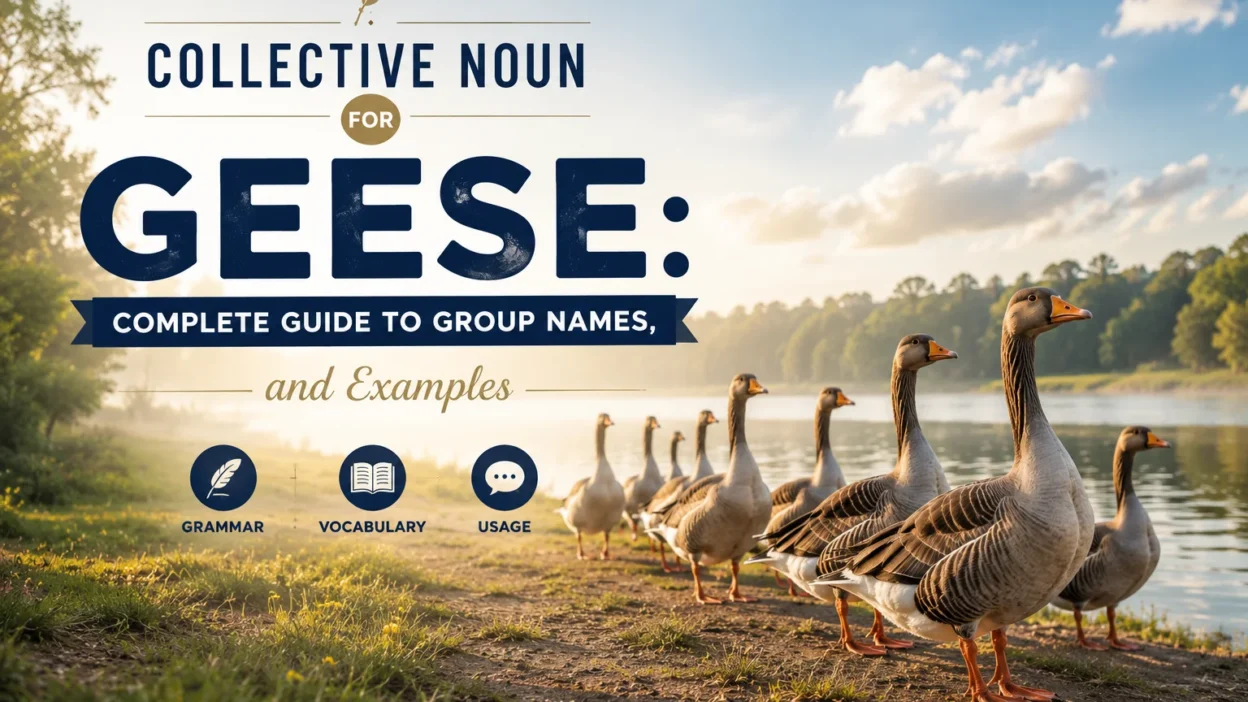
The collective noun for geese helps you describe a group of geese clearly and naturally in English. Among common animal group names, gaggle of geese is widely used for geese gathered together on land. This common expression is useful in everyday English, especially when speaking, writing, or describing a group of waterfowl.
Geese can also be described with special terms based on what they are doing. When flying, a skein of geese is a traditional term and descriptive term for a group moving through the air. These expressions connect language with the behavior and movement of birds, making descriptions more descriptive and engaging.
When studying birds or learning about wildlife, understanding these terms, expressions, and names can help you enrich vocabulary. English learning becomes easier when you connect words with real wildlife, such as flying geese, land geese, and geese that are gathered or moving together.
Why Collective Nouns Are Used for Geese
Geese are social birds that commonly gather in groups. They may feed together, rest near water, travel between locations, or fly in organized formations. Their strong social behavior has inspired several collective nouns in English.
Gaggle is the best-known collective noun for geese, particularly when they are gathered together on the ground. Skein is often used when geese are flying together, especially in a recognizable formation across the sky.
Other expressions can also appear in traditional or descriptive English. Understanding the context helps you choose the most suitable collective noun.
Collective Nouns for Geese
| Collective Noun | Used For | Simple Example |
| Gaggle | Geese gathered on land | A gaggle of geese stood near the pond. |
| Skein | Geese flying together | A skein of geese flew across the sky. |
| Flock | A general group of geese | A flock of geese rested by the lake. |
| Plump | A traditional term for geese | A plump of geese gathered near the water. |
| Team | Geese working or moving together | A team of geese moved across the field. |
Gaggle of Geese
A gaggle is the most famous and widely recognized collective noun for geese. It usually describes geese gathered together on the ground, particularly around a pond, field, park, or other open area.
The word gaggle is especially memorable because it gives a lively image of geese standing, walking, feeding, and making noise together.
Examples of “Gaggle of Geese”
- A gaggle of geese stood near the pond.
- We saw a gaggle of geese in the park.
- The gaggle of geese gathered around the farmer.
- A large gaggle of geese crossed the field.
- The gaggle of geese searched for food.
- A gaggle of geese rested beside the lake.
- The children watched a gaggle of geese.
- A gaggle of geese walked along the riverbank.
- The gaggle of geese became noisy near the water.
- A gaggle of geese returned to the pond.
Skein of Geese
A skein is a traditional collective noun for geese flying together. It is particularly associated with geese traveling in a V-shaped or similar formation during migration.
This term is more specialized than gaggle because it focuses on geese in flight rather than geese gathered on land.
Examples of “Skein of Geese”
- A skein of geese flew across the evening sky.
- We watched a skein of geese heading south.
- The skein of geese crossed the mountains.
- A skein of geese appeared above the lake.
- The skein of geese flew in formation.
- A skein of geese passed over the village.
- We heard a skein of geese overhead.
- The skein of geese traveled toward warmer regions.
- A skein of geese disappeared beyond the hills.
- The photographer captured a skein of geese in flight.
Flock of Geese
A flock is a general collective noun that can describe a group of geese. It doesn’t specifically indicate whether the geese are on land or in the air.
Although gaggle and skein are more distinctive terms, flock of geese is clear and natural in general descriptions.
Examples of “Flock of Geese”
- A flock of geese rested near the lake.
- We saw a flock of geese in the field.
- The flock of geese flew over the river.
- A flock of geese gathered near the pond.
- The flock of geese searched for food.
- A large flock of geese crossed the valley.
- The flock of geese returned before sunset.
- A flock of geese moved across the grass.
- The farmer watched a flock of geese.
- The flock of geese traveled toward the wetlands.
Plump of Geese
A plump is a traditional collective noun that can be found in lists of animal group names for geese. It is much less common in everyday English than gaggle or flock.
The expression can add a playful or old-fashioned tone to writing, but gaggle of geese is generally the better choice for ordinary use.
Examples of “Plump of Geese”
- A plump of geese gathered near the pond.
- We noticed a plump of geese by the lake.
- The plump of geese walked across the field.
- A plump of geese rested near the river.
- The farmer watched the plump of geese.
- The plump of geese searched for food.
- A plump of geese gathered near the water.
- The plump of geese moved toward the grass.
- We saw a plump of geese in the meadow.
- The plump of geese returned to the pond.
Team of Geese
A team of geese is not as common as gaggle or skein, but it can be used descriptively when emphasizing cooperation or coordinated movement. For general English, flock or gaggle is usually more natural.
Examples of “Team of Geese”
- A team of geese moved across the field.
- The team of geese traveled toward the lake.
- A team of geese crossed the grassland.
- The team of geese moved together.
- A team of geese searched for food.
- The team of geese rested near the pond.
- A team of geese walked toward the river.
- We watched a team of geese near the water.
- The team of geese returned to the wetlands.
- A team of geese moved across the meadow.
Goose Behavior and Social Life
Geese are highly social birds and often spend much of their lives in groups. They may gather to feed, rest, communicate, migrate, and protect one another. Many species form strong social bonds, and family groups can remain together for extended periods.
Geese communicate through a variety of vocalizations, including loud honking and other calls. These sounds can help members of a group stay in contact, especially while traveling or flying. Their calls can also signal danger or help coordinate movement.
One of the most recognizable behaviors of geese is their formation flight. During migration, many geese fly in a V-shaped formation. This arrangement can help reduce aerodynamic drag for birds flying behind the leader, allowing the group to travel efficiently over long distances.
Geese are also known for their strong family relationships. Young goslings generally remain close to their parents, and parents can become highly protective when they sense a threat. These social behaviors make collective terms such as gaggle, flock, and skein especially useful when describing geese.
Examples of Goose Behavior
- Geese often travel in groups.
- Geese communicate through vocal calls.
- A skein of geese can fly in formation.
- Geese may migrate over long distances.
- Young goslings stay close to their parents.
- Geese can become protective around their young.
- Geese often feed together.
- Geese may rest together near water.
- Families can remain together within larger groups.
- Geese use calls to maintain contact.
Interesting Facts About Geese
Geese are fascinating waterfowl belonging to the family Anatidae, which also includes ducks and swans. Different goose species vary in size, appearance, habitat, and behavior. Many species can live for well over a decade, and some individuals can survive for several decades under suitable conditions. Their lifespan depends on species, genetics, habitat, food availability, predators, disease, and other environmental factors.
Geese have several unique physiological features that help them survive in different environments. Their bodies are covered with waterproof feathers, which help keep them dry while swimming. They have webbed feet that provide propulsion in water, while their strong wings allow them to travel considerable distances. Their bills are adapted for gathering and processing a variety of foods.
Geese are mainly herbivorous, although their diets can vary by species and season. They commonly eat grasses, aquatic vegetation, seeds, grains, and other plant material. Some geese also consume small amounts of insects and other animal material, particularly when available. Their feeding habits allow them to use a range of habitats, including wetlands, grasslands, agricultural areas, and lakeshores.
Migration is another remarkable part of goose behavior. Many goose species travel long distances between breeding and wintering grounds. They can navigate across large areas and often return to familiar regions year after year. Their ability to coordinate movement within a flock makes their seasonal journeys particularly impressive.
Geese also have strong social bonds. Pairs may remain together for multiple breeding seasons, and parents often stay close to their young. These relationships help explain why geese are frequently observed traveling and resting in family groups within larger flocks.
Examples of Goose Facts
- Geese are waterfowl.
- Geese belong to the family Anatidae.
- Many geese are highly social.
- Geese can form strong family bonds.
- Many goose species migrate.
- Geese often fly in V-shaped formations.
- Geese have webbed feet.
- Their feathers provide waterproofing.
- Many geese mainly eat plant material.
- Geese can live for many years.
- Goslings often remain close to their parents.
- Geese communicate through vocal calls.
Conclusion
The collective noun for geese makes it easier to describe groups of these waterfowl accurately. Gaggle of geese is commonly used for geese gathered on land, while skein of geese traditionally describes geese flying together. Learning these terms can make your English, writing, and vocabulary more descriptive and natural.
FAQs
Q1. What is the collective noun for geese?
The most common collective noun for geese is gaggle. You can say, “A gaggle of geese gathered near the pond.”
Q2. What do you call a group of geese?
A group of geese is commonly called a gaggle of geese, especially when the birds are together on land.
Q3. What is a skein of geese?
A skein of geese is a traditional expression for geese flying together, often in a recognizable formation.
Q4. Is “gaggle of geese” correct?
Yes. Gaggle of geese is a well-established expression and is especially associated with geese gathered on land.
Q5. Can I use “skein” for geese on the ground?
Usually, skein is used for geese in flight. For geese gathered on land, gaggle is the more familiar choice.
Q6. Why are different collective nouns used for geese?
Different terms can describe geese according to their behavior or movement. This makes language more specific and descriptive.
Q7. What is the plural of goose?
The plural of goose is geese, not “gooses.”
Q8. Is “flock of geese” also correct?
Yes. Flock of geese is understandable and commonly used as a general description, although gaggle is a more specific traditional collective noun.
Q9. What is the collective noun for geese when they are flying?
Skein of geese is the traditional term for geese flying together.
Q10. Which collective noun for geese should I use in everyday English?
For everyday English, gaggle of geese is the safest and most familiar choice. Use skein of geese when specifically describing geese in flight.