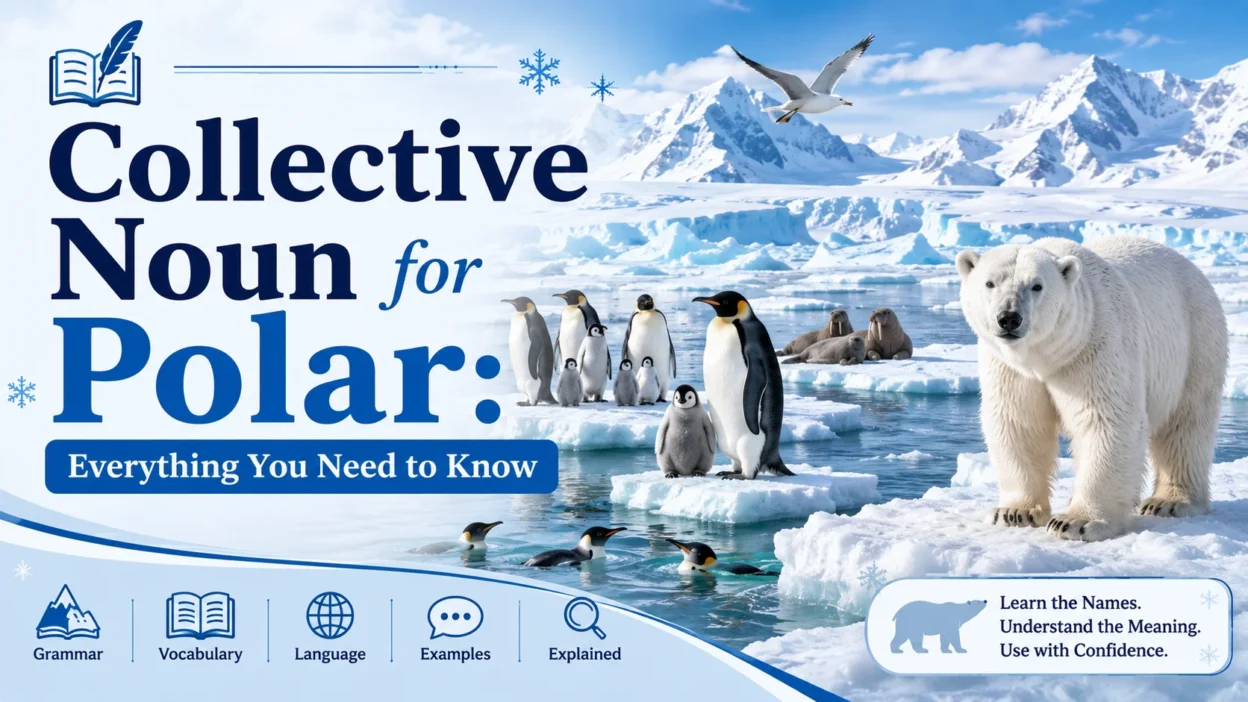
The collective noun for polar collective noun for polar bears can make learning animal group names more interesting and help you understand how these powerful Arctic mammals are described in everyday English. Polar bears are solitary animals, unlike other mammals that often live in large permanent social groups. However, they may gather in certain situations, especially when food is available or during particular stages of their lives. For simple writing, group remains a clear and useful term when you need to describe several polar bears together.
English offers several descriptive expressions depending on the context. A celebration of polar bears is a traditional collective expression associated with these animals, while family may be suitable when the bears are known to be related. You can choose words according to the different situations you are describing. This approach makes your writing clearer because the term matches the way the animals actually behave. It also shows how the English language can connect animal descriptions with real-world behavior.
When describing these remarkable Arctic animals, the most useful choice depends on what you know about the group. Use a group of polar bears when you simply mean several bears together, and use family when a clear family relationship exists. Learning these collective nouns creates an interesting connection between language and the natural behavior of polar bears. From an English-usage perspective, choosing a term that fits the context is more important than forcing an unusual expression into a sentence.
Why Collective Nouns Are Used for Polar Bears
Polar bears have a different social lifestyle from animals that naturally live in large herds or packs. Adult polar bears generally spend much of their time alone, although mothers stay with their cubs for an extended period.
Because of this behavior, collective expressions for polar bears are less commonly used in everyday conversation than terms such as herd of horses or flock of birds. The traditional expression celebration of polar bears is especially interesting because it gives a distinctive and memorable name to a group.
These expressions can make wildlife writing more engaging while helping readers visualize polar bears in their natural environment.
Collective Nouns for Polar Bears
| Collective Noun | Used For | Simple Example |
| Celebration | A group of polar bears | A celebration of polar bears gathered near the ice. |
| Group | A general gathering of polar bears | A group of polar bears rested near the shore. |
| Family | A mother polar bear and her cubs | A family of polar bears traveled across the ice. |
| Litter | A group of polar bear cubs born together | A litter of polar bear cubs stayed close to their mother. |
Celebration of Polar Bears
A celebration of polar bears is a traditional and distinctive collective expression for a group of polar bears. It is much more colorful than simply saying a group of polar bears and is particularly suitable for descriptive or educational writing.
Polar bears don’t normally form large, permanent groups, so this expression is most useful when several bears happen to gather in the same area.
Examples of “Celebration of Polar Bears”
- A celebration of polar bears gathered near the ice.
- We observed a celebration of polar bears from a safe distance.
- The celebration of polar bears rested along the shoreline.
- A celebration of polar bears appeared near the coast.
- Scientists photographed a celebration of polar bears.
- A celebration of polar bears gathered around a food source.
- The celebration of polar bears moved across the frozen landscape.
- We watched a celebration of polar bears near the water.
- A celebration of polar bears attracted the attention of researchers.
- The celebration of polar bears slowly moved away from the shore.
Group of Polar Bears
A group of polar bears is a simple and general expression. It can be used when several polar bears are seen together without relying on a traditional collective noun.
This is often the clearest choice in scientific, educational, or everyday writing because it doesn’t suggest that polar bears normally live in permanent groups.
Examples of “Group of Polar Bears”
- A group of polar bears rested near the shore.
- We saw a group of polar bears on the sea ice.
- The group of polar bears moved toward the water.
- A group of polar bears gathered near a food source.
- Scientists observed a group of polar bears.
- The group of polar bears traveled across the ice.
- A group of polar bears appeared along the coastline.
- The researchers photographed a group of polar bears.
- The group of polar bears remained near the shore.
- A group of polar bears moved across the snowy landscape.
Family of Polar Bears
A family of polar bears generally describes a mother polar bear with her cubs. Female polar bears are strongly protective of their young, and mothers spend considerable time caring for their cubs before they become independent.
The term family is therefore more specific than simply saying group.
Examples of “Family of Polar Bears”
- A family of polar bears traveled across the ice.
- The family of polar bears stayed close together.
- A mother led her family across the snowy landscape.
- We observed a family of polar bears from a distance.
- The family of polar bears rested near the shore.
- A family of polar bears moved toward the sea ice.
- The mother protected her family from danger.
- Researchers studied a family of polar bears.
- The family of polar bears disappeared behind the ice.
- A family of polar bears remained close to the coastline.
Litter of Polar Bear Cubs
A litter of polar bear cubs refers to cubs born to the same mother. This expression describes the young rather than a general gathering of adult polar bears.
Polar bear mothers usually give birth to small numbers of cubs, and the cubs remain dependent on their mother for a significant period.
Examples of “Litter of Polar Bear Cubs”
- A litter of polar bear cubs stayed close to their mother.
- The mother cared for her litter of cubs.
- A litter of polar bear cubs emerged from the den.
- Researchers observed a litter of polar bear cubs.
- The litter of cubs followed their mother.
- A litter of polar bear cubs played near the den.
- The mother protected her litter from danger.
- The litter of cubs rested beside their mother.
- A litter of polar bear cubs explored the snowy ground.
- The mother guided her litter across the ice.
Polar Bear Social Behavior
Polar bears are generally solitary mammals, particularly adult males. They spend much of their time traveling across sea ice and searching for food. However, their solitary nature doesn’t mean they never interact with other polar bears. They may gather in areas where food is available or encounter one another during movements across their Arctic habitat.
The strongest social relationship occurs between a mother and her cubs. A female polar bear gives birth in a maternity den and cares for her cubs until they’re old enough to survive independently. During this period, the cubs learn important survival skills by following and observing their mother.
Polar bears can also display different forms of communication. They use body posture, vocalizations, scent marking, and physical behavior to communicate with other bears. Their interactions can vary depending on whether they’re competing for food, establishing space, courting, or caring for young.
Examples of Polar Bear Behavior
- Polar bears are generally solitary animals.
- Mothers care closely for their cubs.
- Cubs remain dependent on their mothers when young.
- Polar bears can gather around food sources.
- Adult males often live alone.
- Polar bears communicate through sounds and body language.
- Mothers teach cubs important survival behaviors.
- Polar bears spend much of their time searching for food.
- Polar bears are strong swimmers.
- Sea ice is an important part of their natural habitat.
Interesting Facts About Polar Bears
Polar bears are among the largest land carnivores on Earth and are specially adapted to life in the Arctic. They have a thick layer of body fat that provides insulation in extremely cold conditions. Their dense fur also helps reduce heat loss, while their black skin absorbs and retains solar energy more effectively than lighter skin would. Despite their white appearance, the fur itself is actually translucent and scatters light, creating the familiar white appearance.
Polar bears have several remarkable physiological features. Their large paws help distribute their weight over snow and ice and also function as powerful paddles when swimming. The paws are covered with small structures that provide traction on slippery surfaces. Polar bears also have a highly developed sense of smell, which helps them detect prey across considerable distances.
Their dietary habits are closely connected to the Arctic marine ecosystem. Polar bears are primarily carnivorous and depend heavily on seals, particularly in areas where sea ice provides access to hunting opportunities. They may also eat other available foods, including carcasses, birds, eggs, and vegetation when conditions require it. Their ability to store large amounts of body fat helps them survive periods when food is scarce.
Polar bears can also live for many years in the wild. Their longevity varies according to environmental conditions, food availability, health, and other factors. Their large bodies, thick insulation, efficient fat storage, and specialized paws all help them survive in one of Earth’s harshest environments.
Climate change has also become a major concern for polar bears because they depend heavily on sea ice for hunting, traveling, and other important activities. Changes in the amount and timing of sea ice can affect access to their primary prey and increase the challenges they face in the Arctic.
Examples of Polar Bear Facts
- Polar bears are Arctic mammals.
- They are among the largest land carnivores.
- Polar bears have thick layers of body fat.
- Their skin is black beneath their fur.
- Their fur appears white but is actually translucent.
- Polar bears have large, powerful paws.
- Polar bears are excellent swimmers.
- Seals are an important part of their diet.
- Adult polar bears are generally solitary.
- Mother polar bears care for their cubs.
- Sea ice is important for polar bear hunting.
- Polar bears have a highly developed sense of smell.
Conclusion
The collective noun for polar bears can vary depending on the situation. Group is the simplest general term, while family works when related bears are being described. The traditional expression celebration of polar bears adds an interesting language point. Understanding these terms helps you describe Arctic mammals clearly while connecting English vocabulary with their natural behavior.
FAQs
Q1. What is the collective noun for polar bears?
A commonly mentioned collective expression is a celebration of polar bears. However, group is the simplest everyday term.
Q2. Are polar bears social animals?
No. Polar bears are generally solitary animals and usually live alone rather than in permanent groups.
Q3. Can I use “group” for polar bears?
Yes. Group is a clear and natural general term for several polar bears together.
Q4. What does “a celebration of polar bears” mean?
A celebration of polar bears is a traditional collective expression used to describe a group of polar bears.
Q5. Can “family” describe polar bears?
Yes, when the bears are known to be related. For example, a mother polar bear and her cubs can be described as a family.
Q6. Why do polar bears gather together?
They may gather around food or during certain periods of their lives, even though they are normally solitary animals.
Q7. Do polar bears form large permanent groups?
No. Unlike some other mammals, polar bears don’t normally form large permanent social groups.
Q8. Why are collective nouns useful?
Collective nouns make writing more descriptive and help you choose words that accurately fit different situations.
Q9. Is “group of polar bears” grammatically correct?
Yes. A group of polar bears is grammatically correct and is often the safest choice in everyday English.
Q10. What is the best term to use in ordinary writing?
Group is usually the clearest choice when you simply want to refer to several polar bears without emphasizing their relationship or behavior.