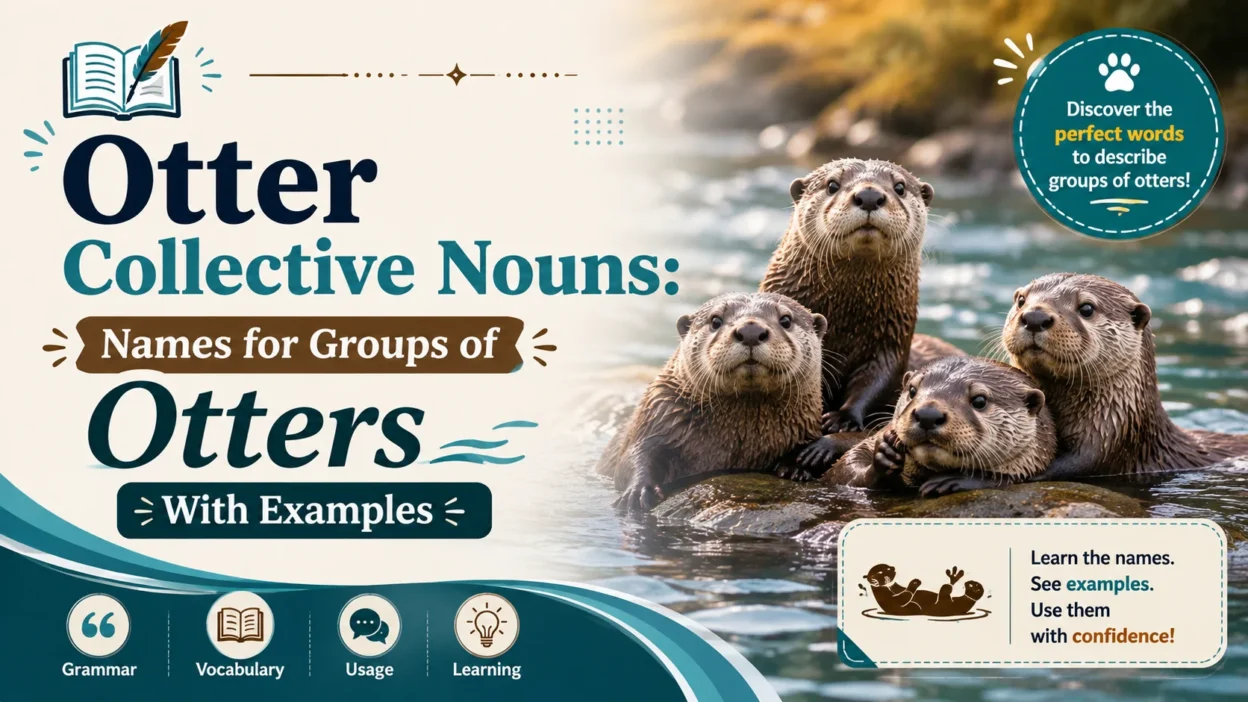
The collective noun for otters helps you describe these playful aquatic mammals when several otters gather together in a group. Learning these animal group names makes everyday English more descriptive, especially when writing about wildlife. Instead of using the same phrase repeatedly, you can choose the right expression to make your sentences clearer and more natural.
A raft of otters is the commonly recognized expression, particularly when otters are floating together on water. Other colorful expressions, such as family, bevy, and romp, can also appear in descriptions of otters. These terms can relate to their social behavior, movement, or the way they gather while playing, swimming, resting, or traveling together.
Using these terms makes wildlife writing more engaging and creates a clearer picture for readers. Whether you’re learning English, studying wildlife, or simply curious about animal group names, understanding these expressions can enrich your vocabulary and help you describe otters naturally.
Why Collective Nouns Are Used for Otters
Otters are social mammals, although their social behavior varies between species. Sea otters, for example, are well known for forming groups while floating on the water. These groups can rest, groom, and sometimes sleep together. River otters may also form family groups, particularly mothers and their young.
Because otters often gather in water and display playful social behavior, English has developed colorful expressions for groups of these animals. Raft is particularly descriptive because it creates an image of otters floating together on the water.
These expressions allow writers to describe not only the number of otters but also the setting and behavior of the group.
Collective Nouns for Otters
| Collective Noun | Used For | Simple Example |
| Raft | Otters floating together | A raft of otters floated on the river. |
| Family | Otters living together as a family group | A family of otters played near the shore. |
| Bevy | A group of otters | A bevy of otters gathered near the water. |
| Romp | A playful group of otters | A romp of otters played in the stream. |
| Group | A general group of otters | A group of otters swam across the lake. |
Raft of Otters
A raft is one of the best-known collective nouns associated with otters, particularly sea otters. It describes otters floating together on the water, often while resting, grooming, or sleeping.
Sea otters may hold onto one another or use kelp to help keep themselves together while resting. Seeing many otters floating side by side can look like a natural raft on the surface of the water.
Examples of “Raft of Otters”
- A raft of otters floated on the river.
- We watched a raft of otters near the shore.
- The raft of otters rested on the calm water.
- A large raft of otters gathered in the bay.
- The raft of otters floated among the kelp.
- We spotted a raft of otters from the boat.
- The raft of otters moved slowly across the water.
- A raft of otters rested together in the afternoon.
- The scientists observed a raft of otters.
- The raft of otters disappeared behind the rocks.
Family of Otters
A family of otters is a useful expression when describing a mother and her young or a related group living together. Some otter species form family groups in which parents and offspring stay together for a period of time.
This expression focuses on the relationship between the animals rather than simply describing their number.
Examples of “Family of Otters”
- A family of otters played near the riverbank.
- We saw a family of otters swimming together.
- The family of otters searched for food.
- A family of otters rested beside the stream.
- The mother otter protected her family.
- The family of otters moved through the water.
- A family of otters disappeared into the reeds.
- We watched a family of otters from a distance.
- The family of otters returned to the river.
- A family of otters explored the shoreline.
Bevy of Otters
A bevy of otters is a colorful expression that can be used to describe a group of otters. It has a more literary or playful quality than the straightforward expression group of otters.
Because bevy isn’t as common in everyday speech, raft remains a more recognizable term when describing otters floating together.
Examples of “Bevy of Otters”
- A bevy of otters gathered near the shore.
- We spotted a bevy of otters in the river.
- The bevy of otters played in the water.
- A bevy of otters searched for food.
- The bevy of otters swam across the bay.
- A bevy of otters rested near the rocks.
- The children watched a bevy of otters.
- A bevy of otters disappeared beneath the water.
- We photographed a bevy of otters at sunrise.
- The bevy of otters moved along the shoreline.
Romp of Otters
A romp of otters is a playful and descriptive expression that emphasizes the energetic behavior of these animals. The word romp suggests lively movement, playing, and having fun.
Otters are famous for their playful behavior, so this expression can work particularly well in creative or wildlife writing.
Examples of “Romp of Otters”
- A romp of otters played in the stream.
- We watched a romp of otters near the waterfall.
- The romp of otters chased one another through the water.
- A romp of otters rolled around on the riverbank.
- The romp of otters played among the rocks.
- A romp of otters splashed in the shallow water.
- The children enjoyed watching the romp of otters.
- A romp of otters disappeared beneath the waves.
- The romp of otters played together at sunset.
- We photographed a lively romp of otters.
Group of Otters
A group of otters is a simple general expression. It isn’t as distinctive as raft, but it’s completely clear and can be used whenever you don’t need a specialized collective noun.
This expression works well in everyday conversation and general writing.
Examples of “Group of Otters”
- A group of otters swam across the lake.
- We saw a group of otters near the riverbank.
- The group of otters searched for food.
- A group of otters rested beside the water.
- The group of otters played together.
- A group of otters crossed the stream.
- The group of otters disappeared into the reeds.
- We watched a group of otters from the shore.
- A group of otters gathered near the rocks.
- The group of otters returned to the river.
Otter Behavior and Social Life
Otters are intelligent and adaptable mammals that spend much of their lives in or around water. Their social behavior varies considerably between species. Sea otters can form large floating groups called rafts, while some river otters are more commonly seen in smaller family groups.
Otters communicate using vocalizations, body movements, scent marking, and physical contact. Social grooming is also important for some species. Young otters often stay close to their mothers while they learn essential skills such as swimming, hunting, and finding food.
Their playful behavior is one of their most recognizable characteristics. Otters may wrestle, chase one another, slide along muddy or snowy surfaces, and play with objects. Although play looks entertaining, it can also help young animals develop physical and social skills.
Otters are also skilled swimmers. Their streamlined bodies, webbed feet, and strong tails help them move efficiently through water. Their dense fur provides insulation, which is especially important for species living in cold aquatic environments.
Examples of Otter Behavior
- Otters are excellent swimmers.
- Some otters live in family groups.
- Sea otters can form large rafts.
- Otters communicate through sounds and body signals.
- Young otters often stay close to their mothers.
- Otters can spend much of their time in water.
- Otters are known for playful behavior.
- Many otters hunt aquatic prey.
- Otters use their whiskers to detect movement in water.
- Some otters groom themselves and one another.
Interesting Facts About Otters
Otters are members of the weasel family, Mustelidae, and include several species adapted to aquatic or semi-aquatic environments. Their lifespan varies by species, habitat, and living conditions. Some otters can live for more than a decade, while individuals under human care may sometimes live considerably longer. Their survival depends on factors such as food availability, habitat quality, disease, predators, and human activity.
Otters have several remarkable physiological features. Their streamlined bodies help them move efficiently through water, while webbed feet provide propulsion. Their muscular tails act like rudders and help with swimming. Many otters have dense fur that traps air and provides insulation against cold water. Sea otters have exceptionally dense fur and rely heavily on grooming to maintain their insulating properties.
Their dietary habits vary among species, but otters are generally carnivorous. They may eat fish, crustaceans, amphibians, aquatic insects, mollusks, and other available prey. Sea otters are particularly famous for eating shellfish and other marine invertebrates. They can use rocks as tools to break open hard-shelled prey, making them one of the best-known examples of tool use among mammals.
Otters also have important ecological roles. As predators, they can influence aquatic food webs and help maintain balance within their ecosystems. Sea otters, in particular, can have a strong influence on coastal ecosystems because their feeding behavior affects populations of sea urchins and other marine organisms.
Examples of Otter Facts
- Otters belong to the weasel family.
- Otters are excellent swimmers.
- Many otters have webbed feet.
- Their strong tails help them swim.
- Otters have dense insulating fur.
- Sea otters have exceptionally dense fur.
- Otters are generally carnivorous.
- Many otters eat fish and aquatic animals.
- Sea otters can use rocks as tools.
- Otters play important roles in aquatic ecosystems.
Conclusion
The collective noun for otters gives you a simple and descriptive way to talk about these playful animals when they gather. Raft is the best-known term, especially for otters floating together in water, while family, bevy, and romp may also appear in different descriptions. Knowing these terms can make your English and wildlife writing more interesting and precise.
FAQs
Q1. What is the collective noun for otters?
The most commonly recognized collective noun for otters is raft, as in “a raft of otters.”
Q2. Why are otters called a raft?
The word raft is especially suitable because otters often float together on the surface of the water.
Q3. What is a group of otters called?
A group of otters is commonly called a raft of otters, particularly when they are floating together.
Q4. Can “family” be used for a group of otters?
Yes. Family can describe otters that live or travel together, particularly when referring to related animals.
Q5. Is “bevy” a collective noun for otters?
Bevy can be used as a group term for otters, although raft is much more widely recognized.
Q6. Can “romp” describe a group of otters?
Yes. Romp may be used to describe a lively group of otters, especially when they are playing together.
Q7. What is the most common term for otters in water?
Raft is the most familiar term when otters are floating together in water.
Q8. Are collective nouns for otters official scientific terms?
No. These are mainly English expressions used to describe groups of animals. They aren’t scientific classifications.
Q9. Why should I use collective nouns for otters?
They make your writing more varied and descriptive. Instead of repeatedly saying “a group of otters,” you can use a more specific expression such as a raft of otters.
Q10. What is the best collective noun to use for otters?
Raft is the safest and most widely understood choice, especially when describing otters floating together on water.