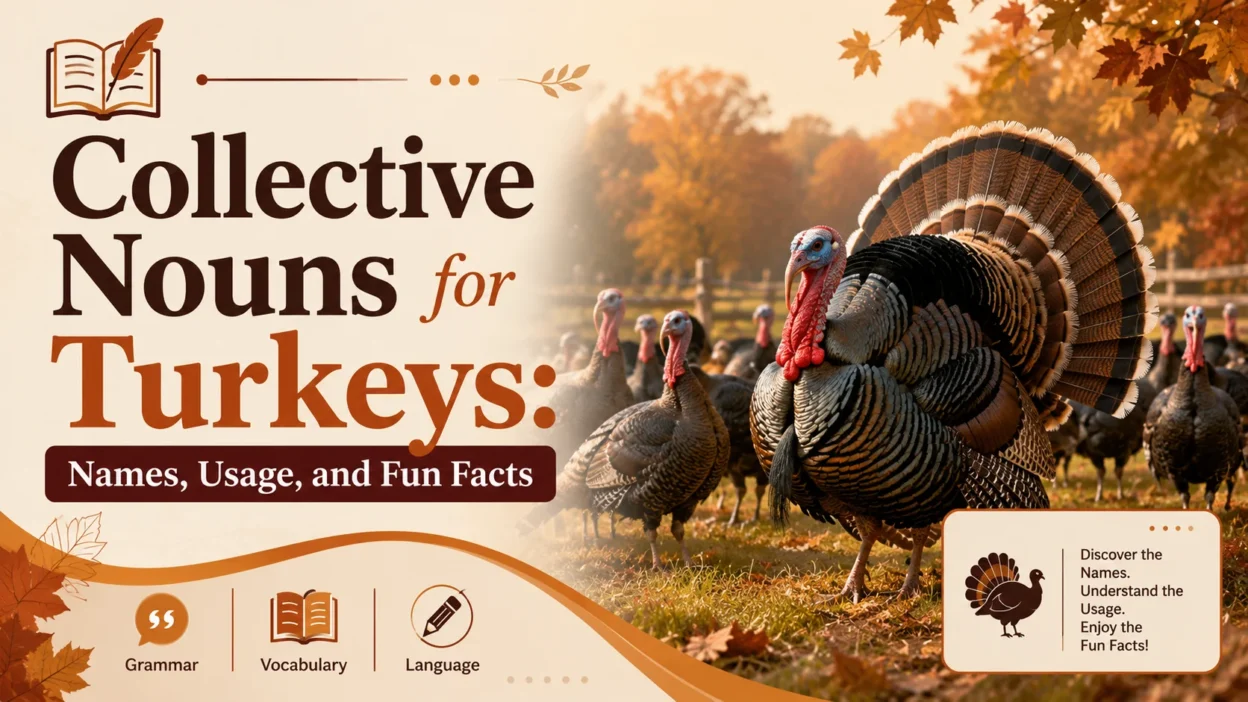
The collective noun for turkeys helps you describe several social birds together in clear and natural English. The most familiar term is flock, which works well for a group of turkeys moving, feeding, or resting together. Using these animal group names can make writing more descriptive and interesting, especially when you’re learning English or studying how birds are discussed in everyday English.
Another useful term is rafter, a traditional term associated with a group of turkeys. English has many colorful expressions, and this word gives you another way to describe turkeys depending on the context. For example, when describing turkeys gathering together, “rafter” can add variety, while “flock” remains a familiar choice for general use. Knowing these expressions can enrich your vocabulary and help you choose the right expression for your sentence.
These collective nouns also connect language with the behavior and appearance of turkeys, making wildlife writing more engaging. When you’re studying birds or simply curious about animal group names, understanding terms such as flock and rafter gives you a clearer picture of how groups of turkeys are described. Their use can make your descriptions feel more precise while keeping your English natural and easy to understand.
Why Collective Nouns Are Used for Turkeys
Turkeys are social birds that often gather in groups, especially while feeding, moving through their habitat, or resting. Wild turkeys can form groups of different sizes, and their social behavior makes collective nouns useful when describing them.
The word flock is a simple and widely understood term for a group of turkeys. Rafter of turkeys is a traditional expression that adds a distinctive and colorful touch to descriptions.
These expressions help make language more vivid while allowing you to describe turkeys as a group rather than referring to each bird individually.
Collective Nouns for Turkeys
| Collective Noun | Used For | Simple Example |
| Flock | A group of turkeys | A flock of turkeys crossed the field. |
| Rafter | A group of turkeys | A rafter of turkeys gathered near the woods. |
| Gang | A group of turkeys, especially informally | A gang of turkeys wandered across the farm. |
| Group | A general group of turkeys | A group of turkeys searched for food. |
Flock of Turkeys
A flock is the most common and straightforward collective noun for turkeys. It can describe turkeys that are feeding, walking, resting, or moving together.
The expression a flock of turkeys is easy to understand and works well in everyday English, educational writing, and wildlife descriptions.
Examples of “Flock of Turkeys”
- A flock of turkeys crossed the field.
- We saw a flock of turkeys near the woods.
- The flock of turkeys searched for food.
- A large flock of turkeys gathered in the meadow.
- The flock of turkeys walked toward the trees.
- A flock of turkeys rested near the farm.
- The farmer watched a flock of turkeys.
- The flock of turkeys disappeared into the forest.
- A flock of turkeys moved across the road.
- The flock of turkeys gathered near the water.
Rafter of Turkeys
A rafter of turkeys is a traditional collective expression for a group of turkeys. It is one of the most distinctive terms associated with turkeys and is often mentioned when discussing unusual animal group names.
The term can be used for turkeys gathered together, particularly in descriptions of wild turkeys.
Examples of “Rafter of Turkeys”
- A rafter of turkeys gathered near the woods.
- We watched a rafter of turkeys crossing the field.
- The rafter of turkeys moved through the forest.
- A large rafter of turkeys searched for food.
- The rafter of turkeys gathered beneath the trees.
- A rafter of turkeys walked across the meadow.
- The farmer noticed a rafter of turkeys nearby.
- The rafter of turkeys moved toward the water.
- A rafter of turkeys disappeared into the woodland.
- We photographed a rafter of turkeys at sunrise.
Gang of Turkeys
A gang of turkeys is an informal and descriptive expression for a group of turkeys. The word gang gives the group a lively or humorous feeling and can work particularly well in casual or creative writing.
It isn’t as neutral as flock, but it can make a sentence more colorful.
Examples of “Gang of Turkeys”
- A gang of turkeys wandered across the farm.
- We saw a gang of turkeys near the road.
- The gang of turkeys searched for food.
- A gang of turkeys gathered in the yard.
- The gang of turkeys moved toward the forest.
- A gang of turkeys crossed the field.
- The farmer watched the gang of turkeys.
- The gang of turkeys disappeared behind the trees.
- A gang of turkeys walked around the garden.
- The gang of turkeys returned before sunset.
Group of Turkeys
A group of turkeys is a simple general expression rather than a specialized collective noun. It can be used whenever you want to describe several turkeys together without focusing on a particular traditional term.
Although flock and rafter are more distinctive, group is completely clear and appropriate in general writing.
Examples of “Group of Turkeys”
- A group of turkeys gathered near the barn.
- We saw a group of turkeys in the field.
- The group of turkeys searched for food.
- A group of turkeys walked through the forest.
- The group of turkeys rested beneath the trees.
- A group of turkeys crossed the road.
- The farmer observed a group of turkeys.
- A group of turkeys gathered near the feeder.
- The group of turkeys moved toward the meadow.
- A group of turkeys disappeared into the woods.
Turkey Behavior and Social Life
Turkeys are social birds that often spend time together, particularly when feeding and moving through their habitat. Wild turkeys can form groups that change in size and composition depending on the season and their social relationships. Staying together can also help birds detect potential dangers while they search for food.
Turkeys communicate through a wide variety of vocalizations and body signals. The familiar gobble is produced mainly by male turkeys, while hens and young birds use other calls to communicate. Turkeys also use posture, feather displays, movement, and other visual signals when interacting with one another.
Turkeys spend much of their time foraging. They search the ground for seeds, nuts, fruits, insects, and other foods. Their strong legs and feet allow them to scratch through leaves and soil while looking for food.
Male turkeys can also perform impressive courtship displays. They spread their tail feathers, lower their wings, and change their posture to attract females. These displays demonstrate how communication among turkeys involves much more than sound.
Examples of Turkey Behavior
- Turkeys often gather in groups.
- A flock of turkeys can forage together.
- Turkeys communicate through different calls.
- Male turkeys use displays during courtship.
- Turkeys search the ground for food.
- Turkeys can walk and run quickly.
- Groups of turkeys may move between feeding areas.
- Turkeys use body language to communicate.
- Wild turkeys can live in social groups.
- Turkeys may gather in wooded areas and open fields.
Interesting Facts About Turkeys
Turkeys are large birds belonging to the family Phasianidae, which also includes pheasants, chickens, and other related birds. The wild turkey is native to North America, while the domesticated turkey is raised in many parts of the world. Wild turkeys can live for several years, although lifespan varies according to habitat, predators, disease, food availability, and other environmental conditions.
Turkeys have several remarkable physiological features. They have powerful legs and feet that help them walk, scratch, and run. Their bodies are covered with feathers, and males have distinctive ornamental features, including a large tail that they can fan during courtship. Turkeys also have a fleshy structure called a snood above the beak and a fleshy wattle around the head and neck.
Turkeys are omnivores, meaning they eat both plant and animal foods. Their diet can include seeds, nuts, berries, fruits, grains, insects, and other small organisms. Young turkeys, known as poults, often consume insects and other protein-rich foods as they grow. Their varied diet allows them to take advantage of different food sources throughout the year.
Turkeys are also known for their strong social behavior. They communicate using many different sounds and can recognize other members of their social groups. Their visual displays are equally fascinating. Male turkeys can fan their tails, puff up their feathers, and change their posture during courtship or social interactions.
Another interesting fact is that wild turkeys are capable of flying, despite their large bodies. They can make surprisingly quick flights over short distances, particularly when escaping danger or reaching a roosting location. They can also run rapidly across the ground.
Examples of Turkey Facts
- Turkeys are large birds.
- Wild turkeys are native to North America.
- Turkeys are social animals.
- A group of turkeys can be called a flock.
- Rafter is a traditional collective noun for turkeys.
- Turkeys are omnivores.
- Turkeys eat seeds, nuts, fruits, insects, and other foods.
- Male turkeys can fan their tail feathers.
- Turkeys have a snood and wattle.
- Wild turkeys can fly short distances.
- Turkeys have powerful legs and feet.
- Turkeys communicate through many different sounds.
Conclusion
Understanding the collective noun for turkeys makes it easier to describe these social birds accurately and naturally. Flock is the most familiar term, while rafter is a traditional expression associated with turkeys. Knowing both terms can improve your vocabulary and make your writing more descriptive when discussing groups of turkeys.
FAQs
Q1. What is the collective noun for turkeys?
The most common collective noun for turkeys is flock. You can say, “A flock of turkeys crossed the field.”
Q2. Is “flock” correct for a group of turkeys?
Yes. Flock is a widely understood collective noun for turkeys and works well in everyday English.
Q3. What is a traditional collective noun for turkeys?
Rafter is a traditional term used for a group of turkeys. It’s especially interesting when discussing traditional animal group names.
Q4. Can I say “a rafter of turkeys”?
Yes. A rafter of turkeys is a recognized expression for describing a group of turkeys.
Q5. Which is more common, “flock” or “rafter”?
Flock is generally more familiar in everyday English. Rafter is less common but provides a distinctive traditional expression.
Q6. Why are collective nouns used for turkeys?
Collective nouns make it easier to describe groups of animals without repeatedly saying “a group of turkeys.” They can also make writing more descriptive.
Q7. Are turkeys social birds?
Yes. Turkeys can gather and move in groups, particularly while feeding, traveling, or staying together in suitable habitats.
Q8. What is an example of a collective noun for turkeys?
A simple example is: “A flock of turkeys was feeding near the woodland.”
Q9. Is “group of turkeys” grammatically correct?
Yes. The group of turkeys is completely correct. However, a flock of turkeys gives you a more specific collective expression.
Q10. What is the easiest way to remember turkey collective nouns?
Remember flock as the familiar choice and rafter as the traditional term. This makes it easier to select the appropriate expression when writing about turkeys.