
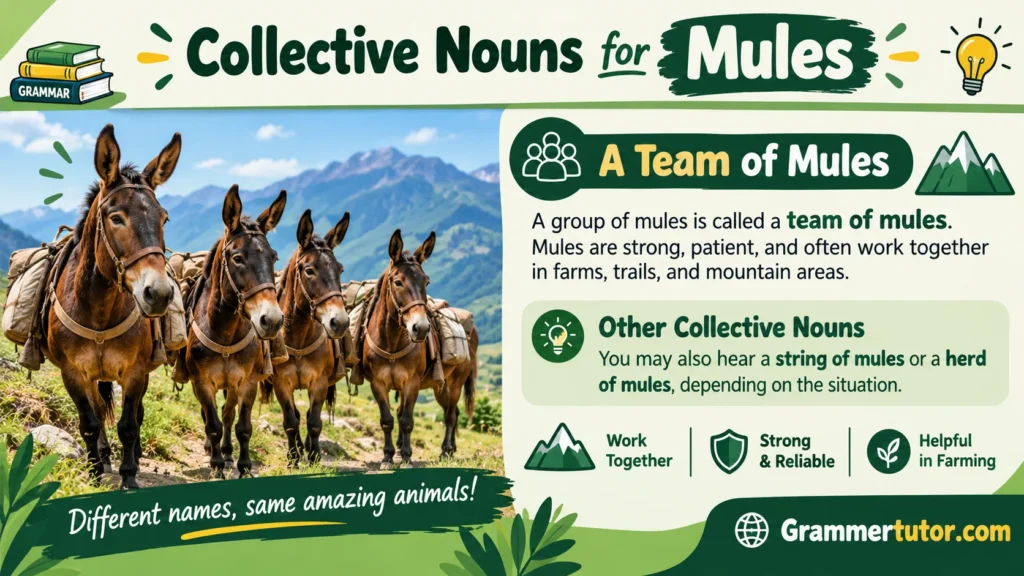
The Collective Noun for Mules helps learners describe groups of hardworking animals clearly while using traditional English terms correctly. The collective noun for mules is an interesting part of English vocabulary, with several traditional expressions used for a group. The commonly listed terms include barren, pack, rake, and span. These expressions have different traditional uses, while pack of mules is a straightforward expression for mules traveling or working together.
Mules are hardworking animals valued for their strength, endurance, and ability to carry loads. Historically, they played an important role in transportation and carrying supplies, which explains why pack is an especially fitting word when describing groups of working mules. When I explain animal vocabulary, I find that connecting a word with its practical use makes it easier to remember and understand.
Learning the collective noun for mules can make your English vocabulary richer and help you describe these useful animals more accurately. Knowing these words also makes it easier to recognize why barren, pack, rake, and span are associated with groups of mules.
Why Collective Nouns Are Used for Mules
Mules have been used by people for transportation, farming, carrying supplies, and traveling through difficult terrain. When several mules work or travel together, a collective noun provides a simple way to describe the entire group.
Pack is a familiar term because mules have traditionally been used as pack animals. Other traditional expressions, including barren, rake, and span, can also be found in dictionaries and collections of animal group names.
The expression you choose can depend on the context. If you are describing several mules carrying loads or traveling together, a pack of mules is easy for readers to understand.
Collective Nouns for Mules
| Collective Noun | Used For | Simple Example |
| Pack | Mules traveling or carrying loads together | A pack of mules crossed the mountain. |
| Barren | A traditional group name for mules | A barren of mules moved along the trail. |
| Rake | A traditional collective noun for mules | A rake of mules stood near the barn. |
| Span | Traditionally associated with a team of two mules | A span of mules pulled the wagon. |
| Group | A general group of mules | A group of mules rested in the field. |
Pack of Mules
A pack of mules is a natural expression for several mules traveling or working together, particularly when they are carrying goods or supplies. Mules have long been valued as pack animals because of their strength and ability to travel over challenging terrain.
The word pack is therefore particularly useful when the mules are carrying loads or moving together on a journey.
Examples of “Pack of Mules”
- A pack of mules traveled along the mountain trail.
- We saw a pack of mules carrying supplies.
- The pack of mules moved slowly up the hill.
- A pack of mules crossed the narrow path.
- The guide led a pack of mules through the valley.
- A pack of mules carried food and equipment.
- The pack of mules rested beside the road.
- We watched a pack of mules climb the rocky trail.
- A pack of mules followed the travelers.
- The pack of mules reached the village before sunset.
Barren of Mules
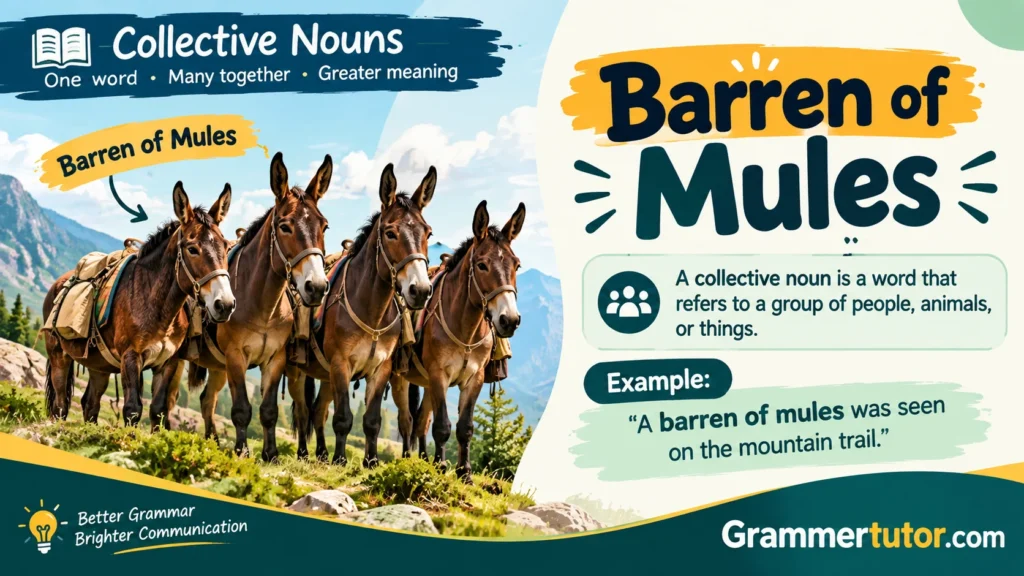
A barren of mules is a traditional collective expression associated with a group of mules. It appears in traditional lists of animal collective nouns and is less familiar in everyday conversation than pack of mules.
The term is useful to know when studying traditional collective nouns and unusual English vocabulary.
Examples of “Barren of Mules”
- A barren of mules stood near the stable.
- We saw a barren of mules on the old trail.
- The barren mules moved toward the village.
- A barren of mules rested beside the river.
- The farmer watched a barren of mules in the field.
- A barren of mules crossed the wooden bridge.
- The barren of mules gathered near the barn.
- We followed a barren of mules along the path.
- A barren of mules waited outside the stable.
- The barren of mules moved across the hillside.
Rake of Mules
A rake of mules is another traditional expression found in collections of English animal group names. It is not as common in everyday speech as pack of mules, but it can be useful when exploring unusual collective nouns.
Because rake is uncommon in this meaning today, readers are more likely to recognize pack of mules in ordinary writing.
Examples of “Rake of Mules”
- A rake of mules stood beside the barn.
- We saw a rake of mules near the village.
- The rake of mules moved along the road.
- A rake of mules waited for the travelers.
- The farmer led a rake of mules toward the field.
- A rake of mules rested under the trees.
- We watched a rake of mules cross the valley.
- The rake of mules carried supplies.
- A rake of mules gathered near the stable.
- The rake of mules continued along the mountain path.
Span of Mules
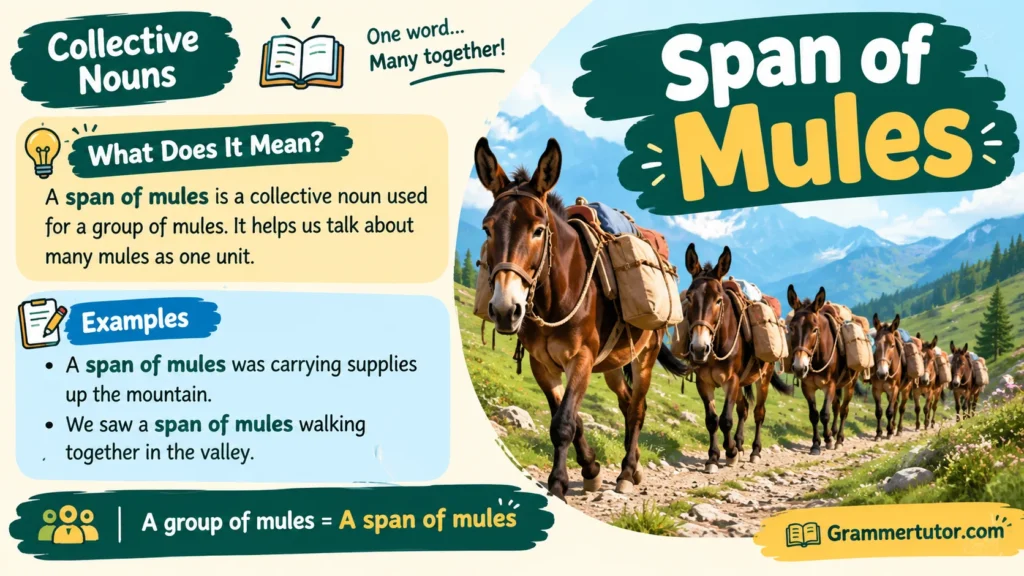
A span of mules is traditionally associated with a team of two mules working together. Some reference sources specifically define a span as a team of two.
This makes span different from a general expression such as pack, because it can refer specifically to a pair working together.
Examples of “Span of Mules”
- A span of mules pulled the wagon.
- The farmer used a span of mules in the field.
- A span of mules stood beside the cart.
- We watched a span of mules pull the heavy load.
- The driver guided a span of mules along the road.
- A span of mules carried the equipment.
- The span of mules moved steadily up the hill.
- A farmer trained a span of mules for farm work.
- The span of mules waited near the barn.
- A span of mules pulled the wagon across the bridge.
Group of Mules
A group of mules is a simple general expression that can be used whenever several mules are together. It is not a specialized traditional collective noun, but it is completely clear and natural.
You can use group when you do not need to describe whether the mules are carrying loads, traveling, or working as a pair.
Examples of “Group of Mules”
- A group of mules stood near the barn.
- We saw a group of mules in the field.
- A group of mules walked along the road.
- The group of mules rested beside the trees.
- A group of mules crossed the bridge.
- We watched a group of mules near the village.
- The group of mules moved toward the stable.
- A group of mules waited for the farmer.
- The farmer fed a group of mules.
- A group of mules traveled through the valley.
Types of Mules and Their Characteristics
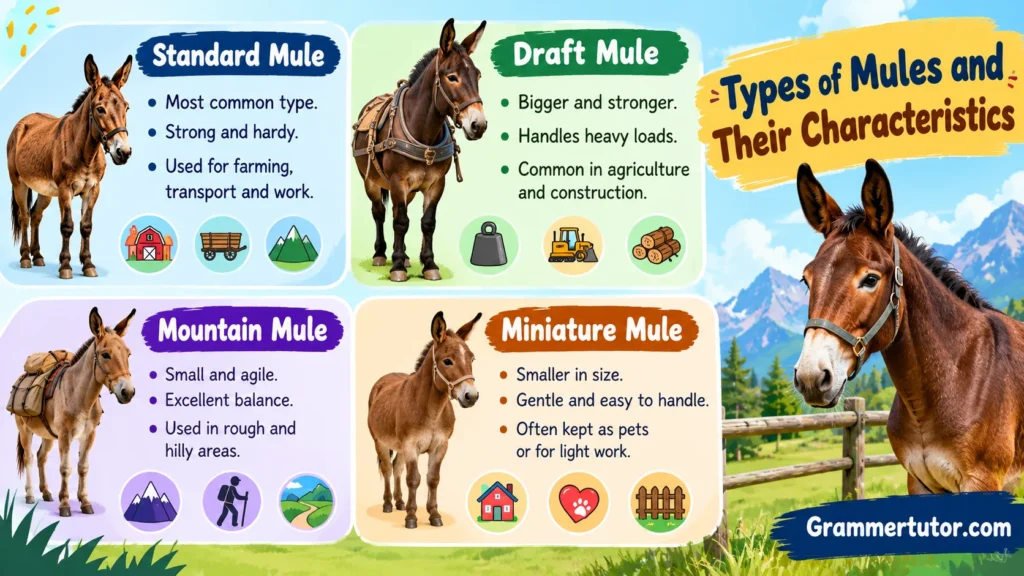
Mules are hybrid animals produced by crossing a male donkey with a female horse. They combine characteristics inherited from both parent species. Mules are generally known for their strength, endurance, sure-footedness, and ability to work in challenging conditions.
Mules can vary in size and appearance depending on the horse and donkey involved in producing them. They may have different coat colors, body shapes, and physical characteristics.
Their strong bodies have made them useful for carrying loads, transportation, farming, and other forms of work. Their ability to negotiate difficult terrain has also made them valuable in mountainous and remote areas.
Examples of Mule Characteristics
- Mules are hybrids of horses and donkeys.
- A mule has a horse as its mother.
- A mule has a donkey as its father.
- Mules are known for their strength.
- Mules can carry heavy loads.
- Mules are often sure-footed on difficult terrain.
- Mules have been used for transportation.
- Mules can work on farms.
- Mules come in different sizes and colors.
- Most mules are unable to reproduce.
Interesting Facts About Mules
Mules are fascinating animals because they combine physical characteristics from horses and donkeys. Their longevity can be considerable, and individual mules may live for several decades when they receive appropriate care. Their lifespan depends on factors such as nutrition, workload, living conditions, veterinary care, and general health.
One of the mule’s most notable physiological features is its combination of traits inherited from its two parent species. Mules often have the strength and body size of horses along with some of the hardiness and sure-footedness associated with donkeys. Their hooves and sturdy build can help them travel over rough and uneven ground.
Mules are also known for their endurance. Historically, people have relied on them to transport supplies through mountains, forests, farms, and other areas where wheeled vehicles were difficult to use. Their ability to carry loads made them particularly valuable as working animals.
Their dietary habits are similar to those of other equids. Mules are herbivores and primarily consume grasses, hay, and other plant-based foods. Depending on their work and environment, their diets may also include suitable grains or formulated feeds. They need adequate water and balanced nutrition to maintain their strength and energy.
An especially interesting biological fact is that most mules are sterile because horses and donkeys have different numbers of chromosomes. This means that although mules can be healthy and vigorous animals, they generally cannot produce offspring themselves.
READ MORE: Collective Noun for Woodpeckers: Examples, and Interesting Facts
Conclusion
The collective noun for mules can be expressed with several traditional terms, including barren, pack, rake, and span. Among these, pack of mules is a clear and useful expression for mules traveling, working, or carrying supplies together. Understanding these terms can make your English vocabulary richer and help you describe groups of mules accurately.
FAQs
Q1. What is the collective noun for mules?
A common collective noun for mules is pack. The phrase pack of mules is used to describe a group of mules, especially when they are working or traveling together.
Q2. What do you call a group of mules?
A group of mules can be called a pack of mules. Other traditional terms associated with mules include barren, rake, and span.
Q3. Is “pack of mules” correct?
Yes, pack of mules is a correct and straightforward expression for a group of mules, particularly when they are carrying loads or traveling together.
Q4. What are some collective nouns for mules?
Some traditional collective nouns for mules include barren, pack, rake, and span.
Q5. Why is “pack” used for mules?
The word pack fits mules because they have historically been used to carry loads and supplies during transportation.
Q6. What does “barren of mules” mean?
Barren is a traditional collective term that can be used for a group of mules. It is less familiar in everyday English than a pack of mules.
Q7. Can I say “a herd of mules”?
You may encounter a herd of mules in general descriptions, but pack of mules is a more traditional expression when referring to mules working or carrying loads together.
Q8. What is a “rake of mules”?
A rake of mules is a traditional expression for a group of mules. It is not as commonly used in everyday modern English as pack of mules.
Q9. What is a “span of mules”?
A span of mules is another traditional expression. The word span can refer to a pair of animals working together, depending on context.
Q10. Why should I learn collective nouns for mules?
Learning collective nouns such as pack, barren, rake, and span can improve your English vocabulary and help you describe groups of mules more precisely.