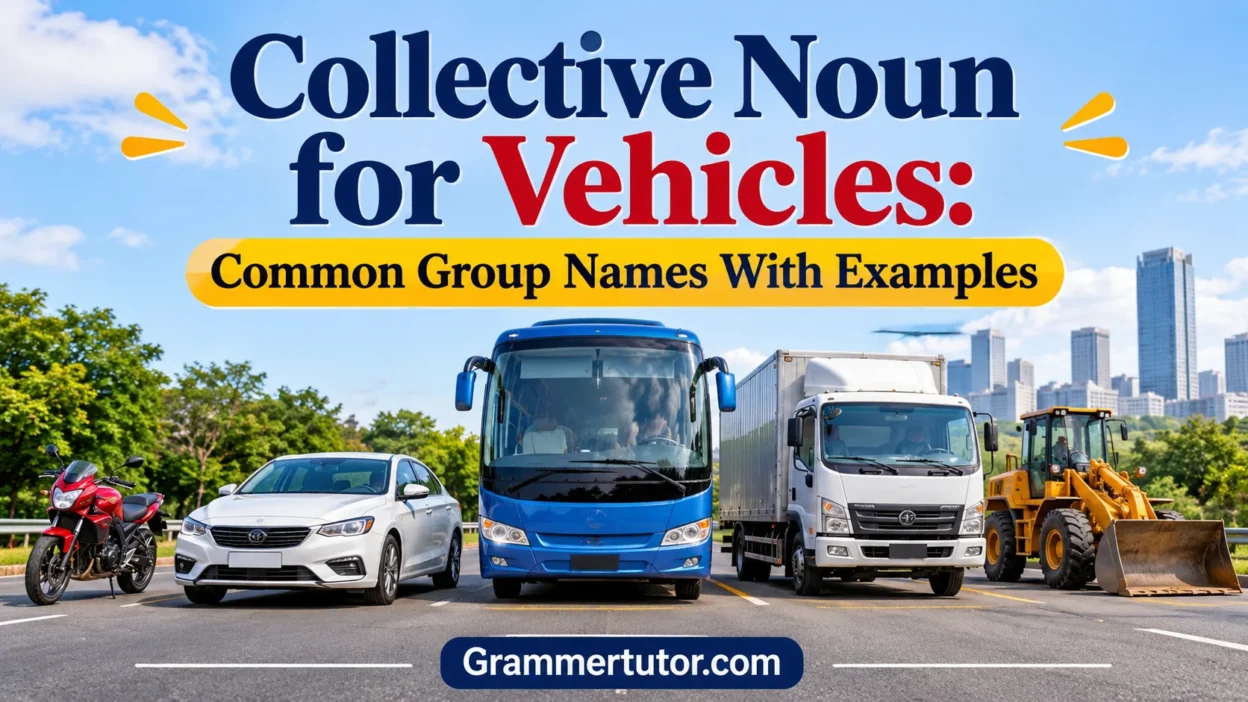
The collective noun for vehicles depends on how vehicles are used, arranged, and moved together in different situations. For example, a fleet of vehicles usually refers to cars, buses, vans, or trucks owned by a company or organisation. These vehicles may serve different purposes, such as transporting goods, carrying passengers, or providing public services. In everyday life, businesses use a fleet to manage their transportation needs and keep their operations organised.
Other collective expressions describe vehicles travelling together. A convoy of trucks usually means several trucks moving along the same road as part of an organised journey. This arrangement is common in military operations, long-distance transportation, and situations where vehicles need to travel together for safety. Similarly, a motorcade of cars refers to an organised procession of cars, often seen during official visits, ceremonies, and public events. Each expression gives readers a clearer idea of the vehicles’ purpose and movement.
Choosing the correct group name makes your English vocabulary stronger and improves your writing. For instance, you can use fleet when discussing company vehicles, convoy when describing trucks travelling together, and motorcade when referring to an official procession. These expressions also make descriptions of road transport, everyday traffic, and vehicle organisation easier to understand. Using the right term helps you create natural sentences and communicate more clearly when writing about different types of vehicles and their activities.
What Is the Collective Noun for Vehicles?
The most common collective noun for vehicles is fleet.
Other useful collective terms include:
- Fleet: Vehicles owned, managed, or operated together.
- Convoy: Vehicles travelling together in an organised group.
- Motorcade: A procession of motor vehicles.
- Caravan: Several vehicles travelling together, often on a journey.
- Column: Vehicles arranged or moving in a line.
- Queue: Vehicles waiting one behind another.
- Traffic: Vehicles collectively using a road or transport route.
The choice depends on the situation rather than the type of vehicle alone.
Why Are Collective Nouns Used for Vehicles?
Collective nouns help us describe multiple vehicles without repeating their individual names. Imagine a delivery company operating 30 vans. Instead of saying that the company manages 30 separate vans every time, you can simply describe them as a fleet of vans.
These expressions also explain the relationship between vehicles. A fleet generally represents vehicles managed by one organisation, whereas a convoy describes vehicles travelling together. Similarly, a queue indicates that several vehicles are waiting in an ordered line.
You will encounter these terms in transport management, logistics, road safety reports, military communication, news articles, and ordinary conversations. Each word provides a different picture of how vehicles are connected.
Using the right expression makes your writing more accurate and prevents confusion. For example, a group of cars parked outside a building is not necessarily a motorcade. That word is more appropriate when the vehicles form an organised procession.
Seven Collective Nouns for Vehicles
| Type | Simple Example |
| Fleet | A fleet of vehicles served the delivery company. |
| Convoy | A convoy of trucks crossed the desert. |
| Motorcade | A motorcade of cars passed through the city. |
| Caravan | A caravan of vehicles travelled across the countryside. |
| Column | A column of military vehicles moved forward. |
| Queue | A queue of vehicles waited outside the station. |
| Traffic | Heavy traffic covered the main highway. |
Fleet of Vehicles
A fleet of vehicles is the most widely used collective expression for vehicles belonging to or managed by a particular organisation, business, or individual. The word fleet can refer to different types of transport, including cars, trucks, buses, delivery vans, and motorcycles.
Businesses frequently maintain vehicle fleets to perform their daily operations. For example, a courier company may operate dozens of delivery vans, while a transport organisation may manage a large collection of passenger buses.
Fleet is also commonly used in industries such as construction, emergency services, public transportation, and car rental. Organisations often monitor fuel consumption, maintenance schedules, insurance, and vehicle performance across their fleets.
This expression is particularly useful when discussing vehicles as an organised business resource rather than simply describing vehicles travelling together.
Examples of “Fleet of Vehicles”
- The transport company purchased a fleet of vehicles for its growing business.
- A fleet of delivery vans arrived at the distribution centre.
- The organisation replaced its ageing fleet of cars.
- The airport maintains a fleet of service vehicles.
- A fleet of buses transported passengers across the city.
- The construction firm expanded its fleet of heavy vehicles.
- The manager inspected the entire fleet before departure.
- The rental agency introduced a new fleet of electric cars.
- A fleet of emergency vehicles remained ready for service.
- The company uses a fleet of trucks to distribute its products.
Convoy of Vehicles
A convoy of vehicles refers to several vehicles travelling together, usually in an organised formation. The members of a convoy often follow a planned route and maintain a particular distance from one another.
Convoys are commonly associated with military transportation, humanitarian assistance, commercial deliveries, and long-distance journeys. For example, several supply trucks may travel together through a remote region to transport food, fuel, or essential equipment.
Travelling as a convoy can make coordination easier, particularly when vehicles are moving through unfamiliar or challenging locations. Military convoys may also include support vehicles that provide communication, protection, or logistical assistance.
Unlike a fleet, which describes vehicles managed as a group, a convoy specifically emphasises their movement together.
Examples of “Convoy of Vehicles”
- A convoy of trucks transported supplies across the border.
- The convoy of vehicles travelled through the mountain pass.
- Several emergency vehicles joined the convoy.
- A convoy of military trucks entered the designated area.
- The humanitarian convoy carried food and medical equipment.
- A convoy of vehicles approached the remote settlement.
- The drivers maintained their positions throughout the journey.
- A convoy of buses transported visitors to the stadium.
- The supply convoy stopped at a roadside checkpoint.
- A convoy of vehicles continued towards the northern region.
Motorcade of Vehicles
A motorcade of vehicles describes an organised procession of motor vehicles travelling together, often for an official visit, public ceremony, political event, or special occasion.
A motorcade commonly consists of several cars, sometimes accompanied by motorcycles, security vehicles, and other support transport. It may carry government officials, important guests, or public figures from one location to another.
The vehicles usually follow a planned route and travel in a coordinated arrangement. Police officers or security personnel may help manage the procession and control surrounding traffic.
This expression is more specific than fleet or convoy because it generally describes a formal or organised procession rather than an ordinary collection of vehicles.
Examples of “Motorcade of Vehicles”
- A motorcade of vehicles arrived at the presidential residence.
- The official motorcade passed through the decorated streets.
- A motorcade of cars escorted the visiting delegation.
- Police officers cleared the road for the motorcade.
- The motorcade travelled towards the conference centre.
- A motorcade of vehicles attracted attention from nearby spectators.
- Security personnel coordinated the movement of the motorcade.
- The visiting leader departed in a motorcade of black cars.
- A motorcade passed through the city during the national celebration.
- The organised procession reached the government building.
Caravan of Vehicles
A caravan of vehicles refers to several vehicles travelling together, generally as part of a shared journey. The expression is especially suitable for road trips, recreational travel, expeditions, and journeys through remote areas.
A caravan may consist of cars, campervans, recreational vehicles, or other forms of transport. Families, friends, and travelling groups sometimes organise caravans so that everyone can follow the same route and reach their destination together.
This arrangement can be useful when travelling through unfamiliar regions, particularly when group members want to remain together. Travellers may agree on meeting points, rest stops, and departure times before beginning their journey.
The term also has another meaning in British English: a caravan can refer to a towable holiday trailer. However, in the expression a caravan of vehicles, it describes a group travelling together.
Examples of “Caravan of Vehicles”
- A caravan of vehicles crossed the countryside during the holiday.
- The travellers organised a caravan for their mountain expedition.
- A caravan of campervans arrived at the coastal campsite.
- Several families joined the caravan for a weekend adventure.
- The caravan of vehicles followed the scenic highway.
- A caravan of cars departed from the city early in the morning.
- The tourists travelled through the desert in a caravan.
- A caravan of vehicles stopped near the mountain village.
- The organisers guided the caravan towards the camping grounds.
- The travelling group maintained its formation throughout the journey.
Column of Vehicles
A column of vehicles describes several vehicles arranged one behind another or moving in an organised line. The expression is frequently used in military transportation, official movements, road operations, and descriptions of organised traffic.
The word column highlights the formation rather than ownership or purpose. For example, military trucks may move in a column when travelling along a narrow road. Similarly, a group of construction vehicles may follow one another through a restricted work area.
This arrangement allows vehicles to occupy a particular route while maintaining an organised sequence. It is especially useful when describing long formations where vehicles cannot travel side by side.
A column can contain cars, trucks, buses, armoured vehicles, or different types of transport depending on the situation.
Examples of “Column of Vehicles”
- A column of military vehicles moved along the narrow road.
- The column of trucks entered the industrial area.
- Several buses formed a column outside the stadium.
- A column of vehicles crossed the bridge one after another.
- The transport unit maintained a steady formation.
- A column of construction vehicles approached the worksite.
- The drivers followed the leading vehicle through the tunnel.
- A column of armoured vehicles travelled across the open ground.
- The long column moved slowly through the mountain pass.
- A column of vehicles waited for permission to proceed.
Queue of Vehicles
A queue of vehicles refers to cars, buses, trucks, or other forms of transport waiting one behind another. The word queue is particularly common in British English, while line of vehicles is also widely understood.
Vehicle queues frequently develop near traffic signals, toll booths, railway crossings, parking entrances, and busy intersections. They may also occur when road construction or accidents temporarily restrict traffic movement.
Unlike a convoy, where vehicles deliberately travel together, a queue generally forms because several drivers are waiting for an opportunity to move forward.
This expression is useful in discussions about road congestion, transport management, traffic control, and everyday driving experiences.
Examples of “Queue of Vehicles”
- A queue of vehicles stretched along the busy highway.
- The queue of cars extended beyond the traffic signal.
- A long queue of trucks formed outside the border checkpoint.
- Drivers waited patiently in a queue of vehicles.
- A queue of buses gathered near the terminal entrance.
- The accident created a queue of vehicles on the main road.
- A queue of vehicles waited outside the parking facility.
- Traffic officers worked to reduce the growing queue.
- The queue of cars slowly moved towards the toll booth.
- A queue of vehicles formed after the railway crossing closed.
Traffic of Vehicles
Traffic of vehicles is an expression used when referring to vehicles collectively moving or operating along roads and transport routes. In everyday English, the single word traffic is usually sufficient.
Traffic can include private cars, public buses, motorcycles, delivery trucks, taxis, and other road transport. Its volume changes according to location, weather, time of day, and road conditions.
For example, cities often experience heavier traffic during morning and evening commuting hours because many people travel to workplaces, schools, and commercial areas at similar times.
The word traffic is generally an uncountable noun in this meaning. Therefore, we normally say heavy traffic or a lot of traffic, rather than a traffic of vehicles. It is a useful collective term, but it is grammatically different from expressions such as a fleet of vehicles.
Examples of “Traffic of Vehicles”
- Heavy traffic covered the main road during rush hour.
- The city introduced new measures to manage road traffic.
- Traffic increased near the shopping district.
- The highway experienced unusually heavy traffic.
- Morning traffic slowed the movement of commuters.
- The bridge remained busy with passing vehicles.
- Traffic conditions improved after the road reopened.
- The new bypass helped reduce congestion in the town.
- Road traffic became heavier during the holiday season.
- The authorities monitored traffic throughout the afternoon.
Interesting Facts About Vehicles and Their Collective Use
Vehicles have transformed the way people travel, trade, and connect with different communities. The earliest automobiles were very different from modern cars, as they used relatively simple mechanical systems and offered limited speed and comfort. Today, vehicles include advanced technologies such as electronic braking systems, navigation devices, automatic transmissions, driver-assistance features, and electric powertrains. Their construction also involves different materials, including steel, aluminium, plastics, and lightweight composites. Depending on their design and maintenance, vehicles can remain in service for many years, although their lifespan varies considerably. Commercial fleets often require regular inspections and scheduled servicing because their vehicles cover substantial distances and perform demanding tasks.
Another interesting feature of modern transport is the variety of energy sources used to operate vehicles. Traditional petrol and diesel engines rely on internal combustion, while electric vehicles use rechargeable batteries and electric motors. Hybrid models combine an internal combustion engine with an electric power system. Heavy transport vehicles, including buses and freight trucks, are designed to carry passengers or large quantities of goods. Their size, weight, engine capacity, and braking requirements differ from those of ordinary passenger cars. Vehicle design also considers aerodynamics, tyre performance, passenger protection, and fuel efficiency.
Collective terms become especially useful when describing the different ways vehicles operate together. A delivery company may organise its transport resources into a fleet, while a group of supply trucks travelling along a common route forms a convoy. An official procession may be described as a motorcade, and recreational travellers may arrange a caravan for a shared road trip. These expressions show that the English language considers not only the number of vehicles but also their purpose, arrangement, and movement. Understanding these distinctions makes transport-related communication more precise and helps readers recognise how different groups of vehicles function in everyday life.
Examples of Vehicle-Related Group Descriptions
- A delivery fleet distributes packages across different neighbourhoods.
- A military convoy transports essential supplies.
- An official motorcade travels through the capital.
- A travelling caravan explores different destinations.
- A column of trucks moves through an industrial route.
- A queue of cars waits at a toll plaza.
- Heavy traffic slows down the morning commute.
- A bus fleet provides public transportation.
- An emergency vehicle fleet supports rescue operations.
- An electric fleet helps organisations reduce fuel consumption.
Conclusion
Understanding the collective noun for vehicles makes your English more descriptive and accurate. Words such as fleet, convoy, and motorcade describe different groups of vehicles based on their purpose and movement. Whether you’re writing about everyday traffic, business transportation, or official processions, choosing the correct collective noun helps you express your ideas clearly and confidently.
FAQs
Q1. What is the collective noun for vehicles?
The most commonly used collective noun for vehicles is fleet. For example, a fleet of vehicles can describe several cars, buses, or trucks operated by the same organisation.
Q2. What do you call a group of cars travelling together?
A group of cars travelling together can be called a convoy of cars. This expression is suitable when several drivers follow an organised route as one travelling group.
Q3. Is fleet a collective noun for vehicles?
Yes. Fleet is a collective noun used for several vehicles managed, owned, or operated together. Businesses, transport companies, and government departments commonly use this term.
Q4. What is a motorcade of vehicles?
A motorcade is an organised procession of motor vehicles. It often accompanies government officials, visiting dignitaries, or important guests during official journeys and public events.
Q5. What is the difference between a fleet and a convoy?
A fleet refers to vehicles managed or operated as a group, whereas a convoy describes vehicles travelling together. A transport company can own a fleet and send some of its vehicles on a convoy.