The collective noun for stars helps you describe how stars appear together in the vast night sky. When several stars form recognizable patterns or arrangements, the word constellation is often used. It gives a clear name to a group of stars that appears to form a particular shape. For example, you can use a constellation of stars when describing a familiar pattern visible in the sky.
Different expressions can describe different collections of stars. A cluster of stars refers to stars gathered closely together, while a galaxy of stars describes an enormous system containing stars, gas, dust, and other matter. Similarly, a group of stars is a simple, general expression that works in everyday English. Each term has its own meaning, so choosing the right expression makes your description more accurate.
When studying astronomy or practicing English, these expressions help improve your vocabulary and make your writing more descriptive. For instance, you might describe a beautiful constellation while looking at the stars or explain how a galaxy contains countless stars. I find that using different expressions instead of repeating the word group makes sentences more natural and interesting, especially when describing the beauty and scale of the universe.
How Stars Are Described in Groups
Stars are enormous celestial objects that produce light and heat through nuclear fusion. Although they appear as tiny shining points when viewed from Earth, they are actually separated by enormous distances.
Astronomers use different words to describe stars according to their positions, relationships, and arrangements in space. For example, a constellation describes a recognizable pattern of stars, while a cluster refers to stars that are physically associated through gravity.
These expressions help people discuss the night sky more clearly. They also make astronomy easier to understand for students, writers, and anyone interested in space.
Group Names Used for Stars
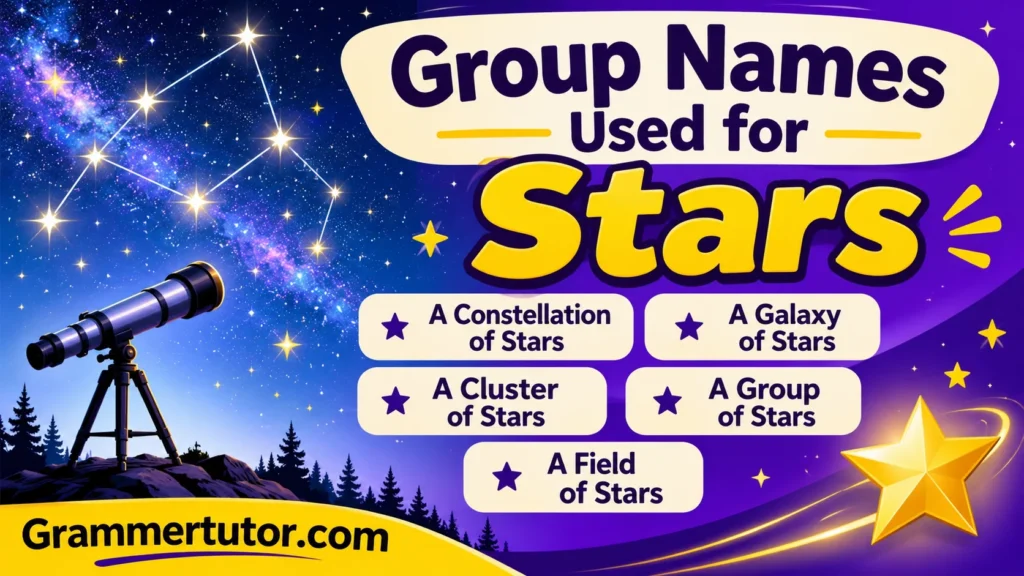
| Collective Noun | Simple Example |
| Constellation | A constellation of stars appeared above us. |
| Cluster | A cluster of stars shone brightly. |
| Galaxy | A galaxy of stars filled the telescope’s view. |
| Group | A group of stars formed a beautiful pattern. |
| System | A system of stars moved through space. |
| Association | An association of stars occupied the same region. |
Constellation of Stars
A constellation of stars refers to a recognizable arrangement of stars in the night sky. People have used these patterns for centuries to identify different regions of the sky and navigate during nighttime journeys.
Some famous constellations include Orion, Ursa Major, and Cassiopeia. The stars in a constellation may appear close together from Earth, although they can actually be located at very different distances.
Examples of “Constellation of Stars”
- A constellation of stars appeared above the mountains.
- We observed a beautiful constellation of stars at night.
- The constellation of stars was easy to recognize.
- Children learned about a constellation of stars in school.
- A bright constellation of stars decorated the evening sky.
- The astronomer studied a constellation of stars through a telescope.
- We identified a constellation of stars during our camping trip.
- A constellation of stars became visible after sunset.
- The guide explained the shape of a constellation of stars.
- A constellation of stars inspired the young astronomer.
Cluster of Stars
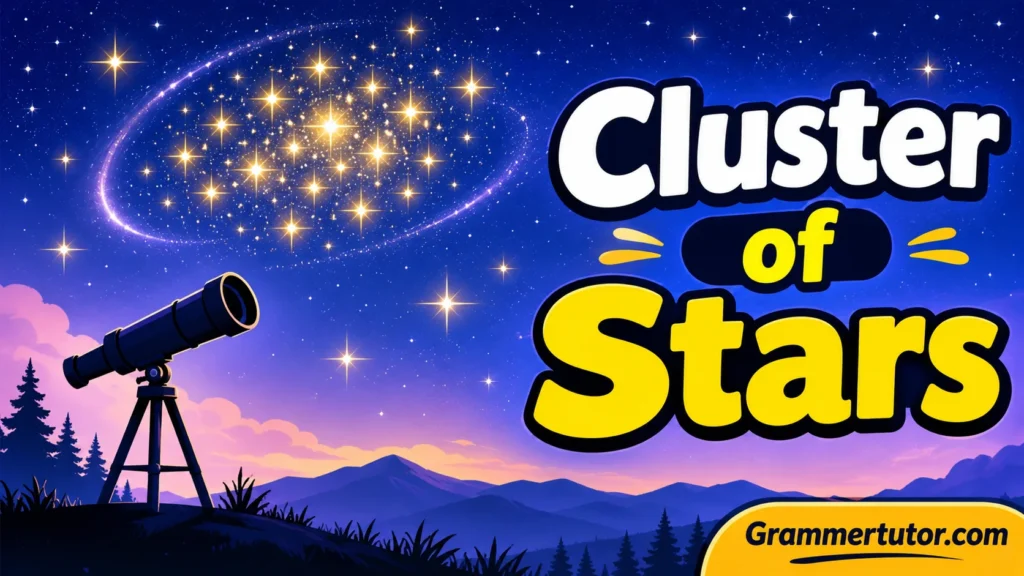
A cluster of stars describes a collection of stars that are physically grouped together in space. Many star clusters are held together by gravitational attraction.
Astronomers study these formations to understand how stars develop, age, and eventually change. Open clusters and globular clusters are two important types of star clusters.
Examples of “Cluster of Stars”
- A cluster of stars sparkled in the distant sky.
- Scientists discovered a cluster of stars through a telescope.
- The cluster of stars contained many bright objects.
- We studied a cluster of stars during astronomy class.
- A cluster of stars appeared in the telescope’s image.
- The astronomer examined the cluster of stars carefully.
- A young cluster of stars formed inside a nebula.
- The cluster of stars attracted scientific attention.
- Researchers measured the brightness of a cluster of stars.
- A cluster of stars revealed interesting details about space.
Galaxy of Stars
A galaxy of stars describes an enormous collection of stars, along with gas, dust, and other celestial material, held together by gravity. Galaxies are among the largest structures in the universe.
The Milky Way is the galaxy that contains our Solar System. Other well-known examples include the Andromeda Galaxy and the Triangulum Galaxy.
Examples of “Galaxy of Stars”
- A galaxy of stars stretched across the universe.
- Scientists photographed a distant galaxy of stars.
- The galaxy of stars contained billions of stellar objects.
- Astronomers explored a galaxy of stars using powerful telescopes.
- A beautiful galaxy of stars appeared in the photograph.
- Researchers studied the movement of stars within a galaxy.
- The galaxy of stars fascinated the astronomy students.
- A distant galaxy of stars was visible through the observatory telescope.
- Scientists examined the structure of a galaxy of stars.
- The galaxy of stars revealed the enormous scale of the universe.
Group of Stars

A group of stars is a general expression used to describe several stars considered together. Unlike specialized astronomical terms, this phrase does not necessarily indicate that the stars are physically connected or gravitationally associated.
It is useful in everyday conversations, educational writing, and simple descriptions of the night sky.
Examples of “Group of Stars”
- A group of stars shone above the village.
- We noticed a group of stars near the horizon.
- The group of stars looked beautiful after sunset.
- A group of stars appeared through the clouds.
- Children counted a group of stars during the lesson.
- The group of stars formed an interesting shape.
- We photographed a group of stars in the countryside.
- A group of stars brightened the dark sky.
- The teacher explained how a group of stars can be observed.
- A group of stars caught everyone’s attention.
System of Stars
A system of stars refers to two or more stars that are gravitationally connected and orbit around a common center of mass. These arrangements are particularly important in astronomy because they help scientists understand how stars interact.
Binary star systems contain two stars, while multiple-star systems can include three or more stars. Such systems provide valuable information about stellar movement, mass, and evolution.
Examples of “System of Stars”
- A system of stars moved around a common center.
- Astronomers discovered a new system of stars.
- The system of stars contained two bright members.
- Scientists studied the movement of a system of stars.
- A binary system of stars attracted researchers.
- The system of stars was observed through a telescope.
- Astronomers calculated the orbit of the system of stars.
- A multiple system of stars displayed complex movements.
- The system of stars provided useful scientific information.
- Researchers examined the relationship between stars in the system.
Different Types of Stars and Their Characteristics
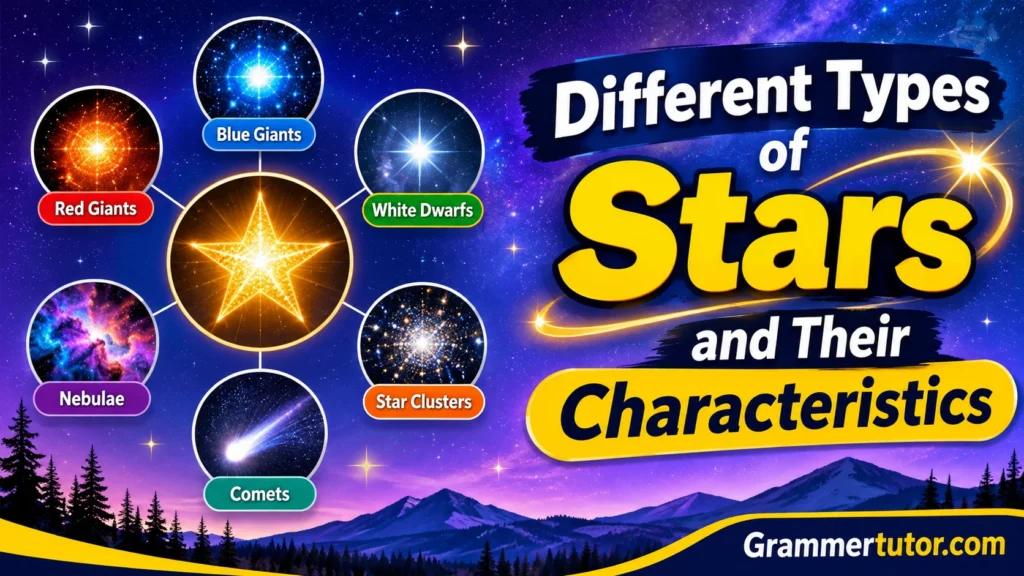
Stars exist in various sizes, temperatures, colors, and stages of development. Some are small and relatively cool, while others are enormous and extremely hot. Their appearance depends on factors such as surface temperature, mass, and age.
Common stellar classifications include red dwarfs, yellow dwarfs, red giants, blue giants, and supergiants. The Sun is a yellow dwarf star, while Betelgeuse is a famous red supergiant. Blue stars generally have higher surface temperatures than red stars.
Stars also differ in their brightness and lifespan. Smaller stars can remain stable for extremely long periods, while massive stars usually consume their nuclear fuel more quickly. These differences make stellar research an important part of understanding the universe.
Examples of Stellar Characteristics
- The Sun is classified as a yellow dwarf.
- Red dwarfs are generally smaller than the Sun.
- Blue stars have very high surface temperatures.
- Red giants expand during later stages of stellar evolution.
- Supergiants can be enormously larger than the Sun.
- Stars produce energy through nuclear fusion.
- Stellar colors provide clues about surface temperature.
- Massive stars generally have shorter lifespans.
- Some stars exist in binary systems.
- Stars can form inside large clouds of gas and dust.
Amazing Facts About Stars
Stars have fascinated humans throughout history because of their brightness, enormous distances, and important role in the universe. Their lifespans vary according to their masses. Smaller stars, especially red dwarfs, can remain active for trillions of years, while massive stars may survive for only a few million years. This difference occurs because larger stars consume their nuclear fuel much faster than smaller ones.
One remarkable physiological and physical feature of stars is their extremely high temperature. Stars are made primarily of hydrogen and helium, and their cores produce energy through nuclear fusion. This process releases enormous amounts of energy in the form of radiation. Their colors also reveal important information about their temperatures: blue stars are generally hotter than white, yellow, orange, and red stars.
Another fascinating fact is that stars are responsible for producing many of the chemical elements found throughout the universe. Through nuclear processes and stellar explosions, stars contribute to the formation and distribution of elements that eventually become part of planets and other celestial objects. This means that studying stars helps scientists understand the history and development of the cosmos.
Conclusion
Understanding the collective noun for stars makes it easier to describe stars appearing together in the night sky. Expressions such as constellation, cluster, galaxy, and group of stars help explain different arrangements and collections. Learning these terms improves your English vocabulary and allows you to write clearer, more descriptive, and meaningful sentences about the beauty of the universe.
FAQs
Q1. What is the collective noun for stars?
A constellation of stars is a familiar expression used for a recognizable arrangement of stars in the night sky. A cluster of stars is another common astronomical expression for stars physically grouped together.
Q2. Can I say “a cluster of stars”?
Yes. A cluster of stars is a correct and widely used astronomical expression. It generally describes stars that are physically associated through gravity.
Q3. What is a group of stars called in astronomy?
Depending on their arrangement, stars may be described as a constellation, cluster, galaxy, or stellar system. Each term has a different astronomical meaning.
Q4. What is the difference between a constellation and a star cluster?
A constellation is a recognized pattern of stars viewed from Earth, whereas a star cluster consists of stars that are physically associated in space. The stars in a constellation do not necessarily belong together physically.
Q5. What is a galaxy of stars?
A galaxy is a massive gravitationally bound structure containing stars, gas, dust, and other celestial material. The Milky Way is the galaxy in which our Solar System is located.