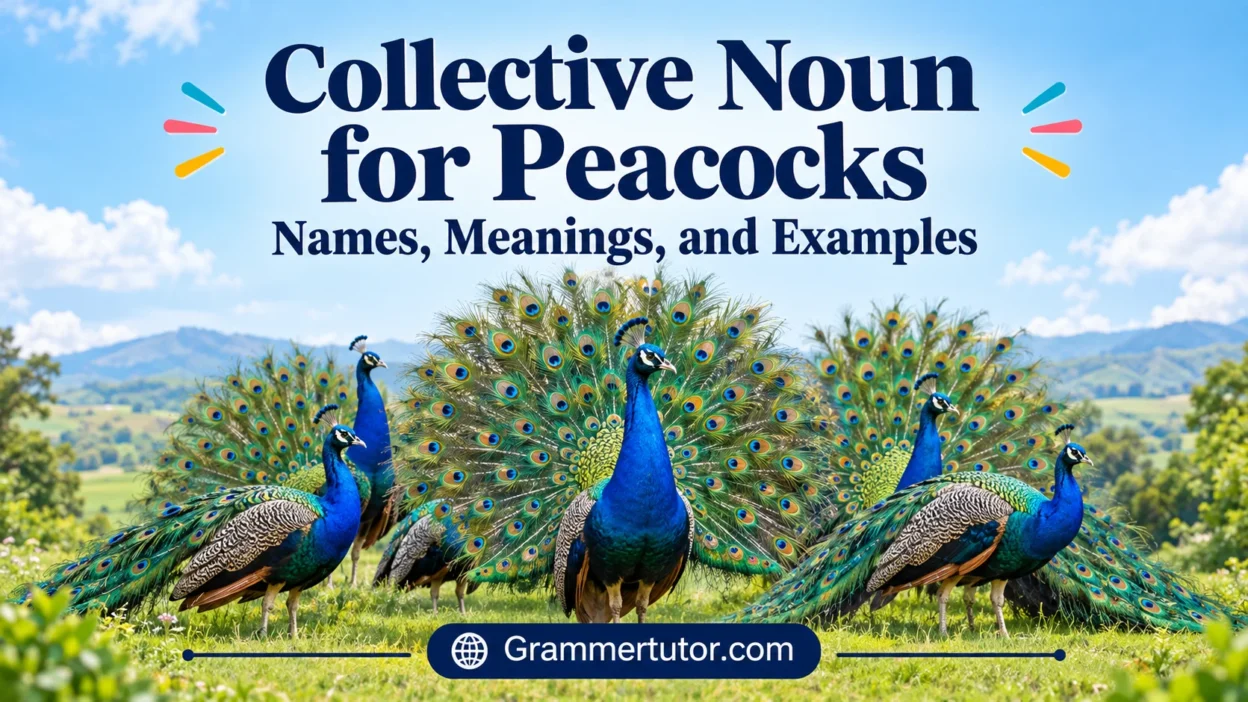
Learning the collective noun for peacocks helps you describe these striking birds and their group in clear, natural English while making your writing more colorful.Peacocks are striking birds that attract attention with their colorful feathers, impressive tail displays, and graceful movements.
When several of these animals appear together, knowing the right collective terms can make your description more interesting. Instead of repeatedly saying group of peacocks, you can choose suitable special words that fit the situation. This makes writing feel more precise while keeping the description lively and easy to understand.Learning animal group names is also a useful way to improve your English vocabulary.
Whether you are curious about animal terminology or working on a school assignment, these expressions can give you more natural ways to describe groups. From my experience with English usage, learning such specific names makes vocabulary easier to remember because each term connects a familiar animal with a particular description. These terms can be especially useful when writing about peacocks and their appearance in the natural world.
Why Do We Use Collective Nouns for Peacocks?
A collective noun is a word or phrase used to refer to several individuals as one group. For example, we say a flock of birds, a herd of horses, and a pride of lions.
Peacocks are usually associated with terms that highlight their appearance, movement, or behavior. Some expressions are more familiar than others, and certain terms may be descriptive rather than universally established.
Using a collective noun also helps make sentences less repetitive. Instead of writing “a group of peacocks” several times, you can choose a suitable group term and make the description more vivid.
For example, compare these two sentences:
- A group of peacocks was walking across the garden.
- A pride of peacocks was walking across the garden.
The first sentence is straightforward, while the second creates a more distinctive image. However, not every poetic collective noun is a standard everyday term, so context matters.
Collective Nouns for Peacocks
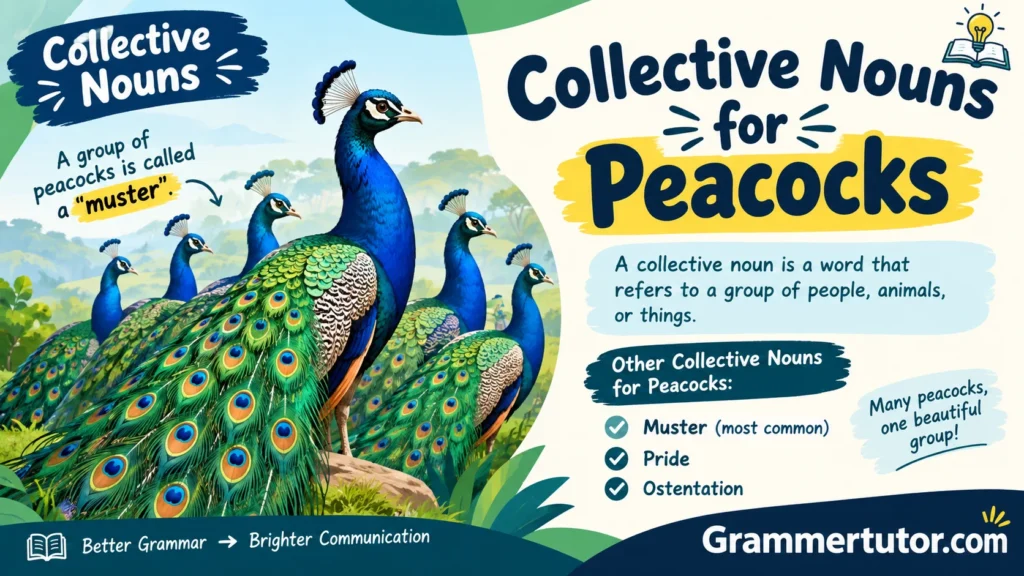
Here are some expressions that may be used when describing peacocks in groups:
| Collective Noun | Used For | Simple Example |
| Ostentation of Peacocks | A group of peacocks, especially emphasizing their showy appearance | An ostentation of peacocks crossed the garden. |
| Pride of Peacocks | A group described in a grand or impressive way | A pride of peacocks gathered near the trees. |
| Party of Peacocks | A group of peacocks in a general or informal description | A party of peacocks moved through the field. |
| Muster of Peacocks | A gathered group of peacocks | A muster of peacocks stood near the water. |
| Flock of Peacocks | A group of peafowl, using the familiar bird-group term | A flock of peacocks rested beneath the trees. |
| Group of Peacocks | A simple, neutral expression | A group of peacocks appeared in the park. |
| Display of Peacocks | A descriptive expression focusing on their colorful display | A display of peacocks attracted many visitors. |
Among these, ostentation of peacocks is the distinctive traditional expression often associated with their conspicuous appearance. In ordinary modern English, however, group or flock may be more natural depending on the context.
Ostentation of Peacocks
Ostentation is a word associated with something showy, impressive, or designed to attract attention. Because male peacocks are famous for spreading their magnificent tail feathers, this term fits their dramatic appearance particularly well.
An ostentation of peacocks refers to a group of peacocks and draws attention to their colorful and spectacular appearance.
This term works especially well in descriptive writing. It can help create a strong visual image for the reader.
Examples of “Ostentation of Peacocks”
- An ostentation of peacocks wandered through the palace garden.
- We saw an ostentation of peacocks near the old fountain.
- The photographer captured an ostentation of peacocks at sunset.
- An ostentation of peacocks gathered beneath the large trees.
- Visitors stopped to admire the ostentation of peacocks.
- The garden became lively when an ostentation of peacocks arrived.
- An ostentation of peacocks moved slowly across the lawn.
- The colorful feathers of the ostentation of peacocks caught everyone’s attention.
- We watched an ostentation of peacocks from a distance.
- The ostentation of peacocks made the garden look magnificent.
Pride of Peacocks
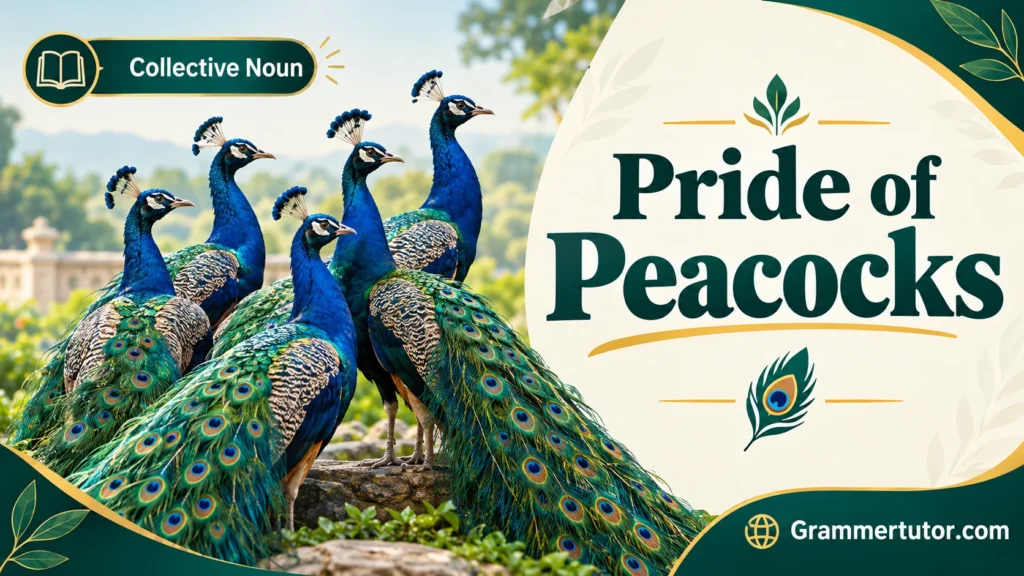
Pride is commonly connected with something magnificent or impressive. Although it isn’t the everyday group term most speakers would choose for peacocks, it can be used descriptively to emphasize their beauty and grandeur.
Peacocks are known for their proud posture and elaborate feather displays. Because of this association, “pride” can work naturally in creative or descriptive writing.
Examples of “Pride of Peacocks”
- A pride of peacocks stood proudly in the garden.
- We noticed a pride of peacocks near the palace.
- The pride of peacocks displayed their beautiful feathers.
- A pride of peacocks moved toward the forest.
- The children watched the pride of peacocks with excitement.
- A pride of peacocks gathered beside the pond.
- The pride of peacocks created a beautiful scene.
- We photographed a pride of peacocks during our visit.
- A pride of peacocks walked across the open field.
- The pride of peacocks disappeared into the trees.
Party of Peacocks
Party is a flexible word that can describe a group of animals in informal or creative writing. A party of peacocks can suggest several birds moving or gathering together.
This expression isn’t as established as ostentation, but it can be useful when the goal is simply to describe a gathering in an easy and conversational way.
Examples of “Party of Peacocks”
- A party of peacocks walked around the garden.
- We spotted a party of peacocks near the road.
- The party of peacocks moved toward the trees.
- A party of peacocks gathered beside the pond.
- The children followed the party of peacocks from a safe distance.
- A party of peacocks appeared in the park.
- The party of peacocks searched the ground for food.
- We watched a party of peacocks crossing the lawn.
- A party of peacocks rested under the shade.
- The party of peacocks slowly disappeared into the bushes.
Muster of Peacocks
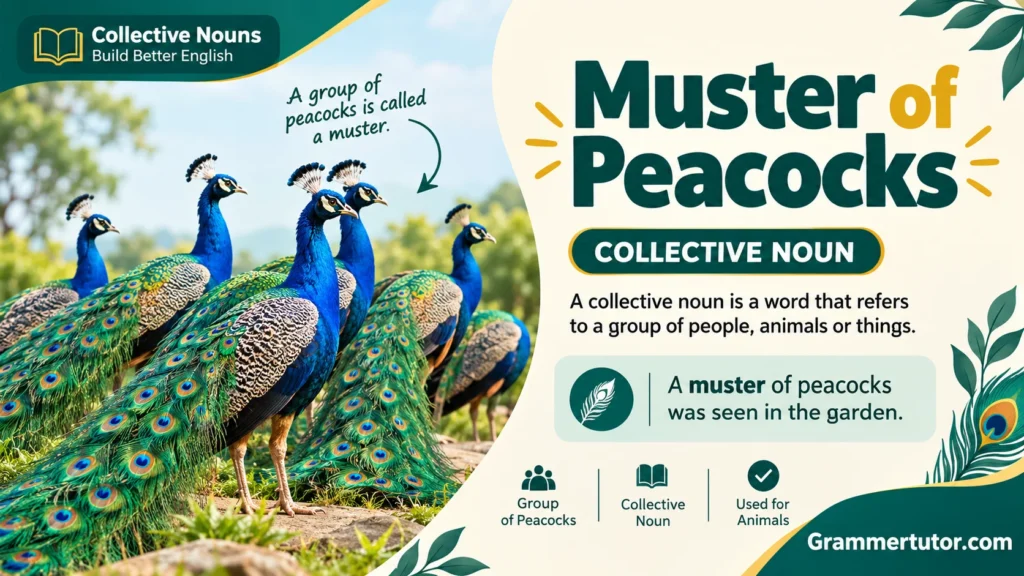
Muster means a gathering or assembling of people or things. When used with peacocks, it can describe several birds gathered together in one location.
This is more literary and less common in everyday conversation. Still, it can add variety to descriptive writing.
Examples of “Muster of Peacocks”
- A muster of peacocks gathered near the garden wall.
- We observed a muster of peacocks in the open field.
- The muster of peacocks moved toward the trees.
- A muster of peacocks appeared beside the old building.
- The photographer waited for the muster of peacocks to settle.
- A muster of peacocks crossed the grassy area.
- The muster of peacocks attracted many visitors.
- We saw a muster of peacocks near the water.
- A muster of peacocks stood together in the shade.
- The muster of peacocks slowly spread across the garden.
Flock of Peacocks
Flock is one of the simplest and most understandable ways to describe several birds together. It is a familiar collective noun for birds in general, so it can be used when you simply want to communicate that several peafowl are together.
In everyday writing, this type of wording can sound more natural than a rare or literary collective noun.
Examples of “Flock of Peacocks”
- A flock of peacocks walked across the field.
- We saw a flock of peacocks near the trees.
- The flock of peacocks gathered beside the pond.
- A flock of peacocks entered the garden.
- The children watched the flock of peacocks quietly.
- A flock of peacocks rested under the shade.
- The flock of peacocks moved toward the forest.
- We photographed a flock of peacocks in the park.
- A flock of peacocks searched for food.
- The flock of peacocks disappeared behind the bushes.
Group of Peacocks
Sometimes the clearest answer is simply a group of peacocks. It is neutral, easy to understand, and suitable for almost any context.
If you’re unsure whether a specialized collective noun is appropriate, “group” is a safe choice because it doesn’t depend on a particular tradition or style of writing.
Examples of “Group of Peacocks”
- A group of peacocks gathered in the garden.
- We saw a group of peacocks near the pond.
- The group of peacocks walked across the lawn.
- A group of peacocks rested beneath the trees.
- The children admired the group of peacocks.
- A group of peacocks appeared near the road.
- We photographed a group of peacocks in the park.
- The group of peacocks moved toward the field.
- A group of peacocks searched the ground for food.
- The group of peacocks disappeared into the woodland.
Display of Peacocks
A display of peacocks is a descriptive phrase rather than a standard collective noun in the same sense as some traditional animal-group names. It works particularly well when the birds are spreading their magnificent tail feathers.
The phrase focuses on what makes peacocks visually remarkable: their colorful feathers and courtship displays.
Examples of “Display of Peacocks”
- A display of peacocks amazed the visitors.
- We watched a beautiful display of peacocks in the garden.
- The display of peacocks attracted everyone’s attention.
- A display of peacocks took place near the fountain.
- The photographer captured the display of peacocks perfectly.
- A colorful display of peacocks brightened the park.
- The display of peacocks lasted several minutes.
- Visitors gathered around to watch the display of peacocks.
- A magnificent display of peacocks filled the garden.
- Everyone enjoyed seeing the display of peacocks.
How Peacocks Behave in Groups
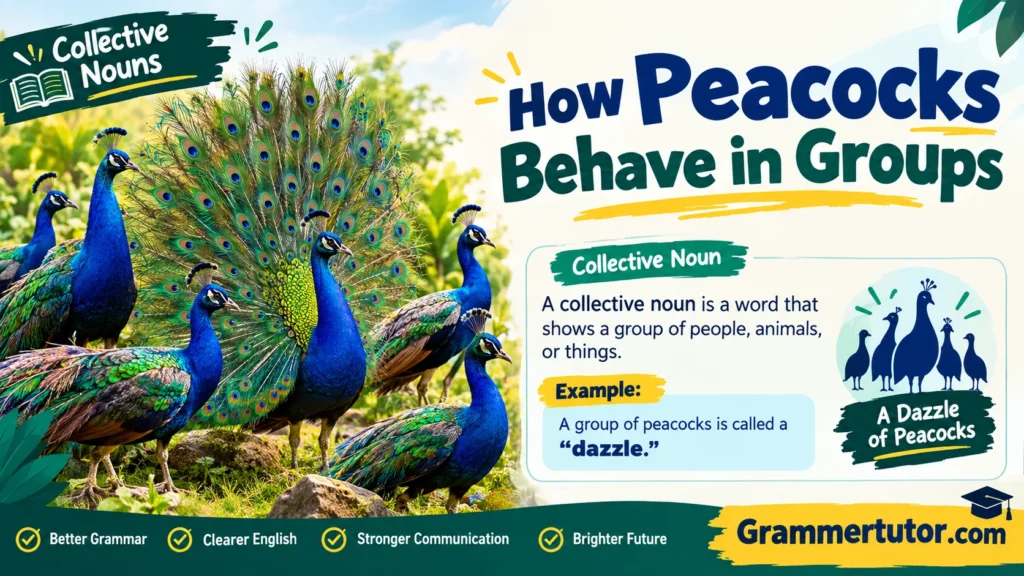
Peacocks are social birds and may gather in groups, especially when feeding, resting, or moving through suitable habitats. Their behavior can vary depending on the season, environment, and availability of food.
During breeding periods, males may spread their spectacular tail feathers and perform courtship displays. These displays aren’t simply about looking beautiful. They are part of the birds’ reproductive behavior and can involve movement, feather positioning, and visual signals.
Peafowls also spend time searching the ground for food. Their diet can include seeds, grains, fruits, insects, plants, and other small food items. When several birds feed in the same area, they may move around together while searching for suitable food.
Interesting Facts About Peacocks
The word peacock technically refers to the male, while peahen refers to the female and peafowl is the general term for the species. This distinction is useful when writing accurately about these birds. The male’s famous tail is made up of elongated upper-tail coverts rather than the ordinary tail feathers people often assume it to be.
Peacocks are famous for their colorful feathers, especially the eye-like patterns on their train. They can spread these feathers into an impressive fan during courtship and other displays. Their feathers can reflect light in ways that create brilliant shades of blue and green.
Peafowl are omnivorous. Their diet may include seeds, grains, fruits, berries, insects, and various plant materials. They spend considerable time foraging on the ground, although they can also fly and use trees as roosting places.
These birds can live for many years when conditions are favorable. Their strong legs allow them to walk and run effectively, while their wings help them escape danger and reach elevated roosting locations.
Why Are Peacocks Called Peafowl?
Peafowl is the general name for the birds in this group. A male is called a peacock, while a female is called a peahen. Young birds are commonly called peachicks.
So, if you are talking about males and females together, peafowl is the most accurate general term.
For example:
- The peacock spread his colorful feathers.
- The peahen walked through the grass.
- Several peafowl gathered near the trees.
Understanding these terms can make your writing more precise.
What Is the Most Common Collective Noun for Peacocks?
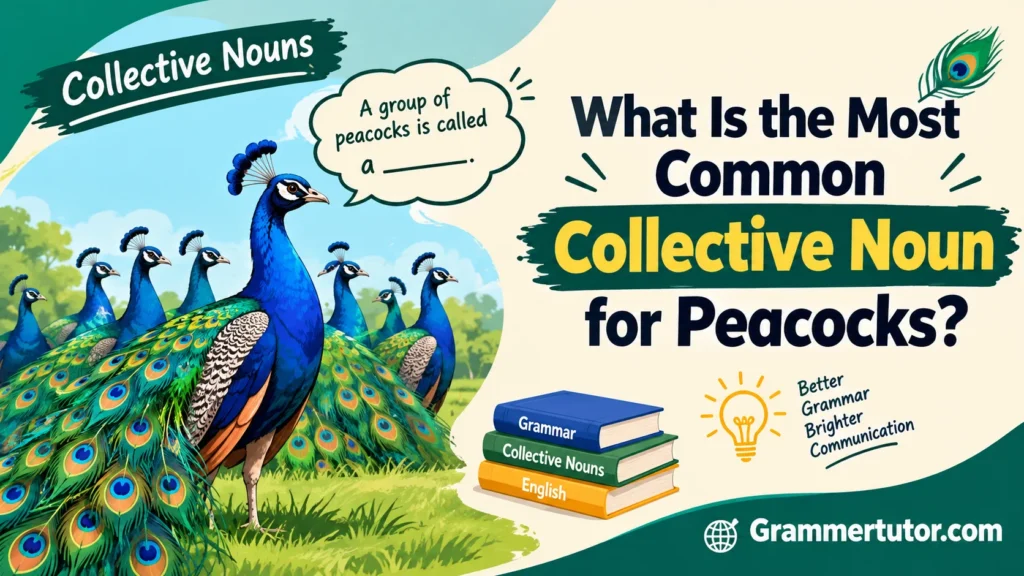
There isn’t one universally used everyday collective noun that all English speakers use for peacocks.
Ostentation of peacocks is a well-known traditional expression and is especially associated with the birds’ showy appearance. However, in ordinary communication, a group of peacocks or a flock of peacocks may be clearer and more natural.
The best choice depends on your purpose:
| Situation | Suitable Expression |
| Traditional or colorful writing | Ostentation of peacocks |
| Simple everyday English | Group of peacocks |
| General bird description | Flock of peacocks |
| Describing their beauty | Display of peacocks |
| Creative or literary writing | Pride of peacocks |
Conclusion
Understanding the collective noun for peacocks gives you a more interesting way to describe these beautiful birds. Their colorful appearance, graceful movements, and impressive displays make group descriptions more vivid. Whether you’re writing for a school assignment, improving your vocabulary, or simply learning about animals, knowing these group terms can make your English more precise and engaging.
READ MORE: Collective Noun for Woodpeckers: Examples, and Interesting Facts
FAQs
Q1. What is the collective noun for peacocks?
A commonly used collective noun for peacocks is pride. You may also find other terms used in different sources and contexts.
Q2. What do you call a group of peacocks?
A group of peacocks can be called a pride of peacocks.
Q3. Is “pride of peacocks” correct?
Yes. Pride is a recognized collective term used for a group of peacocks.
Q4. Can I say “a group of peacocks”?
Yes. A group of peacocks is completely understandable and grammatically correct, especially in everyday English.
Q5. Why are collective nouns used for peacocks?
Collective nouns provide a concise and sometimes colorful way to describe several peacocks together.
Q6. What is the plural of peacock?
The plural form of peacock is peacocks.
Q7. Are peacocks and peafowl the same?
Not exactly. Peafowl is the general term for the species, while a peacock specifically refers to a male and a peahen refers to a female.
Q8. Why are peacocks known for their tails?
Male peacocks have long, colorful tail feathers that they spread during courtship displays and other visual displays.
Q9. Can collective nouns make writing better?
Yes. Using an appropriate collective noun can make descriptions more varied, precise, and engaging.
Q10. What is the easiest way to remember the collective noun for peacocks?
Connect pride with the confident appearance and impressive display of a male peacock. This simple association can make the term easier to remember.