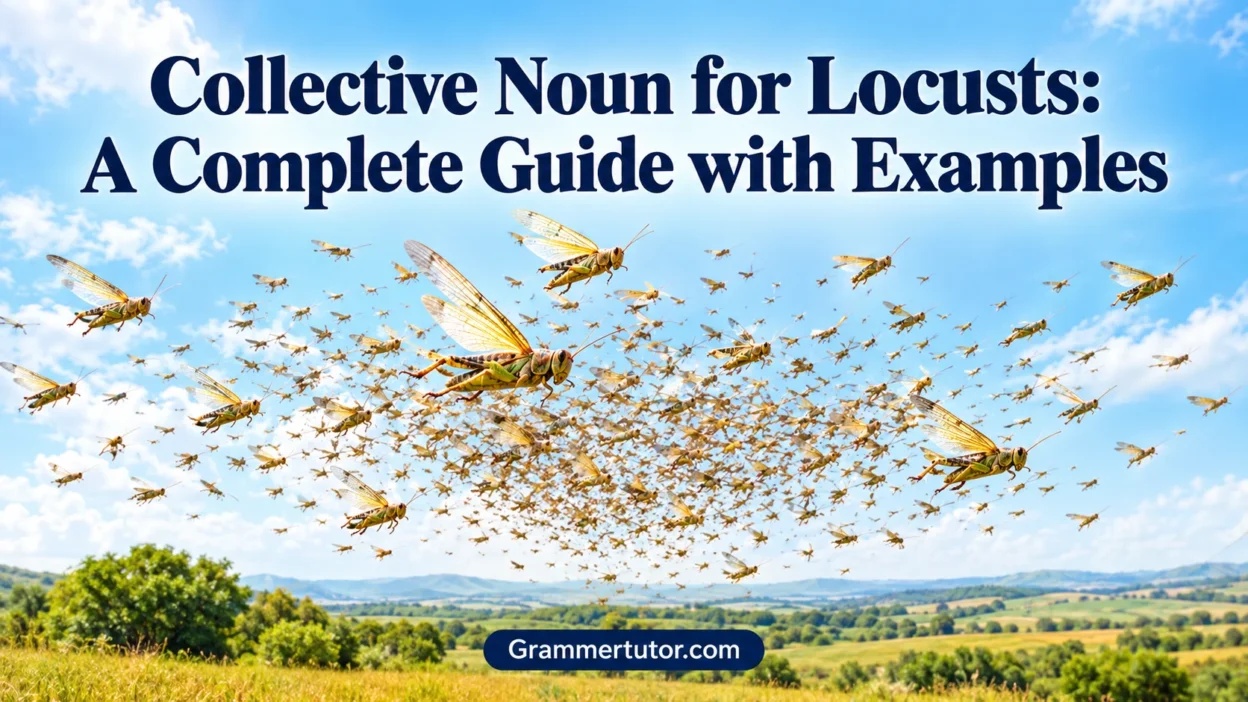
A collective noun for locusts helps describe many locusts when they gather and move together in an enormous group. Locusts are insects that can live alone during part of their lives, but environmental conditions can cause them to gather in large numbers. When one large group appears, English provides several collective expressions to describe this behavior clearly.
The most familiar collective noun is swarm, as in a swarm of locusts. A swarm may contain thousands or even millions of insects that are moving and feeding across an area. Other terms include cloud, plague, horde, and mass. The best choice depends on the context, the meaning a writer wants to emphasize, and whether the description focuses on the insects themselves, their size, or their effects.
Learning these group names makes writing more precise and vivid. Instead of simply saying many locusts, you can describe the insects as gathered in a particular way and explain how their movement affects the surrounding area. In my experience, using the right expression gives readers a clearer picture of the insects and makes the description feel more natural and specific.
Why Are Collective Nouns Used for Locusts?
Collective nouns make it easier to talk about a large number of locusts as a single group. This is particularly useful because locusts can gather in huge numbers and travel together over considerable distances.
For example, “a swarm of locusts crossed the field” immediately gives the reader a picture of a large moving group. The word swarm is much more descriptive than simply saying that many locusts were present.
Different collective expressions can also highlight different situations. A cloud of locusts focuses on their appearance in the sky, while a plague of locusts emphasizes the widespread agricultural damage associated with a severe locust outbreak.
Collective Nouns for Locusts
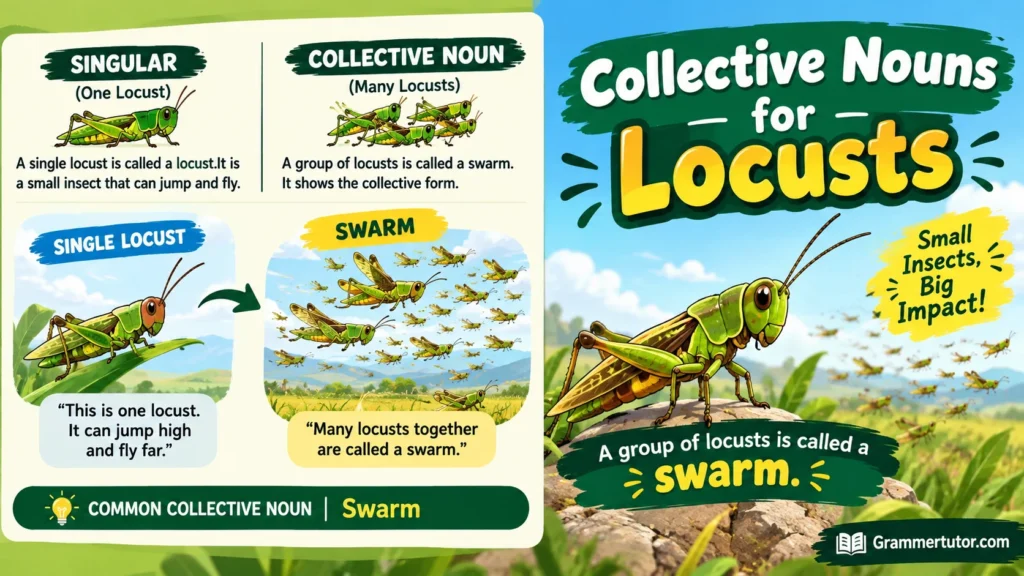
Here are some common and descriptive terms that can be used for groups of locusts:
| Collective Noun | Used For | Simple Example |
| Swarm of Locusts | A large group moving or feeding together | A swarm of locusts covered the crops. |
| Cloud of Locusts | A large group seen flying through the air | A cloud of locusts darkened the sky. |
| Plague of Locusts | A destructive or widespread infestation | A plague of locusts damaged the farmland. |
| Horde of Locusts | A huge, overwhelming group | A horde of locusts moved across the valley. |
| Mass of Locusts | A very large gathering | A mass of locusts settled on the trees. |
| Group of Locusts | A general term for locusts together | A group of locusts rested near the grass. |
| Congregation of Locusts | A gathered collection, especially in descriptive writing | A congregation of locusts gathered near the field. |
Among these, swarm of locusts is the most familiar general expression. Terms such as cloud and plague are especially useful when the writer wants to describe the appearance or impact of the locusts.
Swarm of Locusts
Swarm of locusts is the most widely recognized expression for a large number of locusts moving together. Locust swarms can travel across large areas while searching for food and suitable conditions.
The word swarm creates a strong image of numerous insects moving as one large body. It works well in both everyday writing and descriptions of agricultural events.
Examples of “Swarm of Locusts”
- A swarm of locusts moved across the farmland.
- The farmers noticed a swarm of locusts approaching the crops.
- A huge swarm of locusts settled on the grass.
- The wind carried the swarm of locusts toward the valley.
- We watched a swarm of locusts rise from the field.
- A swarm of locusts covered several trees.
- The villagers saw a swarm of locusts flying overhead.
- The crops were surrounded by a large swarm of locusts.
- A swarm of locusts passed over the village in the afternoon.
- The farmers worked quickly after seeing the swarm of locusts.
Cloud of Locusts
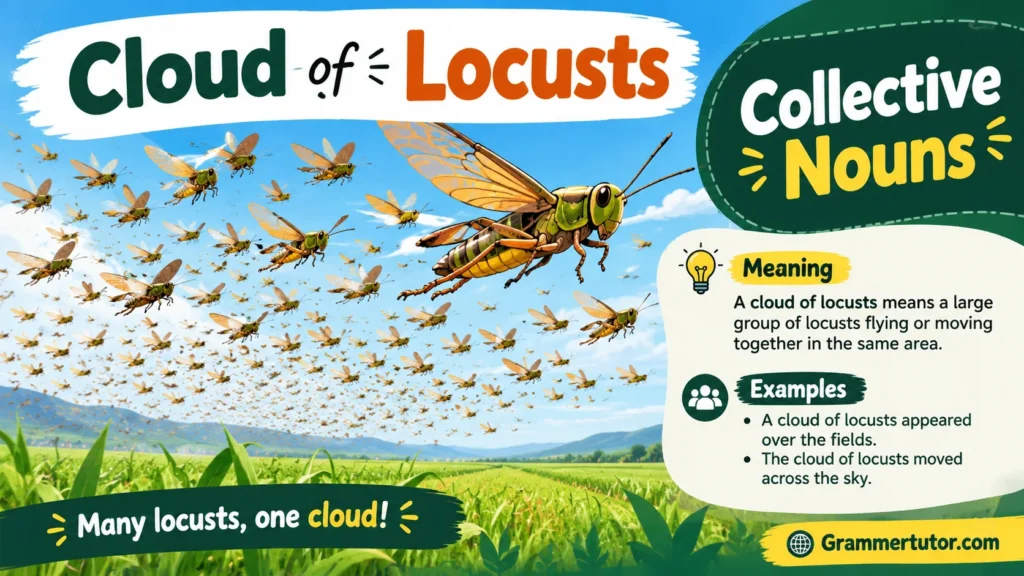
A cloud of locusts is a descriptive expression used when a large number of flying locusts appear together in the sky. From a distance, their numbers can make them look like a moving cloud.
This phrase focuses more on their appearance and movement in the air than on their effect on crops. It is especially effective in descriptive and narrative writing.
Examples of “Cloud of Locusts”
- A cloud of locusts appeared above the fields.
- The farmers watched a dark cloud of locusts approach.
- A cloud of locusts moved across the blue sky.
- The sunlight disappeared behind the cloud of locusts.
- We saw a cloud of locusts flying toward the farmland.
- A huge cloud of locusts passed over the village.
- The cloud of locusts seemed to stretch for miles.
- The birds scattered when the cloud of locusts arrived.
- A moving cloud of locusts covered the horizon.
- The villagers noticed the cloud of locusts before it reached the fields.
Plague of Locusts
Plague of locusts is commonly used when locusts occur in such large numbers that they cause serious agricultural damage. Unlike swarm, this expression highlights the harmful consequences of the infestation.
The word plague has a strong negative meaning, so it is best used when the locusts are causing widespread destruction rather than simply describing a normal group.
Examples of “Plague of Locusts”
- A plague of locusts destroyed large areas of crops.
- The farmers feared a plague of locusts after seeing the insects arrive.
- The region experienced a serious plague of locusts.
- A plague of locusts moved through the agricultural fields.
- The crops suffered after a plague of locusts arrived.
- The community prepared for the approaching plague of locusts.
- A sudden plague of locusts affected several farms.
- The farmers struggled to protect their crops from the plague of locusts.
- The plague of locusts spread across the farming region.
- Heavy crop losses followed the arrival of the plague of locusts.
Horde of Locusts
A horde of locusts is a descriptive phrase for a very large and overwhelming number of locusts. The word horde is not as specific as swarm, but it can make writing more dramatic.
It works particularly well when describing locusts advancing across a landscape in large numbers. Because horde is a general collective expression, it should be understood as descriptive rather than as the standard scientific term.
Examples of “Horde of Locusts”
- A horde of locusts moved toward the crops.
- The farmers watched the horde of locusts approach.
- A massive horde of locusts covered the field.
- The wind pushed the horde of locusts toward the village.
- A horde of locusts landed near the farm.
- The trees disappeared behind the horde of locusts.
- The villagers saw a horde of locusts crossing the valley.
- A large horde of locusts gathered around the plants.
- The horde of locusts moved quickly across the farmland.
- The farmer tried to protect his crops from the horde of locusts.
Mass of Locusts
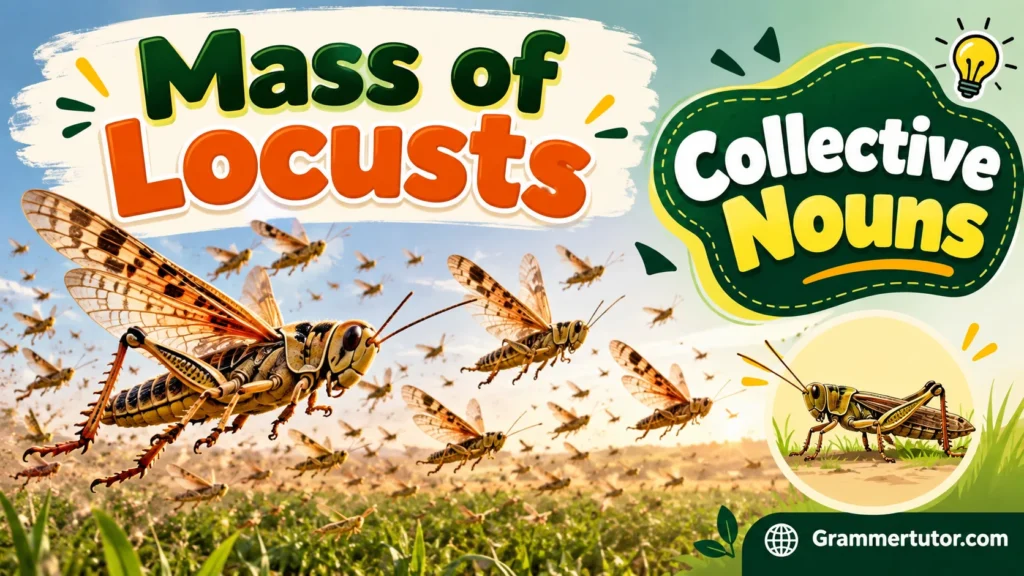
A mass of locusts is another general expression for a very large number of locusts gathered together. The word mass emphasizes their sheer quantity rather than their particular behavior.
This phrase can be useful when the locusts are resting, feeding, landing, or covering an area. It doesn’t necessarily suggest that they are flying together.
Examples of “Mass of Locusts”
- A mass of locusts covered the plants.
- The farmer found a mass of locusts near the crops.
- A huge mass of locusts landed on the trees.
- The grass was hidden beneath a mass of locusts.
- A mass of locusts gathered around the field.
- The children watched the mass of locusts from a safe distance.
- A moving mass of locusts crossed the road.
- The farmer noticed a mass of locusts feeding on the leaves.
- The mass of locusts spread across the garden.
- A large mass of locusts gathered after the rain.
Group of Locusts
Group of locusts is the simplest and most neutral way to describe several locusts together. It doesn’t suggest a particular size or behavior.
While swarm is more characteristic when referring to large numbers of locusts, group can be used for smaller gatherings or when the exact size of the gathering isn’t important.
Examples of “Group of Locusts”
- A group of locusts rested on the leaves.
- We found a group of locusts near the grass.
- A small group of locusts moved through the garden.
- The children noticed a group of locusts on the plants.
- A group of locusts jumped from the field.
- The farmer observed a group of locusts feeding together.
- A group of locusts gathered beside the road.
- Several groups of locusts appeared after the warm weather.
- A group of locusts disappeared into the tall grass.
- The researcher observed a group of locusts in the field.
Congregation of Locusts
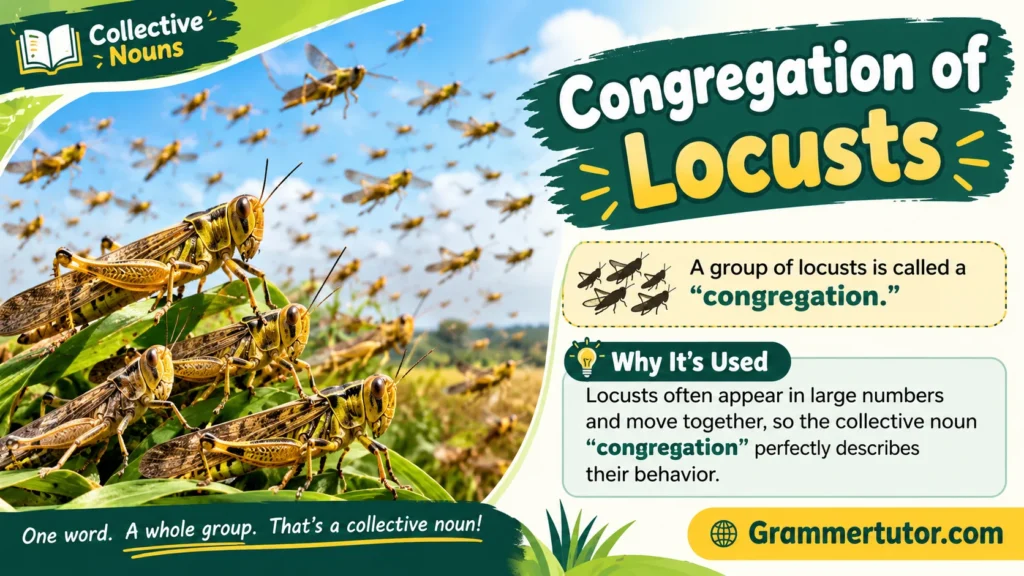
Congregation of locusts can be used as a descriptive expression for locusts gathered in one place. It is less common than swarm and should not be treated as the standard term for every gathering.
This phrase can work in creative or descriptive writing when the focus is on a collection of locusts gathered together rather than on their movement as a swarm.
Examples of “Congregation of Locusts”
- A congregation of locusts gathered around the plants.
- The field contained a large congregation of locusts.
- We noticed a congregation of locusts near the crops.
- A congregation of locusts rested on the branches.
- The farmer watched the congregation of locusts from the edge of the field.
- A large congregation of locusts formed near the grass.
- The congregation of locusts moved toward the green plants.
- The garden attracted a congregation of locusts.
- A congregation of locusts covered part of the field.
- The researcher recorded the congregation of locusts in the area.
How Locusts Behave in Large Groups
Locusts are especially interesting because their behavior can change when their population becomes dense. Under suitable conditions, some locust species can shift from a more solitary phase to a gregarious phase, in which they become more likely to gather and move together.
When locusts form large groups, they can travel in the same general direction and search for vegetation as a collective. Their ability to gather in enormous numbers is one reason the word swarm is so strongly associated with them.
Large locust gatherings can also have a major effect on vegetation. Since locusts feed on plants, an unusually large swarm may consume substantial amounts of vegetation over a relatively short period.
Interesting Facts About Locusts
Locusts belong to the grasshopper family, but not every grasshopper behaves like a locust. The term locust is generally used for certain grasshopper species that can develop swarming behavior under particular environmental conditions.
One fascinating feature of locusts is their ability to change behavior and appearance when population density increases. This phenomenon is called phase polyphenism. Environmental signals, including contact with other locusts, can contribute to changes associated with the transition between solitary and gregarious phases.
Locusts are herbivores and feed mainly on vegetation. Their diet can include grasses, leaves, crops, and other green plant material. When very large numbers gather, their feeding activity can put considerable pressure on vegetation.
Locusts also have strong legs that help them jump, while their wings allow many species to travel long distances. Their combination of jumping and flying abilities makes them highly mobile insects.
Another interesting fact is that locusts have compound eyes that help them detect movement and changes in their surroundings. Like other insects, they also have antennae that provide sensory information about their environment.
Collective Noun for Locusts in a Sentence
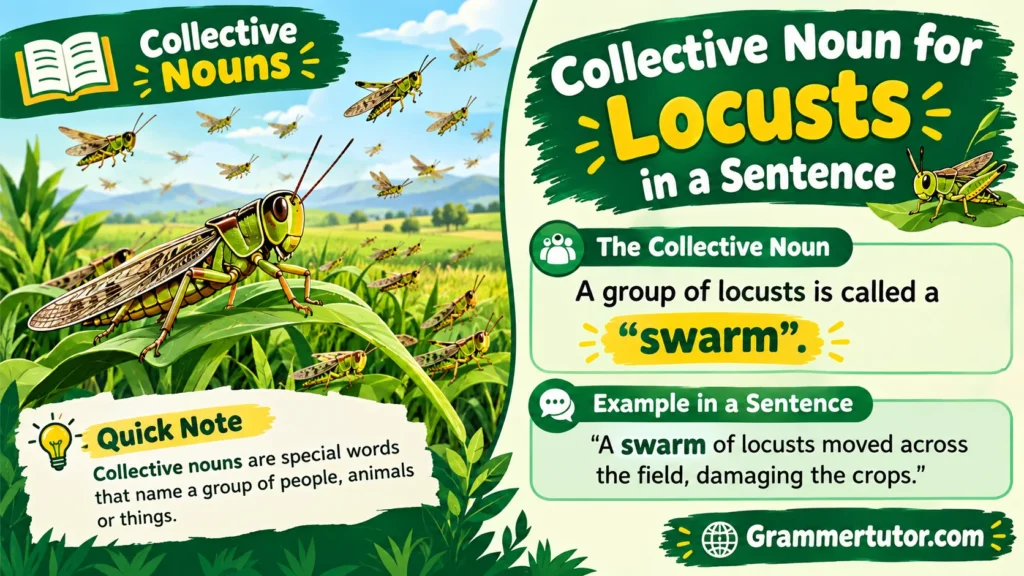
Choosing the right expression depends on what you want your sentence to communicate.
If you simply want to describe a large moving group, a swarm of locusts is the clearest choice. If the insects are filling the sky, a cloud of locusts creates a stronger visual image. When their presence is associated with widespread agricultural damage, plague of locusts communicates the seriousness of the situation.
For example:
- Swarm: A swarm of locusts crossed the farmland.
- Cloud: A cloud of locusts filled the sky.
- Plague: A plague of locusts damaged the crops.
- Horde: A horde of locusts moved across the valley.
- Mass: A mass of locusts covered the plants.
- Group: A group of locusts rested on the grass.
The best expression depends on the size, movement, appearance, and effect of the locusts you are describing.
READ MORE: Collective Noun for Poultry: A Complete Guide With Examples
Conclusion
The most common collective noun for locusts is swarm, as in “a swarm of locusts.” Other words, such as cloud, plague, horde, and mass, can also describe groups of locusts depending on the context. Choosing the right term helps make your writing more precise, clear, and vivid. When you want to describe a large group of locusts moving or feeding together, swarm is usually the most natural choice.
FAQs
Q1. What is the collective noun for locusts?
The most common collective noun for locusts is swarm. You can say, “A swarm of locusts crossed the field.”
Q2. What do you call a group of locusts?
A group of locusts is commonly called a swarm. Other terms, including cloud, plague, horde, and mass, may also be used in suitable contexts.
Q3. Is “swarm of locusts” correct?
Yes. “A swarm of locusts” is a standard and natural expression for describing a large group of locusts.
Q4. Can “cloud” be used for a group of locusts?
Yes. Cloud can describe a large number of locusts, especially when they appear together in the air and create the impression of a moving cloud.
Q5. Is “plague of locusts” correct?
Yes. Plague of locusts is commonly used when the focus is on the destructive or harmful effects of a large number of locusts.
Q6. Can “horde” describe locusts?
Yes. Horde can describe a very large group of locusts, particularly when emphasizing their great number or movement across an area.
Q7. Can “mass” be used for locusts?
Yes. Mass is a general term that can describe a large gathering of locusts. It is less specific than swarm.
Q8. What is the plural of locust?
The plural of locust is locusts. For example, “Thousands of locusts covered the field.”
Q9. What is the difference between “swarm” and “plague” of locusts?
Swarm focuses mainly on the group of locusts, while plague often emphasizes the large-scale harmful impact of the locusts.
Q10. Which collective noun should I use for locusts?
For general writing, swarm is the most familiar choice. Use cloud, plague, horde, or mass when the context calls for a particular emphasis.