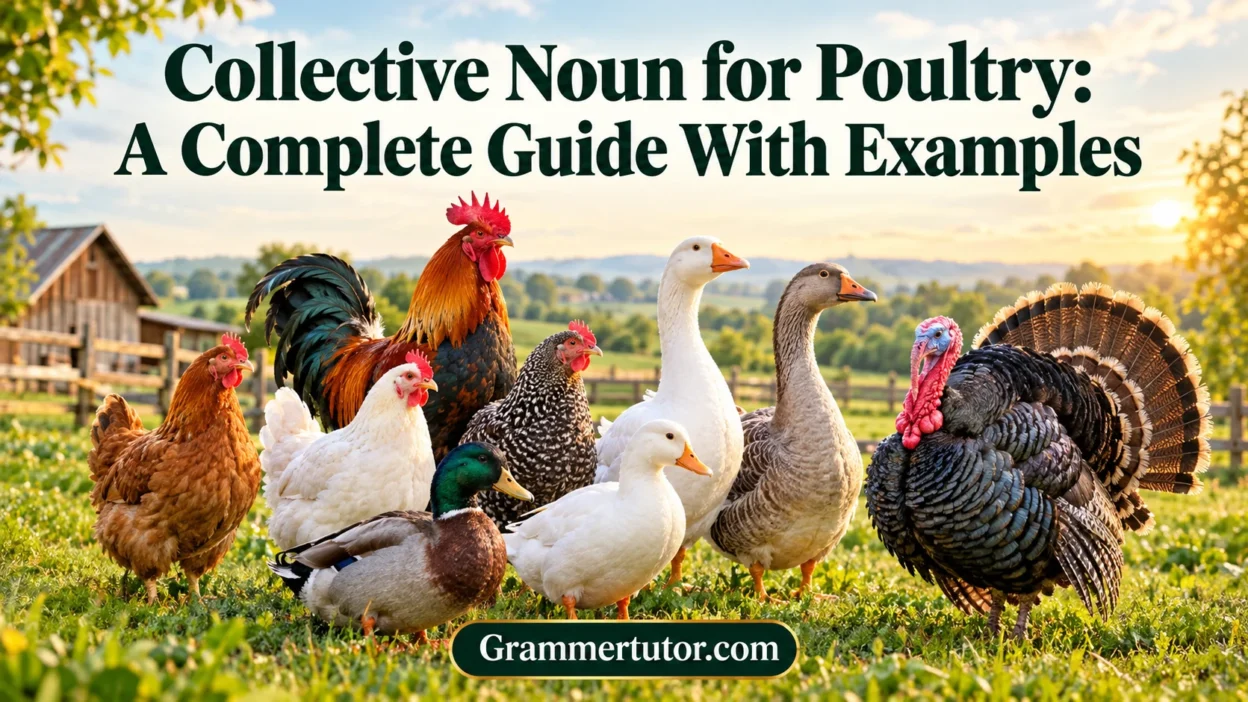
A collective noun for poultry helps describe domesticated birds clearly when they are kept for eggs, meat, breeding, or farm-related purposes. Chickens, ducks, turkeys, and geese are common examples of poultry, a broad term for these similar domestic birds. When the exact type of bird is not important, flock is a natural choice for describing a group of poultry.
English provides several collective nouns for different groups of birds, and the best exact word can depend on the age or situation of the birds. A brood, clutch, or gaggle may be more suitable for certain birds or particular situations. In practical writing, I find that choosing a specific expression makes sentences more natural and precise than repeatedly using the phrase group of poultry.
These expressions can also give the reader useful information without making the sentence longer. Instead of saying group of poultry every time, you can choose a suitable collective noun according to the birds being discussed. This approach keeps your writing clear and helps you describe birds in a more natural way, especially when discussing farms, domestic flocks, or different kinds of poultry.
Why Are Collective Nouns Used for Poultry?
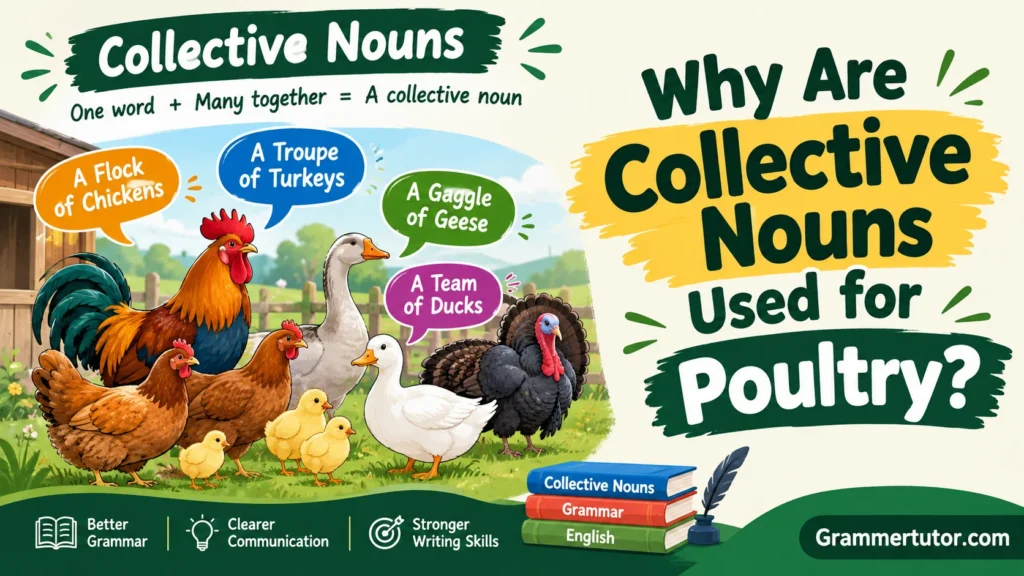
Collective nouns make language shorter and more descriptive. Rather than explaining that many domestic birds are gathered together, you can simply say a flock of poultry.
The word poultry covers several kinds of domesticated birds, so the appropriate collective noun may change depending on the species. Chickens are commonly described as a flock, while a group of geese may be called a gaggle when they are on the ground.
These expressions are especially useful in farming, animal writing, educational material, and everyday descriptions. They help readers understand whether you’re talking about birds in general, young birds, eggs, or a particular species.
Collective Nouns for Poultry
Here are some useful collective nouns associated with poultry and domestic birds:
| Collective Noun | Used For | Simple Example |
| Flock | Poultry birds generally | A flock of poultry moved across the farmyard. |
| Brood | Young birds with a mother | A brood of chicks followed the hen. |
| Clutch | A group of eggs | The hen was sitting on a clutch of eggs. |
| Gaggle | Geese, especially on land | A gaggle of geese gathered near the pond. |
| Pack | A group of birds in some informal descriptions | A pack of birds moved together across the yard. |
| Covey | Certain groups of game birds | A covey of quail disappeared into the grass. |
| Herd | Sometimes used informally for domestic birds, though less standard | A herd of birds crossed the open area. |
Among these, flock is the most useful general expression when you’re talking about poultry as a whole.
Flock of Poultry
A flock of poultry refers to a group of domesticated birds kept together, usually on a farm or in another managed setting. Chickens, ducks, turkeys, and other domestic birds may be described as a flock.
This is the most straightforward collective expression when the particular species isn’t important. Farmers and animal owners may use the word to describe birds kept together for eggs, meat, breeding, or general farming.
The word also works well when discussing poultry as a group without identifying every individual bird.
Examples of “Flock of Poultry”
- A flock of poultry wandered around the farmyard.
- The farmer checked the flock of poultry early in the morning.
- A large flock of poultry was kept inside the enclosure.
- The flock of poultry gathered near the feeding area.
- We watched a flock of poultry move across the field.
- The farmer provided fresh water for the flock of poultry.
- A flock of poultry rested under the shade.
- The children observed the flock of poultry from a distance.
- The flock of poultry returned to the coop before sunset.
- The farmer counted the flock of poultry before closing the gate.
Brood of Poultry
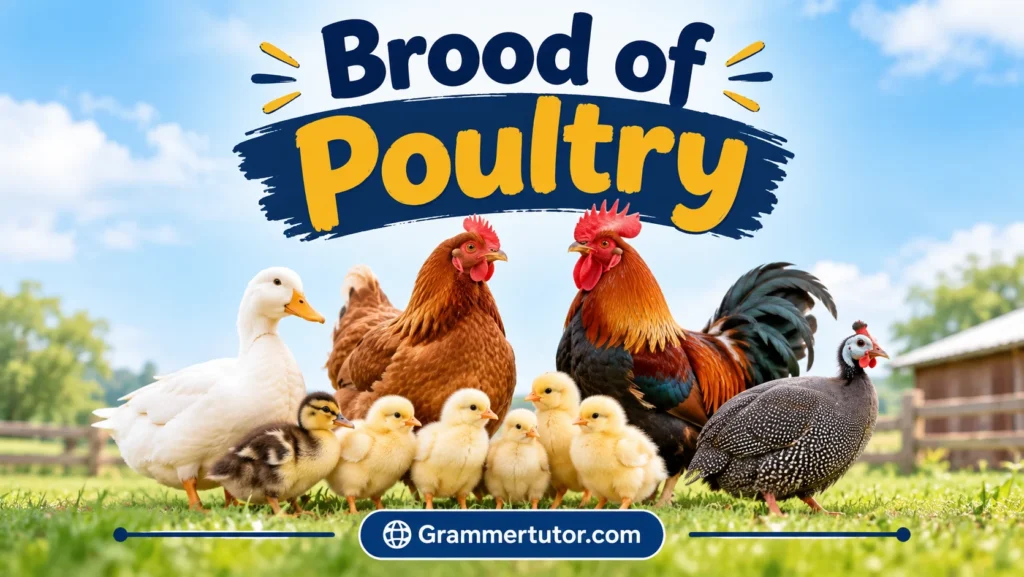
Brood is generally associated with a mother bird and her young. In poultry farming, the term is particularly useful when describing a hen with her chicks.
A brood isn’t simply any group of adult poultry. It focuses on young birds, usually gathered around or cared for by a mother.
For example, “a brood of chicks” clearly tells us that the group consists of young chickens. The word gives the sentence more detail than simply saying “a group of chickens.”
Examples of “Brood of Poultry”
- The hen stayed close to her brood.
- A brood of chicks followed their mother across the yard.
- The farmer moved the brood into a warmer shelter.
- The brood gathered beneath the hen’s wings.
- We saw a brood of young birds near the coop.
- The hen protected her brood from the cold.
- A brood of chicks searched for food beside their mother.
- The farmer watched the brood carefully.
- The brood rested together after feeding.
- The hen called her brood back to the nesting area.
Clutch of Poultry Eggs
A clutch refers to a group of eggs laid by a bird, especially when the eggs are being considered together as one set.
So, a clutch isn’t normally a term for a group of adult poultry. Instead, it describes the eggs produced or laid by a bird.
This distinction is useful because poultry farming often involves discussing both birds and their eggs. Saying “a clutch of eggs” immediately tells the reader what is being grouped.
Examples of “Clutch of Poultry Eggs”
- The hen laid a clutch of eggs in the nest.
- The farmer carefully collected the clutch of eggs.
- A clutch of eggs was hidden beneath the straw.
- The hen sat quietly on her clutch.
- We found a small clutch of eggs in the nesting box.
- The farmer marked the clutch for observation.
- The clutch of eggs was kept warm.
- A clutch of eggs rested safely inside the coop.
- The hen returned to her clutch after feeding.
- The farmer checked the clutch every morning.
Gaggle of Geese
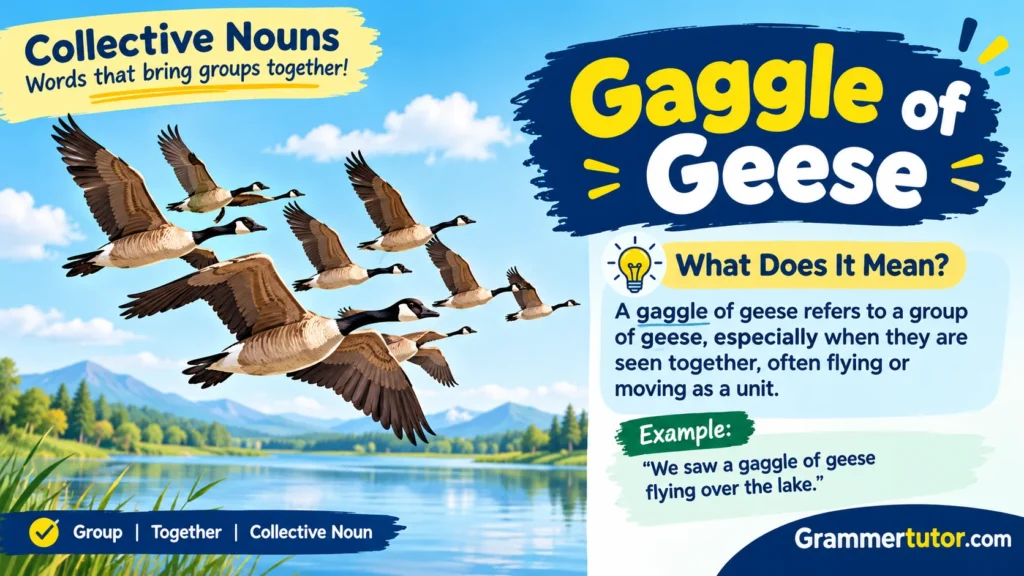
A gaggle is a familiar collective noun for geese, particularly when they are gathered together on the ground.
Because geese are a type of poultry, the term can appear in discussions about domestic poultry. However, it is more precise to say a gaggle of geese rather than “a gaggle of poultry.”
Geese are social birds and often stay together while feeding, walking, or resting. Their loud calls can make a group particularly noticeable around a farm.
Examples of “Gaggle of Geese”
- A gaggle of geese walked across the farmyard.
- The farmer fed the gaggle of geese near the pond.
- A noisy gaggle of geese approached the gate.
- We watched a gaggle of geese gather by the water.
- The gaggle of geese moved together toward the barn.
- A gaggle of geese rested in the grass.
- The children watched the gaggle of geese from afar.
- The gaggle of geese made loud calls near the pond.
- A gaggle of geese crossed the path.
- The farmer guided the gaggle of geese back to their enclosure.
Covey of Quail
A covey is traditionally used for a small group of certain game birds, including quail. Since quail can be kept as domesticated birds, this term can appear in discussions involving poultry and bird farming.
Unlike flock, which is a broad term, covey identifies a more specific type of bird group.
For accurate writing, it’s better to use covey of quail when you’re specifically discussing quail rather than applying the term to all poultry.
Examples of “Covey of Quail”
- A covey of quail moved through the grass.
- We noticed a convoy of quail near the field.
- The convoy of quail disappeared into the bushes.
- A small convoy of quail gathered together.
- The farmer watched the convoy of quail from a distance.
- The convoy of quail searched for food.
- A convoy of quail crossed the edge of the farm.
- The birds stayed together as a covey of quail.
- We heard a convoy of quail nearby.
- The convoy of quail moved quickly through the vegetation.
Flock of Chickens
Although flock of poultry is a general expression, chickens are also commonly described as a flock of chickens.
This is one of the most natural collective expressions used in poultry-related writing. It can describe hens, roosters, or chickens of different ages when they are considered as a group.
If you’re writing specifically about chickens rather than poultry in general, flock is usually the simplest choice.
Examples of “Flock of Chickens”
- A flock of chickens gathered near the coop.
- The farmer fed the flock of chickens at sunrise.
- The flock of chickens scratched the soil.
- We watched a flock of chickens move across the yard.
- A flock of chickens rested beneath the tree.
- The farmer opened the gate for the flock of chickens.
- The flock of chickens returned to the coop.
- Several chickens joined the flock.
- The flock of chickens searched for insects.
- A large flock of chickens lived on the farm.
How Do Poultry Birds Behave in Groups?
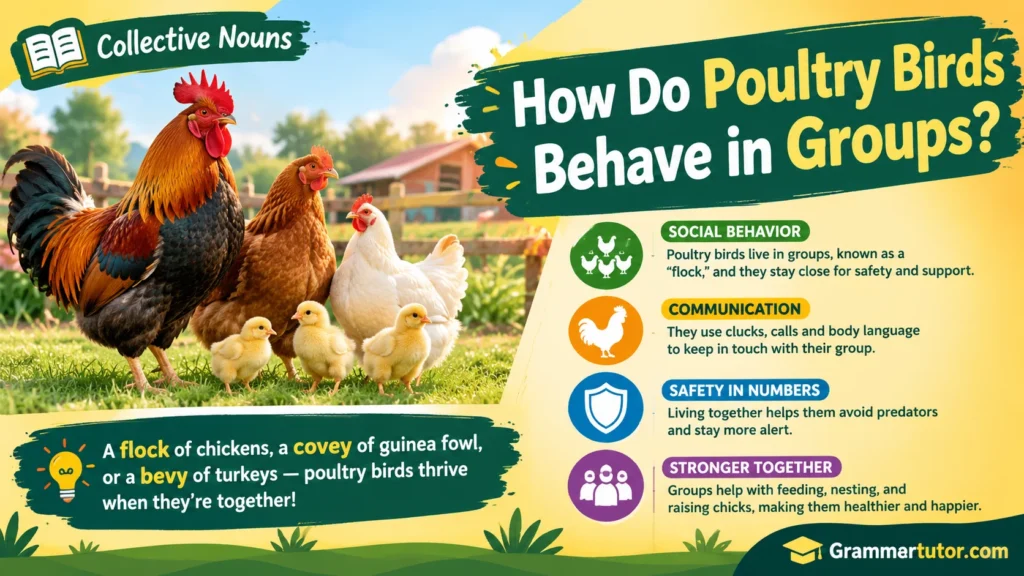
Poultry birds often show strong social behavior. Chickens, ducks, geese, and turkeys may spend much of their time near other members of their group.
A flock can provide social interaction and can also help birds respond to possible danger. Birds may feed, rest, move, and search for suitable shelter together.
Different poultry species behave differently. Chickens often establish a social order within their flock, while geese may remain closely associated with other geese around feeding and nesting areas. Ducks commonly gather around water, and turkeys can form noticeable groups while searching for food.
Understanding these behaviors also helps explain why collective nouns are useful. Words such as flock, brood, and gaggle don’t just identify numbers; they can give additional context about the birds being discussed.
Interesting Facts About Poultry
Poultry includes several domesticated bird species, and each has its own physical and behavioral characteristics. Chickens are among the most widely raised poultry birds and are kept mainly for eggs and meat. Depending on breed and living conditions, chickens can live for several years, although commercial production systems often involve much shorter productive periods.
Poultry birds also have interesting physical adaptations. Chickens have strong scratching feet that help them search through soil and litter for food. Ducks have webbed feet that make them effective swimmers, while geese have strong bodies and feet suited to both walking and swimming. These differences show how varied the poultry group can be.
Diet also varies between poultry species. Chickens commonly eat grains, seeds, insects, vegetables, and other suitable foods. Ducks and geese may feed on plants, seeds, small invertebrates, and aquatic foods. Turkeys naturally search for seeds, fruits, insects, and other food sources.
Poultry also plays an important role in human agriculture. Chickens provide eggs and meat, ducks and geese are raised for meat and eggs, and turkeys are widely kept for meat. Because these birds are closely connected to farming, collective nouns such as flock and brood appear frequently in agricultural descriptions.
Difference Between Poultry, Flock, Brood, and Clutch
These words can sometimes be confusing because they all appear in discussions about domestic birds. However, they don’t mean exactly the same thing.
| Word | Meaning |
| Poultry | Domesticated birds raised or kept by people |
| Flock | A group of birds |
| Brood | A mother bird with her young |
| Clutch | A group or set of eggs |
| Gaggle | A group of geese, especially on land |
| Covey | A small group of certain game birds, such as quail |
The key point is that poultry is not itself a collective noun. It is a general category name for domesticated birds. Flock is the most useful general collective noun when referring to a group of poultry.
READ MORE: Collective Noun for Magpies: A Complete Guide with Examples
Conclusion
The collective noun for poultry depends on the type of birds and the situation being described. Flock is a common general term for a group of poultry, while words such as brood, clutch, and gaggle can describe specific birds or groups in particular contexts. Using the right term makes your English more natural, clear, and precise.
FAQs
Q1. What is the collective noun for poultry?
The most common collective noun for poultry is flock. You can say “a flock of poultry” when referring to a group of domestic birds generally.
Q2. What is a group of poultry called?
A group of poultry is commonly called a flock. The word works well for chickens, ducks, turkeys, and other domestic birds.
Q3. Is “flock of poultry” correct?
Yes, flock of poultry is a natural and commonly understood expression for a group of domesticated birds.
Q4. What is the collective noun for chickens?
Flock is a common collective noun for chickens. For example, “A flock of chickens was moving around the farm.”
Q5. What is the collective noun for ducks?
A flock can be used for ducks, especially when referring to them generally. Gaggle is also traditionally associated with geese, particularly when they are on the ground.
Q6. What is the collective noun for turkeys?
A flock of turkeys is a common expression. The word flock is useful when referring to several turkeys together.
Q7. Can “brood” be used for poultry?
Yes, broods can describe a group of young birds, especially when they are being cared for by a mother bird.
Q8. Can “clutch” be used as a collective noun for poultry?
Yes. Clutch is commonly used for a group of eggs produced or incubated together. It can also refer to the young birds that hatch from those eggs in some contexts.
Q9. Why are collective nouns useful for poultry?
Collective nouns make writing more natural and precise. Instead of repeatedly saying “a group of poultry,” you can use a suitable term such as flock.
Q10. Which collective noun should I use for poultry?
Use flock when you need a general term for poultry. For a more specific meaning, choose another collective noun according to the type, age, or situation of the birds.