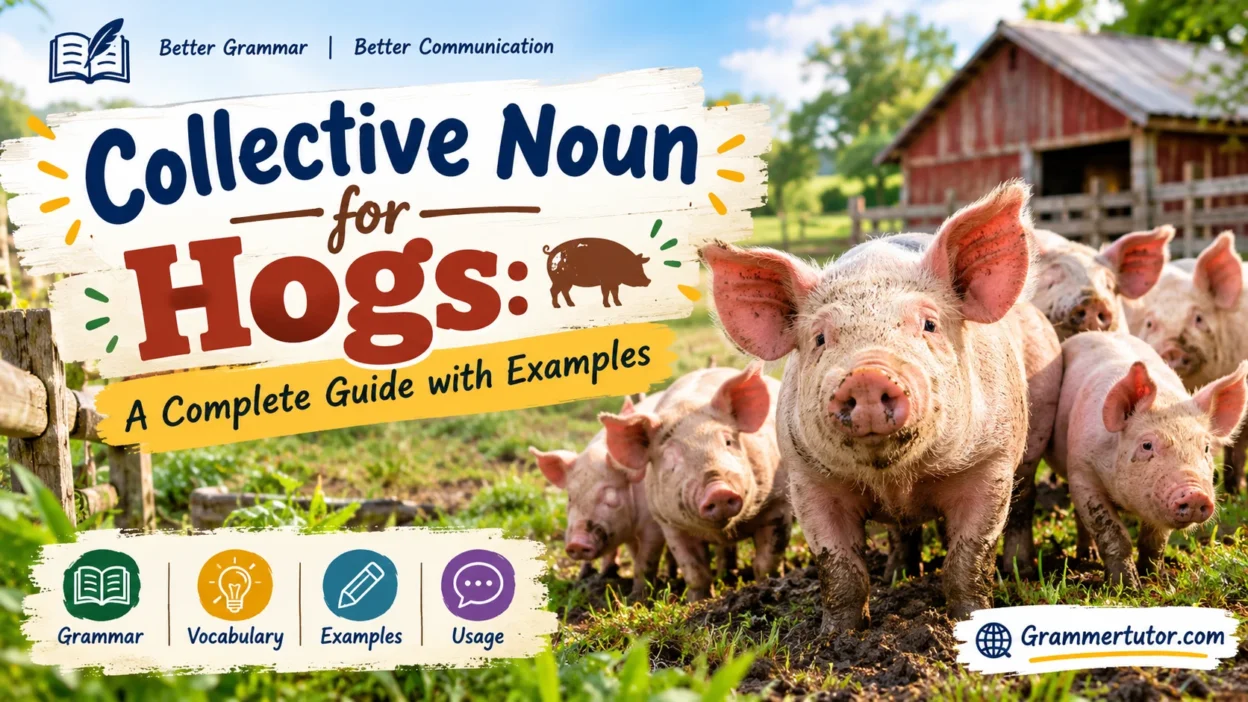
The collective noun for hogs helps you describe these social animals when they gather together and live together. Hogs are intelligent and adaptable animals, so English uses several terms to describe their group based on their behavior, movement, and way of living.
The most commonly used term is sounder, especially for wild hogs and wild pigs. A sounder of hogs describes a group that may travel, forage, and stay together. Depending on the situation and type of hog, words such as herd, drove, and group may also be used when the animals are being described.
These terms can make your English more precise while helping you understand hog behavior. Hogs spend considerable time searching for food, communicating, resting, and interacting with other members of their group.
Why Collective Nouns Are Used for Hogs
Hogs often gather in groups for feeding, resting, traveling, and protection. Wild hogs, in particular, may form social groups that move through forests, grasslands, and other habitats while searching for food.
Because their group behavior is easy to observe, English has developed several terms for describing groups of hogs. The word sounder is especially associated with wild hogs or wild pigs, while herd is a more general term that can be used for groups of hoofed animals.
Using the appropriate collective noun gives a sentence more detail. For example, a sounder of hogs moved through the forest creates a more specific image than simply saying some hogs were in the forest.
Collective Nouns for Hogs
| Collective Noun | Used For | Simple Example |
| Sounder | A group of wild hogs | A sounder of hogs crossed the trail. |
| Herd | A group of hogs | A herd of hogs gathered near the field. |
| Drove | A group of pigs or hogs | A drove of hogs moved toward the barn. |
| Group | A general collection of hogs | A group of hogs searched for food. |
Sounder of Hogs
A sounder is one of the most distinctive collective nouns associated with hogs. It commonly describes a social group of wild hogs or wild pigs traveling and feeding together.
A sounder may include females and young hogs. Wild hogs can travel through different habitats while searching for roots, plants, insects, and other sources of food.
Examples of “Sounder of Hogs”
- A sounder of hogs crossed the forest trail.
- We spotted a sounder of hogs near the woodland.
- The sounder of hogs searched for food.
- A large sounder of hogs moved through the grass.
- The sound of hogs disappeared into the trees.
- Rangers observed a sounder of hogs from a distance.
- A sounder of hogs gathered near the water.
- The sounder of hogs traveled through the forest.
- A sounder of hogs disturbed the soil while feeding.
- The sounder of hogs moved away before sunrise.
Herd of Hogs
A herd is a general collective noun that can describe a group of hogs. It is especially useful when you’re talking about domestic animals or when you don’t need the more specific term sounder.
The word herd emphasizes the fact that several animals are living or moving together. It can be used in everyday conversation and general writing.
Examples of “Herd of Hogs”
- A herd of hogs gathered in the field.
- The herd of hogs moved toward the shelter.
- A herd of hogs searched for food.
- We saw a herd of hogs near the farm.
- The farmer watched the herd of hogs.
- A large herd of hogs rested in the shade.
- The herd of hogs walked across the pasture.
- A herd of hogs gathered near the feeding area.
- The herd of hogs returned to the pen.
- A herd of hogs moved slowly across the field.
Drove of Hogs
A drove is another traditional collective noun that can be used for pigs or hogs. The word often describes a group of animals being driven or moved together, particularly in farming or historical contexts.
While sounder is more distinctive for wild hogs, drove can be useful when describing a group of domesticated pigs or hogs being moved from one place to another.
Examples of “Drove of Hogs”
- A drove of hogs moved toward the barn.
- The farmer guided a drove of hogs across the field.
- A drove of hogs walked along the farm road.
- The drove of hogs entered the pasture.
- A farmer moved the drove of hogs before sunset.
- The drove of hogs gathered near the gate.
- A drove of hogs traveled toward the feeding area.
- The workers guided the drove of hogs carefully.
- The drove of hogs returned to the enclosure.
- A drove of hogs crossed the farmyard.
Group of Hogs
A group of hogs is a simple and flexible expression. Unlike sounder, herd, or drove, the word group doesn’t have a special animal-related meaning. However, it’s completely natural when you simply want to describe several hogs together.
This expression works well in everyday English because the meaning is immediately clear.
Examples of “Group of Hogs”
- A group of hogs gathered near the trees.
- We saw a group of hogs in the field.
- The group of hogs searched for food.
- A group of hogs crossed the road.
- The farmer watched a group of hogs.
- The group of hogs rested in the shade.
- A group of hogs moved toward the water.
- The group of hogs entered the enclosure.
- A group of hogs walked across the pasture.
- The group of hogs disappeared into the forest.
Hogs and Their Social Behavior
Hogs are intelligent and adaptable mammals that can live in a variety of environments. Wild hogs often form social groups, particularly among females and their young. These groups can travel together while looking for food and suitable places to rest.
Hogs spend a large part of their active time foraging. They use their strong snouts to investigate the ground and search for roots, bulbs, insects, small animals, fruits, and other edible materials. Their ability to locate food allows them to adapt to many different habitats.
Social communication is also important. Hogs can use sounds, body movements, scent, and physical contact to interact with one another. Mothers and young hogs maintain close relationships, and young animals often remain near adults while developing.
Wild hogs can also be highly adaptable. They may live in forests, wetlands, grasslands, agricultural areas, and other environments where food and shelter are available. Their ability to find different food sources contributes to their success in diverse habitats.
Examples of Hog Behavior
- Hogs often search for food together.
- Wild hogs can form social groups.
- Young hogs often stay close to adults.
- Hogs use their snouts while foraging.
- A sounder may travel together.
- Hogs communicate through different sounds.
- Hogs can adapt to many environments.
- Groups may gather near food and water.
- Hogs can rest together during the day.
- Wild hogs may travel through forests and grasslands.
Interesting Facts About Hogs
Hogs, including domestic pigs and their wild relatives, are fascinating mammals with several unusual biological characteristics. They can live for many years when provided with appropriate care, although lifespan varies according to species, breed, environment, health, and living conditions. Domestic pigs may live considerably longer under managed conditions than animals exposed to disease, predators, harsh environments, or other risks.
One of their most distinctive physiological features is their snout. A hog’s snout is highly sensitive and powerful, allowing it to investigate soil, locate food, and manipulate objects. Wild hogs can use their snouts to root through the ground in search of roots, tubers, insects, and other food. Their strong bodies and sturdy legs also allow them to travel through rough terrain.
Hogs are omnivores, which means they can eat both plant and animal material. Their diet may include roots, fruits, seeds, grains, grasses, insects, worms, and other small organisms. Domestic hogs are usually given carefully balanced feed, while wild hogs take advantage of whatever food sources are available in their environment.
Their digestive system allows them to process a broad variety of foods. This dietary flexibility is one reason hogs can survive in many different habitats. Wild hogs may change their feeding behavior according to the season and availability of food.
Hogs are also known for their intelligence. Domestic pigs can learn tasks, recognize individuals, and interact with their surroundings in complex ways. Their strong memory and problem-solving abilities make them among the more behaviorally sophisticated domesticated mammals.
Examples of Hog Facts
- Hogs are omnivores.
- Hogs have highly sensitive snouts.
- Wild hogs often form social groups.
- Hogs can forage for roots and insects.
- Hogs can adapt to different habitats.
- Young hogs often stay near adults.
- Hogs communicate through sounds and body language.
- Domestic pigs can learn and solve simple problems.
- Hogs can eat both plant and animal foods.
- Wild hogs can travel considerable distances while searching for food.
Conclusion
Understanding the collective noun for hogs makes it easier to describe these animals clearly and naturally. Sounder is the most specific term for a group of wild hogs, while herd, drove, and group can also fit different contexts. Knowing these terms helps you choose the right expression when discussing hogs and their social behavior.
FAQs
Q1. What is the collective noun for hogs?
The most commonly used collective noun for hogs is sounder, especially when referring to wild hogs.
Q2. What is a sounder of hogs?
A sounder of hogs is a group of hogs, particularly wild hogs, that stay, travel, and forage together.
Q3. Can you say “a herd of hogs”?
Yes. Herd can describe a group of hogs, although sounder is more specific for wild hogs.
Q4. Is “drove” a collective noun for hogs?
Yes. Drove can refer to a group of pigs or hogs and is an accepted collective term.
Q5. What is the difference between a sounder and a herd?
A sounder commonly refers to a group of wild hogs, while herd is a broader term for a group of animals living or moving together.
Q6. What do wild hogs do as a group?
Wild hogs may travel, forage, search for food, rest, and interact with other members of their group.
Q7. Are hogs social animals?
Yes. Hogs are social animals that often stay together and communicate or interact with other hogs.
Q8. Can “group of hogs” be used correctly?
Yes. Group of hogs is a simple and grammatically correct phrase, although sounder provides a more specific collective term.
Q9. Why are collective nouns useful for hogs?
Collective nouns make descriptions more precise and can provide information about how hogs gather, move, or live together.
Q10. Which term should I use for wild hogs?
Sounder is generally the best choice when you specifically mean a group of wild hogs.