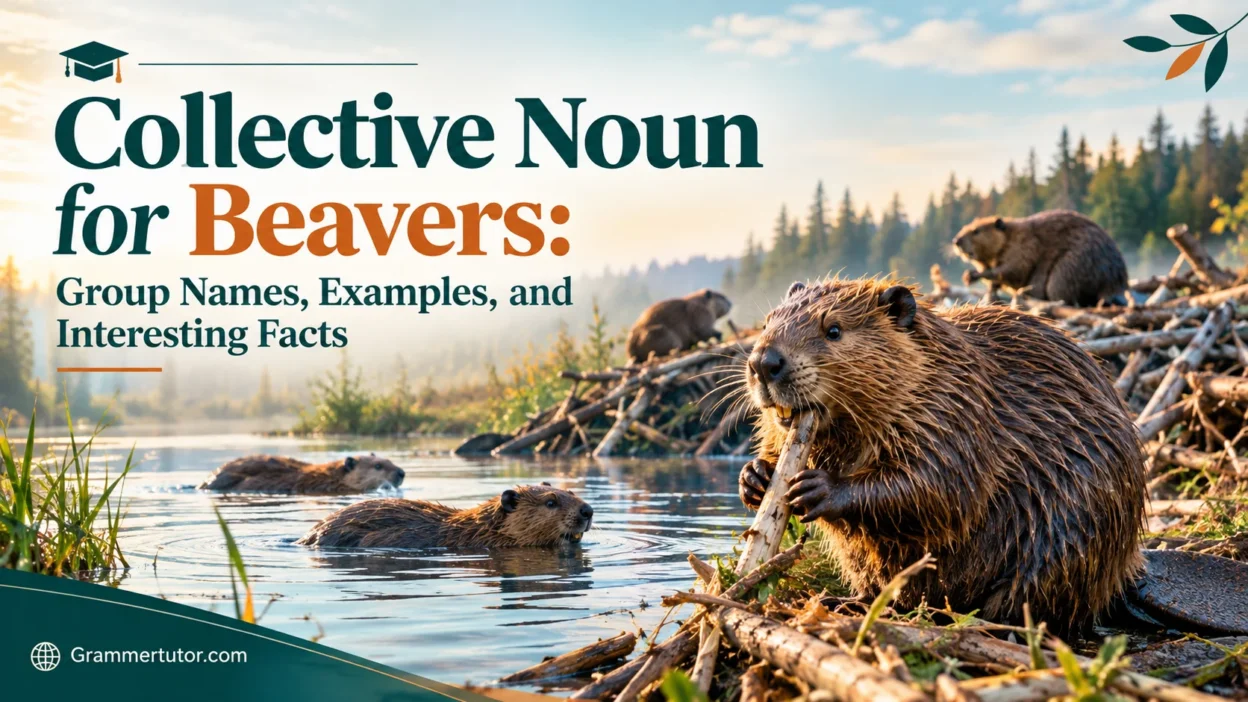
The Collective Noun for Beavers is a useful English term when you want to describe several beavers living and working together as one group. A collective noun is a word that represents multiple animals, people, or things together. Just as English uses a herd for deer, a flock for birds, and a colony for ants, it uses specific expressions to describe groups of beavers.
For beavers, colony is one of the most useful terms because these hardworking aquatic mammals often live together in family groups. You may also see a family of beavers or a group of beavers in different situations. These expressions are easy to understand and work well when a traditional collective noun isn’t necessary. Talking about beavers this way also helps connect English vocabulary with their fascinating social behavior.
From an English-learning perspective, connecting a word with real animal behavior makes it easier to remember. In wildlife writing, terms such as colony, family groups, and group of beavers can make descriptions sound more natural and interesting. Learning these terms gives you a simple way to describe how several beavers interact and live together while using clear and familiar English.
Why Collective Nouns Are Used for Beavers
Beavers are social animals that commonly live together in family groups. They cooperate in activities such as building lodges, maintaining dams, gathering food, and protecting their living area. Because several beavers often share the same habitat and work together, group expressions are useful when describing them.
The word colony is particularly helpful when referring to a group of beavers living together in the same area. A family of beavers can be used when the focus is specifically on related animals.
These expressions make descriptions clearer because they allow us to talk about several beavers without repeatedly using the word beavers.
Collective Nouns for Beavers
| Collective Noun | Used For | Simple Example |
| Colony | Beavers living together in an area | A colony of beavers built a dam. |
| Family | Related beavers living together | A family of beavers lived near the pond. |
| Group | A general gathering of beavers | A group of beavers entered the water. |
| Lodge Group | Beavers sharing a lodge | A lodge group of beavers rested nearby. |
| Community | Beavers living and working together | A community of beavers changed the stream. |
Colony is a particularly useful term when discussing beavers that live together and modify their shared environment. In simple everyday English, a group of beavers is also perfectly understandable.
Colony of Beavers
A colony of beavers refers to beavers living together in the same general area. Beavers can cooperate in maintaining their habitat, building structures, and raising young.
The word colony is useful in wildlife writing because it emphasizes the idea of several beavers sharing a territory and living as a social unit.
Examples of “Colony of Beavers”
- A colony of beavers built a large dam.
- We discovered a colony of beavers near the river.
- The colony of beavers lived beside the pond.
- A colony of beavers changed the flow of the stream.
- The researchers observed a colony of beavers.
- A colony of beavers worked around the wetland.
- The colony of beavers created a safe habitat.
- We watched a colony of beavers swimming together.
- A colony of beavers settled near the woodland.
- The colony of beavers maintained its dam throughout the season.
Family of Beavers
A family of beavers is a natural expression when several related beavers are living together. Beaver family groups can include adult beavers and their young.
This expression is especially appropriate when discussing parenting, raising kits, or the relationships between individual members of a beaver family.
Examples of “Family of Beavers”
- A family of beavers lived beside the pond.
- We saw a family of beavers near the riverbank.
- The family of beavers entered the water together.
- A family of beavers built a shelter near the stream.
- The family of beavers cared for their young.
- We watched a family of beavers gathering food.
- A family of beavers rested inside the lodge.
- The family of beavers swam across the pond.
- A family of beavers appeared near the dam.
- The family of beavers returned to its lodge before dark.
Group of Beavers
A group of beavers is a simple and flexible expression for several beavers together. Unlike a colony, it does not suggest a particular social structure or living arrangement.
You can use group when you are simply describing several beavers that you see swimming, feeding, working, or moving together.
Examples of “Group of Beavers”
- A group of beavers swam across the pond.
- We noticed a group of beavers near the river.
- A group of beavers gathered beside the dam.
- The group of beavers entered the water.
- A group of beavers was feeding near the bank.
- We watched a group of beavers building a structure.
- The group of beavers disappeared beneath the water.
- A group of beavers moved toward the lodge.
- The photographer captured a group of beavers at sunset.
- A group of beavers rested near the stream.
Lodge Group of Beavers
A lodge group of beavers can be used descriptively for beavers that share or occupy the same lodge. It focuses more on their living arrangement than on a traditional collective-noun form.
Beaver lodges provide shelter and can serve as important places for family groups. Therefore, this expression can be useful when explaining where a particular group of beavers lives.
Examples of “Lodge Group of Beavers”
- A lodge group of beavers rested inside the shelter.
- The lodge group of beavers remained close to the pond.
- We observed a lodge group of beavers near the dam.
- A lodge group of beavers returned before sunset.
- The lodge group of beavers stayed inside during the cold weather.
- A lodge group of beavers gathered near the entrance.
- The lodge group of beavers moved into the water.
- A lodge group of beavers shared the protected shelter.
- We watched the lodge group of beavers from a distance.
- The lodge group of beavers disappeared into the lodge.
Community of Beavers
A community of beavers is a broad descriptive expression for beavers living and interacting within the same area. It can be useful when discussing the combined effects of beavers on their surroundings.
Beavers can have a major influence on wetlands because their dams and ponds create or change habitats used by many other organisms.
Examples of “Community of Beavers”
- A community of beavers transformed the wetland.
- We studied a community of beavers near the river.
- The community of beavers created several ponds.
- A community of beavers lived throughout the wetland.
- The researchers monitored the community of beavers.
- A community of beavers maintained several dams.
- The community of beavers changed the local water flow.
- We observed a community of beavers during the survey.
- A community of beavers settled along the stream.
- The community of beavers influenced the surrounding habitat.
Types of Beavers and Their Characteristics
Beavers are large semi-aquatic rodents belonging to the family Castoridae. The two living species are the North American beaver and the Eurasian beaver. Although they belong to the same family, they have differences in appearance, distribution, and certain physical characteristics.
Beavers are famous for their strong front teeth, broad tails, webbed hind feet, and dense waterproof fur. Their large incisors continue growing throughout their lives, which allows them to cut through wood and other plant material.
Their ability to construct dams is one of their most remarkable behaviors. By changing water flow, beavers can create ponds and wetlands that provide habitat for numerous plants and animals.
Examples of Beaver Characteristics
- Beavers are semi-aquatic mammals.
- Beavers are rodents.
- Their front teeth continue growing.
- Beavers have broad, flat tails.
- Their hind feet are webbed.
- Beavers have dense waterproof fur.
- They can build dams from natural materials.
- Beavers can create ponds and wetlands.
- They eat a variety of plant materials.
- Beavers spend a great deal of time near water.
Interesting Facts About Beavers
Beavers are remarkable animals with a number of adaptations that help them survive in aquatic environments. Their lifespan can vary depending on habitat, predators, disease, food availability, and environmental conditions. In suitable conditions, beavers can live for many years, while threats in the wild can significantly affect survival.
One of their most noticeable physiological features is their large orange-colored incisors. These teeth continue growing throughout a beaver’s life and are naturally worn down as the animal gnaws on wood and vegetation. Their broad, flat tail also serves several purposes, including helping with swimming, storing some body fat, and communicating danger by creating a loud slap against the surface of the water.
Beavers are mainly herbivores. Their diet can include tree bark, leaves, twigs, aquatic plants, grasses, and other vegetation. They are especially well known for feeding on woody plants such as willow, aspen, birch, and similar species where available.
Perhaps the most fascinating thing about beavers is their ability to reshape their environment. By constructing dams, they slow or redirect water and can create ponds and wetland habitats. These changes can provide homes and resources for fish, amphibians, birds, insects, and many types of plants.
READ MORE: Collective Noun for Buffaloes: A Complete Guide with Examples
Conclusion
The collective noun for beavers is commonly colony, especially when describing beavers living together in family groups. You can also use family of beavers or group of beavers when a simple and clear expression fits the context. Choosing the right term makes your English more natural and helps you describe these fascinating aquatic mammals accurately.
FAQs
Q1. What is the collective noun for beavers?
The most common collective noun for beavers is colony.
Q2. Can I say “a colony of beavers”?
Yes. A colony of beavers is a natural expression for a group of beavers living together.
Q3. Is “family of beavers” correct?
Yes. Family of beavers is appropriate when you’re specifically referring to a family group.
Q4. Can I use “group of beavers”?
Yes. Group of beavers is completely understandable and works when you don’t need a specific collective noun.
Q5. Why are beavers called a colony?
The term colony relates to the way beavers can live together in family-based groups and share an environment.
Q6. Is “herd of beavers” correct?
Herd isn’t the usual collective noun for beavers. Colony is a better choice in most contexts.
Q7. What is the plural of beaver?
The plural of beaver is beavers.
Q8. What sentence uses the collective noun for beavers?
A simple example is: “A colony of beavers built a dam near the river.”
Q9. Are beavers social animals?
Yes. Beavers can live in family groups and cooperate in activities such as building and maintaining their habitat.
Q10. Which term should I use in formal writing?
For formal or educational writing, colony of beavers is a good choice when you’re describing a group collectively.