
The Collective Noun for Swine helps English learners describe groups of pigs clearly and choose the right term for domestic or wild swine correctly. When learning English vocabulary, it is interesting to explore the language used to describe animals. A collective noun is a word that refers to several animals, people, or objects as one group. For swine, the most common collective nouns are herd and sounder.
A herd of swine is a general expression for a group of pigs, while a sounder of swine is commonly used for a group of wild pigs, especially wild boars. For anyone learning English, understanding the difference between domestic pigs and wild swine makes it easier to choose the right collective noun. Other expressions, such as group and drive, may also be used depending on the situation.
When improving English, writing about animals, or studying collective nouns, these expressions can help create sentences that are clearer and more natural. From my experience with English vocabulary, exploring these terms through regular writing makes their usage easier to remember. Knowing when to use a herd, sounder, group, or drove gives learners a practical way to describe swine accurately.
Why Collective Nouns Are Used for Swine
Swine are mammals that include domestic pigs and wild members of the pig family. These animals may live, feed, travel, or rest together in groups. Collective nouns help us describe their social behavior without mentioning every animal separately.
The word herd is commonly used for a group of domestic pigs or swine in general. For wild pigs, the term sounder is particularly useful because these animals often form social groups consisting of females and their young.
The word drove is another traditional term that can describe a group of pigs, especially when they are being moved together. Meanwhile, group is a simple expression that can be used in almost any situation.
These collective nouns make it easier to describe swine in farming, wildlife observation, and everyday conversation.
Collective Nouns for Swine
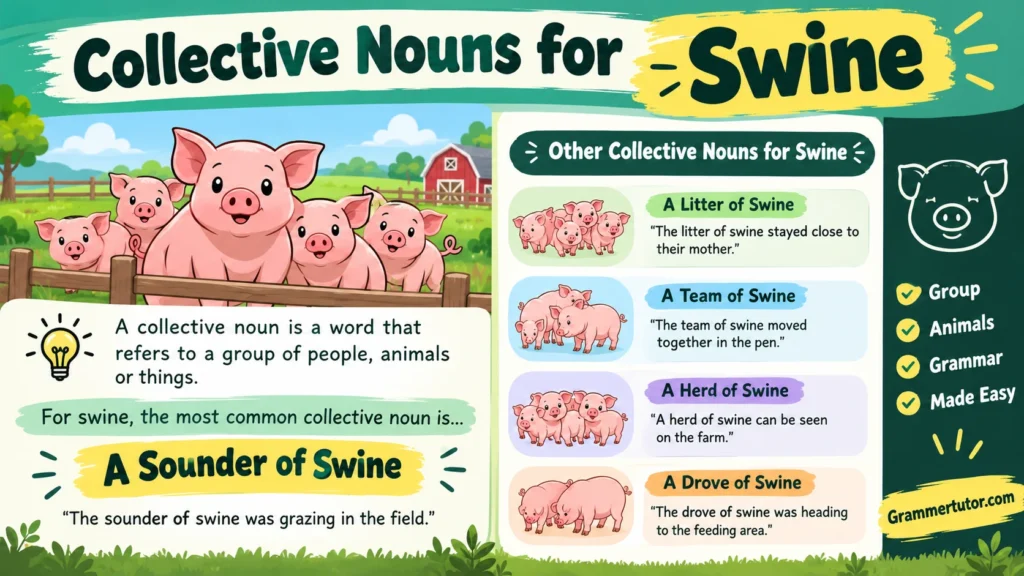
| Collective Noun | Used For | Simple Example |
| Herd | A general group of swine | A herd of swine rested in the field. |
| Sounder | A group of wild pigs | A sounder of wild pigs entered the forest. |
| Drove | Pigs being moved together | A drove of pigs walked along the road. |
| Group | A general gathering of swine | A group of swine gathered near the farm. |
Herd of Swine
A herd of swine is one of the most familiar expressions used to describe a group of pigs. It is especially common when talking about domestic pigs living together on a farm.
The word herd is simple and widely understood. It can describe pigs feeding, resting, walking, or gathering in the same area.
Examples of “Herd of Swine”
- A herd of swine rested in the field.
- The farmer fed a herd of swine in the morning.
- A herd of swine walked toward the barn.
- We saw a herd of swine near the farm.
- The herd of swine gathered around the feeding area.
- A large herd of swine was kept on the farm.
- The farmer watched the herd of swine carefully.
- A herd of swine moved into the shaded area.
- The herd of swine searched for food.
- A herd of swine rested under the trees.
Sounder of Swine
A sounder of swine is a collective noun commonly used for a group of wild pigs, particularly wild boars. A sounder often includes related females and their young, although its size and composition can vary.
This term is especially useful when describing wild pigs living in forests, grasslands, or other natural habitats. Unlike herd, which is a general term, sounder is strongly associated with wild pigs.
Examples of “Sounder of Swine”
- A sounder of swine moved through the forest.
- We spotted a sounder of wild pigs near the trees.
- A sounder of swine searched for food in the woodland.
- The sounder of swine crossed the muddy path.
- A sounder of wild pigs rested near the bushes.
- The researchers observed a sounder of swine from a distance.
- A sounder of swine entered the grassy clearing.
- The sounder of swine moved quietly through the forest.
- A sounder of wild pigs gathered near the stream.
- The sounder of swine disappeared into the thick vegetation.
Drove of Swine
A drove of swine is a traditional expression used for a group of pigs, particularly when they are being driven or moved together.
The word drove is useful when describing pigs traveling along a path or being guided from one place to another. It is less common than heard in everyday conversation but remains a recognizable animal-group expression.
Examples of “Drove of Swine”
- A drove of swine walked along the country road.
- The farmer guided a drove of pigs toward the barn.
- A drove of swine moved across the field.
- We watched a herd of pigs near the village.
- The drive of swine followed the farmer.
- A drove of swine crossed the farmyard.
- The farmer moved the drove of pigs into another pen.
- A drove of swine traveled along the muddy path.
- The drove of pigs reached the feeding area.
- A drove of swine moved slowly toward the farm.
Group of Swine
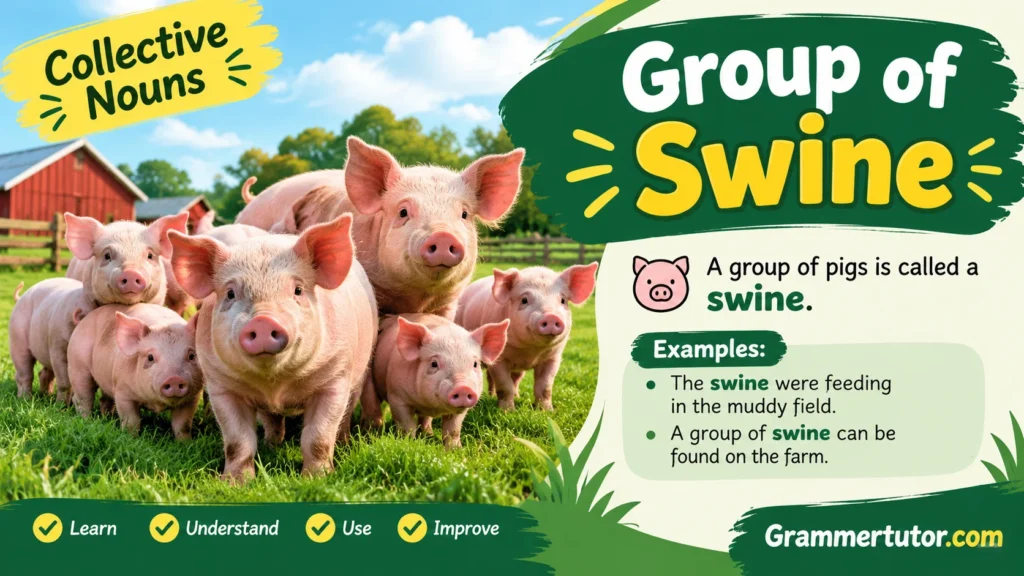
A group of swine is a general expression that refers to several pigs or wild swine together. It is not a specialized traditional collective noun, but it is grammatically correct and easy to understand.
You can use groups when you do not need to specify whether the animals are domestic pigs, wild boars, or another type of swine.
Examples of “Group of Swine”
- A group of swine gathered near the fence.
- We saw a group of pigs in the field.
- A group of swine rested beside the barn.
- The group of swine moved toward the trees.
- The farmer watched a group of pigs feeding.
- A group of swine walked across the farmyard.
- We noticed a group of wild pigs near the forest.
- The group of swine searched for food.
- A group of pigs gathered near the water.
- The group of swine returned to the shelter.
Types of Swine and Their Characteristics
Swine belong to the family Suidae, which includes domestic pigs, wild boars, and several other species of pig-like mammals. Domestic pigs are commonly raised on farms for food, while wild pigs live in a variety of natural environments.
Domestic pigs come in different breeds and can vary in size, color, body shape, and other physical characteristics. Wild pigs are often more adapted to searching for food in forests, grasslands, and wooded areas. Some wild species have strong bodies, powerful snouts, and tusks that help them defend themselves and search for food.
Swine are intelligent and social animals. They communicate through sounds, body movements, and other behaviors. Their social habits are one reason why collective nouns such as herd and sounder are useful when describing them.
Examples of Swine Characteristics
- Swine belong to the family Suidae.
- Domestic pigs are commonly raised on farms.
- Wild pigs can live in forests and grasslands.
- Pigs have strong snouts.
- Some wild pigs develop prominent tusks.
- Swine are mammals.
- Pigs are intelligent animals.
- Many pigs are social and live in groups.
- Swine can use their snouts to search for food.
- Domestic pigs come in different breeds.
Interesting Facts About Swine
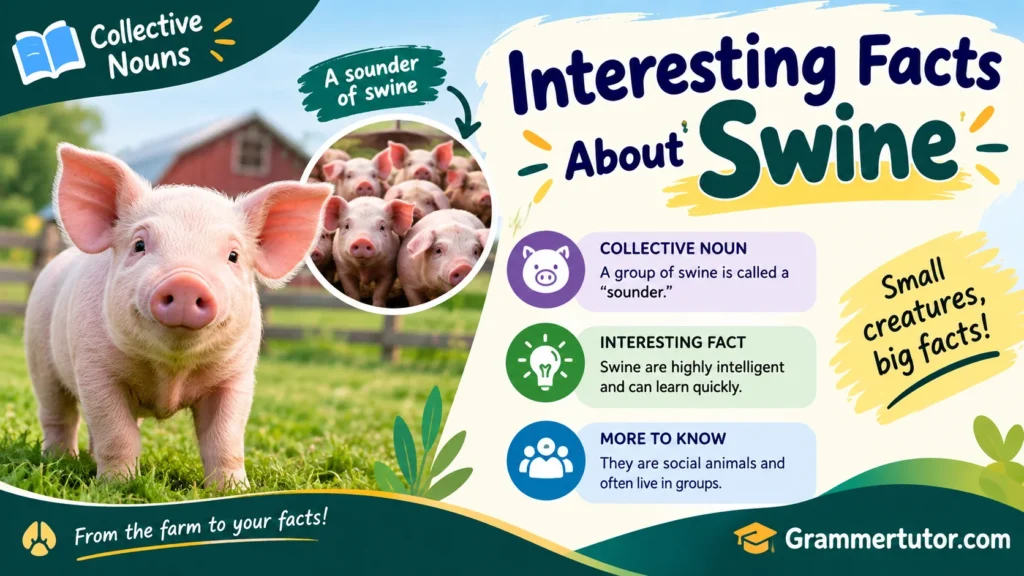
Swine are fascinating mammals with several unusual biological features. Their lifespan depends on their species, living conditions, diet, and health. Domestic pigs can live for many years when properly cared for, while wild pigs often face additional challenges from predators, disease, food shortages, and environmental conditions. Their longevity therefore varies considerably between domestic and wild populations.
One distinctive feature of pigs is their snout, which is highly useful for exploring their surroundings. Pigs use their strong noses to smell, investigate objects, and search for food in the soil. Wild pigs may use their snouts to dig for roots, bulbs, insects, and other food sources. Some wild pigs also have tusks that can help with defense and competition.
Swine are omnivores, meaning they can eat both plant and animal matter. Their diets may include roots, fruits, seeds, leaves, insects, and other available foods. Domestic pigs are often fed carefully prepared diets, while wild pigs obtain food from their natural environments. Their flexible eating habits help them survive in different habitats.
Another interesting feature of swine is their social behavior. Domestic pigs may form groups, while many wild pigs live in sounders. These groups can help animals remain close to one another and may provide advantages when searching for food or caring for young. Understanding these behaviors makes the collective nouns herd and sounder more meaningful.
READ MORE: Collective Noun for Cockroaches: A Complete Guide with Examples
Conclusion
The collective noun for swine can vary depending on the type of pigs being described. Herd is a common term for a group of swine, while sounder is often used for wild pigs, especially wild boars. Group and drive can also describe pigs in suitable situations. Learning these terms helps English learners write clearer and more natural sentences when talking about swine.
FAQs
Q1. What is the collective noun for swine?
The most common collective nouns for swine are herd and sounder. The correct choice depends on the type of swine and the context.
Q2. What is a group of swine called?
A group of swine can be called a herd. For example, “A herd of swine was moving across the field.”
Q3. What is a swine sounder of swine?
A sounder is a collective noun commonly used for a group of wild pigs, particularly wild boars.
Q4. Is herd a collective noun for pigs?
Yes. Herd is a common collective noun used for a group of pigs or swine.
Q5. What is the difference between a herd and a swine sounder?
A herd is a general term for a group of swine, while sounder is more specifically associated with groups of wild pigs.
Q6. Can I use “group” for swine?
Yes. Group is a general expression and can be used when you do not need a more specific collective noun.
Q7. Can “drove” be used for swine?
Yes. Drove can be used as a collective term for pigs or swine, depending on the situation.
Q8. What is the collective noun for wild pigs?
Sounder is a commonly used collective noun for a group of wild pigs, including wild boars.
Q9. What is the collective noun for domestic pigs?
Herd is a common choice for domestic pigs. The general term group can also be used.
Q10. Why are collective nouns for swine important?
Collective nouns make sentences more precise and natural. Knowing terms such as herd, sounder, and drove helps English learners describe groups of swine accurately.