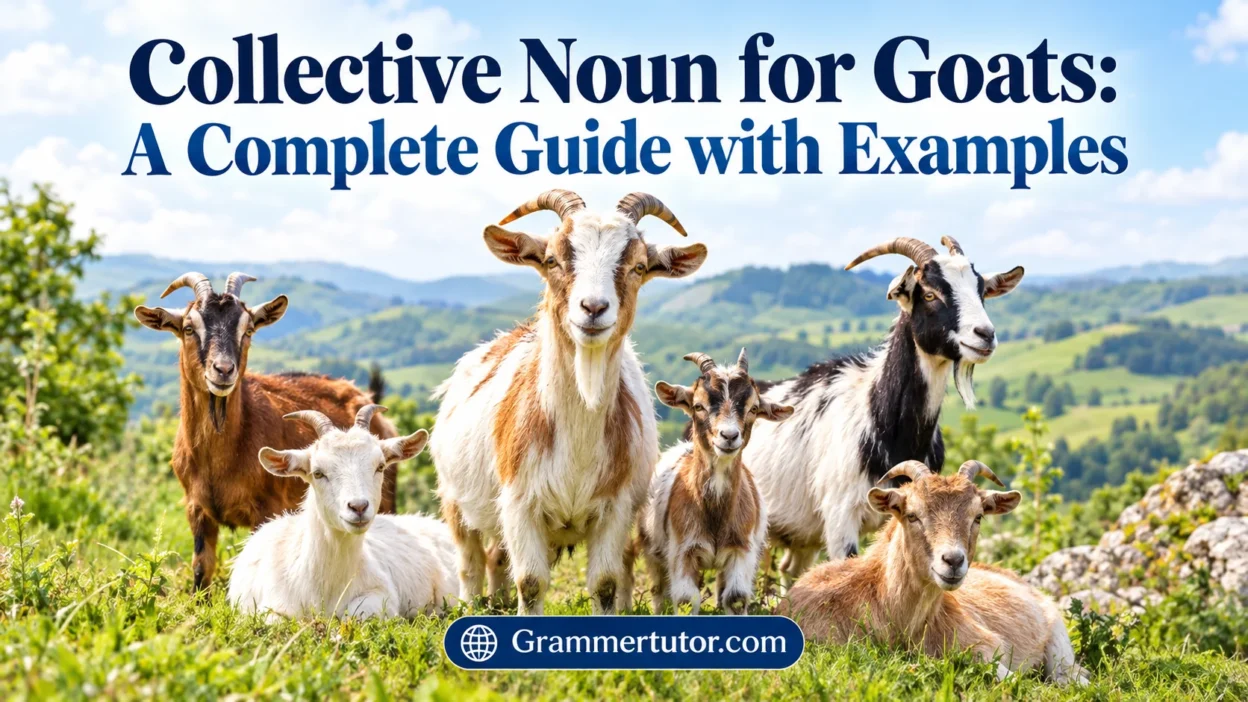
A collective noun for goats is a word used to describe several goats as one group, making English more natural and specific when describing them.The most common expression is herd, as in a herd of goats. Instead of repeatedly saying that several goats are together, you can use the herd to describe them clearly.
Goats are social, adaptable animals that often live and move together. They may be grazing, walking, or resting in the same area. They communicate through sounds and body movements, and they can establish social relationships while showing strong group behavior.
Other expressions, including trip, tribe, and flock, may appear in different contexts, although they are not equally common. Learning these terms gives you useful English vocabulary and helps you describe the natural behavior of goats more clearly. In everyday English, herd remains the clearest and most familiar choice, while the other terms can provide variety when the situation calls for a different specific expression.
Why Collective Nouns Are Used for Goats
Goats are naturally social animals, and they commonly gather together while feeding, resting, traveling, or seeking shelter. A group can contain goats of different ages and sexes, and individual animals may develop social relationships within the group.
Because goats often stay together, herd is the most familiar collective noun for them. Other expressions can provide a more colorful description or may be used in particular traditional or literary contexts.
These terms make sentences more concise and help readers form a clearer picture of how goats are behaving. For example, a herd of goats climbing the hillside immediately gives you an image of several animals moving together across uneven ground.
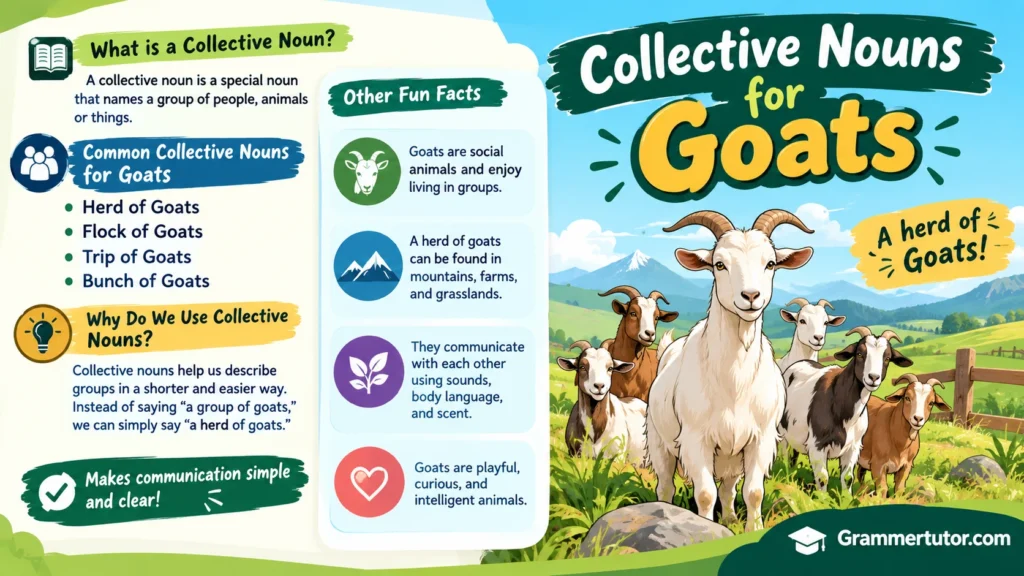
Collective Nouns for Goats
| Collective Noun | Used For | Simple Example |
| Herd | A general group of goats | A herd of goats grazed on the hill. |
| Trip | A group of goats | A trip of goats moved across the field. |
| Tribe | A group of goats | A tribe of goats gathered near the rocks. |
| Flock | A group of goats in some usage | A flock of goats moved toward the barn. |
| Group | A general collection of goats | A group of goats stood by the fence. |
| Band | Goats moving or staying together | A band of goats crossed the path. |
| Kids | Young goats as a group | The kids played near the shelter. |
Herd of Goats
A herd is the most common and practical collective noun for goats. It can describe goats that are grazing, walking, resting, or traveling together.
The phrase a herd of goats works well in everyday English, farming discussions, wildlife writing, and general descriptions. When you aren’t sure which collective noun to choose, herd is the clearest option.
Examples of “Herd of Goats”
- A herd of goats grazed on the hillside.
- We saw a herd of goats near the village.
- The herd of goats moved toward the pasture.
- A large herd of goats crossed the rocky path.
- The farmer watched his herd of goats.
- A herd of goats gathered near the water.
- The herd of goats rested beneath the trees.
- A herd of goats climbed the steep hill.
- The children watched a herd of goats.
- The herd of goats returned to the farm before sunset.
Trip of Goats
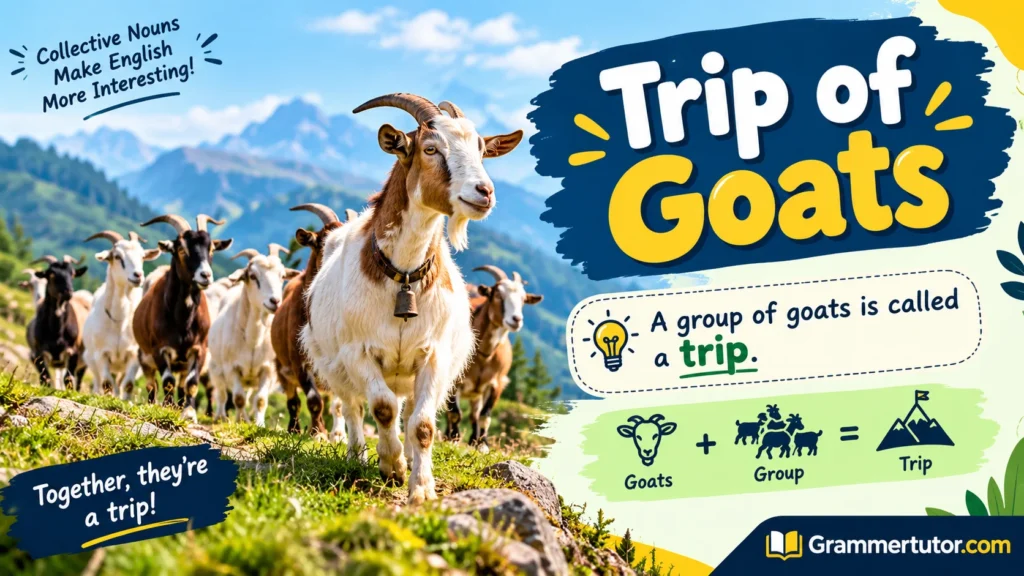
A trip of goats is a traditional collective expression associated with goats. It is much less common in everyday conversation than herd, but it can appear in lists of traditional animal group names and in playful or literary writing.
The word trip gives the expression a distinctive sound and can make a sentence more colorful. However, for ordinary communication, the herd of goats remains much more familiar.
Examples of “Trip of Goats”
- A trip of goats crossed the meadow.
- We watched a trip of goats climbing the hill.
- The trip of goats moved toward the farm.
- A trip of goats gathered near the rocks.
- The farmer guided a trip of goats across the field.
- A trip of goats wandered along the mountain path.
- The trip of goats stopped near the stream.
- A trip of goats disappeared behind the trees.
- The trip of goats returned before evening.
- A trip of goats explored the grassy slope.
Tribe of Goats
A tribe of goats is another traditional or descriptive expression that can be used for a group of goats. The word tribe gives the group a social and organized feeling.
It is not as common in modern everyday English as herd, but it can be useful in creative descriptions or when discussing goats as a closely connected social group.
Examples of “Tribe of Goats”
- A tribe of goats gathered near the mountain.
- We saw a tribe of goats on the rocky slope.
- The tribe of goats moved through the valley.
- A tribe of goats rested beneath the trees.
- The tribe of goats searched for food.
- A tribe of goats climbed the hillside.
- The farmer watched the tribe of goats.
- The tribe of goats gathered near the shelter.
- A tribe of goats crossed the narrow path.
- The tribe of goats returned to the pasture.
Flock of Goats
Flock is most strongly associated with birds and sheep, but it can sometimes appear in broader or informal descriptions of groups of goats. It isn’t the primary collective noun for goats.
When writing standard English, a herd of goats is generally the more natural choice. Still, flock may appear in some traditional lists or regional usage.
Examples of “Flock of Goats”
- A flock of goats moved across the field.
- We saw a flock of goats near the farm.
- The flock of goats climbed the hillside.
- A flock of goats gathered near the trees.
- The farmer watched the flock of goats.
- The flock of goats crossed the rocky path.
- A flock of goats rested near the shelter.
- The flock of goats moved toward the pasture.
- A flock of goats wandered through the valley.
- The flock of goats returned to the farm.
Band of Goats
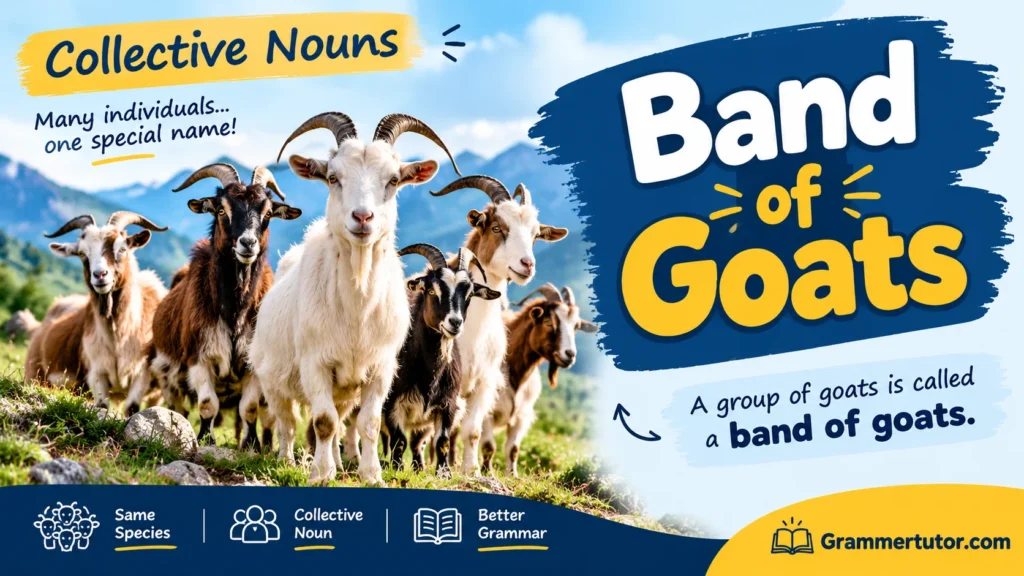
A band of goats can be used as a descriptive expression for goats moving or staying together. The term emphasizes the group as a collection traveling or interacting in the same area.
It is less common than herd, so it is best viewed as a secondary descriptive expression rather than the standard everyday choice.
Examples of “Band of Goats”
- A band of goats crossed the mountain path.
- We noticed a band of goats near the valley.
- The band of goats moved toward the pasture.
- A band of goats climbed the rocky hillside.
- The band of goats gathered near the trees.
- A band of goats wandered across the field.
- The farmer guided the band of goats home.
- The band of goats rested beside the stream.
- A band of goats disappeared behind the rocks.
- The band of goats returned before sunset.
Group of Goats
A group of goats is a simple and completely understandable expression. Unlike some traditional collective nouns, it does not have a special or unusual meaning. It simply tells the reader that several goats are together.
This expression is especially useful when you don’t want to use a traditional collective noun or when the exact nature of the group isn’t important.
Examples of “Group of Goats”
- A group of goats stood near the fence.
- We saw a group of goats in the field.
- The group of goats moved toward the barn.
- A group of goats gathered near the water.
- The group of goats rested under the trees.
- A group of goats climbed the hill.
- The farmer fed a group of goats.
- The group of goats crossed the road.
- A group of goats wandered around the farm.
- The group of goats returned to the shelter.
Kids as Young Goats
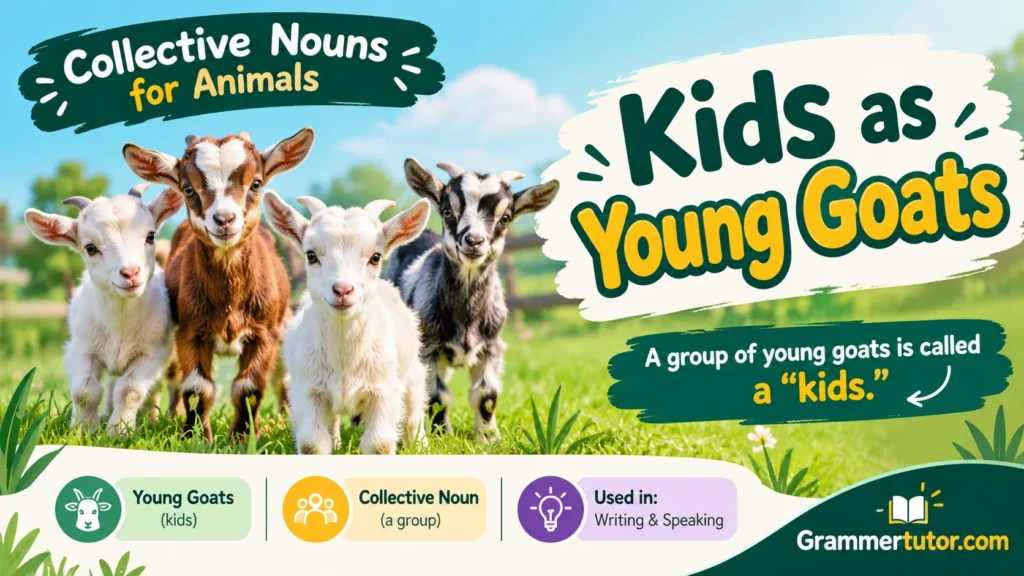
Kids is the common term for young goats. It isn’t a collective noun in the same sense as herd, but it is useful when describing several young goats together.
Young goats are energetic and curious. They often jump, climb, run, and play around their mothers or other members of the group.
Examples of “Kids”
- The kids played near the barn.
- Several kids followed their mother.
- The young kids climbed over the rocks.
- The kids ran across the pasture.
- The farmer watched the kids playing.
- The kids rested beside their mothers.
- A group of kids gathered near the fence.
- The kids jumped over the small stones.
- The young goats explored the shelter.
- The kids returned to the herd.
Interesting Facts About Goats
Goats are fascinating hoofed mammals belonging to the family Bovidae. Domestic goats have been associated with humans for thousands of years and are raised for milk, meat, fiber, and other products. Their lifespan can vary depending on breed, genetics, nutrition, healthcare, and living conditions, but well-cared-for domestic goats can often live for many years. Their ability to adapt to different environments has helped goats become widespread domestic animals.
One of the most interesting physiological features of goats is their specialized digestive system. Goats are ruminants, which means they have a complex four-compartment stomach that helps them process fibrous plant material. They can eat a wide variety of vegetation and are particularly well adapted to browsing on leaves, shrubs, and other plants. Their split hooves also help them move across rocky and uneven terrain.
Goats are primarily herbivores. They eat grasses, leaves, shrubs, weeds, herbs, and other plant material. Despite the common idea that goats will eat almost anything, goats don’t normally consume objects simply because they are curious. They often investigate unfamiliar items with their mouths, but their natural diet consists mainly of vegetation.
Goats also have remarkable climbing abilities. Many breeds can move confidently across steep and rocky surfaces because of their strong legs, flexible movement, and specialized hooves. Some wild goat species are particularly skilled at navigating mountains and cliffs.
Their social behavior is another reason the word herd fits them well. Goats communicate through vocalizations, body movements, facial expressions, and physical contact. They can develop social relationships and often stay close to familiar members of their group. Goats may also establish dominance relationships within a herd.
Examples of Goat Facts
- Goats are hoofed mammals.
- Goats belong to the family Bovidae.
- Goats are ruminants.
- Goats are primarily herbivores.
- Goats eat leaves, grass, shrubs, and other vegetation.
- Goats have specialized split hooves.
- Many goats are excellent climbers.
- Goats are social animals.
- Goats can form strong social relationships.
- Young goats are called kids.
- Goats have a complex digestive system.
- Domestic goats have been kept by humans for thousands of years.
READ MORE: Collective Noun for Racehorses: A Complete Guide with Examples
Conclusion
The most common collective noun for goats is herd. You can say a herd of goats when several goats are living, grazing, walking, or resting together. Other terms, such as trip, tribe, and flock, may appear in some contexts, but herd is the clearest and most widely understood choice.
FAQs
Q1. What is the collective noun for goats?
The most common collective noun for goats is herd. You can say a herd of goats to describe several goats as one group.
Q2. What do you call a group of goats?
A group of goats is commonly called a herd of goats. This is the most familiar expression in everyday English.
Q3. Is “herd” a correct collective noun for goats?
Yes. Herd is a standard and widely used collective noun for goats.
Q4. Can “flock” be used for goats?
Flock may appear in some contexts, but it is not as common for goats as for herds. Herd is the more natural general choice.
Q5. Can “tribe” be used for a group of goats?
Tribe can sometimes be used as a collective expression for goats, but it is less common than herd.
Q6. Can “trip” describe a group of goats?
Trip is sometimes listed as a collective noun for goats, but it is much less common in ordinary English than herd.
Q7. What is the plural form of goat?
The plural form of goat is goats. For example, “Three goats are grazing in the field.”
Q8. How do you use “herd of goats” in a sentence?
You can say, “A herd of goats was grazing on the hillside.” Here, the herd identifies the goats as one group.
Q9. Why are collective nouns used for goats?
Collective nouns make language shorter and clearer. Instead of repeatedly saying “a group of goats,” you can use “herd.
Q10. What is the best collective noun for goats?
Herd is the most common and familiar term for a group of goats, making a herd of goats a useful expression to remember.