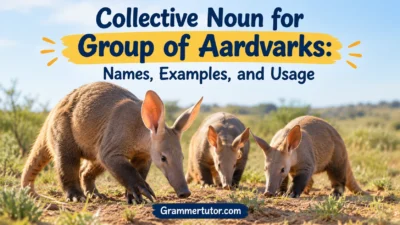
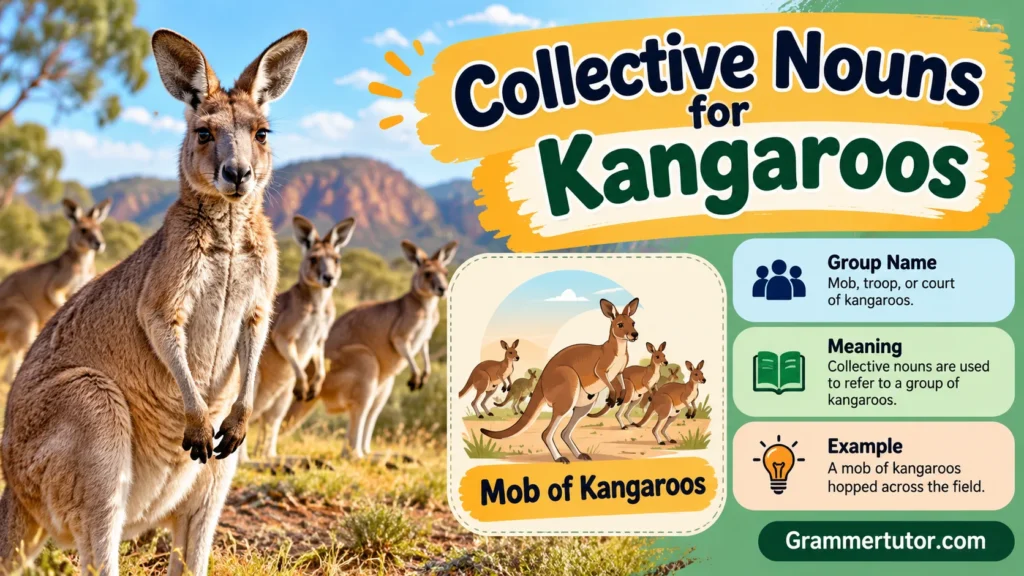
A collective noun for kangaroos is mob. A mob of kangaroos describes several kangaroos that gather together in Australia. Kangaroos are recognizable animals with powerful hind legs, large tails, and a distinctive hopping movement. The word mob is the commonly used term and is strongly connected with groups of kangaroos.
English has other expressions for a group, including troop and herd, depending on the context. However, mob is the term most strongly associated with kangaroos. Choosing the right collective noun makes your vocabulary more precise and your animal-related writing more engaging. For example, you might describe a mob of kangaroos moving across open land or resting together.
Kangaroos are social animals, so groups may spend time feeding, resting, moving, and watching for danger together. A collective noun does more than identify several animals; it can also create a clear picture of how they gather and behave. In everyday writing, mob provide a natural way to describe these animals when they are seen together.
Why Collective Nouns Are Used for Kangaroos
Kangaroos frequently gather in social groups, particularly where food and water are available. These groups can include females, young kangaroos, and males, although the exact composition can change depending on the species and circumstances.
The word mob is especially useful when describing kangaroos because it reflects the way these animals can gather and move together across grasslands, open woodland, and other habitats. Using a specific collective noun also makes descriptions more vivid than repeatedly saying a group of kangaroos.
Different expressions may be appropriate depending on the context. Mob is the familiar general term, while troop or herd may sometimes be used more loosely. The safest choice for everyday writing is a mob of kangaroos.
Collective Nouns for Kangaroos
| Collective Noun | Used For | Simple Example |
| Mob | A social group of kangaroos | A mob of kangaroos crossed the field. |
| Troop | A group of kangaroos | A troop of kangaroos moved through the grassland. |
| Herd | A group gathered together | A herd of kangaroos grazed nearby. |
| Group | A general gathering of kangaroos | A group of kangaroos rested under the trees. |
Mob of Kangaroos
A mob is the most commonly associated collective noun for kangaroos. It refers to a group of kangaroos that live, feed, rest, or move together.
A mob can vary in size and composition. It may include adult females, young kangaroos, and males. Kangaroos may join or leave groups depending on food availability, social relationships, and environmental conditions.
Examples of “Mob of Kangaroos”
- A mob of kangaroos crossed the open field.
- We spotted a mob of kangaroos near the woodland.
- The mob of kangaroos rested beneath the trees.
- A large mob of kangaroos gathered near the water.
- The mob of kangaroos moved across the grassland.
- A mob of kangaroos disappeared into the bush.
- Tourists watched a mob of kangaroos from a distance.
- The mob of kangaroos began feeding at dawn.
- A mob of kangaroos hopped across the road.
- The ranger observed a mob of kangaroos in the reserve.
Troop of Kangaroos
A troop of kangaroos can be used as another expression for a group of kangaroos. However, mob is more strongly associated with kangaroos in common usage.
The word troop generally emphasizes animals traveling or staying together. It can therefore work in descriptive or creative writing when several kangaroos are moving as a group.
Examples of “Troop of Kangaroos”
- A troop of kangaroos moved across the valley.
- We watched a troop of kangaroos near the trees.
- The troop of kangaroos crossed the grassland.
- A troop of kangaroos gathered near the waterhole.
- The troop of kangaroos rested in the shade.
- A troop of kangaroos hopped toward the open field.
- The photographer followed a troop of kangaroos from a distance.
- A troop of kangaroos disappeared into the woodland.
- The troop of kangaroos searched for food.
- A troop of kangaroos moved quietly through the bush.
Herd of Kangaroos
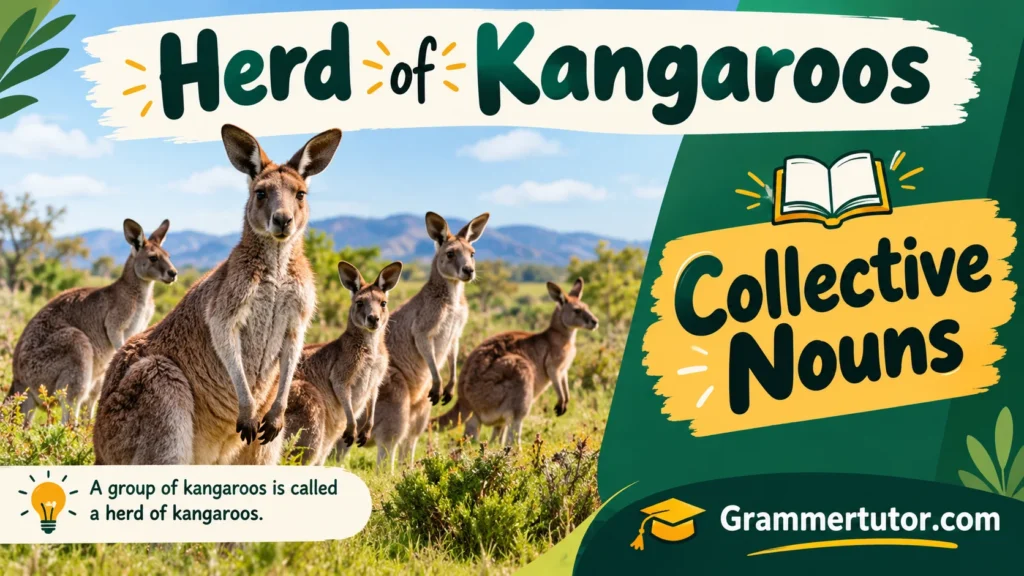
Herd is a general collective term for groups of animals that live or move together. It can sometimes be used for kangaroos, although mob is the more characteristic term.
When writing specifically about kangaroos, using a mob of kangaroos will usually sound more natural and recognizable.
Examples of “Herd of Kangaroos”
- A herd of kangaroos moved across the plain.
- We saw a herd of kangaroos near the road.
- The herd of kangaroos gathered at sunset.
- A herd of kangaroos grazed near the woodland.
- The herd of kangaroos rested in the shade.
- A herd of kangaroos crossed the grassland.
- The ranger observed the herd from a distance.
- A herd of kangaroos moved toward the water.
- The herd of kangaroos disappeared into the bush.
- A herd of kangaroos gathered near the trees.
Group of Kangaroos
A group of kangaroos is a simple and neutral expression. Unlike mob, it doesn’t have a special animal-group meaning, but it is always easy for readers to understand.
This expression works well when you don’t need to emphasize the social behavior or traditional terminology associated with kangaroos.
Examples of “Group of Kangaroos”
- A group of kangaroos rested near the trees.
- We noticed a group of kangaroos beside the road.
- The group of kangaroos moved toward the water.
- A group of kangaroos gathered in the field.
- The group of kangaroos began feeding.
- A group of kangaroos crossed the open land.
- The photographer observed a group of kangaroos.
- A group of kangaroos hopped across the grassland.
- The group of kangaroos stayed close together.
- A group of kangaroos disappeared into the woodland.
Kangaroo Behavior and Social Life
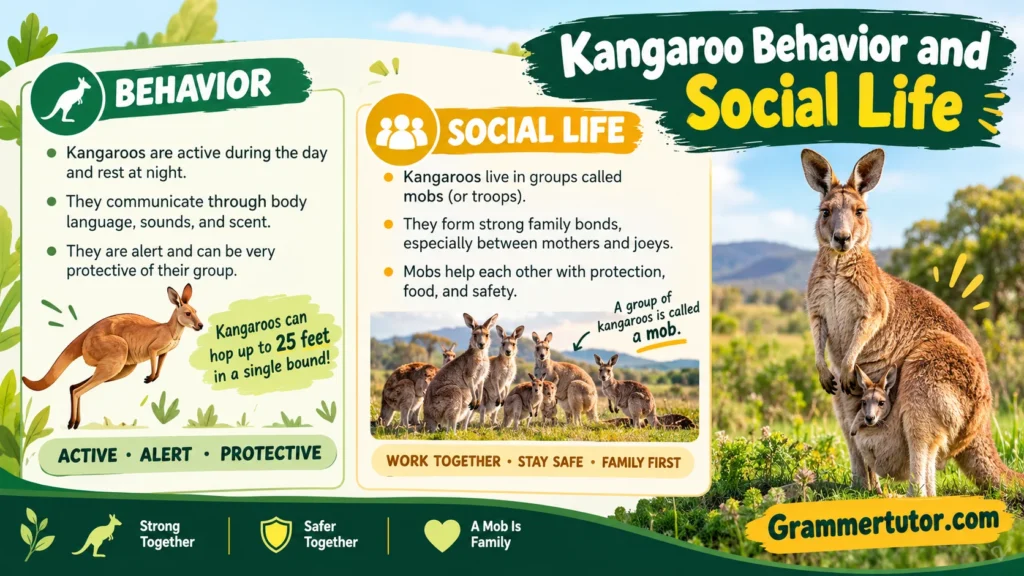
Kangaroos are social marsupials, and their groups can change in size and composition. They may gather around food and water sources or remain close to other kangaroos while resting. These social groups provide opportunities for interaction and may offer some protection because several animals can remain alert to their surroundings.
Kangaroos communicate through body movements, vocalizations, posture, and physical contact. They may use different signals when interacting with other members of their group. Males can also display competitive behavior, especially when establishing dominance or competing for access to females.
One of the most recognizable features of kangaroo behavior is their powerful movement. Their large hind legs and strong tail allow them to hop efficiently over long distances. When a mob moves together, several kangaroos may travel across the landscape in a distinctive series of powerful hops.
Female kangaroos have an especially unusual relationship with their young. Like other marsupials, they carry their developing offspring in a pouch. A young kangaroo, called a joey, spends an important part of its early development inside or around its mother’s pouch.
Examples of Kangaroo Behavior
- A mob of kangaroos rested together.
- Kangaroos often gather near food and water.
- Kangaroos communicate through sounds and body movements.
- Male kangaroos may compete with one another.
- A joey stays close to its mother.
- Female kangaroos carry young joeys in their pouches.
- Kangaroos use their powerful hind legs for hopping.
- A mob can move across open grassland together.
- Kangaroos may rest during the hottest part of the day.
- Several kangaroos can remain alert to their surroundings.
Interesting Facts About Kangaroos
Kangaroos are marsupials native to Australia and nearby regions. They belong to the family Macropodidae, a group that also includes wallabies and other macropods. Their lifespan varies according to species, environment, food availability, predators, disease, and human influence. Some kangaroos can live for well over a decade in suitable conditions, while lifespan can be shorter in the wild because of environmental pressures.
One of their most remarkable physiological features is their powerful hind-leg structure. Kangaroos have large hind feet, strong leg muscles, and a long muscular tail. Their tail acts as an important support and balancing structure, especially when they are moving slowly or standing. Their hopping movement allows them to travel efficiently across open terrain and conserve energy during sustained movement.
Kangaroos are herbivores. Their diets mainly consist of grasses, leaves, shrubs, and other vegetation, although the exact diet varies by species and habitat. Their digestive systems are adapted to process plant material, and some kangaroos can survive periods when food quality is relatively poor. They often spend considerable time feeding, particularly during cooler periods of the day.
Another fascinating feature is their reproductive system. Female kangaroos give birth to very small, underdeveloped young. The newborn joey makes its way into the mother’s pouch, where it continues developing while feeding on milk. As it grows, the joey gradually spends more time outside the pouch before becoming independent.
Examples of Kangaroo Facts
- Kangaroos are marsupials.
- Kangaroos are native to Australia.
- A group of kangaroos is commonly called a mob.
- Kangaroos have powerful hind legs.
- Their long tails help with balance and support.
- Kangaroos are herbivores.
- Their diet includes grasses and other vegetation.
- A baby kangaroo is called a joey.
- Female kangaroos have pouches.
- Kangaroos are adapted for efficient hopping.
- Kangaroos can form social groups.
- Different kangaroo species vary in size and habitat.
READ MORE: Collective Noun for Chinchillas: A Complete Guide with Examples
Conclusion
The word mob is the most commonly associated collective noun for kangaroos. You may also see group, herd, or troop in different contexts, but mob of kangaroos is the familiar expression. Using this term can make your writing about kangaroos more natural, clear, and precise.
FAQs
Q1. What is the collective noun for kangaroos?
The most commonly used collective noun for kangaroos is mob. You can say a mob of kangaroos.
Q2. What do you call a group of kangaroos?
A group of kangaroos is commonly called a mob. The phrase a mob of kangaroos is widely recognized.
Q3. Is “mob” the only collective noun for kangaroos?
No. Group, herd, and troop may also appear in different contexts, but mob is strongly associated with kangaroos.
Q4. Why are kangaroos called a mob?
Mob is a traditional and commonly used term for a social group of kangaroos, particularly in Australian English.
Q5. Can I use “herd” for kangaroos?
Yes, herd can be used in some contexts to describe a group of kangaroos. However, mob is the more distinctive term.
Q6. Can I say “a group of kangaroos”?
Yes. A group of kangaroos is grammatically correct and easy to understand, although a mob of kangaroos is more specific.
Q7. Are kangaroos social animals?
Yes. Kangaroos can gather in groups to feed, rest, move, and remain alert to possible danger.
Q8. What is a mob of kangaroos?
A mob of kangaroos is simply a group of kangaroos gathered or moving together.
Q9. Is “troop of kangaroos” correct?
Troop can be used as another expression for a group in some contexts, but mob is the term most strongly associated with kangaroos.
Q10. Why are collective nouns useful?
Collective nouns make language more precise and can help create a clearer picture of how animals gather and behave together.