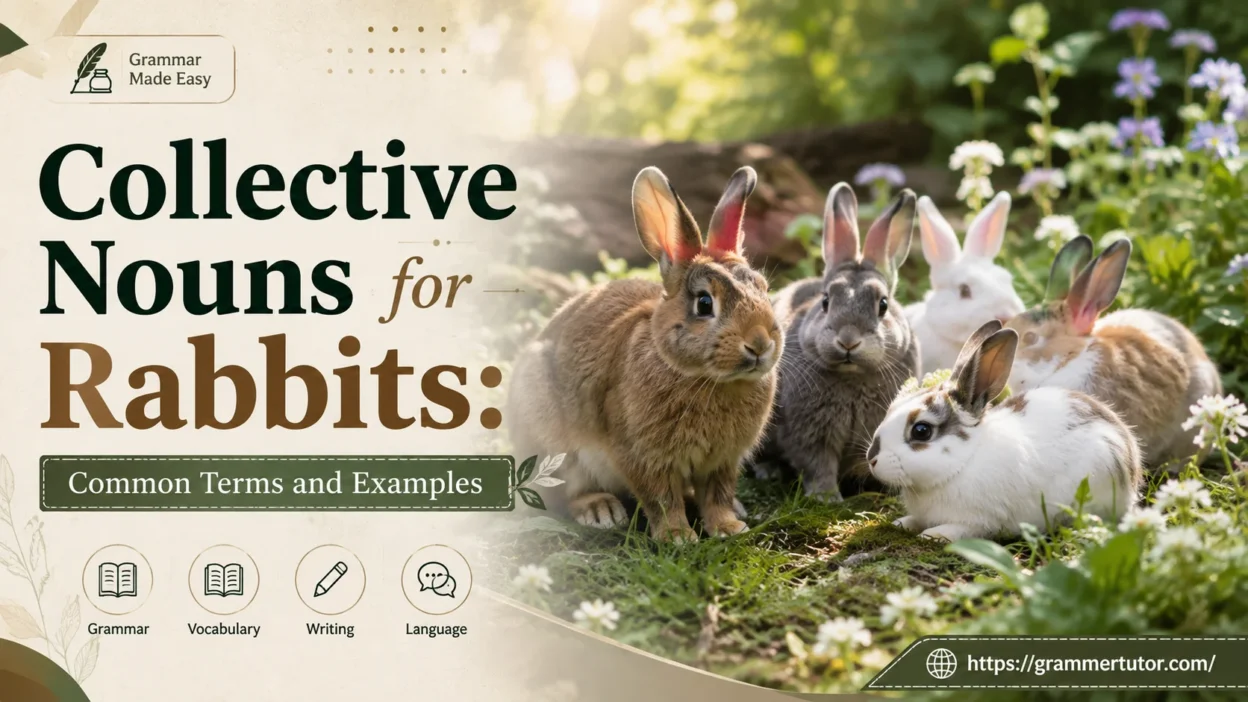
The collective noun for rabbits gives you a clear way to describe several rabbits living or moving together as a group in different situations.Rabbits are small, social mammals that often live close to one another, making them easy to observe in groups. They communicate through body movements, sounds, and scent, and they may gather in one particular place.
The most familiar term is colony, especially when referring to rabbits living together in a shared habitat. Using collective expressions instead of the simple phrase a group of rabbits can make your English more specific and vivid.Learning these traditional and descriptive expressions is useful for students, writers, and animal lovers who want to improve their English vocabulary.
These terms can make sentences more interesting and help you describe different situations, including rabbits living together, moving through an area, or gathering in a particular place. From my experience with animal vocabulary, connecting each expression with a real setting makes the terms much easier to remember and use naturally.
Why Collective Nouns Are Used for Rabbits
Rabbits are naturally social animals, and many wild rabbits live in groups. They may share a network of underground burrows, forage in the same area, and interact with other members of their group. Domestic rabbits can also form close social bonds when they live with compatible companions.
English uses several expressions to describe groups of rabbits. Some terms are more common than others, and some have a traditional or literary flavor. Colony is especially useful when discussing rabbits living together, while warren is strongly associated with the place where wild rabbits live rather than being a straightforward collective noun for the animals themselves.
These distinctions are helpful because they allow you to choose a word that matches the situation instead of treating every group of rabbits in exactly the same way.
Collective Nouns for Rabbits
| Collective Noun | Used For | Simple Example |
| Colony | Rabbits living together | A colony of rabbits lived near the hillside. |
| Warren | Rabbits associated with a shared burrow system | A warren of rabbits occupied the field. |
| Nest | Rabbits gathered around a nest, especially young rabbits | A nest of rabbits rested in the grass. |
| Herd | A group of rabbits, less commonly used | A herd of rabbits crossed the field. |
| Group | A general group of rabbits | A group of rabbits gathered near the trees. |
Colony of Rabbits
A colony is one of the most useful collective expressions for rabbits, particularly when several rabbits live together in the same area. Wild rabbits can form social groups and may share interconnected burrows within a larger habitat.
The word colony emphasizes rabbits living together over a period of time rather than simply passing through the same location.
Examples of “Colony of Rabbits”
- A colony of rabbits lived near the hillside.
- We discovered a colony of rabbits in the grassland.
- The colony of rabbits became active at dusk.
- A large colony of rabbits occupied the meadow.
- The colony of rabbits searched for food.
- Scientists observed the colony of rabbits carefully.
- The colony of rabbits stayed close to its burrows.
- A colony of rabbits moved through the field.
- The farmer noticed a colony of rabbits near the crops.
- The colony of rabbits sheltered underground during the day.
Warren of Rabbits
A warren is closely connected with rabbits, but it primarily refers to the network of underground burrows and tunnels where rabbits live. The word can sometimes be used in expressions describing the rabbits associated with that warren, but its strongest and most precise meaning is the rabbit habitat itself.
A warren may contain interconnected tunnels, entrances, nesting areas, and sheltered spaces. This underground system gives rabbits protection from weather and predators.
Examples of “Warren of Rabbits”
- A warren of rabbits occupied the edge of the field.
- We found a warren near the woodland.
- The rabbits disappeared into their warren.
- The warren provided shelter for many rabbits.
- A large warren stretched beneath the hillside.
- The farmer discovered a warren near the crops.
- Rabbits returned to the warren before nightfall.
- The Warren contained several underground entrances.
- Foxes searched around the rabbit warren.
- The rabbits remained close to their warren.
Nest of Rabbits
A nest is generally associated with young rabbits, especially kits. A mother rabbit prepares a nest using grass, fur, and other soft material to protect her young.
Because nest describes a particular family or breeding situation, it isn’t the best general collective noun for all rabbits.
Examples of “Nest of Rabbits”
- A nest of rabbits was hidden beneath the grass.
- We discovered a nest of young rabbits.
- The mother rabbit protected her nest.
- A nest of rabbits rested safely underground.
- The nest contained several baby rabbits.
- The young rabbits remained inside the nest.
- The farmer carefully avoided the rabbit nest.
- A nest of rabbits was found near the meadow.
- The mother returned to the nest to feed her young.
- The nest provided warmth and protection for the kits.
Herd of Rabbits
Herd is most strongly associated with animals such as cattle, horses, and other grazing mammals. However, it can occasionally be used more loosely for a group of rabbits.
For standard English, colony is generally a better choice when you’re describing rabbits living together. If you’re simply describing rabbits moving across an area, the group of rabbits is also perfectly clear.
Examples of “Herd of Rabbits”
- A herd of rabbits crossed the field.
- We saw a herd of rabbits near the meadow.
- The herd of rabbits moved toward the bushes.
- A herd of rabbits scattered across the grass.
- The herd of rabbits searched for food.
- A herd of rabbits gathered near the hillside.
- The herd of rabbits disappeared into the vegetation.
- A herd of rabbits moved through the garden.
- We watched the herd of rabbits from a distance.
- The herd of rabbits ran toward the burrows.
Group of Rabbits
A group of rabbits is a simple and universally understandable expression. It isn’t as distinctive as a colony, but it’s useful when you don’t need to describe the rabbits’ habitat or social arrangement.
This phrase works well in everyday conversation, school assignments, and general writing.
Examples of “Group of Rabbits”
- A group of rabbits gathered near the trees.
- We saw a group of rabbits in the meadow.
- The group of rabbits moved across the field.
- A group of rabbits searched for food.
- The rabbits formed a small group near the bushes.
- A group of rabbits rested in the shade.
- The group of rabbits disappeared into the grass.
- A group of rabbits crossed the garden.
- The children watched a group of rabbits.
- A group of rabbits gathered around the burrow.
Rabbit Behavior and Social Life
Rabbits have fascinating social behavior, especially when they live in groups. Wild rabbits may form social communities around shared burrow systems. Living near other rabbits can provide opportunities for social interaction and may help individuals respond to potential danger.
Rabbits communicate in several ways. They use body posture, ear position, scent marking, movement, and vocalizations to convey information. A rabbit may thump its hind foot when it senses danger, creating a sound that can alert nearby rabbits.
Social grooming is another important behavior. Rabbits may groom one another as a way of maintaining bonds and showing trust. Rabbits that live together can develop strong relationships, and compatible domestic rabbits often benefit from companionship.
Rabbits also spend considerable time foraging. Their natural diet consists mainly of grasses, leaves, herbs, and other plant material. Their digestive systems are specially adapted to extract nutrients from fibrous foods.
The social structure and behavior of rabbits help explain why expressions such as colony can be useful. A colony suggests more than several rabbits happening to stand together; it can describe animals sharing an area and interacting within the same community.
Examples of Rabbit Behavior
- Rabbits often live in social groups.
- Rabbits communicate through body language.
- A rabbit may thump its hind foot when alarmed.
- Rabbits can groom one another.
- Wild rabbits may share burrow systems.
- Rabbits spend much of their time foraging.
- Rabbits eat a variety of plant material.
- Young rabbits remain protected in nests.
- Rabbits use scent marking to communicate.
- A colony can contain many interacting rabbits.
Interesting Facts About Rabbits
Rabbits are fascinating small mammals belonging to the order Lagomorpha. They aren’t rodents, although they are sometimes mistakenly classified as such. Rabbits have distinctive physiological features, including powerful hind legs, long ears, sensitive whiskers, and continuously growing teeth. Their long ears help with hearing and can also help regulate body temperature.
Rabbits can have surprisingly long lifespans when kept in safe and well-managed conditions. Domestic rabbits often live for many years, with lifespan influenced by breed, genetics, nutrition, healthcare, housing, and general living conditions. Wild rabbits typically face more challenges, including predators, disease, food availability, and environmental hazards, which can affect survival.
Their unique physiology is particularly well suited to their lifestyle. Powerful hind legs allow rabbits to make rapid movements and sudden changes in direction when escaping danger. Their large ears help them detect sounds, while their wide-set eyes provide a broad field of vision. Their whiskers also provide sensory information about nearby objects and spaces.
Rabbits are herbivores with a diet based mainly on fibrous plant material. Wild rabbits commonly eat grasses, herbs, leaves, and other vegetation. Domestic rabbits generally need a diet rich in hay or grass, supplemented with suitable leafy greens and other appropriate foods. Fiber is especially important for maintaining healthy digestion and proper tooth wear.
One of the most interesting aspects of rabbit digestion is cecotrophy. Rabbits produce special soft fecal pellets called cecotropes, which they consume directly. This allows them to recover nutrients produced during fermentation in the cecum. Although it may sound unusual, cecotrophy is an important and normal part of rabbit biology.
Rabbits are also known for their impressive reproductive ability. Female rabbits can produce several litters in a year under favorable conditions, and their young develop relatively quickly. This reproductive capacity contributes to the ability of wild rabbit populations to increase rapidly when food and habitat conditions are suitable.
READ MORE: Collective Noun for Ferrets: The Correct Terms and How to Use Them
Examples of Rabbit Facts
- Rabbits are lagomorphs, not rodents.
- Rabbits have powerful hind legs.
- Their teeth grow continuously.
- Rabbits have long, sensitive ears.
- Their eyes provide a broad field of vision.
- Rabbits are herbivores.
- Hay and grass are important sources of fiber.
- Rabbits practice cecotrophy.
- Wild rabbits may live in underground warrens.
- Rabbits communicate through body language and sounds.
- Rabbits can form strong social bonds.
- Domestic rabbits can live for many years with proper care.
Conclusion
Understanding the collective noun for rabbits makes your English more precise and interesting. Colony is the most familiar term for rabbits living together, while descriptive expressions can help explain different situations. Whether you’re writing about rabbits in a shared habitat, observing them in groups, or simply improving your vocabulary, these terms give you clearer ways to describe rabbits.
FAQs
Q1. What is the collective noun for rabbits?
The most commonly used collective noun for rabbits is colony, especially when rabbits live together in a shared habitat.
Q2. Can I say “a group of rabbits”?
Yes. A group of rabbits is completely understandable and natural in everyday English, even though colony can be more specific in some contexts.
Q3. What does “colony” mean for rabbits?
A colony refers to rabbits that live together in the same area or shared habitat. It emphasizes their living arrangement as a group.
Q4. Are rabbits social animals?
Yes. Rabbits are social mammals and can live close to one another. They also communicate through body movements, sounds, and scent.
Q5. Why are collective nouns useful for rabbits?
Collective nouns help you describe several rabbits more clearly and can make your sentences more specific, vivid, and interesting.
Q6. Is “herd” a collective noun for rabbits?
Herd isn’t the usual term for rabbits. Colony is a more appropriate term when referring to rabbits living together.
Q7. What is the plural of rabbit?
The standard plural is rabbits. For example, “Several rabbits were eating grass.”
Q8. Can “colony” be used for wild rabbits?
Yes. A colony can describe a group of rabbits living together in a particular area, including wild rabbits.
Q9. Who can benefit from learning rabbit collective nouns?
Students, writers, animal lovers, and anyone learning English vocabulary can benefit from knowing these expressions.
Q10. What is an example of a collective noun for rabbits?
A simple example is: “A colony of rabbits lived near the woodland.” Here, colony identifies the group of rabbits.