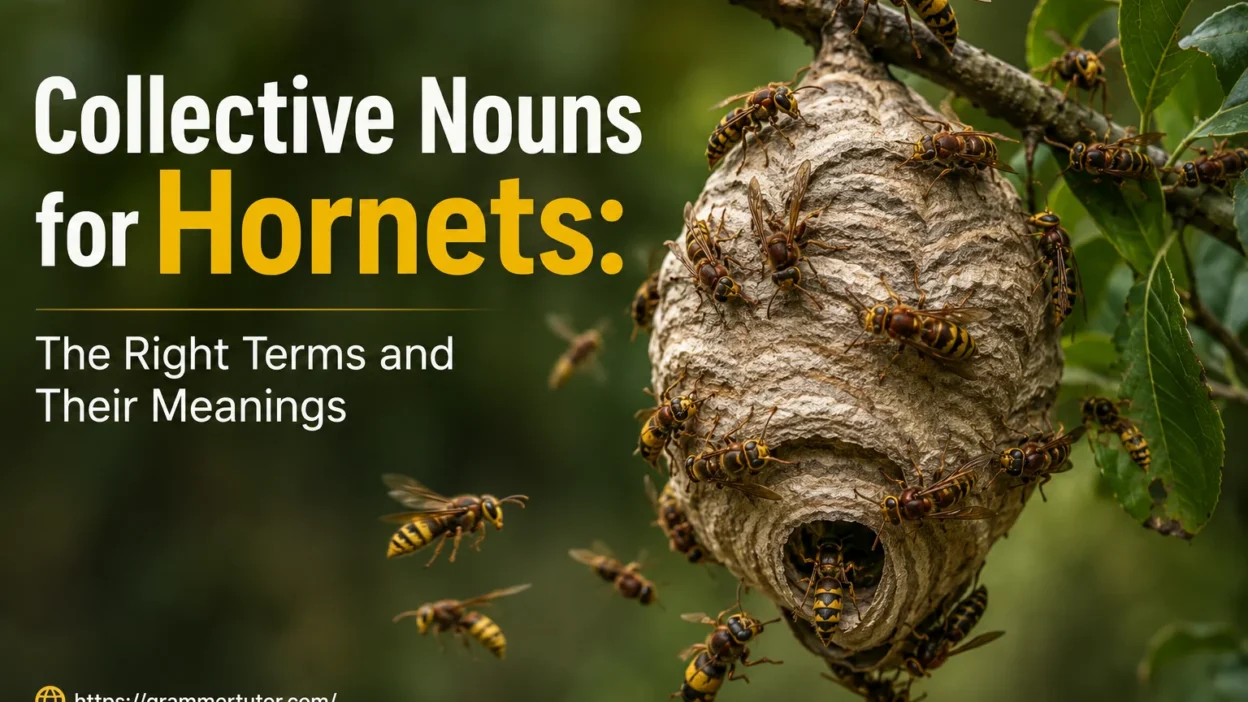
The phrase collective noun for hornets gives you a clear way to describe these social insects when they gather together. The familiar term nest of hornets is useful when they live in a shared colony, while swarm can describe hornets flying together or moving in large numbers. These descriptive terms connect their nesting habits and movement with everyday English.
Hornets are related to wasps and live in organized colonies with a strong social lifestyle. Members work together to find food, protect their territory, raise their young, and maintain the colony. Because of this behavior, the word group alone doesn’t always show what the hornets are doing. A nest focuses on where they live, while a swarm focuses more on their movement.
From a language–learning point of view, these terms show how collective nouns can describe real hornet behavior instead of simply naming an intimidating gathering. When you see hornets living together, gathering together, or moving in large numbers, choosing the right term makes your description more precise and connects language with the natural world.
Why Collective Nouns Are Used for Hornets
Hornets are social insects that often live together in colonies. Rather than living independently, many hornet species cooperate within a nest. Workers may search for food, care for developing young, maintain the nest, and defend the colony.
Because hornets gather and behave collectively, different expressions can describe them depending on the situation. Nest focuses on where they live, while swarm emphasizes a large number of hornets flying or moving together.
These expressions make descriptions more vivid. For example, saying a nest of hornets was hanging from the tree immediately gives you more information than simply saying there were many hornets near the tree.
Collective Nouns for Hornets
| Collective Noun | Used For | Simple Example |
| Nest | Hornets living together in a nest | A nest of hornets hung from the tree. |
| Swarm | Many hornets flying or moving together | A swarm of hornets flew overhead. |
| Colony | Hornets living together as a social group | A colony of hornets occupied the nest. |
| Cloud | A large number of hornets appearing together in flight | A cloud of hornets filled the air. |
| Group | A general gathering of hornets | A group of hornets gathered nearby. |
Nest of Hornets
A nest is one of the most useful expressions when describing hornets living together. Unlike some collective nouns that focus mainly on the animals themselves, nest emphasizes their shared home and organized colony.
Hornets construct nests from materials such as chewed plant fibers mixed with saliva. Depending on the species, nests may be built in trees, shrubs, underground spaces, wall cavities, or other sheltered locations.
Examples of “Nest of Hornets”
- A nest of hornets hung from the tree.
- We noticed a nest of hornets near the shed.
- The nest of hornets was hidden among the branches.
- A large nest of hornets covered part of the wall.
- The nest of hornets became active during the day.
- Workers discovered a nest of hornets in the attic.
- The nest of hornets was surrounded by flying insects.
- A nest of hornets occupied the hollow tree.
- The gardeners spotted a nest of hornets nearby.
- The nest of hornets remained undisturbed.
Swarm of Hornets
A swarm of hornets describes a large number of hornets flying or moving together. This expression focuses on their movement rather than their nest.
A swarm can create an impressive sight, but hornets should be observed carefully because some species can become defensive when their nest or colony is threatened.
Examples of “Swarm of Hornets”
- A swarm of hornets flew across the garden.
- We saw a swarm of hornets near the trees.
- The swarm of hornets moved through the air.
- A swarm of hornets appeared above the field.
- The swarm of hornets disappeared into the forest.
- A large swarm of hornets passed over the road.
- The swarm of hornets gathered near the nest.
- A swarm of hornets flew around the branches.
- The swarm of hornets moved away from the house.
- We noticed a swarm of hornets at a distance.
Colony of Hornets
A colony refers to the organized social community of hornets living together. This term is particularly useful when discussing hornet biology and their cooperative lifestyle.
A colony typically contains a reproductive queen and workers that perform different tasks. Depending on the species and season, males and new queens may also be present.
Examples of “Colony of Hornets”
- A colony of hornets lived inside the nest.
- Scientists studied the colony of hornets.
- The colony of hornets grew throughout the summer.
- A large colony of hornets occupied the tree.
- The colony of hornets worked together efficiently.
- Workers protected the colony of hornets.
- The colony of hornets remained active during the warm months.
- Researchers observed the colony of hornets carefully.
- The colony of hornets built a new section of the nest.
- The colony of hornets eventually declined in cooler weather.
Cloud of Hornets
A cloud of hornets is a descriptive expression for a large number of hornets appearing together, particularly when they are flying through the air. The word cloud creates a visual image of numerous insects filling an area.
This expression is more descriptive than technical, so it works especially well in nature writing and storytelling.
Examples of “Cloud of Hornets”
- A cloud of hornets filled the air.
- We saw a cloud of hornets above the trees.
- The cloud of hornets moved toward the nest.
- A cloud of hornets appeared near the garden.
- The cloud of hornets disappeared into the distance.
- A cloud of hornets surrounded the old tree.
- The hikers noticed a cloud of hornets nearby.
- The cloud of hornets moved through the branches.
- A dark cloud of hornets hovered above the field.
- The cloud of hornets quickly dispersed.
Group of Hornets
A group of hornets is a simple and general expression for several hornets gathered together. It isn’t as distinctive as terms such as colony or swarm, but it is perfectly clear in everyday English.
You can use group when you don’t need to describe whether the hornets are nesting, flying, or behaving as an organized colony.
Examples of “Group of Hornets”
- A group of hornets gathered near the tree.
- We noticed a group of hornets in the garden.
- The group of hornets moved toward the nest.
- A group of hornets flew over the field.
- The group of hornets disappeared into the bushes.
- A group of hornets hovered near the flowers.
- The farmer spotted a group of hornets.
- The group of hornets remained near the nest.
- A group of hornets entered the tree hollow.
- We watched the group of hornets from a distance.
Hornet Behavior and Social Life
Hornets are fascinating because many species live in highly organized colonies. A colony works almost like a small community, with different individuals performing different roles. Workers may gather food, feed larvae, maintain the nest, and protect the colony.
Communication plays an important role in colony life. Hornets use chemical signals, physical interactions, and other behaviors to coordinate activities. Their ability to cooperate allows the colony to maintain its nest and raise new generations.
Hornets are also known for their defensive behavior. When a colony feels threatened, workers may respond aggressively to protect the nest. This is one reason people should avoid disturbing an active hornet nest.
Their nests are another remarkable feature. Hornets create paper-like nest material by chewing wood fibers and mixing them with saliva. The resulting material is shaped into protective structures that provide sheltered spaces for the colony.
Examples of Hornet Behavior
- Hornets often live in organized colonies.
- Workers help maintain the nest.
- Hornets cooperate to raise young.
- Workers search for food.
- Hornets can defend their colony.
- Hornets communicate through different signals.
- Hornets construct nests from plant fibers.
- A colony can contain different types of individuals.
- Hornets become active during suitable weather.
- The nest provides shelter for developing young.
READ MORE: Collective Noun for Vipers: What Is a Group of Vipers Called?
Interesting Facts About Hornets
Hornets are social wasps belonging to the family Vespidae. Although the exact species and behavior vary around the world, many hornets live in colonies with a queen and numerous workers. Their colonies are generally seasonal in temperate regions, with activity increasing during warmer months and declining as temperatures fall.
One of the most interesting physiological features of hornets is their segmented body and specialized stinger. Like other insects, hornets have three main body sections: the head, thorax, and abdomen. Their thorax contains the muscles that power their wings, allowing them to fly and maneuver effectively. Their antennae provide important sensory information, while their compound eyes help them detect movement and changes in their surroundings.
Hornets are omnivorous predators and scavengers. Adult hornets may consume sugary liquids such as nectar and fruit juices, while they also capture insects and other small animals. Much of the animal protein collected by workers is used to feed developing larvae. This makes hornets important predators of other insects and gives them a role in regulating insect populations.
Their dietary habits change with the needs of the colony. Workers may search for protein-rich prey when larvae require food, while adults can obtain energy from carbohydrate-rich sources. This division between food collected for developing young and energy consumed by adults helps the colony function efficiently.
Hornets also have an important ecological role. By preying on other insects, they can influence local insect populations. At the same time, they may compete with other insects for food resources. Their presence is therefore part of the complex relationships found within many ecosystems.
Examples of Hornet Facts
- Hornets are social wasps.
- Many hornets live in colonies.
- A colony commonly contains workers and a queen.
- Hornets build paper-like nests.
- Their nests can be made from chewed plant fibers.
- Hornets are predators and scavengers.
- Adults can consume sugary foods.
- Workers capture insects for developing larvae.
- Hornets can help control insect populations.
- Many colonies are seasonal.
- Hornets have segmented bodies.
- Their wings allow active and controlled flight.
Conclusion
Understanding the collective noun for hornets makes your English more precise and descriptive. A nest of hornets is appropriate when hornets are living together in their colony, while swarms can be used when they are flying or moving together. These terms also reflect the social behavior, organized colonies, and natural habits of hornets.
FAQs
Q1. What is the collective noun for hornets?
The most common collective expression is a nest of hornets. A swarm can also be used when hornets are flying or moving together.
Q2. Is “a nest of hornets” correct?
Yes. A nest of hornets is a natural expression for hornets living together in their shared nest or colony.
Q3. Can “swarm” be used for hornets?
Yes. A swarm of hornets can describe a group that is flying, moving, or gathering together.
Q4. What is the difference between a nest and a swarm of hornets?
A nest refers mainly to their home or colony, while a swarm emphasizes the hornets‘ movement or gathering.
Q5. Are hornets social insects?
Yes. Hornets are social insects that live in organized colonies and cooperate in activities such as raising young and finding food.
Q6. Are hornets related to wasps?
Yes. Hornets belong to the wasp family and are closely related to other wasps.
Q7. What do hornets do together?
Hornets work together to protect their territory, find food, maintain their colony, and care for their young.
Q8. Can I simply say “a group of hornets”?
Yes. A group of hornets is grammatically correct, although a nest of hornets or a swarm of hornets can provide more specific information.
Q9. Why are collective nouns useful for hornets?
Collective nouns make descriptions more precise. They can show whether hornets are gathered in their nest, flying together, or moving as a group.
Q10. What is the best term to use in everyday English?
A nest of hornets is a good choice when referring to hornets living together, while a swarm of hornets works well when they are flying or moving together.