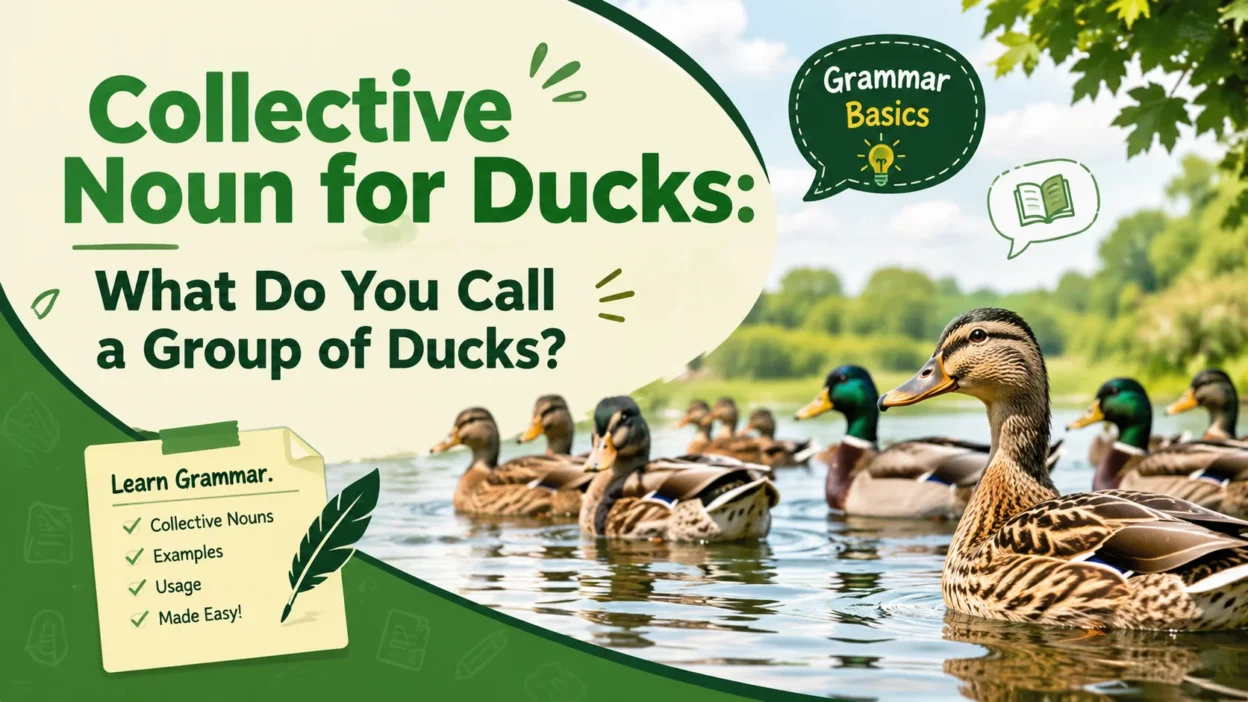
The collective noun for ducks helps describe a group clearly, especially when you want your English to sound natural and precise. English offers several useful terms for these water-loving birds, depending on the situation. The most familiar choice is flock of ducks, which works well when several ducks are together. Other terms, such as brace, raft, and paddling, can add more detail when describing a particular group or movement.
These collective nouns for ducks can make writing and conversation more descriptive without making your sentences difficult. For example, you might use raft when describing ducks resting together on water, while paddling can focus on their movement. A brace can describe two ducks. Choosing the right expression depends on where they are, what they’re doing, and how they move, giving readers a clearer picture of the scene.
When studying birds or learning English, these animal group names are useful vocabulary to remember. They make wildlife writing more engaging and help you describe ducks with greater accuracy. I’ve found that connecting each term with a simple image—ducks swimming, flying, or gathering together—makes these special terms easier to remember. If you’re curious about animal language, learning these expressions can also enrich your vocabulary.
Why Collective Nouns Are Used for Ducks
Ducks are social birds that often gather in groups around ponds, lakes, rivers, wetlands, and coastal areas. They may swim together, search for food, rest on the water, or fly in groups during seasonal movements.
Because ducks commonly gather together, flock is the most useful general collective noun. Other expressions can describe particular situations. For example, raft is commonly used for ducks floating together on water, while brace traditionally refers to a pair of ducks.
These expressions make language more descriptive and help readers picture the behavior of ducks more clearly.
Collective Nouns for Ducks
| Collective Noun | Used For | Simple Example |
| Flock | A group of ducks | A flock of ducks swam across the pond. |
| Raft | Ducks floating together on water | A raft of ducks rested on the lake. |
| Brace | A pair of ducks | A brace of ducks flew over the river. |
| Paddling | Ducks swimming together | A paddling of ducks moved across the pond. |
| Team | A group of ducks | A team of ducks searched for food. |
| Skein | Ducks flying together, especially in a line | A skein of ducks flew across the sky. |
| Badling | A traditional collective noun for ducks | A badling of ducks gathered near the water. |
Flock of Ducks
A flock is the most common and widely understood collective noun for ducks. It can describe ducks swimming, feeding, resting, or flying together.
The expression a flock of ducks is suitable for everyday English and is the easiest term to use when you’re simply describing several ducks.
Examples of “Flock of Ducks”
- A flock of ducks swam across the pond.
- We saw a flock of ducks near the river.
- The flock of ducks searched for food.
- A large flock of ducks gathered on the lake.
- The flock of ducks flew toward the wetlands.
- A flock of ducks rested beside the water.
- The children watched a flock of ducks.
- A flock of ducks crossed the pond.
- The flock of ducks returned before sunset.
- A flock of ducks gathered near the shore.
Raft of Ducks
A raft of ducks is a descriptive collective noun used for ducks floating together on water. The word raft creates a clear image of many ducks resting closely together on the surface of a lake, pond, or other body of water.
This expression is especially useful when the ducks aren’t flying or walking but are floating together.
Examples of “Raft of Ducks”
- A raft of ducks floated on the lake.
- We watched a raft of ducks near the shore.
- The raft of ducks rested quietly on the water.
- A large raft of ducks covered the pond.
- The raft of ducks moved toward the reeds.
- A raft of ducks gathered near the island.
- The photographer captured a raft of ducks.
- A raft of ducks drifted across the lake.
- The raft of ducks disappeared behind the reeds.
- We observed a raft of ducks at sunrise.
Brace of Ducks
A brace of ducks traditionally refers to two ducks, rather than a large group. The term is particularly associated with older hunting and sporting language.
Because brace means a pair, it shouldn’t normally be used when describing a large flock.
Examples of “Brace of Ducks”
- A brace of ducks flew over the pond.
- We spotted a brace of ducks near the river.
- The brace of ducks rested beside the reeds.
- A brace of ducks landed on the lake.
- The brace of ducks moved toward the shore.
- A brace of ducks crossed the wetland.
- We watched a brace of ducks swimming together.
- The brace of ducks disappeared into the reeds.
- A brace of ducks flew across the field.
- The photographer saw a brace of ducks near the water.
Paddling of Ducks
A paddling of ducks is a descriptive collective noun that focuses on ducks swimming together. The word paddling refers to the way ducks use their webbed feet to move through water.
It creates a particularly vivid image of ducks moving across a pond or lake.
Examples of “Paddling of Ducks”
- A paddling of ducks moved across the pond.
- We watched a paddling of ducks near the shore.
- The paddling of ducks searched for food.
- A paddling of ducks swam toward the reeds.
- The paddling of ducks crossed the lake.
- A paddling of ducks followed the mother duck.
- The paddling of ducks rested near the bank.
- A paddling of ducks moved through the calm water.
- We photographed a paddling of ducks.
- The paddling of ducks disappeared behind the bushes.
Team of Ducks
A team of ducks is a less common expression that can be used descriptively for ducks working or moving together. However, flock and raft are generally more natural choices depending on the situation.
Examples of “Team of Ducks”
- A team of ducks moved across the pond.
- The team of ducks searched for food.
- A team of ducks swam near the shore.
- The team of ducks followed the river.
- A team of ducks gathered beside the reeds.
- The team of ducks moved toward the lake.
- We watched a team of ducks near the water.
- A team of ducks crossed the wetland.
- The team of ducks rested on the bank.
- A team of ducks disappeared into the reeds.
Skein of Ducks
A skein of ducks describes ducks flying together, particularly when they form a line or loose formation in the sky. The term is often used for waterfowl during flight.
It creates a vivid image of ducks traveling together above wetlands, lakes, or fields.
Examples of “Skein of Ducks”
- A skein of ducks flew across the evening sky.
- We watched a skein of ducks above the lake.
- The skein of ducks traveled toward the wetlands.
- A skein of ducks crossed the valley.
- The skein of ducks flew over the river.
- A skein of ducks disappeared beyond the hills.
- We noticed a skein of ducks at sunset.
- The skein of ducks changed direction suddenly.
- A skein of ducks flew toward the marsh.
- The skein of ducks continued across the sky.
Badling of Ducks
A badling of ducks is a traditional and unusual collective noun for ducks. It isn’t as common in everyday English as flock, but it can appear in lists of traditional animal group names.
Because badling is uncommon, flock of ducks is usually the better choice for ordinary writing and conversation.
Examples of “Badling of Ducks”
- A badling of ducks gathered near the pond.
- We saw a badling of ducks beside the river.
- The badling of ducks swam across the lake.
- A badling of ducks rested near the reeds.
- The badling of ducks searched for food.
- A badling of ducks moved toward the shore.
- The children watched a badling of ducks.
- The badling of ducks crossed the wetland.
- A badling of ducks gathered at sunrise.
- The badling of ducks disappeared into the reeds.
Interesting Facts About Ducks
Ducks are fascinating waterfowl found in many habitats around the world. They can live in freshwater and saltwater environments, including ponds, lakes, rivers, marshes, wetlands, and coastal areas. Their lifespan varies greatly by species and living conditions. Wild ducks face threats from predators, disease, habitat loss, hunting, pollution, and food shortages, while protected domestic ducks can live considerably longer under suitable care.
One of the most distinctive physiological features of ducks is their webbed feet. Their toes are connected by skin, which helps them push against water while swimming. Ducks also have feathers with excellent water-resistant properties. They spread oil from a gland near the base of their tail across their feathers during grooming, helping keep their plumage relatively waterproof and providing insulation.
Ducks have specialized bills that vary according to species and diet. Many ducks use their bills to filter or strain food from water, while others use them to grasp plants, insects, seeds, and other food. Their diets can include aquatic plants, grasses, seeds, insects, small aquatic animals, and other available foods. This variety allows different duck species to occupy different ecological niches.
Ducks are also known for their ability to swim and fly efficiently. Many species spend significant amounts of time on water, while others migrate long distances between breeding and wintering areas. During migration, ducks may travel in groups, sometimes forming recognizable flight patterns.
Their social behavior explains why collective nouns such as flock, raft, and paddling are so useful. Ducks can gather closely together for feeding, resting, swimming, or traveling, creating different scenes that these descriptive terms help us express.
Examples of Duck Facts
- Ducks are waterfowl.
- Ducks can live in freshwater and saltwater habitats.
- Ducks have webbed feet.
- Their feathers help repel water.
- Ducks groom their feathers using oil from a special gland.
- Duck bills vary according to species and diet.
- Many ducks eat plants, seeds, insects, and aquatic animals.
- Ducks can swim efficiently.
- Many duck species can fly long distances.
- Some ducks migrate seasonally.
- Ducks often gather in social groups.
- A group floating on water can be called a raft of ducks.
Conclusion
Knowing the collective noun for ducks can make your English more descriptive and interesting. While flock of ducks is the most familiar expression, terms such as brace, raft, and paddling can describe ducks in different situations. Understanding these expressions helps you choose the right word when writing or talking about groups of ducks.
FAQs
Q1. What is the collective noun for ducks?
The most common collective noun for ducks is flock. You can say, “A flock of ducks was swimming across the pond.”
Q2. What is a group of ducks called?
A group of ducks is commonly called a flock. Depending on the situation, other terms such as raft may also be used.
Q3. Is “flock of ducks” correct?
Yes. Flock of ducks is a natural and widely understood expression for a group of ducks.
Q4. What does “raft of ducks” mean?
A raft of ducks describes a group of ducks gathered together on water, especially when they are floating or resting.
Q5. What does “brace of ducks” mean?
A brace of ducks traditionally refers to two ducks. The term is more specific than the general word flock.
Q6. Can I use “group of ducks” in English?
Yes. The group of ducks is completely correct. However, flock of ducks is more specific as a collective expression.
Q7. What is a group of ducks swimming called?
A group of ducks swimming can be called a flock of ducks. Paddling may also be used when the focus is on their movement through water.
Q8. What is a group of ducks on water called?
A group of ducks floating together on water can be called a raft of ducks.
Q9. Why are collective nouns for ducks useful?
Collective nouns make language more descriptive and precise. They help you describe groups of ducks without repeatedly using the phrase “a group of ducks.”
Q10. Which collective noun for ducks should I use?
Use flock as the general choice. Use a raft when ducks are gathered on water and brace when referring specifically to two ducks.