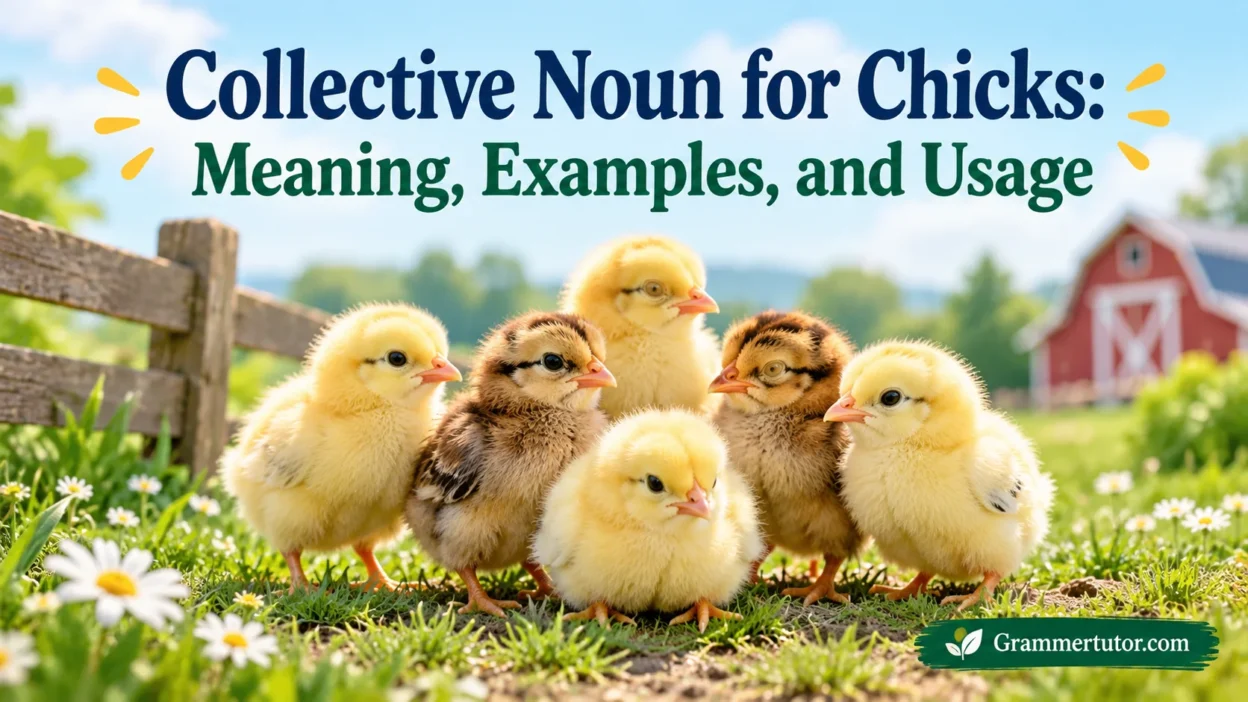
When young chickens stay, move, or feed together, the collective noun for chicks helps describe them as one group in clear, natural English. The common term is brood, while flock can be used in general situations.Chicks are young chickens and baby birds with a small size, soft feathers, quick movements, and constant peeping sounds.
They often remain close to their mother and gather together for warmth and protection. Their social behavior makes collective nouns useful when describing these farm animals, especially when they are staying together, feeding, or showing active movement.Knowing the correct collective noun for chicks can improve your English vocabulary and help you write clearer sentences.
Whether you describe chickens, birds, or other animals, the right collective noun makes the description more natural. Brood is useful for young chicks, while flock gives a broader way to describe a group. Their feathers, peeping, sounds, feeding, and movement also make the group easy to recognize.
Why Are Collective Nouns Used for Chicks?
A collective noun refers to a word that describes several individuals as a single group. For chicks, these nouns help explain how young chickens gather and behave together.
For example, “a brood of chicks” is a common expression when referring to young birds being raised together, especially with their mother. If you are simply talking about several chickens as a group, “a flock of chicks” can also be used.
These expressions are useful in everyday speech, farming discussions, children’s books, wildlife descriptions, and creative writing. They also make sentences shorter and more interesting.
Compare these two sentences:
- A group of chicks followed the hen.
- A brood of chicks followed the hen.
The second sentence gives the reader a more specific and natural description.
Collective Nouns for Chicks
Several expressions can describe groups of chicks, but they do not all have exactly the same use. Brood is particularly associated with young birds cared for together, while flock is a broader term for birds that gather as a group.
| Collective Noun | Used For | Simple Example |
| Brood of Chicks | Young chicks raised together | A brood of chicks followed the hen. |
| Flock of Chicks | A group of chicks moving or staying together | A flock of chicks crossed the yard. |
| Group of Chicks | General description | A group of chicks gathered near the feeder. |
| Clutch of Chicks | Sometimes used informally for chicks from the same hatching | A clutch of chicks stayed close together. |
Among these, brood of chicks is one of the most useful terms when you specifically mean young birds associated with the same mother or being raised together.
Brood of Chicks
The phrase brood of chicks is one of the clearest collective expressions for young chickens. A brood usually refers to young birds that are being cared for together, often by their mother.
A hen may hatch several eggs and then care for the resulting chicks as one brood. The chicks usually stay close to her, follow her around, and gather underneath her when they need warmth.
The word brood can also be used for young birds of other species, so it isn’t limited to chickens. However, “brood of chicks” is a natural phrase when discussing young chickens.
Examples of “Brood of Chicks”
- A brood of chicks followed the hen across the farmyard.
- The farmer checked the brood of chicks every morning.
- A brood of chicks gathered beneath the hen.
- The hen protected her brood of chicks from danger.
- We watched a brood of chicks explore the grass.
- The brood of chicks stayed close to their mother.
- A healthy brood of chicks began feeding after sunrise.
- The farmer moved the brood of chicks into a warm shelter.
- The brood of chicks made soft peeping sounds.
- The children enjoyed watching the brood of chicks walk around the coop.
Flock of Chicks
Another useful expression is flock of chicks. The word flock is a general collective noun for birds, particularly when several birds gather or move together.
Although “flock” is more commonly associated with groups of adult birds, it can also describe several chicks when they are viewed simply as a group. For example, you might see a flock of chicks moving around a farmyard or gathering near food.
The difference is mainly one of context. Brood highlights the chicks as young birds being raised together, while flock focuses more generally on the fact that several birds are together.
Examples of “Flock of Chicks”
- A flock of chicks wandered around the garden.
- The flock of chicks gathered near the food tray.
- We saw a flock of chicks crossing the path.
- A small flock of chicks stayed inside the coop.
- The farmer counted the flock of chicks before closing the gate.
- The flock of chicks followed the hen toward the barn.
- A flock of chicks moved quickly across the grass.
- The children watched the flock of chicks from a distance.
- The flock of chicks became quiet when the hen called them.
- A flock of chicks gathered around the feeder.
Group of Chicks
Sometimes you don’t need a specialized collective noun. The group of chicks is completely clear and can be used in ordinary conversation.
This phrase is particularly useful when the exact relationship between the chicks isn’t known. For example, if you see several chicks together but don’t know whether they came from the same hen, saying “a group of chicks” is straightforward.
It is also a good choice for beginner English learners because the meaning is immediately understandable.
Examples of “Group of Chicks”
- A group of chicks was resting under the shade.
- We found a group of chicks near the barn.
- The group of chicks gathered around the feeder.
- A farmer carried a group of chicks into the coop.
- The group of chicks began peeping loudly.
- A group of chicks followed the sound of the hen.
- The children saw a group of chicks near the fence.
- The group of chicks stayed warm together.
- A group of chicks explored the newly cleaned pen.
- The group of chicks returned to the coop before dark.
Clutch of Chicks
The word clutch is most strongly associated with a set of eggs laid or incubated together. In some informal or descriptive contexts, people may also use it when referring to chicks that hatched from those eggs.
However, if you want the clearest standard expression for young chickens, brood of chicks is generally preferable.
This distinction is important because a clutch of eggs refers to the eggs themselves, while a brood of chicks refers to the young birds.
Examples of “Clutch of Chicks”
- The hen stayed close to the chicks that hatched from her clutch.
- The farmer cared for the newly hatched chicks.
- The chicks remained together after hatching.
- The young birds stayed near their mother.
- The newly hatched chicks began moving around the nest.
- The farmer checked the chicks after they emerged.
- The hen kept her young birds warm.
- The chicks gathered together for protection.
- The young chickens followed the hen around the yard.
- The farmer watched the newly hatched chicks carefully.
How Do Chicks Behave as a Group?
Chicks are highly active and curious when they are young. They spend much of their time searching for food, exploring their surroundings, and responding to sounds from their mother and other chicks.
One noticeable behavior is their tendency to stay close together. A group of chicks may gather beneath a heat source or around their mother. Staying together can provide warmth and help the young birds remain near protection.
Chicks also communicate through different peeping sounds. A mother hen can respond to her chicks, and the chicks may react to her calls. This communication helps keep the young birds together when they move around.
Their group behavior also makes collective nouns such as brood and flock particularly useful when describing them.
Interesting Facts About Chicks
Chicks begin life with soft down rather than the full feathers seen on adult chickens. Their appearance gradually changes as they grow and develop their juvenile and adult feathers.
Young chicks are also surprisingly active. Soon after hatching, they can walk around and begin exploring their surroundings. They use their beaks to investigate objects and search for food.
Temperature is especially important during the early stages of a chick’s life. Young chicks cannot regulate their body temperature as effectively as mature chickens, so they often stay close to their mother or a suitable heat source.
Their diet changes as they grow. Chicks need appropriate nutrition for healthy development, including adequate protein and other essential nutrients. On farms, specially formulated chick feed is commonly used during their early growth.
Chicks also have strong social tendencies. They often remain close to one another and communicate through soft peeps. When separated from their mother or group, a chick may become more vocal.
Another interesting feature is how quickly chicks develop. Their small bodies gradually become larger, their feathers become more developed, and their behavior begins to resemble that of mature chickens.
READ MORE: Collective Noun for Hawks: Meaning, Examples, and Interesting Facts
Conclusion
The most useful collective noun for chicks is brood, especially when referring to young chickens staying with their mother. Flock can also describe a group of chicks in broader situations. Understanding these terms makes your English more natural and helps you describe groups of young birds clearly.
FAQs
Q1. What is the collective noun for chicks?
The most common collective noun for chicks is brood. You can say “a brood of chicks” when referring to a group of young chickens.
Q2. Can I use “flock” for chicks?
Yes. Flock is a general collective noun for birds and can be used for chicks when describing them as a group.
Q3. What is a group of chicks called?
A group of chicks is commonly called a brood of chicks. The word “flock” may also be used in general contexts.
Q4. Is “brood” only used for chicks?
No. Brood can refer to a group of young birds or other young animals produced or cared for at the same time.
Q5. What is the difference between a brood and a flock?
A brood usually emphasizes young birds, often associated with their mother. A flock is a broader term for a group of birds.
Q6. What is the correct phrase for several chicks?
The phrase “a brood of chicks” is a natural way to describe several young chickens as one group.
Q7. Can “group of chicks” be used instead?
Yes. A group of chicks is grammatically correct and easy to understand, although a brood of chicks is more specific.
Q8. Why are collective nouns used for chicks?
Collective nouns provide a convenient way to describe several chicks together instead of repeatedly saying “a group of chicks.”
Q9. What sentence uses “brood” correctly?
A simple example is: “A brood of chicks followed their mother across the farmyard.”
Q10. What sentence uses “flock” correctly?
You can say: “A flock of chicks moved together near the chicken coop.” This uses “flock” as a general group term for birds.